Put ramekins on a baking sheet. Bake for 25-35 minutes, until puffed and golden. Remove from oven, and let stand for 5 minutes. With a flexible spatula, remove strata to
There is no single agreed-upon term in the English language for a gathering of Santas, but there should be. A sleigh of Santas? A jingle of Kringles? A chimneyful of
There is no single agreed-upon term in the English language for a gathering of Santas, but there should be. A sleigh of Santas? A jingle of Kringles? A chimneyful of
Before the beard and belly laugh, becoming the Man in Red requires a little magic — and plenty of training — in Charlotte, where Santas go to earn their ho-ho-ho.
There is no single agreed-upon term in the English language for a gathering of Santas, but there should be. A sleigh of Santas? A jingle of Kringles? A chimneyful of St. Nicks? We need a term for it, because it happens more often than you might think, and when it does and you find yourself in the midst of it — on a blistering hot Saturday in the middle of August, say, at a hotel in Charlotte — the wonder of Christmas is multiplied in ways impossible to have foreseen. Santa checking in at the front desk, for instance, or holding the elevator door for you, or one Santa waiting for another Santa — or perhaps Mrs. Claus — in the lobby. You’ve stepped into a familiar reality turned wildly askew.
But it’s not a dream. It’s the first day of Advanced Santa Studies Class. Doug Eberhart, who lives in Charlotte and created and runs this two-day seminar, who is a Santa himself and who in almost every way is smack-dab in the middle of the Santa universe, puts on two big events a year. The first is an introductory class, The Practical Santa, primarily for Santas just learning the craft, and the second is this one — the advanced class. Santas from various walks of life are here: a lawyer from Raleigh, a shopkeeper from Weldon, a claims adjustor from Lexington. Many are retired. But their goals are the same: to become the best possible Santa they can be, to be worthy inheritors of a myth.
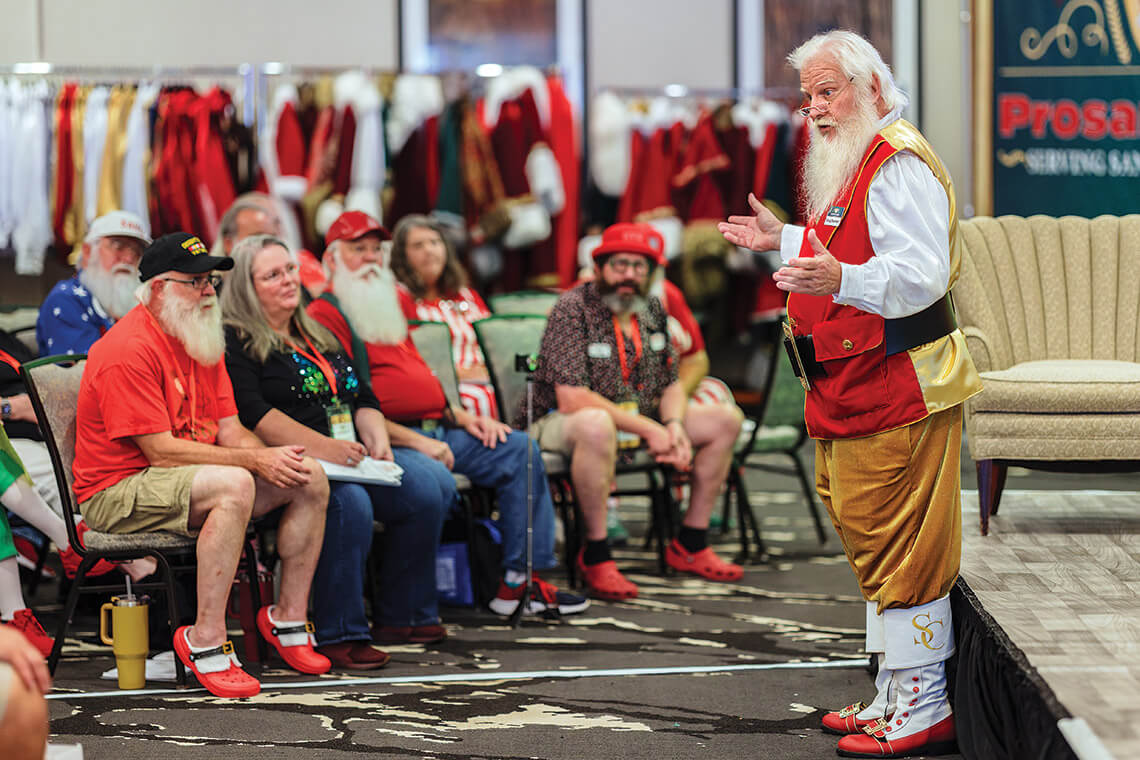
Doug Eberhart has been Santa for TV commercials, the Carolina Panthers, department stores, and more. Many of his Santa outfits are based on vintage postcards and drawings. photograph by Jerry Wolford & Scott Muthersbaugh
On offer this weekend is a rare opportunity for Santas from all over the state and beyond to watch other Santas at work, to study their routines, and, not unlike a child at the mall getting their picture taken with the Man in Red, to ply the old pros with questions of their own, such as, well, “What do you say when they ask you where your reindeer are?” No two Santas have the exact same answer to this question, or to any question for that matter. But you need at least one.
Eberhart — who leaves his reindeer across town in a field — has been a Santa, off and on, for almost half a century, starting when he was just 14 years old. He was a big kid, the kind of big that would go on to play center on the Princeton University football team. His mother made him his first three suits, and he still has one of them in a shadowbox at his shop. Were he ever to be inducted into the International Santa Claus Hall of Fame based in Santa Claus, Indiana — and one day, he may very well be — this suit, like Mister Rogers’s sweater in the Smithsonian, could be there on display.
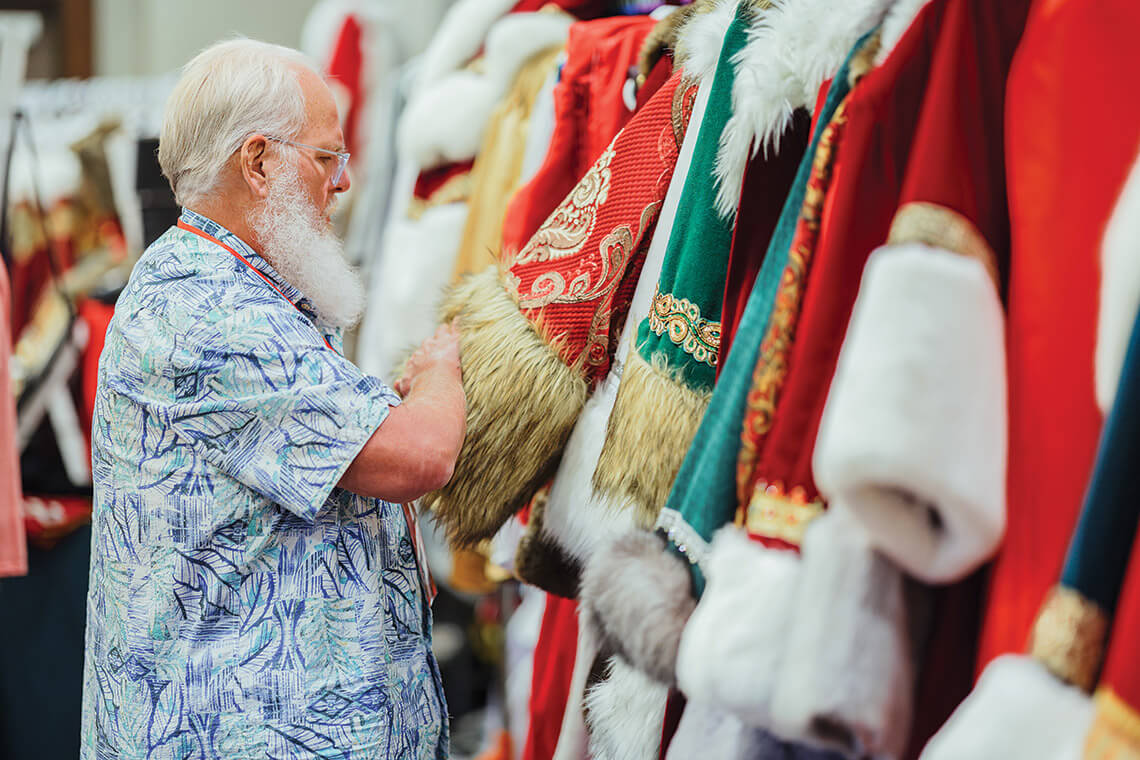
Ray Semple, a longtime Santa visiting from Illinois, peruses the coats that are available to order.<br><span class="photographer">photograph by Jerry Wolford & Scott Muthersbaugh</span>
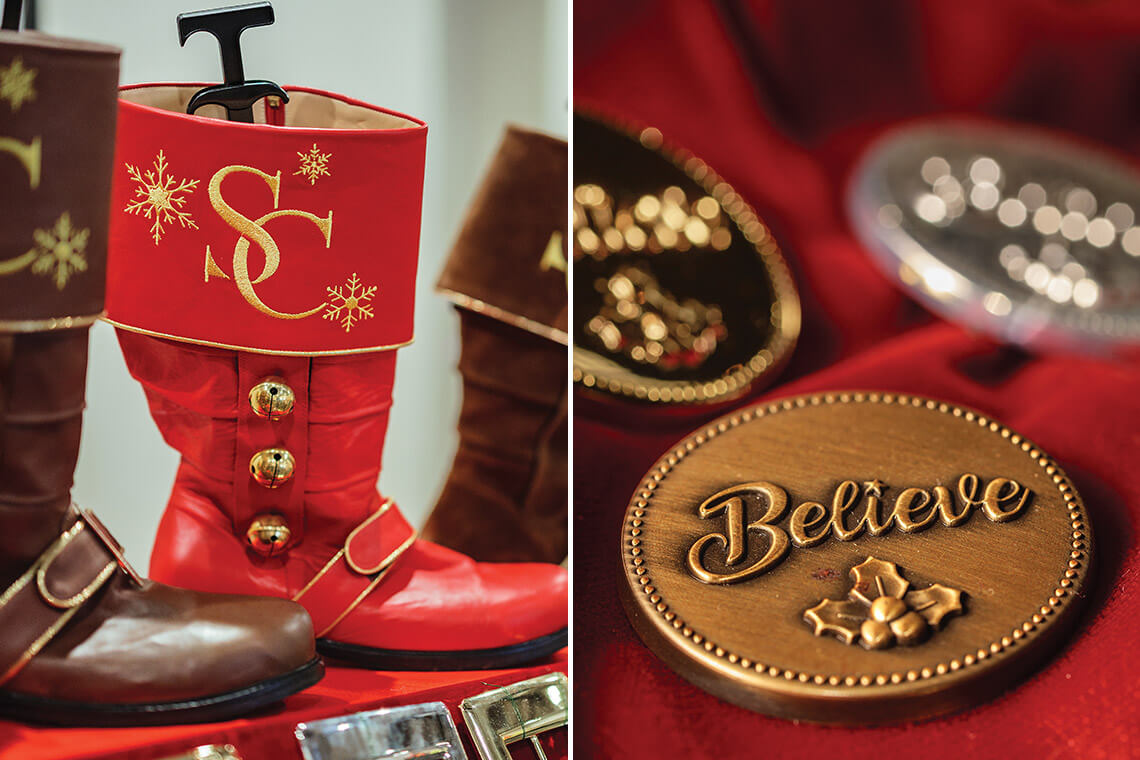
Custom-made boots, belt buckles, and special coins are also on display for purchase.<br><span class="photographer">photograph by Jerry Wolford & Scott Muthersbaugh</span>
He’s come a long way since being a 14-year-old Santa: At events such as this one, and through his ProSanta websites like ProSantaShop.com and RentaSanta.com, he is now a major supplier of Santa suits and any and all Santa-related accoutrements you can imagine, including golden belt buckles, designer beards and wigs, toy bags, boots, and assorted Kringle bling.
But what Eberhart provides through his work, his workshops, and his websites is so much more than that. The men here — around 70 of them, mostly in jeans and T-shirts and looking like Santa on the weekend about to tackle some yard work — represent a self-selecting cross-section of middle America. And while all Santas are alike in some obvious ways, there are subtle but important differences between them, too: the laugh, the songs they sing, the calibrated sense of humor, the bag of tricks and props. The possibilities are endless, and that’s why so many men with snowy-white beards and unapologetically respectable girths are in this ballroom together — to discover who they are.
• • •
On the first day of Advanced Santa Studies Class, we witness three exceptional Santas perform their routines; three more, including Eberhart, will perform tomorrow. The first is Rich Lange of Huntersville. Lange is an example of the traditional Santa: He has a pleasant, grandfatherly demeanor and a booming voice, and he nails the trademark Ho-ho-ho! He has a ton of props — including a rack of actual reindeer antlers he passes around. His reindeer? Back at the North Pole, resting up for Christmas.
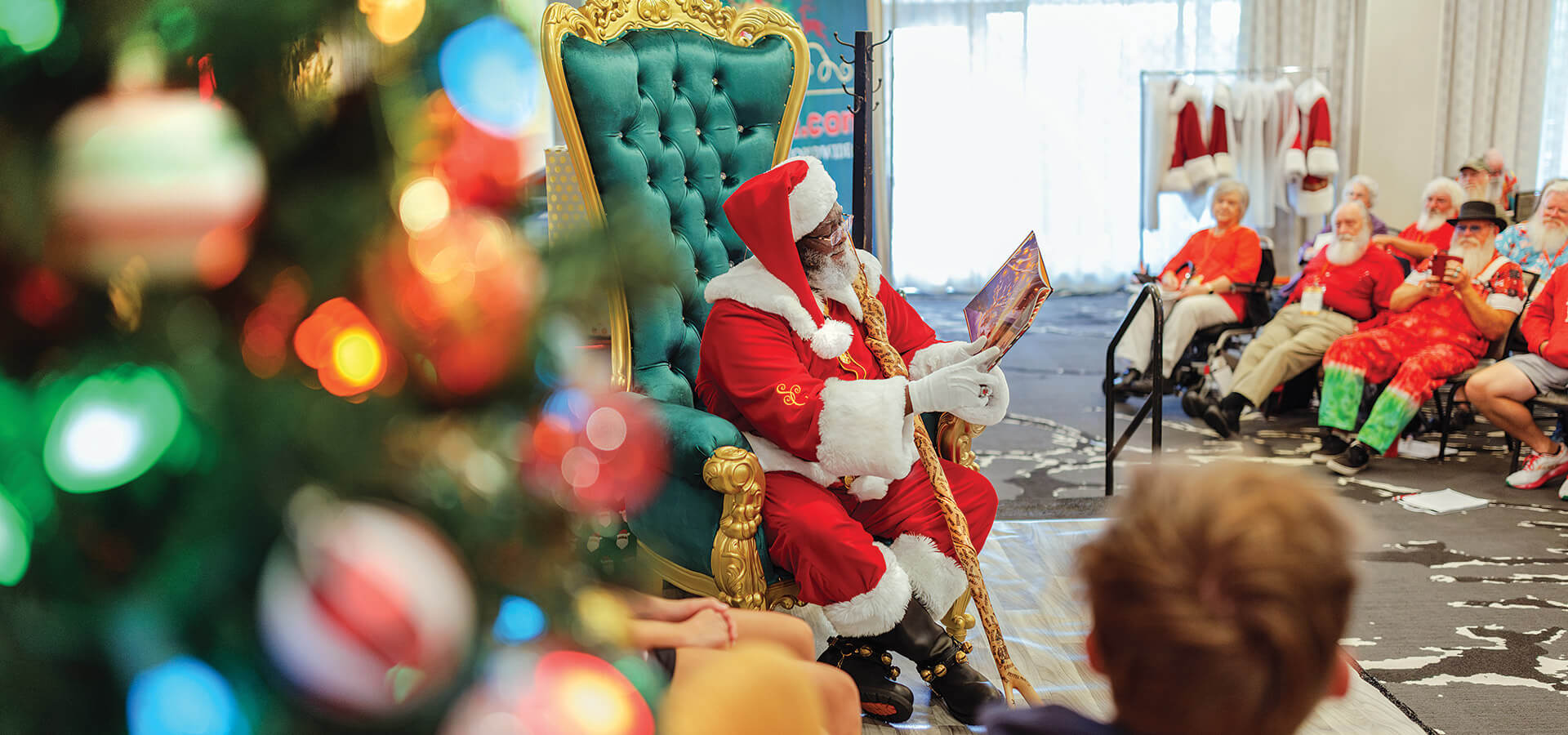
The second Santa is Titus Hopper. Hopper, a Shelby native, is the only Black Santa in attendance this weekend, and instead of Ho-ho-ho! he says Bro-ho-ho! He can also dance and has a beautiful singing voice. Where are his reindeer, you ask? He’ll show you on the Reindeer Cam app on his phone.
As Hop the Black Santa, Titus Hopper spreads joy and hope to children — a skill he’s honed during a lifetime spent working in education in Cleveland County. photograph by Jerry Wolford & Scott Muthersbaugh
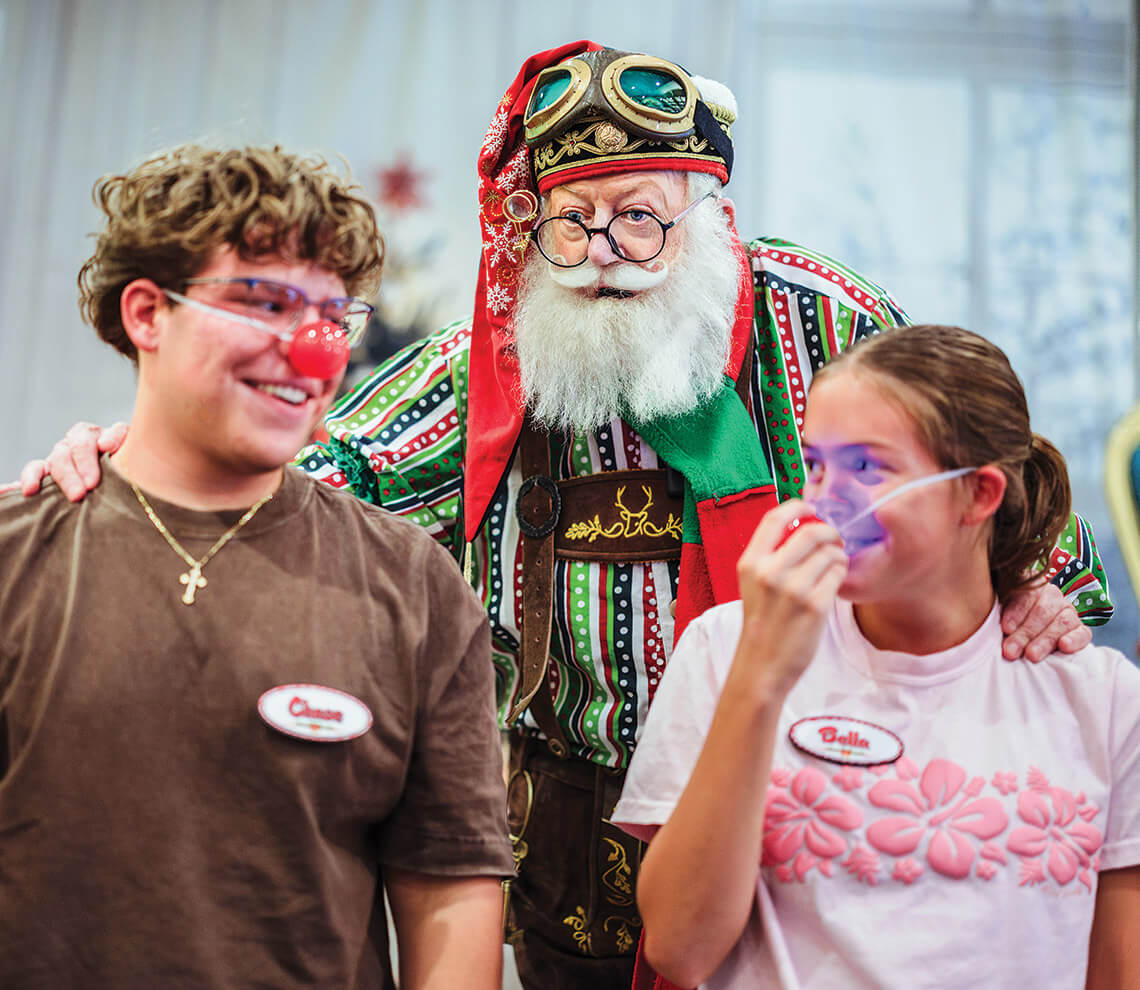
The third Santa is the headliner, Joe Barney, and he is unlike any Santa I have ever seen. Barney is on the smaller side (no way could he have played football for Princeton) and dresses in a snappy and colorful outfit. It’s stunning, but more like what a wealthy elf would wear for a night out on the town than what Santa might: a floppy cap bedazzled with giant jewels, a skinny Christmassy scarf, lederhosen, a tool belt, and a flawless designer beard that looks more real than a real one. He’s funny, full of one-liners and snappy repartee. He could have done the same routine at a comedy club in Brooklyn — a wildly divergent, playful, sarcastic, and life-of-the-party Santa. Santa as loopy uncle. Barney is a Santa for Macy’s in New York City and was the White House Santa from the George H.W. Bush presidency through Bill Clinton’s tenure. His reindeer don’t fly until Christmas Eve, the only time he can get permission from the FAA.
Barney also talks about the business of being Santa, because yes, Virginia, being Santa is also a business. It’s a part-time job. Most of us have only had a glimpse of what a Santa’s life is really like and what’s required to be successful at this seasonal gig. We have a photograph taken with him at the mall, mementos of our children in awe — or horror — on his lap. But there’s much more to it. There are corporate events, church and school visits. Santa is in demand. According to Eberhart, there’s actually a Santa shortage.
As part of his performance, Santa Joe Barney works his magic with 13-year-olds Chase and Bella Carbuto. photograph by Jerry Wolford & Scott Muthersbaugh
But home visits make up most of a Santa’s work during the holidays — and most of their paychecks, too. The average income for mall Santas from November to Christmas Eve is, according to Eberhart, from $4,000 to $8,000; many get far less than that, while a much smaller number earn more.
Before attending the advanced class, I had never heard of home visits. Imagine being a child and having Santa come to your house just to hang out for a little while — that’s what home visits are, and it’s where the practiced art of being Santa really comes into play. Families get Santa’s undivided attention, so their routine must be solid — think hours of practice, memorizing names ahead of time, and knowing what might get kids off the naughty and onto the nice list: Be a good listener, clean your room, be kind.
For many kids, Santa takes up more space in their imagination than almost anything else.
Each home visit is different, so you need to be able to improvise. Props come in handy — antlers, magic tricks, sing-alongs, the staff on which you’ve inscribed the names of some of your elves — but in the end it’s about being Santa, and the attendant pressure and responsibility of playing the role is not negligible. Santa is, after all, one of the most famous fictional people on the planet; for many kids, he takes up more space in their imagination than almost anything else. There is a quasi-religious element at work there, as well.
So sure, you can buy the suit and the boots and the belts and the staff. You can get a fancy beard. You can travel to other Santa schools in Michigan and Georgia, and learn more tips and tricks. And yes, training and equipment are an investment that might take two seasons to earn back. But look at what you’re getting in return: You’ve become a representative of one of the last scraps of magic left to us, an authentic facsimile, the one and only Santa in a sleigh full of them. I believe in you.
Get our most popular weekly newsletter: This is NC
In art class, we learn to notice texture, form, color, and light. On the plate, those same techniques guide chefs, bakers, and makers across North Carolina, turning ingredients into compositions meant to be admired before they’re savored.