Put ramekins on a baking sheet. Bake for 25-35 minutes, until puffed and golden. Remove from oven, and let stand for 5 minutes. With a flexible spatula, remove strata to
Listen as the pages of the magazine come to life in the Storytellers podcast showcasing the voices of Our State writers. Each podcast episode features a writer reading their column
Listen as the pages of the magazine come to life in the Storytellers podcast showcasing the voices of Our State writers. Each podcast episode features a writer reading their column
Listen as the pages of the magazine come to life in the Storytellers podcast showcasing the voices of Our State writers. Each podcast episode features a writer reading their column aloud, allowing each distinct voice to shine. Click below to listen to Brad read his column aloud.
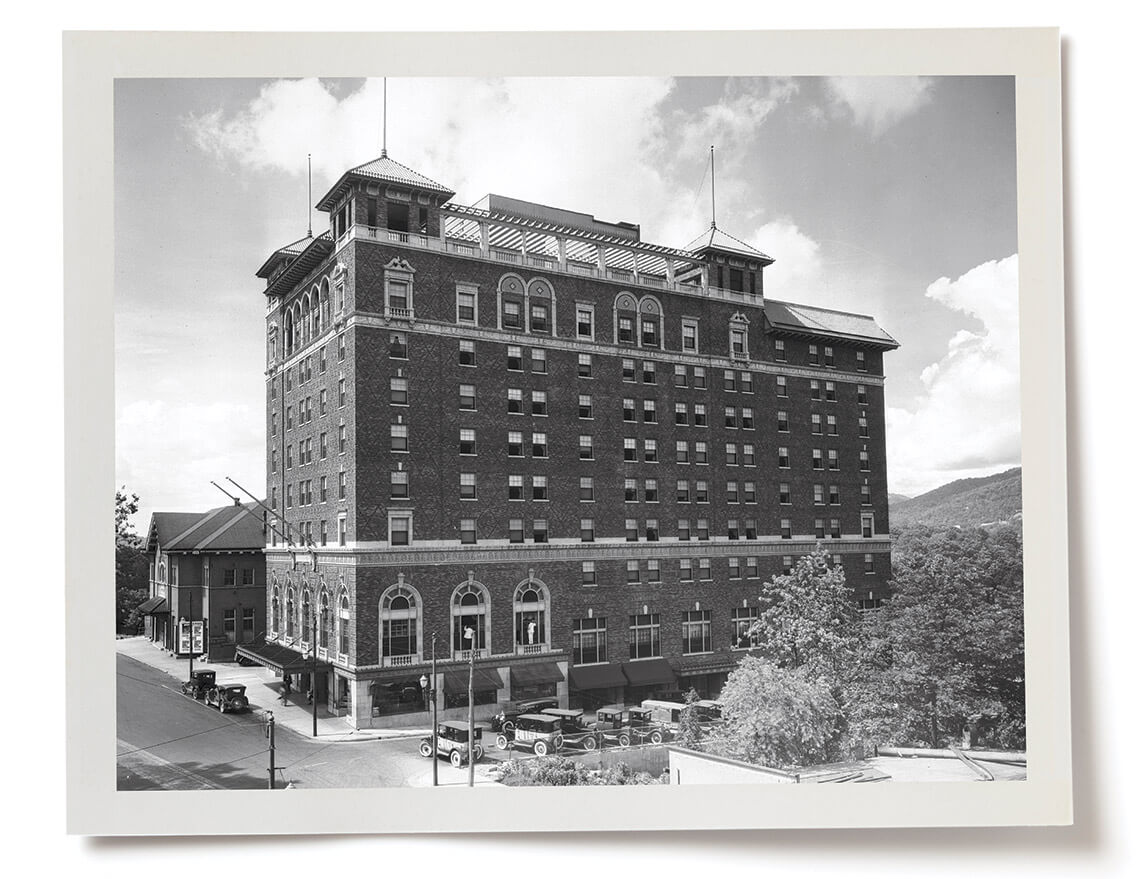
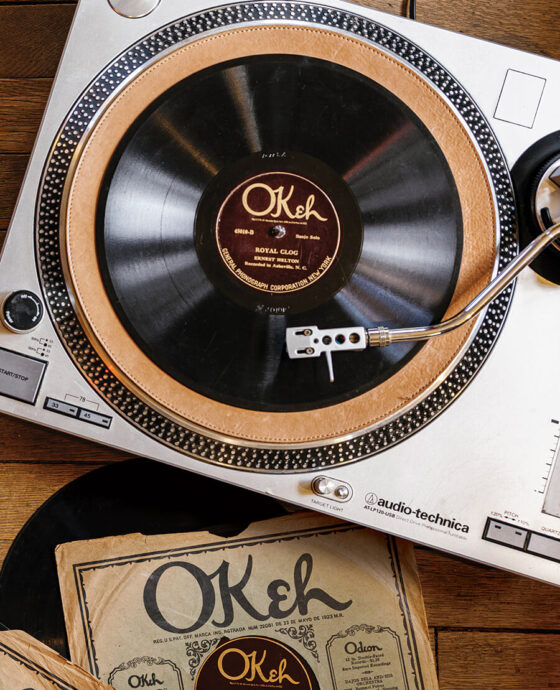
Heat and pressure. When applied in the right amounts and under the right conditions, these forces create diamonds. And that’s exactly what recording director and music impresario Ralph Peer was hoping to mine in a small room on the rooftop of the George Vanderbilt Hotel in Asheville in August 1925.
The heat came from late summer in the South. The pressure? Peer put that on himself. His New York bosses at OKeh Records had invested in this trip into the heart of the Appalachian Mountains to record “old-time” music.
His first recording trip — to Atlanta in 1923 — had produced what one might call a diamond in the rough: a record featuring Fiddlin’ John Carson that included “The Little Old Log Cabin in the Lane,” backed by “The Old Hen Cackled and the Rooster’s Going to Crow.” Not expecting much from the endeavor, OKeh is said to have ordered just 500 to 1,000 copies of the record. Yet it was an immediate hit, eventually selling hundreds of thousands of copies. Perhaps at least one of the songs from the Asheville sessions would show the same flash of brilliance.
Peer recorded the Asheville sessions from the top of the George Vanderbilt Hotel, pictured in 1925. Photography courtesy of E.M. Ball Collection, D.H. Ramsey Library Special Collections, UNC Asheville 28804
Another of the artists Peer had recorded during those Atlanta sessions was Buncombe County’s Bascom Lamar Lunsford, an attorney, performer, and collector of Appalachian songs. Lunsford was well acquainted with the musical talent in western North Carolina, and some historians believe he influenced Peer to choose Asheville for the producer’s second foray into the South.
On August 17th, The Asheville Times ran a short article inviting musicians to apply for a recording slot. Lunsford was immediately proved right. The article garnered more than 300 responses. Peer whittled the number down to about 20 performers/ensembles, and on August 25th, recording began.
Whether any of the 50-plus tracks that were recorded would be a hit was still unknown, but one thing was certain: History was being made. Peer’s equipment captured the first music ever recorded in North Carolina and the first commercial recordings made in Appalachia.
• • •
For years, Bristol, Tennessee, has been touted as the “Birthplace of Country Music.” The title stems from a landmark series of recordings that Peer conducted for a different record company, Victor — two years after the Asheville sessions. It was in Bristol that Peer heard The Carter Family and Jimmie Rodgers for the first time.
The Bristol Sessions and the arrival of those two artists on the music scene is often referred to as the “Big Bang” that launched country music. While it makes for a tidy origin story, the truth is more nuanced. In fact, the Asheville sessions — and North Carolina’s rich musical traditions — helped forge one of the nation’s most enduring and popular music genres.
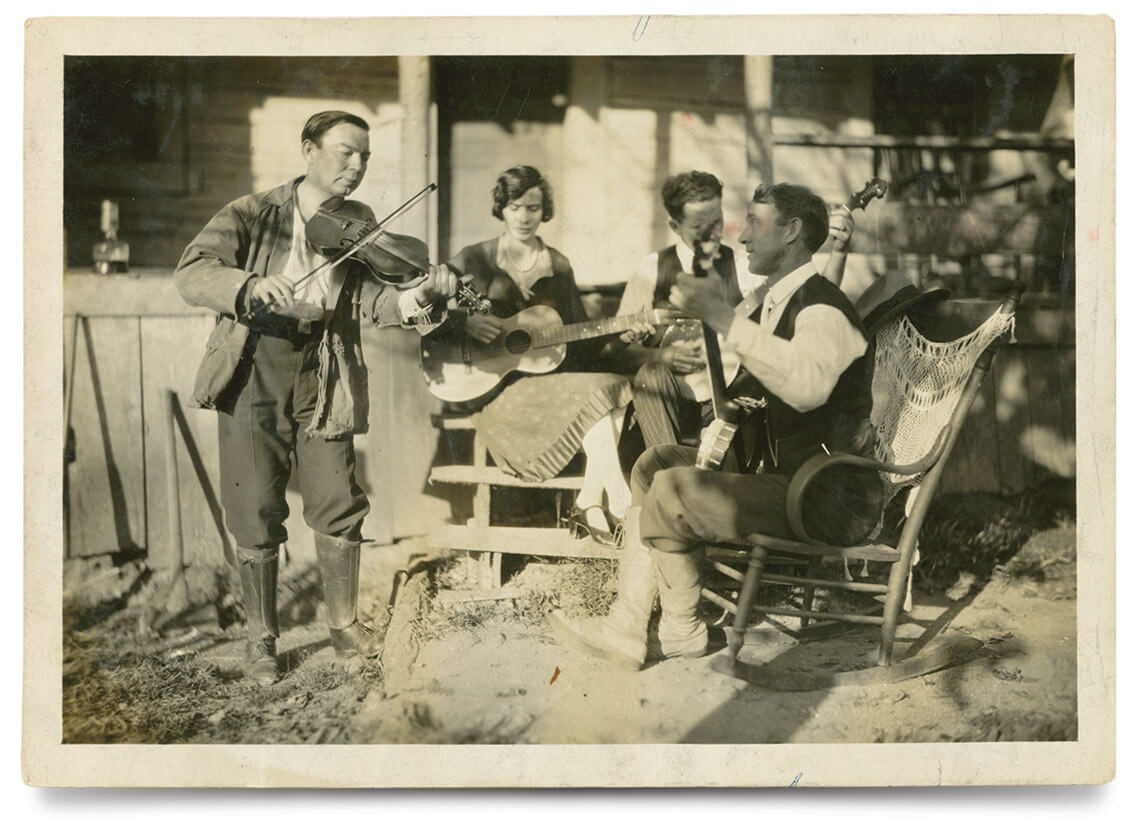
Some historians believe Bascom Lamar Lunsford (far left), an attorney from Buncombe County, helped bring OKeh to North Carolina. Lunsford recorded two songs during the 1925 sessions. Photography courtesy of Bascom Lamar Lunsford Scrapbook, Southern Appalachian Archives, Mars Hill University
Yet Asheville’s role in the birth of country music might well be forgotten if not for a music historian from the North — North London, that is. Tony Russell grew up in the ’60s and ’70s listening to rhythm and blues before hearing the seminal Anthology of American Folk Music: “It was issued in 1952, and it fell upon the world like a Biblical revelation,” he says.
The collection included old-time, blues, folk, and Cajun music. For Russell, the songs were an intoxicating stew of influences that simmered up from a singular place. “They were all part of a complex vernacular tradition that was largely Southern, largely rural, and small-town.”
In the fall of 1971, the long-haired Londoner with the English accent touched down in North Carolina. “It was still possible at that time to find people who had made records in the ’20s and ’30s,” Russell says. “It was the fulfillment of a dream. It made me realize the music of the past was not something to go to a museum to find out about. It was in the memories of living people.”
Russell wrote about the musicians he met in a magazine he published, Old Time Music. Among his readers was a fiddle player named Wayne Martin, who retired as executive director of the North Carolina Arts Council in 2021. For more than half a century now, Martin has been delving into the world of old-time music, trying to understand the tradition and what it says about our state.
Old-time music was social music, he explains. “It was played to cement bonds, to bring a community together.” It was old-time music that helped Martin forge social bonds when he moved to Raleigh in the mid-’60s. A friend with an interest in string band music had purchased a banjo. “He suggested, ‘Why don’t you play the fiddle?’ So I got me a fiddle and began sawing away.”
Some of the music has its origins in Scots-Irish fiddle tunes, but there’s much more to it. “You can tell it’s been developed over generations,” Martin says. “There’s a lot that comes from Black and Native traditions.”
These were songs played on front porches that echoed across valleys and hollows on sultry summer nights. Songs that were passed from one generation to the next like peas and cornbread at a church picnic. Peer’s goal was to share those songs with the wider world, to etch them onto wax discs that could be played anywhere and anytime with the right kind of newfangled equipment.
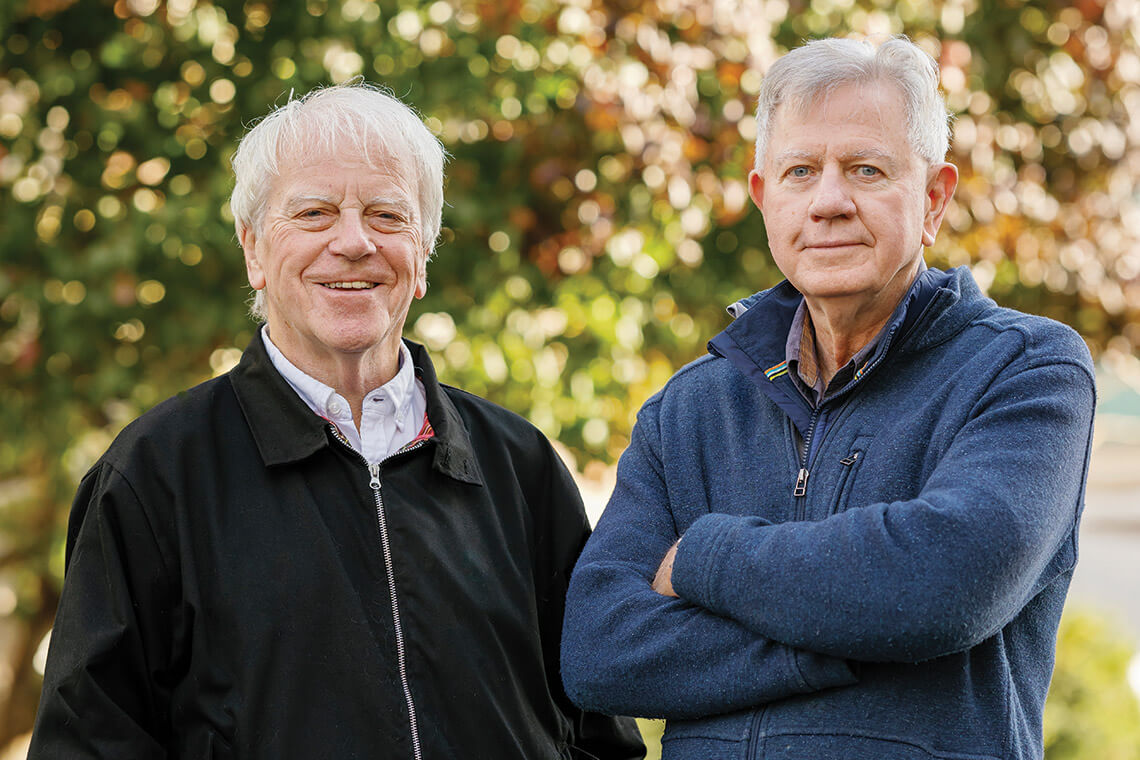
Tony Russell (left) and Wayne Martin have devoted decades to exploring and preserving the history of old-time music in North Carolina, including the Asheville sessions. photograph by Tim Robison
“Peer is trying to create a commercial genre that people can profit from,” Martin says. “They’re basically trying to get the word out to people who might want to take a chance on the idea of it becoming a livelihood.”
But back in 1978, Martin had never heard of the Asheville sessions. He was surprised to learn about the pivotal recordings from an article published in Russell’s magazine. “It was really a significant event,” Martin says. “I asked myself, ‘Why isn’t this more available to people to learn about and have access to?’”
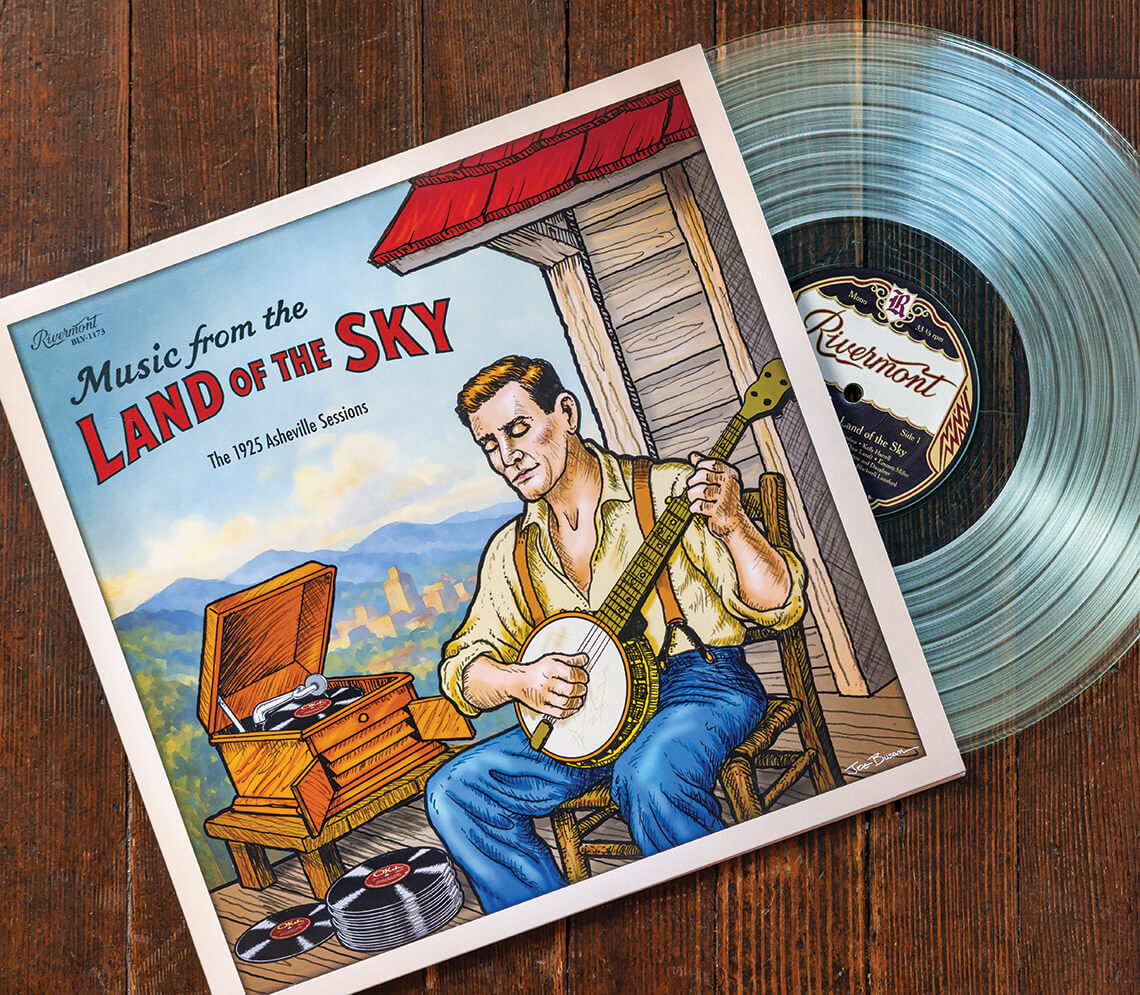
Last fall, he and other organizers had a chance to help remedy that shortcoming. At a centennial event held in Asheville, descendants of some of the 1925 musicians spoke on a panel. A concert at Thomas Wolfe Auditorium — right next door to the building where the Asheville sessions took place — brought songs from the 1925 sessions to life. And 28 of the original OKeh recordings made in Asheville were rereleased on both CD and a double LP for a new generation of old-time fans.
• • •
The hothouse environment of the Asheville sessions was captured in an Asheville Times article on August 26, 1925: “There’s a lot of respiration and perspiration connected with the making of phonograph records.”
Peer had hedged his bets for the session. In addition to a lineup of previously unrecorded acts, he’d recruited some of OKeh’s established artists, including Lunsford, Henry Whitter, and Ernest V. Stoneman, figuring the sales from those artists would justify the cost. Almost half of the performers were from North Carolina.
The songs included “event ballads” about natural and man-made tragedies, often with a religious or moral message in the end, Russell says, adding, “This is a vigorous tributary of the great river of country songs.” They included “The Wreck on the Southern Old 97,” performed by Kelly Harrell, and “Fate of Santa Barbara,” performed by Lunsford and his brother Blackwell.
There were also components of blues and pre-blues, ragtime, and minstrel songs. In short, the influence of Black musicians is palpable.
As part of last year’s centennial celebration, Rivermont Records released Music from the Land of the Sky: The 1925 Asheville Sessions on CD and double LP. photograph by Tim Robison
The minstrel traditions of the past are offensive, but they reflect an attachment by white musicians to the art that was being made and interpreted by Black musicians. Martin points to Emmett Miller’s “Lovesick Blues” as a recording from the sessions “whose reverberations are still being felt today. Hank Williams covered it, and you see it performed by modern bands.”
The titles of many of the tunes leave no doubt as to the rural, red-dirt origins of the music. Harmonica player Jim Couch performed “Dill Pickle” and “Turkey in the Straw.” J.D. Weaver played “Arkansas Traveler” and “Hog Drivers.” Banjoist Wade Ward served up “Fox Chase.” And vocalist Ernest Stoneman delivered “The Kicking Mule.”
After nine days of recording, Peer packed up his equipment, promising to return. But he never did. He left OKeh for Victor Records; two years later, he made his fateful recording trip to Bristol.
“I know how much it meant to me that the place I lived created these remarkable works of art.”
OKeh released several of the songs from the Asheville sessions, but none of them turned out to be big hits. They were purchased, listened to, and ultimately ended up in yard sales and secondhand shops, where they were scooped up by a few knowing record collectors. In recent years, Russell, Martin, and others have helped bring attention to their significance.
“It’s some of the earliest documentation that we have of this incredibly resilient community music-making tradition in western North Carolina,” Martin says. “I know how much that meant to me in my own sense of worth to know that the place I lived had created these really remarkable works of art, and that’s part of who I am.”
Peer had to wait until the Bristol sessions before discovering the gems he was looking for — the singing and playing of The Carter Family, the yodeling of Jimmie Rodgers. Yet there’s no doubt that the Asheville sessions produced something just as valuable: proof, etched in wax, of a legacy that still sparkles.
In art class, we learn to notice texture, form, color, and light. On the plate, those same techniques guide chefs, bakers, and makers across North Carolina, turning ingredients into compositions meant to be admired before they’re savored.



 Listen as the pages of the magazine come to life in the