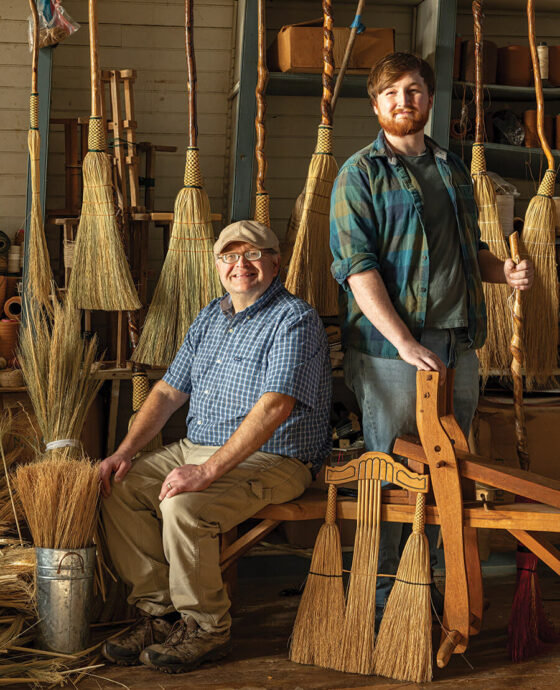
All spruced up in a collared shirt, Marlow Gates scaled a steep bank along New Leicester Highway in the dead of February. A twisty broom handle is worth a pit stop.
“That was on the way to one of our first dinner dates,” Marlow recalls with a laugh, looking at his wife, Diana, who had called out the bittersweet vine wrapped around a maple branch from the passenger seat nearly 30 years ago. They keep pruning tools in their cars for such occasions.
Today, they sit across from each other, weaving and whittling in their studio — a 130-year-old former general store beside their home in the quiet valley of Big Sandy Mush, near Leicester.
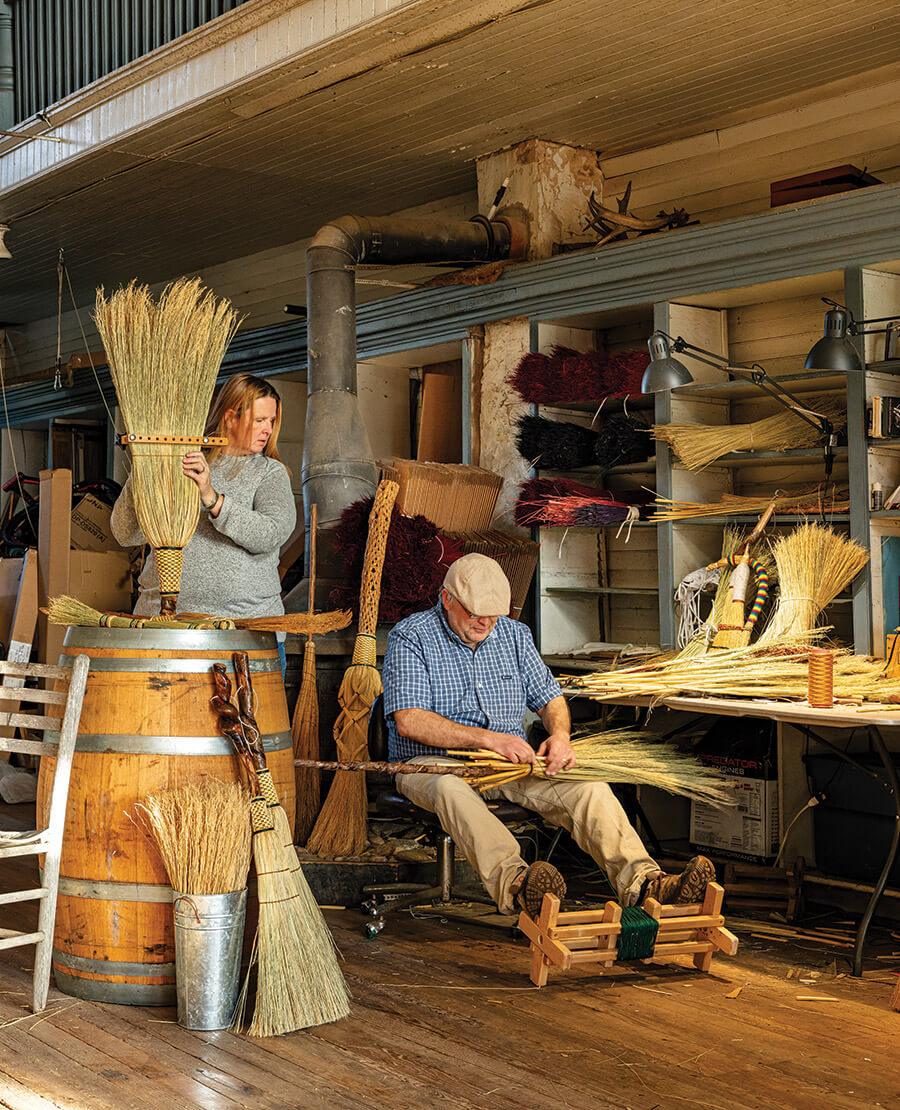
At Friendswood Brooms’ studio, visitors can watch Marlow and Diana Gates make artful brooms the old-fashioned way. photograph by Tim Robison
If you haven’t heard of Leicester, about 12 miles northwest of Asheville, you’re not alone. If you have, you’re in a favorable position if anyone asks you to pronounce it (it’s LESS-ter).
Marlow’s family moved to the property in 1981, and after the last proprietor closed the general store in 1994, his dad, Ralph, turned it into a broom shop called Friendswood Brooms. It traces its roots to Gatlinburg, Tennessee, where Ralph trained as a broom maker. After moving to North Carolina, he built a legacy crafting brooms as functional art that has lived well beyond him. Today, it’s three generations deep.
• • •
Inside Friendswood Brooms’ studio, which rests on bricks leftover from the construction of Biltmore, a staircase leads to a slightly askew balcony. Built-in shelves line the walls, stacked with nylon cord, newspaper clippings, awards, and brooms — flat hearths, stout whisks, lanky cobwebs, and fanned sweepers. Several dozen sheaves of broomcorn are propped below, awaiting their turn.
Broomcorn, a type of sorghum, has three parts: bristle, stem, and knurl — the toughest section. After removing the seed pods from the bristles, the fibers soak in a steamy bath to ensure pliability for weaving. The Gateses still grow a couple of rows in their garden for tradition’s sake.
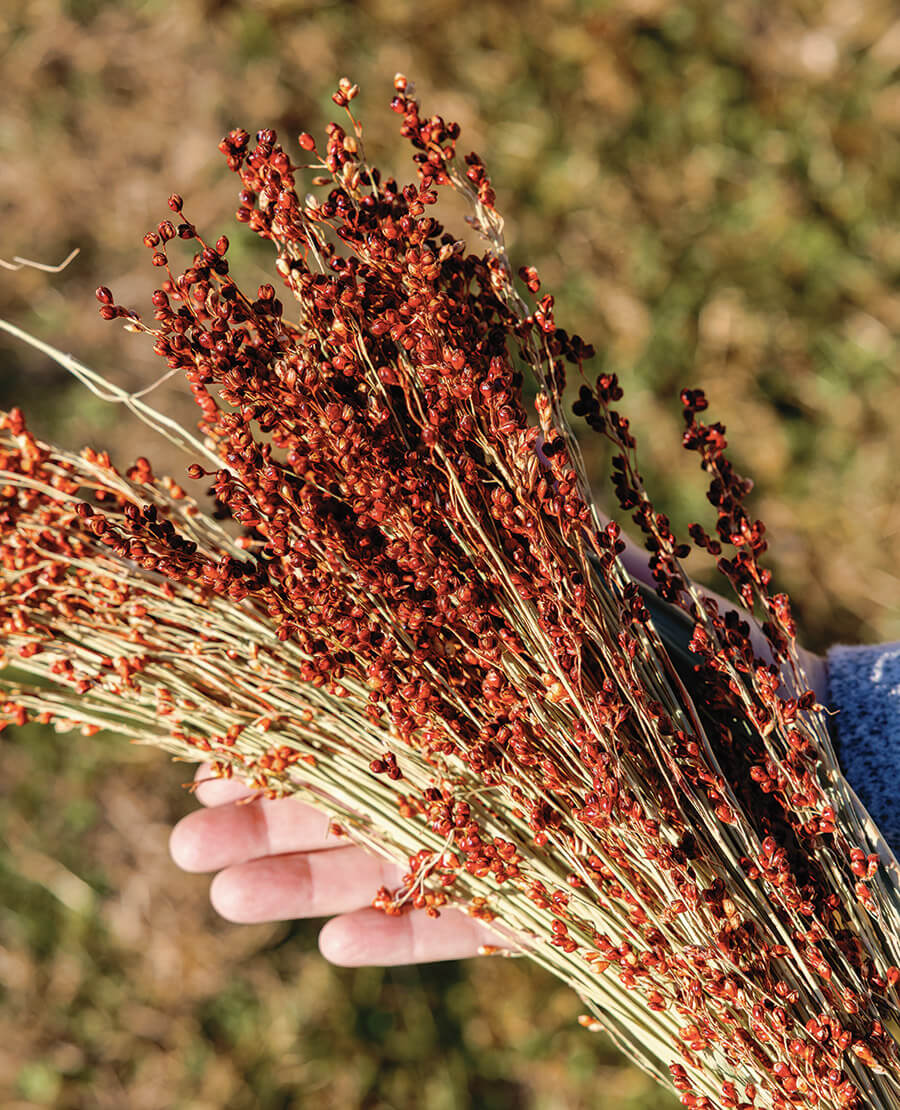
Seed pods must be removed from the broomcorn bristles before the fibers are ready for shaping. photograph by Tim Robison
Marlow rests his feet on what he calls a tying wheel, his version of a wooden bobbin that keeps the string taut while he weaves. It turns with each wrap, flipping for the next cycle of thread.
“He came up with this particular design while studying architecture at NC State,” Diana says as she carves a handle.
Dogwood, maple, bittersweet vine, and sassafras are some of their favorite woods to work with, and they use a hooked knife to notch designs.
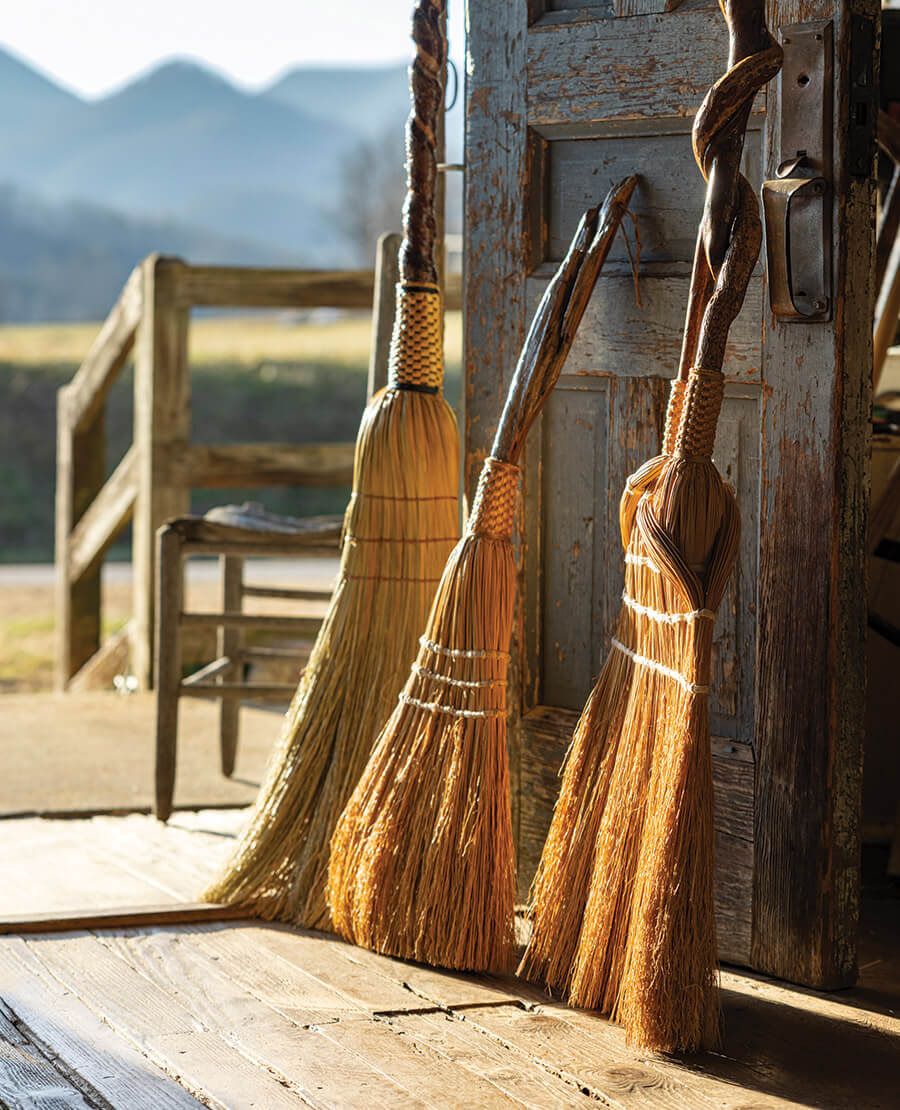
Brooms leaned against the doorway welcome shop visitors to Friendswood Brooms. photograph by Tim Robison
It’s common for neighbors to lean pieces of wood against the store when they find something interesting. In a shed downhill, the couple keeps a collection that spans years of gathering, most labeled with their origin.
Not only do they handwrite tags with where the wood came from — an idea from Marlow’s mom, Sally — but his dad also chose to add on a lifetime guarantee: Any worn sweeper can be replaced for a nominal fee — usually lunch or the cost of materials, whichever is cheaper.
• • •
The roadside handle Diana spotted all those years ago became the first iteration of Marlow’s hallmark wedding broom design. He surprised her with it as an engagement gift.
The two met in 1997 at Mast General Store in Waynesville, where Diana was a manager at the time. Marlow had set up a demonstration, so Diana tried her hand at broomcraft.
“She says I wouldn’t have married her unless she knew how to make a broom,” Marlow jokes.
He’s been working with broomcorn his whole life, picking up what his father started. It seems to run in the family. Marlow and Diana’s sons — Corbin and Jayton — know their stuff, too. Corbin joined his dad at their last two North Carolina State Fair booths and makes his own dyed broomcorn sweepers. As Ralph liked to say, “The lifetime guarantees just got extended another lifetime.”
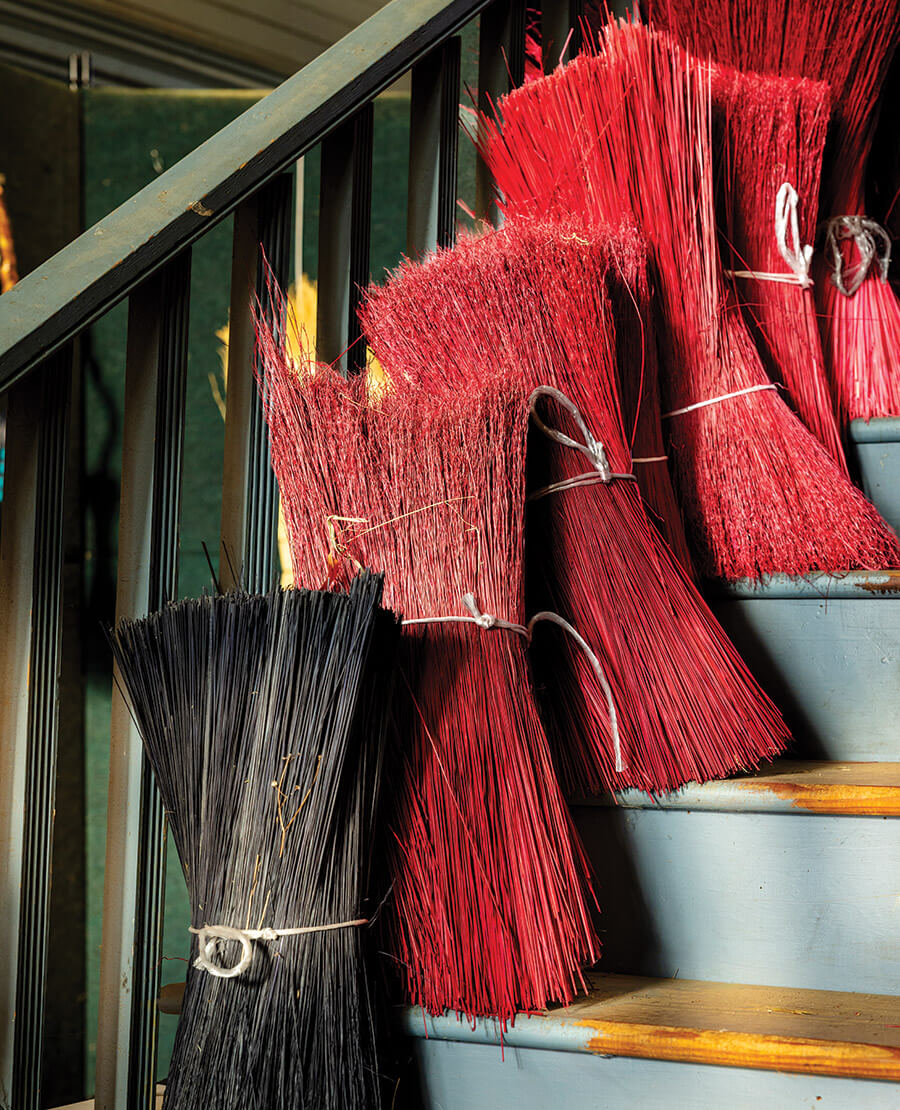
“My dad taught hundreds of people,” says Marlow of his family craft. “I’ve taught hundreds, if not thousands, at this point, and we love to see people carry on tradition.” photograph by Tim Robison
But Ralph wasn’t born into it. His first career was as a software-systems engineer for Grumman Aerospace Corporation at Kennedy Space Center. The job kept him away from family, and he realized he didn’t really know Marlow’s three older siblings because of it.
So, he left the aerospace industry and spent a year training with legendary broom maker Lee Ogle in Tennessee. Marlow celebrated his first birthday at Ogle’s Broom Shop in Gatlinburg. Soon after, drawn by the Southern Highland Craft Guild, the family moved to North Carolina, where they lived for seven years in the old Reynolds Mansion in Asheville before settling in Leicester when Marlow was 8.
“I remember Dad saying that, in the first year, he made less than he had paid in taxes the year before,” Marlow says. “It was a whole different lifestyle, but he loved it.”
Ralph traded his crew cut for a beard, and denim overalls became his trademark look. The family spent summers loading up a four-door pickup named Big Red to vend at craft shows and art festivals.
“I’ve taught hundreds, if not thousands, at this point, and we love to see people carry on tradition.”
While other kids watched cartoons on Saturday mornings, Marlow and his siblings headed into the woods to harvest handles.
“I’d give my dad a head start, and he would leave three sticks in an arrow at the edge of a pile he’d made, pointing in the direction he was heading next,” Marlow says. “Dad always said, ‘People say money doesn’t grow on trees. They haven’t found the right trees yet.’”
Along with working in the studio and teaching at the John C. Campbell Folk School in Brasstown, Marlow is the resident broom maker at Antler Hill Barn at Biltmore Estate. Some folks stop by his setup to reminisce about relatives who dabbled in the craft, but most are just intrigued to learn that no glue is involved.
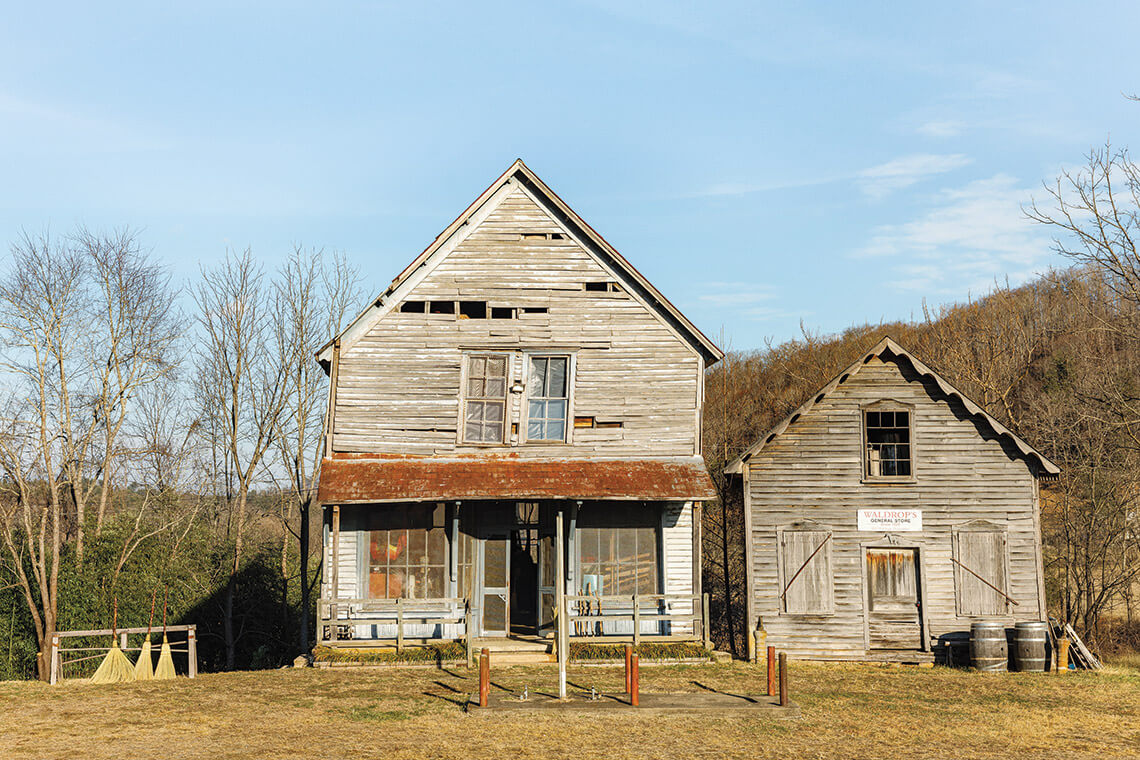
Friendswood Brooms operates out of a 130-year-old former general store. photograph by Tim Robison
It’s easy enough: Find a handle in the woods. Anchor the thread to the handle with a small nail. Add broomcorn and bind it in layers. Tie it off with a whip-knot, trim it once more, and stomp it flat. Lay it out in the sun to dry. Finish the handle with lacquer, and you have yourself a broom.
A master broom maker makes it look that simple, anyway. But it always starts with the handle.
Marlow no longer relies on wooden arrows to lead him to the best handles. He knows where to find them, the way Ralph did.
“He loved that nature provided them,” Marlow says. “You just had to go find them. Those handles were gifts to him. He would thank the trees for what he took.”
Marlow is thankful for the trees, too — and the legacy his father left him.
Friendswood Brooms
8 Willow Creek Road
Leicester, NC 28748
(828) 683-9521
friendswoodbrooms.com
print it