Put ramekins on a baking sheet. Bake for 25-35 minutes, until puffed and golden. Remove from oven, and let stand for 5 minutes. With a flexible spatula, remove strata to
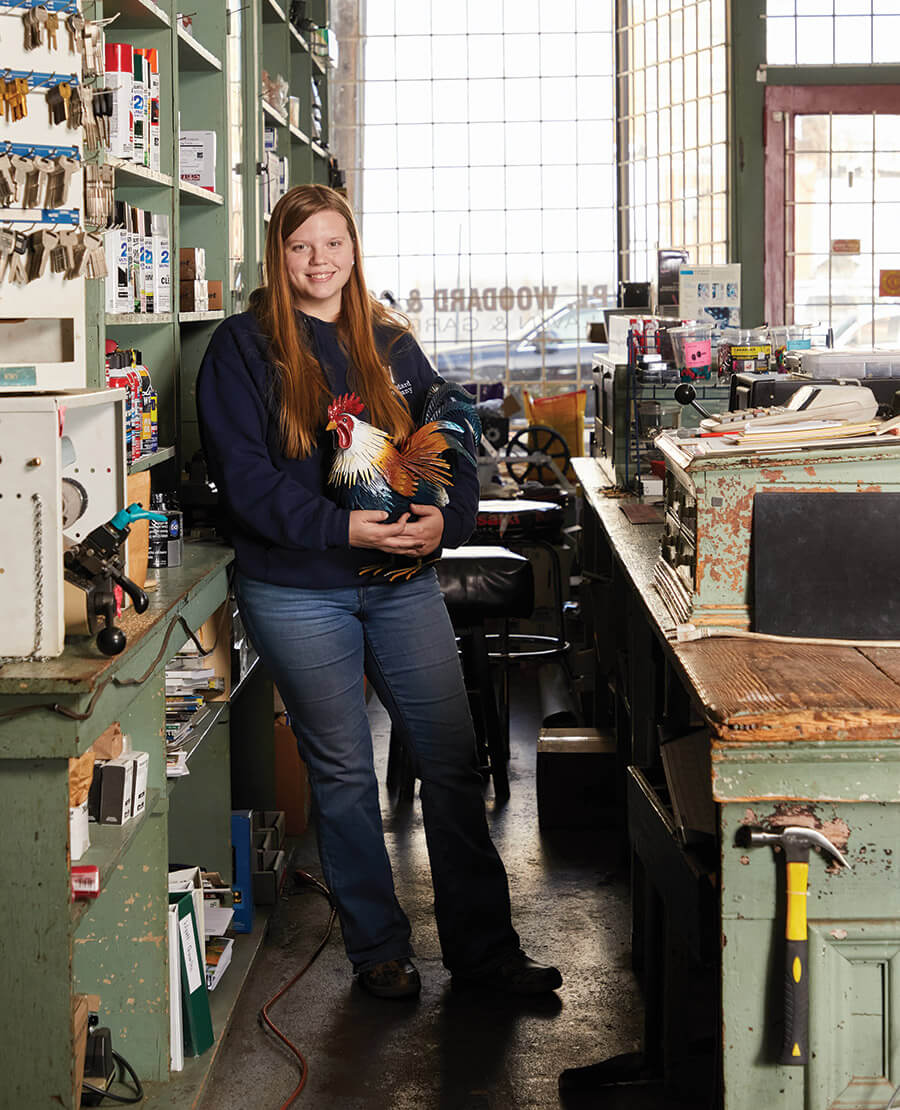
Samantha “Sam” Batts sits on a stool behind a worn work counter, its seafoam-green paint barely hanging on. She’s rekeying a gold doorknob above a section where the paint has
Samantha “Sam” Batts sits on a stool behind a worn work counter, its seafoam-green paint barely hanging on. She’s rekeying a gold doorknob above a section where the paint has
Samantha “Sam” Batts sits on a stool behind a worn work counter, its seafoam-green paint barely hanging on. She’s rekeying a gold doorknob above a section where the paint has fully given way to the wood underneath. That worn spot is a ledger of hands and years: This isn’t the first knob worked on here, nor are Batts’s young hands the first to move across its surface.
Bundled in a sweatshirt and Carhartt overalls to keep out the building’s drafts, Batts chooses a pin from the metal tray in front of her. Behind her, built-in shelves stretch up and across the wall, painted the same green and stacked with paint cans, caulk tubes, racks of keys, rolls of tape, light bulbs, doorknobs, buck knives, and oil lamps.
Batts didn’t know how to rekey a lock when the Womble family hired her four years ago. “I started by handwriting inventory,” she says. Today, they trust her to manage the hardware section of their store.
To rekey a lock, head to the hardware section at P.L. Woodard & Co., where Sam Batts can offer her assistance — if you don’t get distracted by offerings along the way. photograph by Chris Rogers
Across the room, cashier Angela Dail rings up a customer buying country ham and plexiglass. The register area is as crowded as the shelves, but with Smokey Mountain dip and wedges of hoop cheese, pocketknives, calendars, moisture absorbers, lanyards, screwdrivers, a couple Radio Flyer tricycles, and whirligig art.
Nearby, Jaden Morgan wheels a dolly stacked with bags of goat feed through a side door, knocking a metal rooster to the floor with a shrill clank.
“I run into something about every time I come in here,” he says, righting the befouled bird.
“You can’t help but to,” Dail replies.
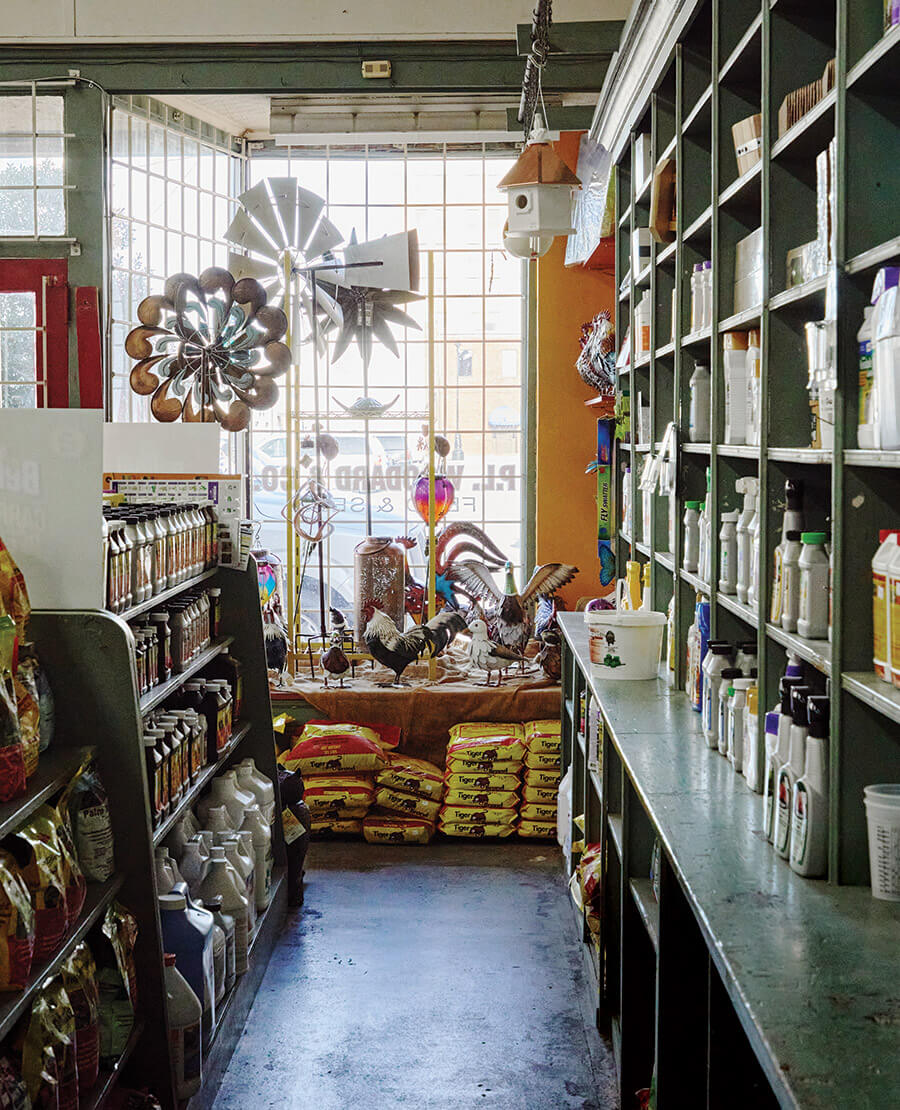
The clutter is deliberate.
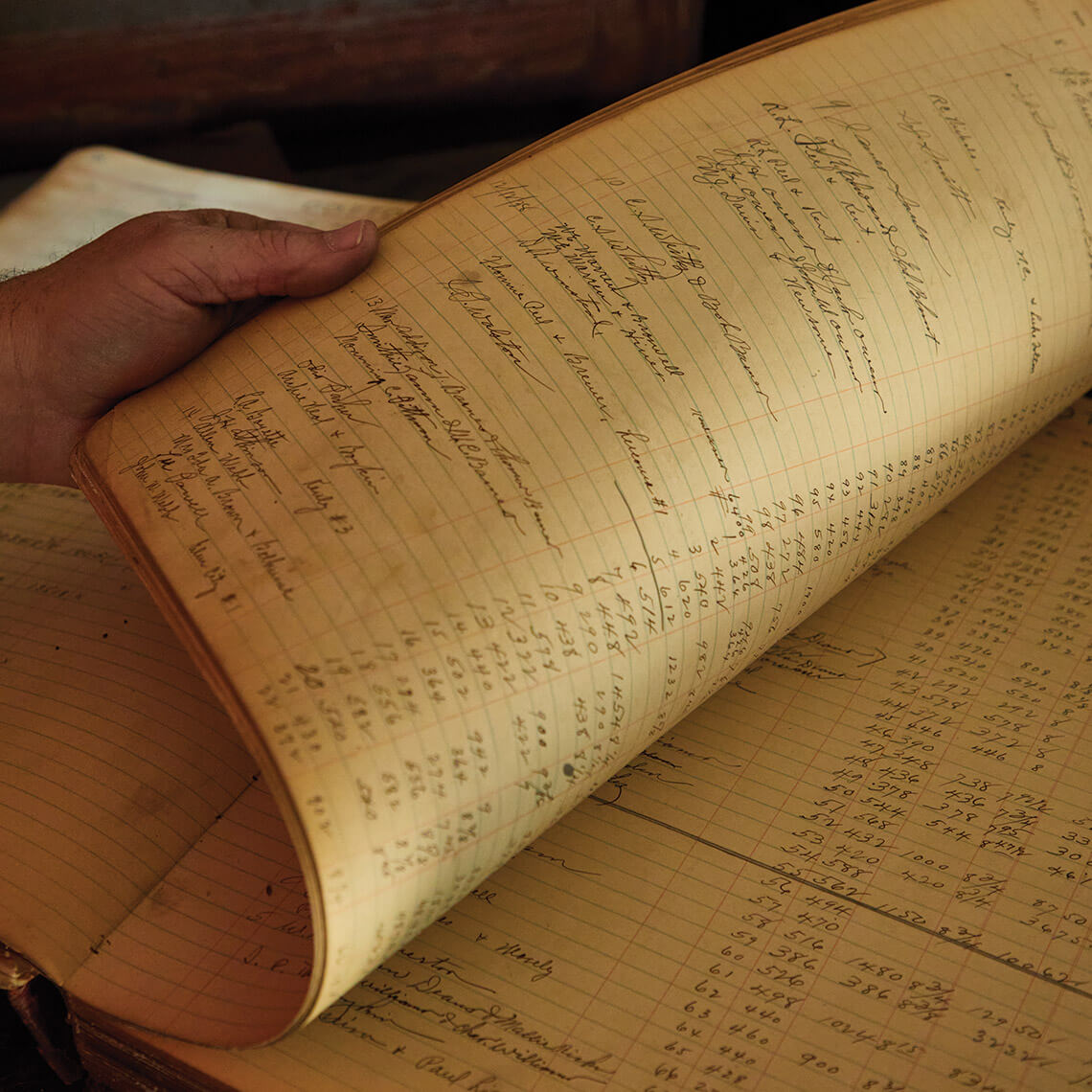
Miller has held onto the store’s old ledgers …<br><span class="photographer">photograph by Chris Rogers</span>
… some of which date back to the turn of the century. <br><span class="photographer">photograph by Chris Rogers</span>
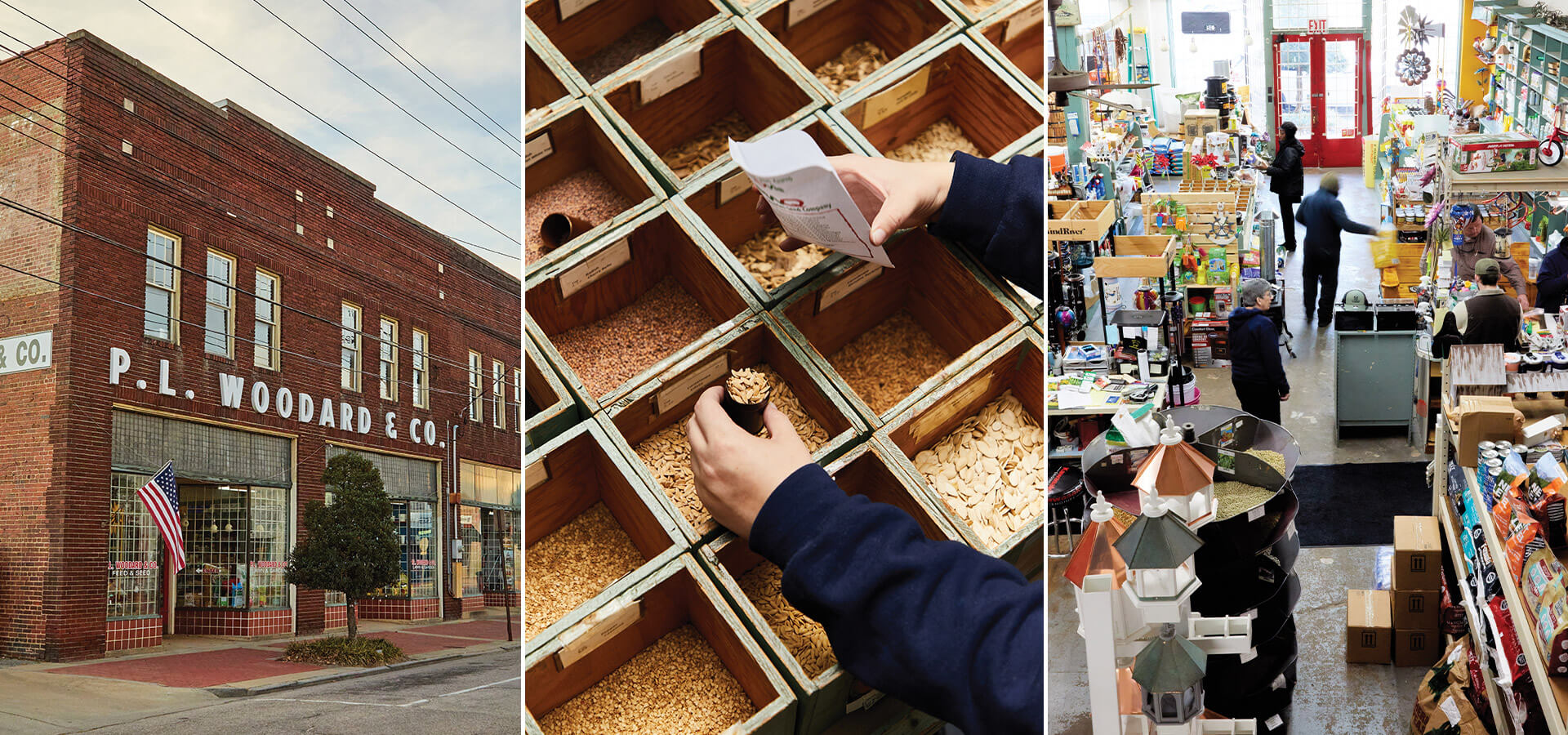
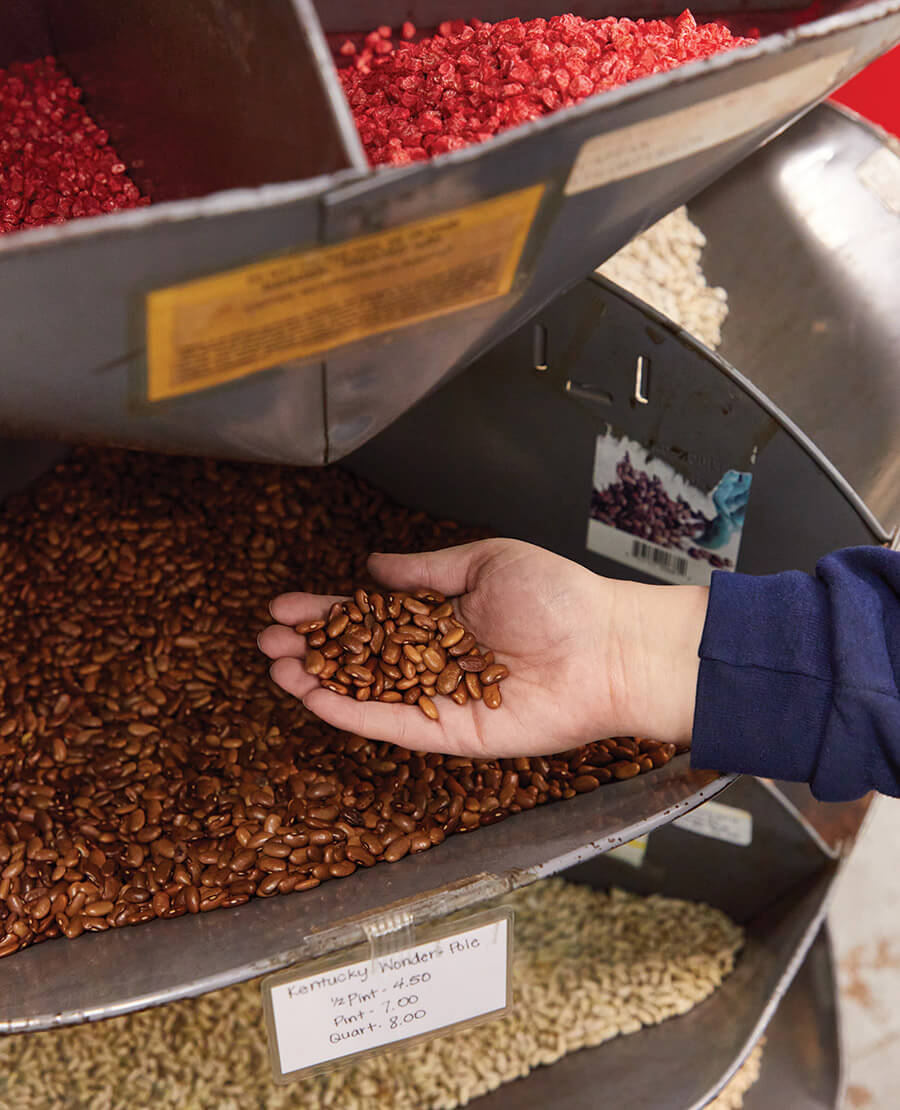
P.L. Woodard & Co. has lasted 127 years by stocking whatever its customers need, sometimes before they know they need it. That approach has helped the store weather shifting economies and the rise of big-box retailers. Shoppers can still buy seeds by the scoop and parts for long-since-discontinued machinery. They can also find new lawnmowers and gourmet gift baskets, fuzzy socks and dog treats, hunting licenses and garden flags.
Yet the store’s longevity rests not only in what’s on its shelves but also on the people behind the counters. Since 2010, the Womble family — whose roots in Wilson run as deep as the shop’s — has carried that responsibility. Because of their dedication, P.L. Woodard & Co. is thriving at a time when the number of stores like it in North Carolina is dwindling. Those counters, worn smooth by generations of hands, will be here a while longer.
• • •
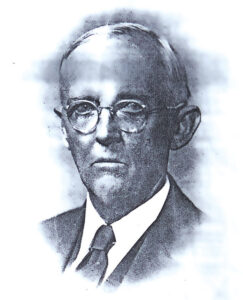
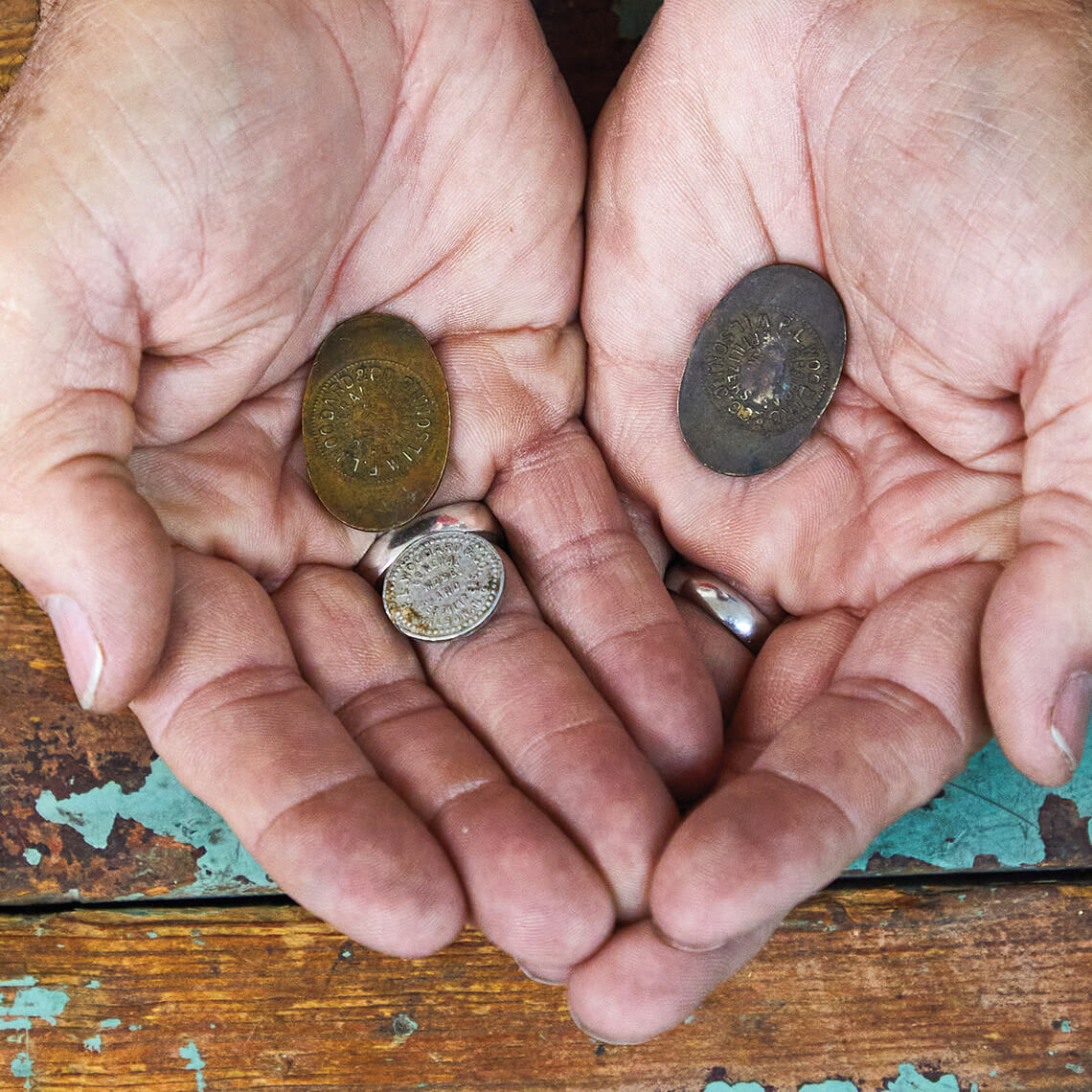
P.L. Woodard & Co. began in 1899, when Paul Lee Woodard opened a store in Black Creek, a small farming community south of Wilson. For more than a century, it served as a lifeline for farmers: keeping their books, spreading fertilizer, issuing crop liens, extending credit during hard times — even minting its own coins during the Depression.
Paul Lee Woodard Photography courtesy of Womble Hardware & P.L. Woodard & Co.
“Woodard had these little medallions that he would hand out,” Penny Womble says. The 78-year-old is perched on a stool in the equipment shop off the side of the retail store. She’s the business’s owner and the Womble family matriarch, but her kids, Jimmy Miller and Allyson Moye, run the place.
From his seat beside her, Miller adds: “He printed his own money — nickels, dimes, quarters, and dollar pieces — that the employees would get paid with, and they could go to the downtown merchants and use that money. Then merchants would come back to him to get their cash.”
That kind of care kept the farmers coming — first by wagon, then by automobile — through three locations and as many ownership changes. In 1920, the business settled into the two-story brick building on Barnes Street Southwest where it still stands today.
Miller keeps a few of the minted coins that Paul Lee Woodard used to pay employees during the Depression. photograph by Chris Rogers
But by 2010, P.L. Woodard & Co. was at a crossroads. Agriculture had changed, downtown foot traffic had slowed, and big-box stores were siphoning sales. That’s when the Wombles stepped in. They already operated their third-generation family business, Womble Hardware & Tackle, just up the street, so they understood P.L. Woodard & Co.’s value to Wilson.
Womble remembers coming in here when she was still too small to see over the counters. “I’ve always loved this place,” she says. Moye nods from a stool next to her brother, recalling plunging her little hands into the wooden bins of seeds. “It still has the same smell,” she says.
“But I’m not even gonna lie,” she continues. “I voted no.” At the time her family was discussing buying P.L. Woodard & Co., Moye was pregnant with her daughter, and they’d just bought out a real estate management company. But she was finally swayed.
Today, the trained accountant handles the store’s finances and also juggles the family’s real estate and property management company, following in the footsteps of her grandfather. “It’s a challenge,” she says, with that look in her eye that tells you she’s about to cut up. Then she does: “The fact that I’m not a raging alcoholic — I take great pride in that.”
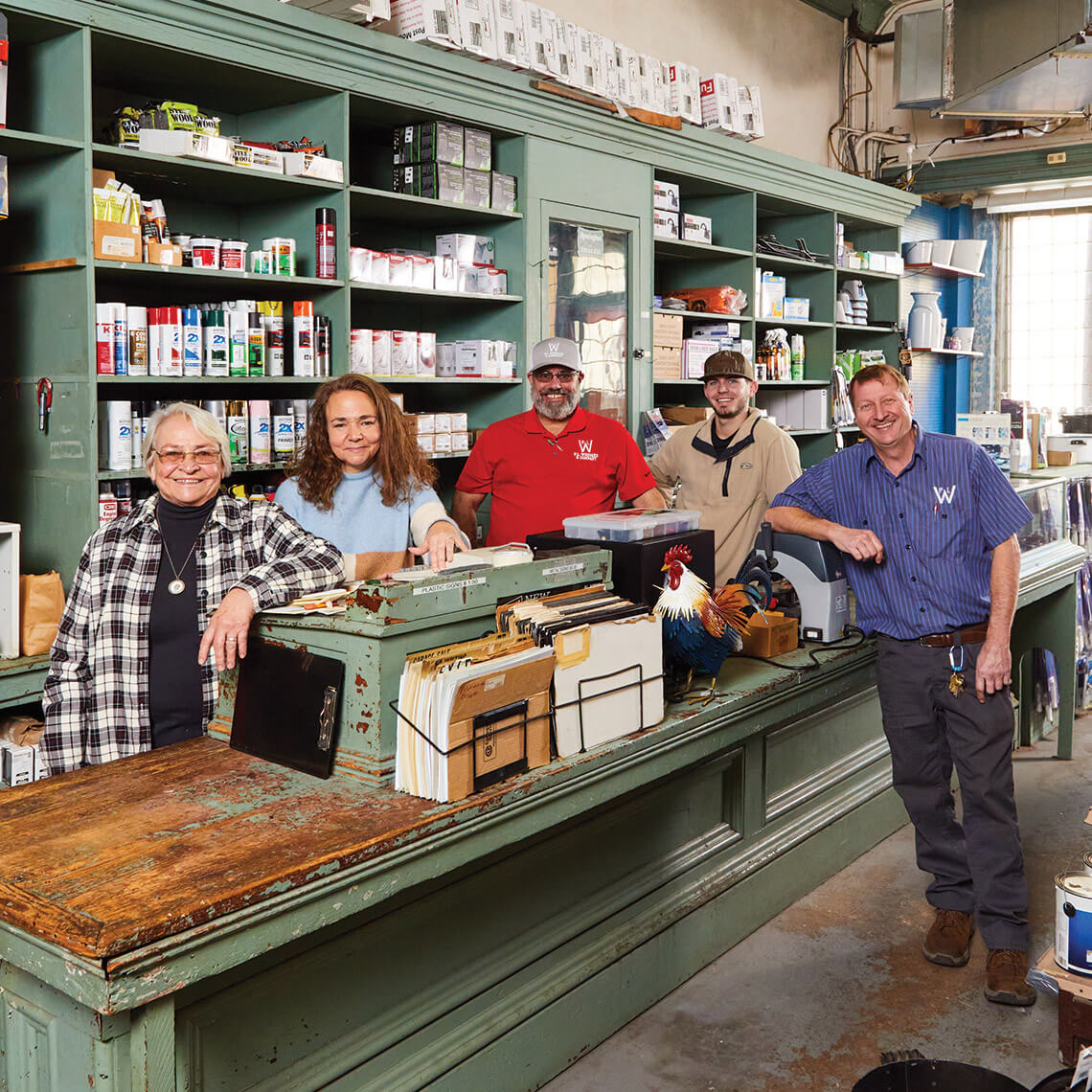
The Womble family — (from left) Penny Womble; Allyson Moye; Jimmy Miller and his son, Alex; and Ron Braswell — help keep Paul Lee Woodard’s legacy alive. photograph by Chris Rogers
The Wombles also run a storm window and door repair shop in the original Womble Hardware & Tackle building. Over four generations, they’ve operated a license plate agency, a slot-machine casino, and businesses selling everything from furniture and appliances to paint and motorboat glass. If they see a need in town, they fill it, for however long it lasts.
“We just sort of evolve with the times,” Jimmy says.
The family has since merged the two stores, formally becoming Womble Hardware & P.L. Woodard & Co. — a name as fulsome as everything else around here.
• • •
For the Wombles, preserving P.L. Woodard & Co. has always been about the people. Inside the store, the family dynamics are on full display: They talk over and tease one another, and the atmosphere feels like home — if home sold lawnmowers.
The family’s grown, too. “They bought me with the store,” jokes Ron Braswell, who started working here in 2009, about a year before the Wombles took over. Today, he manages the equipment repair shop, fixing everything from commercial riding mowers to chainsaws and pressure washers.
When Miller first mentioned buying the place, Braswell says he wasn’t sure he’d stay. “Then I saw him walking out with his sister,” he adds with a laugh, “and I thought, Maybe I will.”
He did stay — and now he and Moye are engaged.
“I don’t like for someone to come in and us not have something,” Miller says. “It eats me up!” photograph by Chris Rogers
“Seein’ all the people who come in to talk about how good my granddaddy and the family was,” Miller says, his eyes a little misty, “it makes a huge difference to me to be able to carry on and to do the same things they did.”
Miller keeps a bin of fertilizer from torn bags in the stockroom so customers can buy exactly what they need — even if that’s just 50 cents’ worth. “It’s just the old way of doing things,” he says. “Talking to people, helping them get what they need.”
Someday, over those same worn counters, people may tell Miller’s kids — who are learning the business — the same kinds of stories about their father, aunt, and grandmother.
At P.L. Woodard & Co., shoppers can also buy beans by the cup, pint, or quart. photograph by Chris Rogers
Eight years ago, Moye helped an 89-year-old man whom she calls Mr. Ball find a house on a $40,000 budget. “He’d lived in an apartment, but he wanted a house where he could have a little garden and grow tomatoes,” she recalls. She found him a house and, as a closing gift, got him a six-pack of tomato plants, a spade, and a pair of gardening gloves from P.L. Woodard & Co.
“I’ll never forget him sitting there at the table in the lawyer’s office, holding his tomato plants,” she says.
That summer, Mr. Ball brought Moye some of the first tomatoes from the garden she’d helped him sow.
In art class, we learn to notice texture, form, color, and light. On the plate, those same techniques guide chefs, bakers, and makers across North Carolina, turning ingredients into compositions meant to be admired before they’re savored.