I returned to White Lake for two reasons: to see how it has changed in the half-century since I hung out there, and to swim.
It makes historical sense that swimming should come first, since hanging out came later. My first taste of “the lake,” as we called it, came when my family moved from Siler City to Clinton in the summer of 1966. We arrived to find that the house my father had purchased was not ready. The real estate agent kindly offered us the use of his cottage in a development on the south side of the lake called “Little Clinton.” Moving to a new town already felt exotic to a 7-year-old, but a town with a micro-colony on the shores of a lake I could barely see across?
It was July in Bladen County and Bladen-County-hot. I remember spending most of that weekend in the water, a few feet from shore, puzzled by and slightly scared of the prehistoric-looking cypress trees and the Spanish moss dripping overhead. In last light, the moss cast wavy shadows on the lake bottom’s white sand. It was a magical introduction to eastern North Carolina, which, despite the accident of my birth in the red-clay Piedmont, became my spiritual home.
• • •
Sixty years later, on a mild Friday last fall, I caught sight of the lake again. To be honest, I’d visited in the early 2000s to compete in half-Ironman-distance triathlons. Those visits didn’t count. Swimming to a buoy with dozens of other athletes, hemmed in and kicked a couple of times in the head, was so tense and purposeful that I might as well have never put a toe in the water. (Nothing cheapens nature quicker than competition.) The town, and how it had changed, did not register. All I saw were competitors to best.
Because I was traveling back to a place I knew well in the past, on the drive to White Lake from my home in Durham, I avoided roads that did not exist back then. Namely, Interstate 40 between Raleigh and Wilmington. After a necessary and surprisingly innocuous stretch of toll road around Raleigh, I hit the back roads. The exurbs faded into fields and vaguely bell-ringing hamlets: Chalybeate Springs, Kipling.
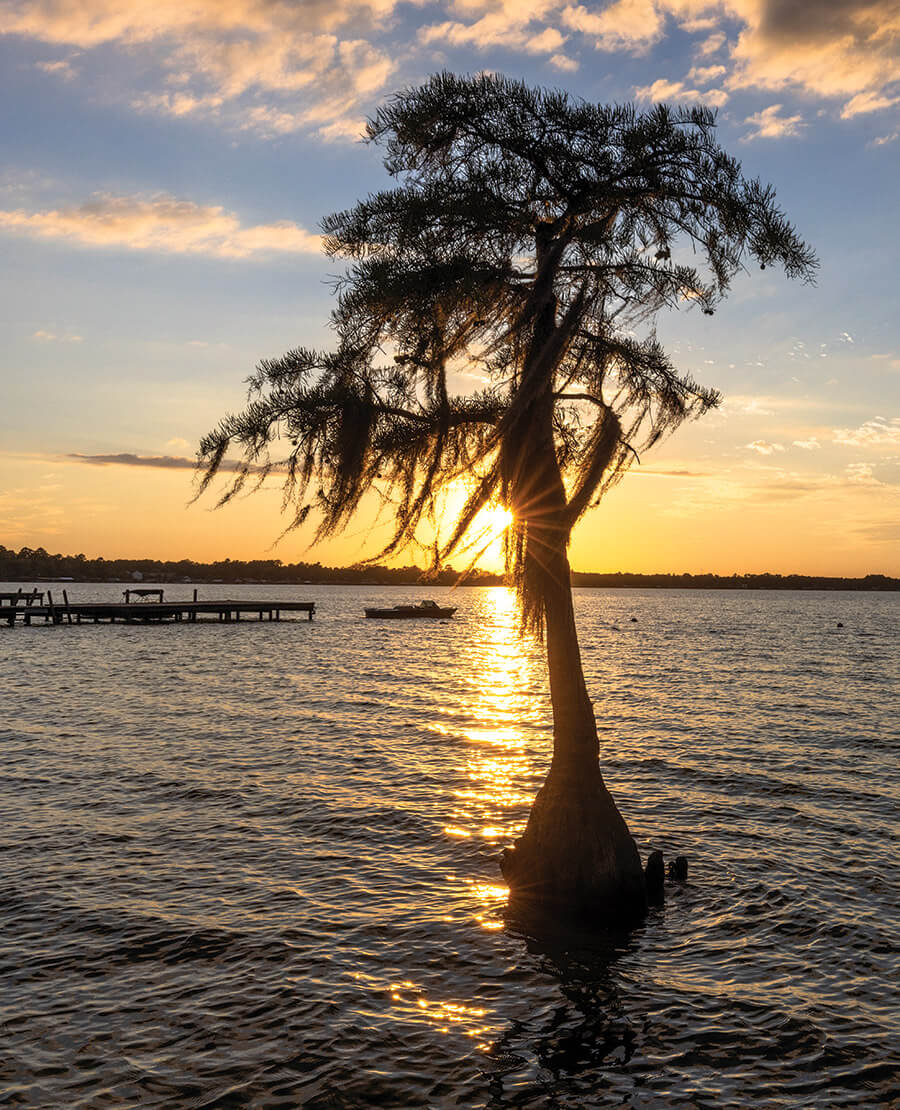
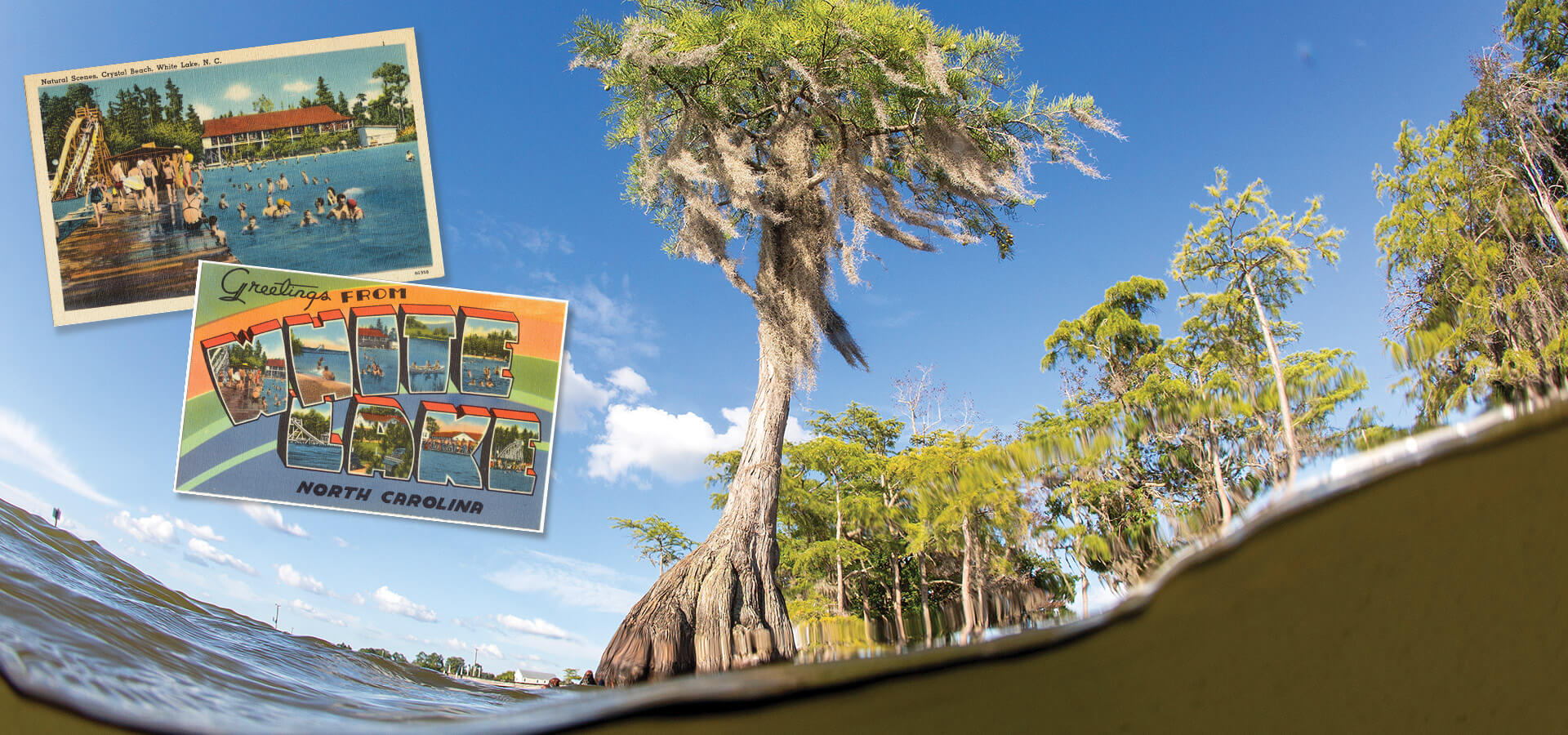
Adapted to thrive in shallow waters, today’s cypress trees draped with Spanish moss carry the same prehistoric look that the author remembers from childhood. photograph by Todd Pusser
Once I reached U.S. Route 701, the drive from my hometown of Clinton to White Lake rang bells not vague in the least. The dun-colored soil of Sampson County turning, just north of Garland, into the white sands of the Carolina Bays. Towering cypress trees darkening the swamps around the South River.
As I turned off 701 onto the familiar White Lake Drive, sprawling new builds had cropped up alongside the familiar old clapboard cottages I remembered from Little Clinton. I am always struck, when I return to a place I’ve not been in years, by an obvious but nonetheless shocking fact: the roads themselves are the same, they take you to the same places, but their character, due to what we call “development,” has been so altered you feel disoriented. The road around the lake mostly evoked the same slow groove as my first days there, but there were just enough changes — a short street of new houses on the dry side of the road, paved lanes which were once thick sand — to upset the rhythm.
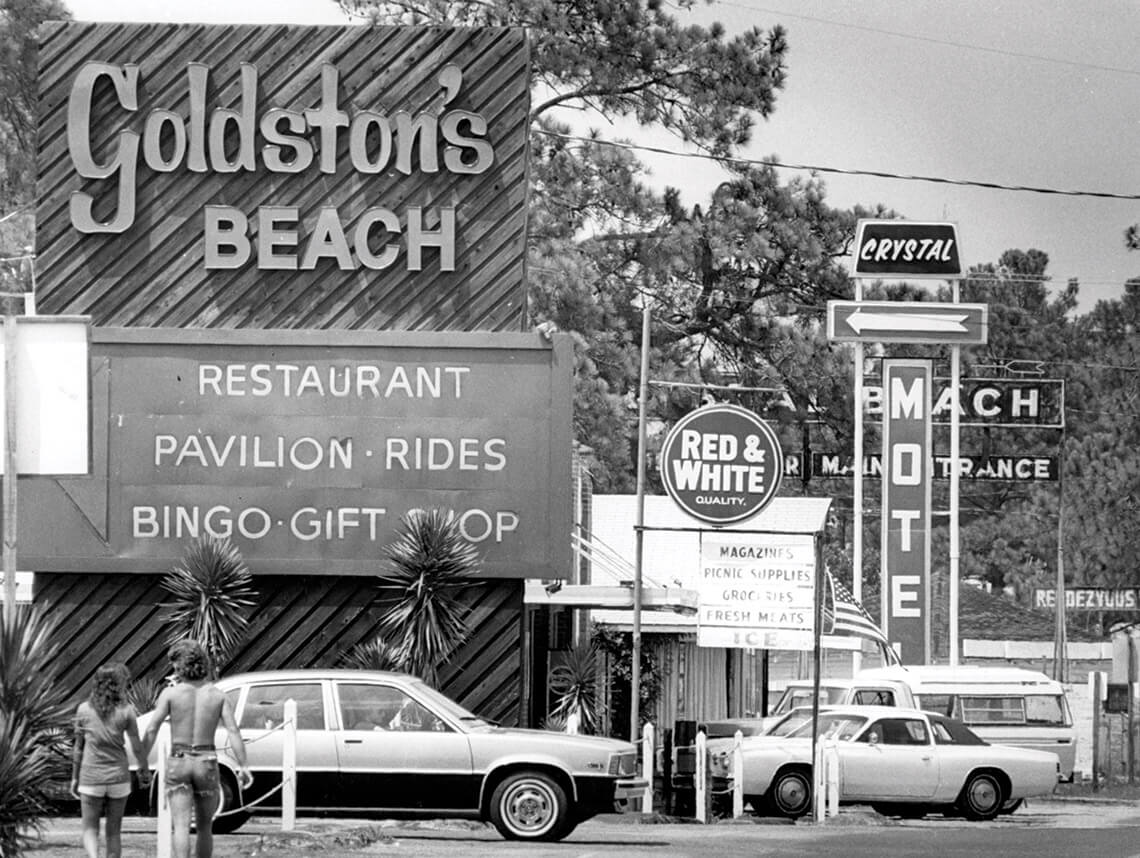
After a day on the lake, families found fun at Goldston’s Beach (pictured in 1981), with attractions like the pier, arcade, and shops. Now called The Grand Regal Resort, its amenities remain a draw. Photography courtesy of © The Fayetteville Observer-USA TODAY Network via Imagn Images
I arrived at my accommodations for the weekend to find the most obvious change: The Grand Regal Resort, built around Goldston’s Beach. Though there was something a little too fancy about the word “resort” in a place I remembered as a laid-back, no-frills destination, the Regal had incorporated many of the original buildings, and the additions — among them a row of waterfront tiny houses, one of which was mine for the weekend — blended well with the atmosphere.
One thing that had not changed was the water. I was in it 15 minutes after I unpacked the car. A few cold nights had lowered the temperature, but it was only a slightly bracing low-70s. The lake was mine — no boats, no other swimmers. There was a bit of chop from a late afternoon breeze, but I put in a pleasant 20-minute swim. What took me back in time was the taste of the water — rust and copper. It acted upon me like long-dormant sensory details do: It activated the past in a way memory could never do.
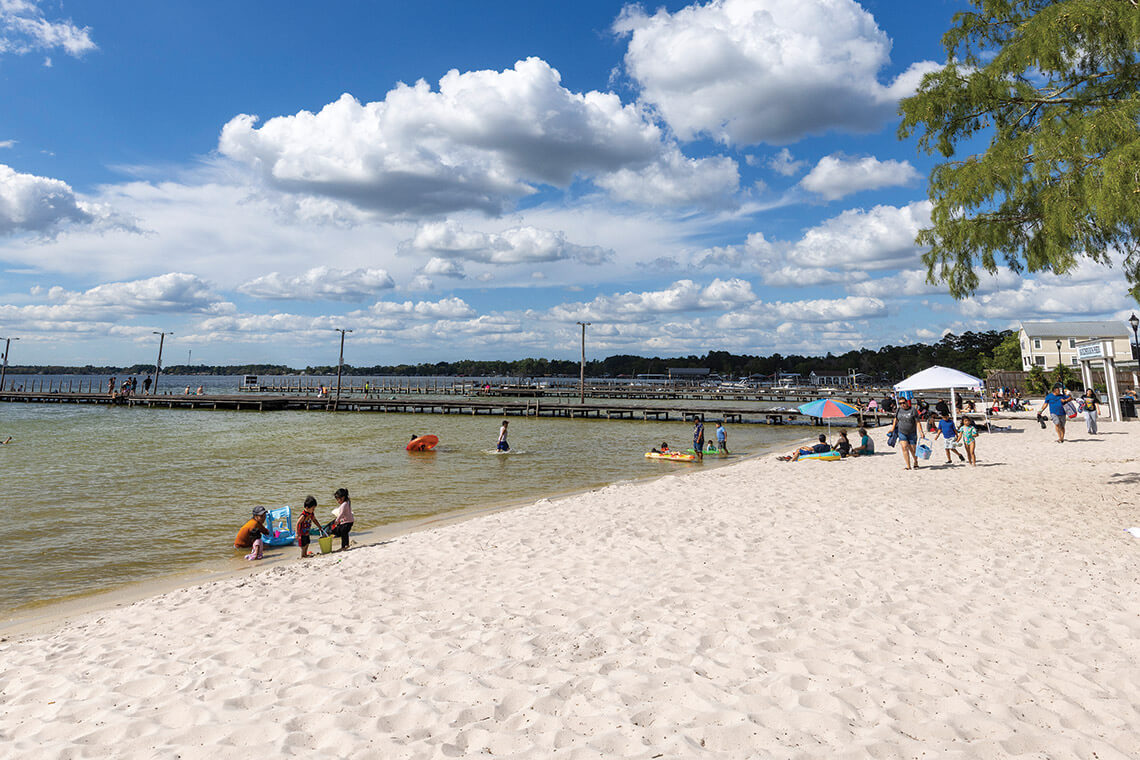
Today, White Lake continues to draw day swimmers and beach goers for a day of sunshine and splashing. photograph by Todd Pusser
Later that evening, my daughter Emma — a passionate swimmer and willing recipient of a handed-down love of eastern North Carolina — arrived. We woke on Saturday to a flat, glassy lake and preternatural quiet. So eager was I to get in that I skipped my ritual cup of coffee. The water was as peaceful as any I’ve swum in. The only sound, other than my breathing, was an overhead “V” of geese.
Soon we encountered the only other people on the water that morning: two teenage boys who were lying on their stomachs at the end of a pier, studying the ridged sand of the bottom.
“Don’t stop, the fish is going to get you,” one boy called out to us.
“Y’all getting in?” Emma asked.
“Ah, hell nawww,” said the other boy, which is exactly what I would have said 50-some-odd years earlier, had I come to the lake not for by-god exercise, but for fun.
• • •
Fifty-some-odd years ago, 1973 or ’74: A Sunday afternoon at the lake. A day off from the tobacco or produce fields many of us worked in. The bathing suit of choice back then: a pair of Wranglers hacked off just above the knee. Boys wore them and only them. Girls wore them with their bikini tops. Strings left by crude scissor cuts clinging like white manes to knees and calves and shins.
In the Goldston’s Beach arcade, which was the place to be on a summer afternoon, I watched a girl I knew from Harrell’s Store maneuver a pinball machine with devilish English, shooting straight from the hip. Gangs of sideburned and faintly mustachioed boys in sleeveless blue corduroy FFA jackets and requisite cutoffs clogged the ring-toss and target-practice booths, where prizes were peace-symbol-adorned beer mugs, puka-shell necklaces, and those heat-stretched, elongated Coke bottles that seem slightly hallucinatory, like Salvador Dalí’s melting clocks.
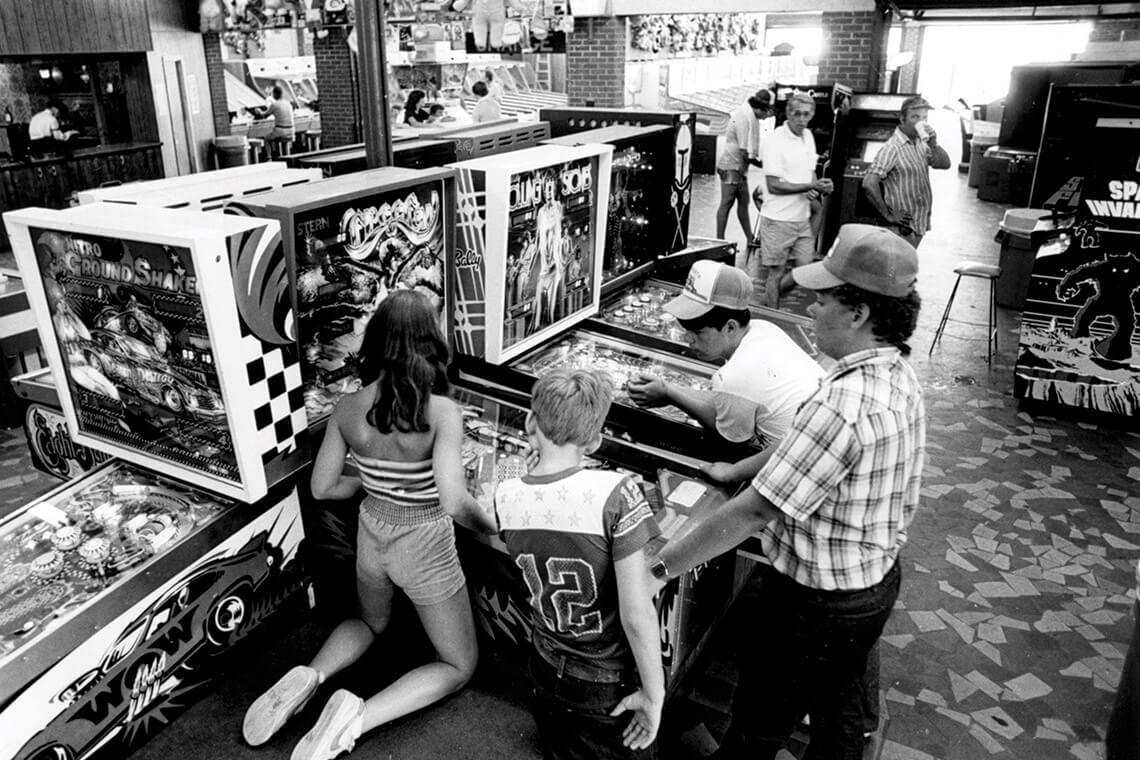
A handful of friends and a pocketful of coins is all a kid needed to pass an evening at the Goldston’s Beach arcade (pictured in 1981). Photography courtesy of © The Fayetteville Observer-USA TODAY Network via Imagn Images
After we spent our last quarter in the arcade, we’d hit the pier. Slat to slat with sweaty bodies, seared by the brutal afternoon sun to Budweiser and Ace of Spades beach towels. The smell of sweat beneath the cloying odors of Coppertone and Hawaiian Tropic tanning lotion. Someone’s tinny transistor, tuned to a Myrtle Beach station, blared “Troglodyte” by The Jimmy Castor Bunch.
We came from Sampson, Duplin, Bladen, Robeson, in search of, well, each other. The lake was the backdrop until heat drove us into the water. We watched the water-skiers, who were many and talented. We swam around scanning the bottom, as we had when we were younger, and boarded the famous Glass Bottom Boat at Crystal Beach pier to take a half-hour spin around the lake. I confess I never saw much but aluminum cans, half-filled with sand, and sometimes a shard of glass bottle, glinting when sunstruck like treasure. That boat has long been retired, but keeping the memory alive on shore is The Glass Bottom bar, which was sadly closed on our visit.
• • •
That evening, Emma and I strolled across the parking lot to the old arcade. We had the place to ourselves. To my pleasure, there were still pinball machines and a shooting gallery, but most of the attractions were more current: The Fast and the Furious race car game, a computer-simulated deep-sea fishing trip. I cheered Emma on as she reeled in a giant tuna. I stuck, feebly, to pinball, as much out of nostalgia as skill.
Sunday morning, I packed up and went for one last swim. The water was pure glass again, pure bliss as I swam out to the buoys signaling boats to slow their wake. Five minutes in, the silence was interrupted by an amplified voice, which I tracked to a lakeside church by Camp Clearwater. And then, gloriously, a hymn. Voices rising in unison, bouncing lightly off the lake. I swam toward it, through holy water.