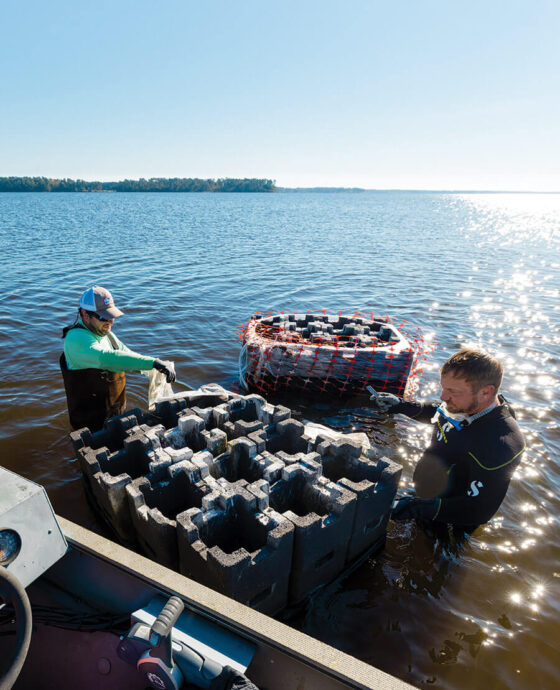
Pat Donovan-Brandenburg and her crew are waist-deep in the New River, building oyster reefs — just as they have been twice a week for the past several months. While they work, mullet jump out of the water. An osprey circles overhead, then swoops to the surface to snatch a large fish in its talons. Schools of smaller fish swim past. Some days, dolphins frolic nearby. Once, they saw a shark feeding.
This New River — not to be confused with a waterway of the same name in the western part of the state — is entirely contained in Onslow County, flowing languidly through southeastern North Carolina swamps, hardwood forests, and salt marshes on its way to the Atlantic.
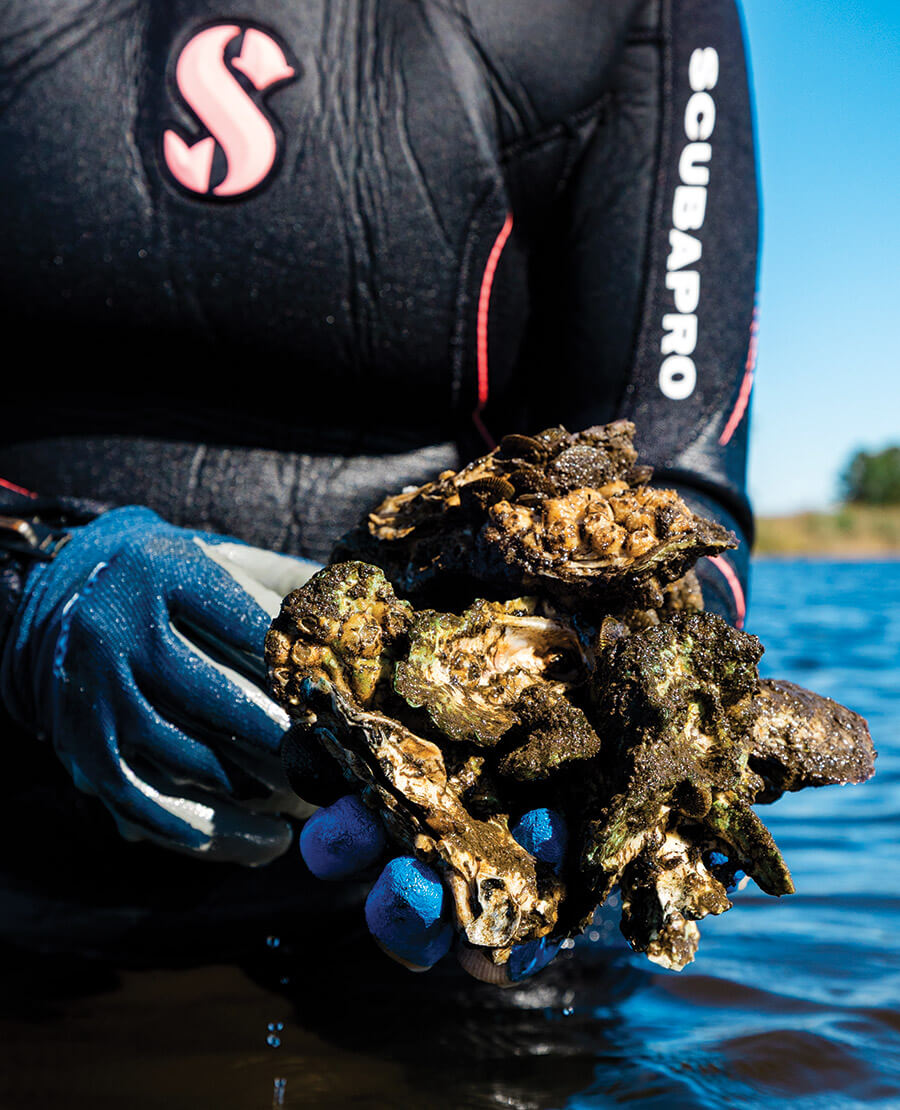
Oysters help filter waterways, like the New River, improving the water quality and supporting healthy habitats for native species. photograph by Matt Ray Photography
On a section of the river in Jacksonville, city employees load concrete building blocks onto a skiff and hand them off to Pat and Lisa Miller, who stack them on mats in the slow-moving water. After these “oyster castles” are placed, the team will “plant” the mollusks in them, creating artificial reefs that, in time, will filter millions of gallons of water per day.
Twenty-five years ago, the numbers and diversity of animals that the team sees today would not have been here. The waterway was so polluted that most discernible life had disappeared. And due to dangerously high bacteria levels, parts of the river had closed to the public in the 1980s. Pat, now stormwater manager for the City of Jacksonville, and her team have been working to clean it up since 1999.
Today, the river has new life.
• • •
Before construction began on Marine Corps Base Camp Lejeune in 1941, Jacksonville was a “sleepy little town,” says Lisa, the city’s communications manager. “I think the population was around 800.”
The area along the 50-mile-long New River was settled in the early 1700s. Later that century, James Wantland operated a ferry across the water. The town of Jacksonville, initially known as Wantland’s Ferry, sprang up here. During the mid-19th century, agricultural products and goods were shipped along the river. There was a profitable fishing industry. Then the Marine Corps built its new amphibious base on the banks of the New.
With the arrival of Camp Lejeune, the town’s population soared. The municipal wastewater treatment plant began dumping more and more water into Wilson Bay, in the upper third of the river. Farther downstream, Camp Lejeune and Marine Corps Air Station New River dumped their own wastewater into the New.
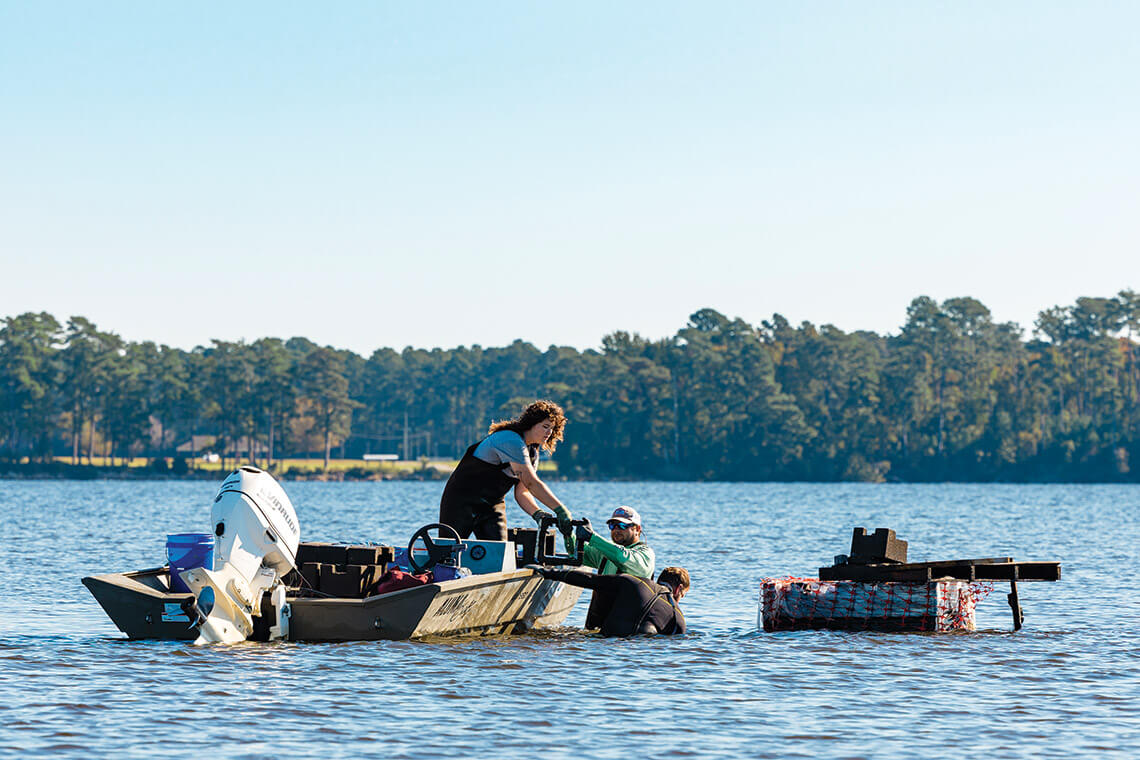
In addition to building the Oyster Highway, volunteers also focus on five streams that feed the New River. By restoring wetlands and removing debris and dilapidated boardwalks from these creeks, they continue to improve the health of the New. photograph by Matt Ray Photography
All of the treatment plants only cleaned the water to a secondary level, meaning organic matter was removed, but nutrients like nitrogen and phosphorus remained. The excess nutrients caused algal blooms, which led to low oxygen levels and fish kills. From above, the water looked like “muddy coffee with lots of cream in it,” Pat says, and it smelled like a sewage plant. Below the surface, the river was dying. The city needed a wake-up call.
That call came in 1995, when a hog waste spill dumped approximately 25 million gallons of effluent into the river — the worst spill from a livestock operation in state history. Typically, such an event causes massive fish kills. But that didn’t happen: There were few fish left in the river to be killed. “And that was our real turning point, when we realized, ‘Oh my gosh, something really horrible has happened to our river, and we need to take steps to turn that around,’” Lisa says.
The city, the base, and the air station worked together to devise a solution. The city ceased discharging wastewater into the river in 1998 and, with a new treatment plant, began applying its processed wastewater to a sustainably managed forest. The same nutrients that led to the demise of the New River now fertilize trees, which are cut and used for timber or paper.
Camp Lejeune and Air Station New River updated and consolidated their wastewater treatment facilities and, like the city, use their wastewater for land application. Camp Lejeune also began treating its wastewater to a tertiary level, meaning it removes the nutrients that cause algal blooms. Once the water was no longer being polluted with bacteria, excess nutrients needed to be removed.
• • •
Oysters are filter feeders. They take on water through their gills, which filter out solids and semi-solids to be digested. Materials that can’t be digested or incorporated into shells or tissue are expelled as waste or unwanted food and deposited on the river floor. Microorganisms then transform the pollutants into nitrogen gas, a natural component of the atmosphere. It was Pat’s former boss, Dr. Jay Levine, who first had the idea to clean up Wilson Bay using the bivalves.
While growing up in Dunn in the ’70s and ’80s, Pat often visited her parents’ second home in Sneads Ferry. There, near the mouth of the New, tidal water flushed the river more often and kept it cleaner than the waters farther upstream. Pat’s family often fished, swam, and boated on the New.
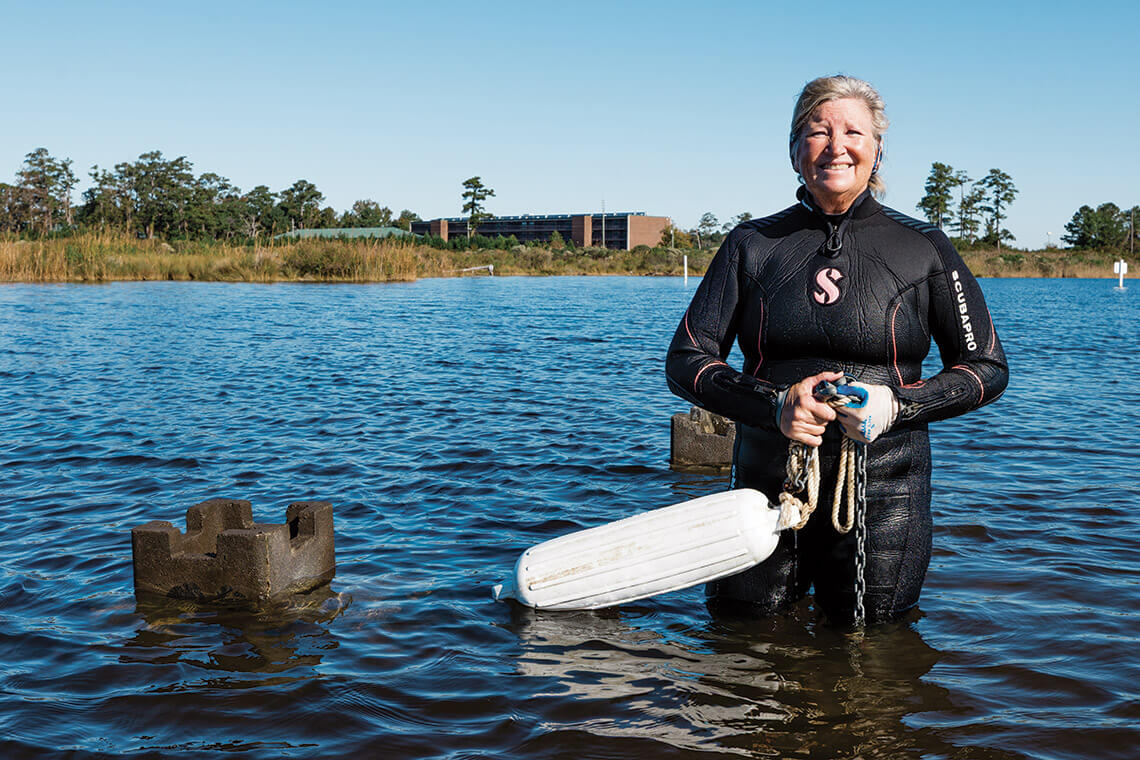
For Pat Donovan-Brandenburg, restoring the New has been deeply meaningful. “To have a healthy watershed that people can live and eat and play on lets them unplug and see what’s really beautiful around them,” she says. “It’s important to your soul.” photograph by Matt Ray Photography
Pat received her bachelor’s degree in marine biology from UNC Wilmington and moved onto a ship near Bermuda to work in deep-sea biology. After that six-month stint, she worked for NC Aquarium for several years, then moved to the Florida Keys and took a job with The Nature Conservancy. When she became pregnant with her first son, she decided that spending her days in a submersible was too dangerous, so she moved back to her home state and began teaching at Coastal Carolina Community College.
By the time the Wilson Bay Initiative began in 1999, Pat had been working on the project with Levine for two years. Over the next 20, she and her team planted more than 10 million oysters in the bay. In a field setting, one oyster might filter up to 25 gallons of water in 24 hours — that’s a possible 250 million gallons of filtration per day.
“This river starts and ends in one county: our county. That means it is our responsibility.”
The plan was a success. The river reopened to the public in 2001, just two years after the project began. But the work never stops. “With any restoration project, the key is not ‘one and done,’” Pat says. “You can’t restore something that was depleted or destroyed for 50-plus years and think one Band-Aid is going to fix it. You’re going to have to constantly maintain that restoration effort.”
Now, the team is planting oysters along what they call the “Oyster Highway” — the stretch of river downstream from Wilson Bay.
All along, the city has been supportive, through multiple mayors, city managers, and city council members. “This river starts and ends in one county: our county,” Pat says. “That means it is our responsibility, and everyone here took that responsibility very seriously and cleaned it up. That’s a beautiful thing. It’s a historic thing. Not all watersheds have been successful like this.”
• • •
For Pat and her team, success is measured in parameters like bacteria count, dissolved oxygen, and species present.
When the Wilson Bay Initiative began, there were 35 to 70 thousand fecal coliform bacteria per 100 milliliters of water. For a waterway to be safe for recreation, that number must be less than 200 per 100 milliliters of water. “When I first started working on the river, I was in a hazmat suit,” Pat says. Today, the river’s bacteria counts are usually between 20 and 120, and she and her team jump in the water in shorts and T-shirts.
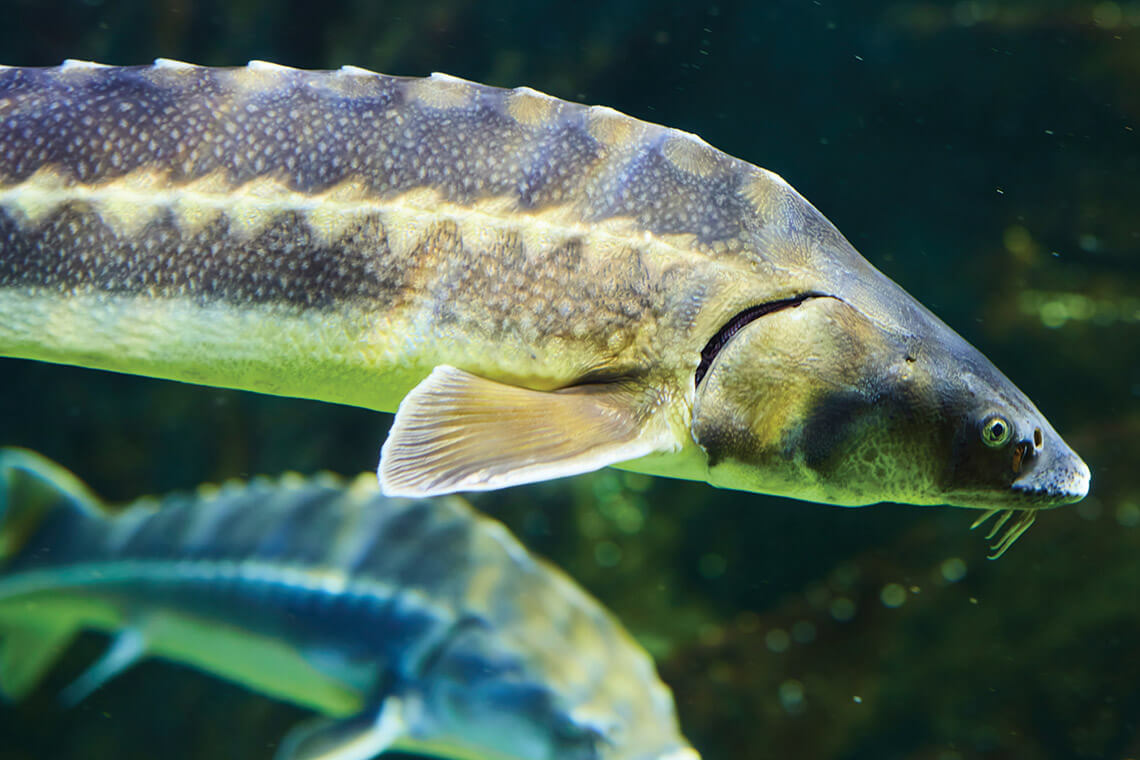
Once plentiful in the New, native sturgeon disappeared from the river for decades. Their return was a sign that restoration efforts are working. photograph by Natalia Kirsanova/iStock/Getty Images Plus
And there are plenty of visible signs of the river’s rebirth, too. Before Camp Lejeune was built, sturgeon were a common sight in the New. But by the time the Wilson Bay Initiative started, there was no dissolved oxygen near the bottom of the river during critical summer months. Without dissolved oxygen, the benthic community — the organisms that live in, on, or near the sediment at the bottom of the river — could not survive. Benthic organisms are food for sturgeon.
“So when sturgeon returned, we knew we had cleaned up that portion of the river from top to bottom, because the bottom, which is the most critical part, is where they survive,” Pat says.
The community holds fishing tournaments and a triathlon, in which competitors swim from the docks at River Walk to a buoy and back. From those same docks, recreational boaters set sail. Folks kayak and ride Jet Skis. The city holds festivals at the waterfront. “[The river has] very much brought us together as a community,” Pat says.
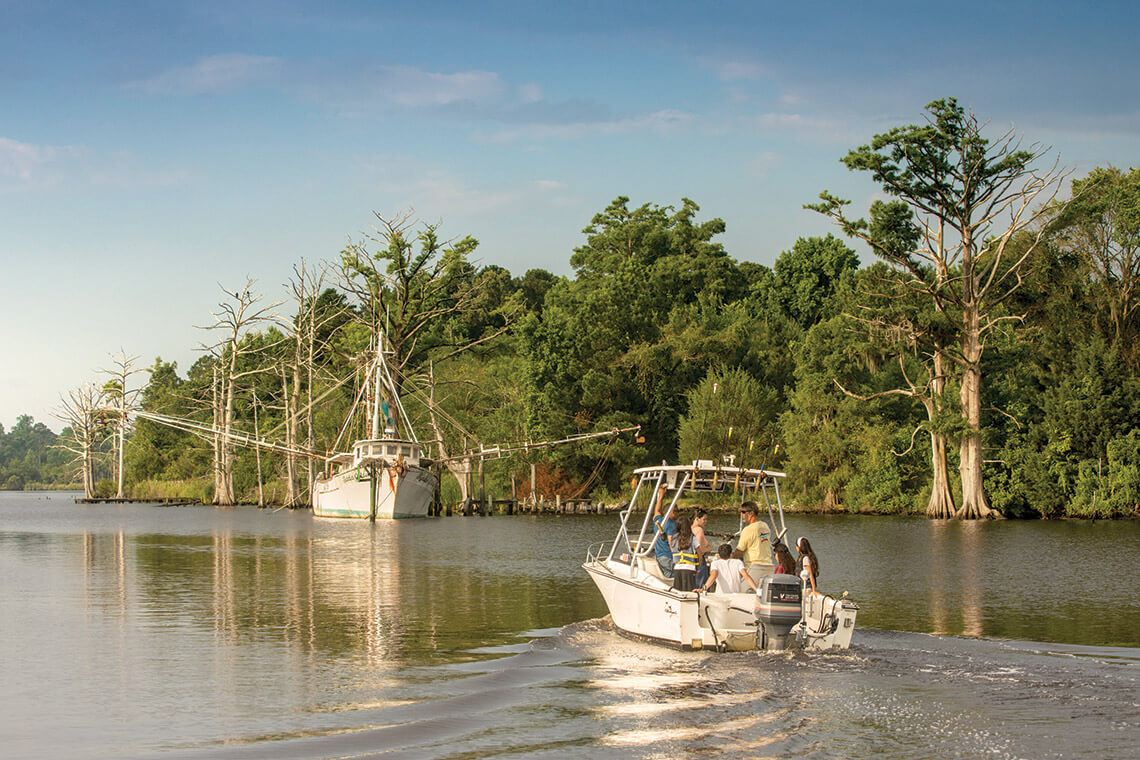
Fish from the New are safe to eat once again, making angling a popular local pastime. Photography courtesy of VisitNC.com
Wilhelmina Bradway was born here in 1999, the year the Wilson Bay Initiative began. Today, she’s a stormwater and water quality technician for the city, and she helps build reefs along the Oyster Highway. When she was a child, and the river became safe again, her family bought kayaks and began paddling and fishing here.
“The older I’ve gotten, to watch the river come back to life — it’s really beautiful,” she says. “It is very special to me to live where the local government is willing to take some responsibility for the mistakes of the past and go out of their way so much to try and fix it.”
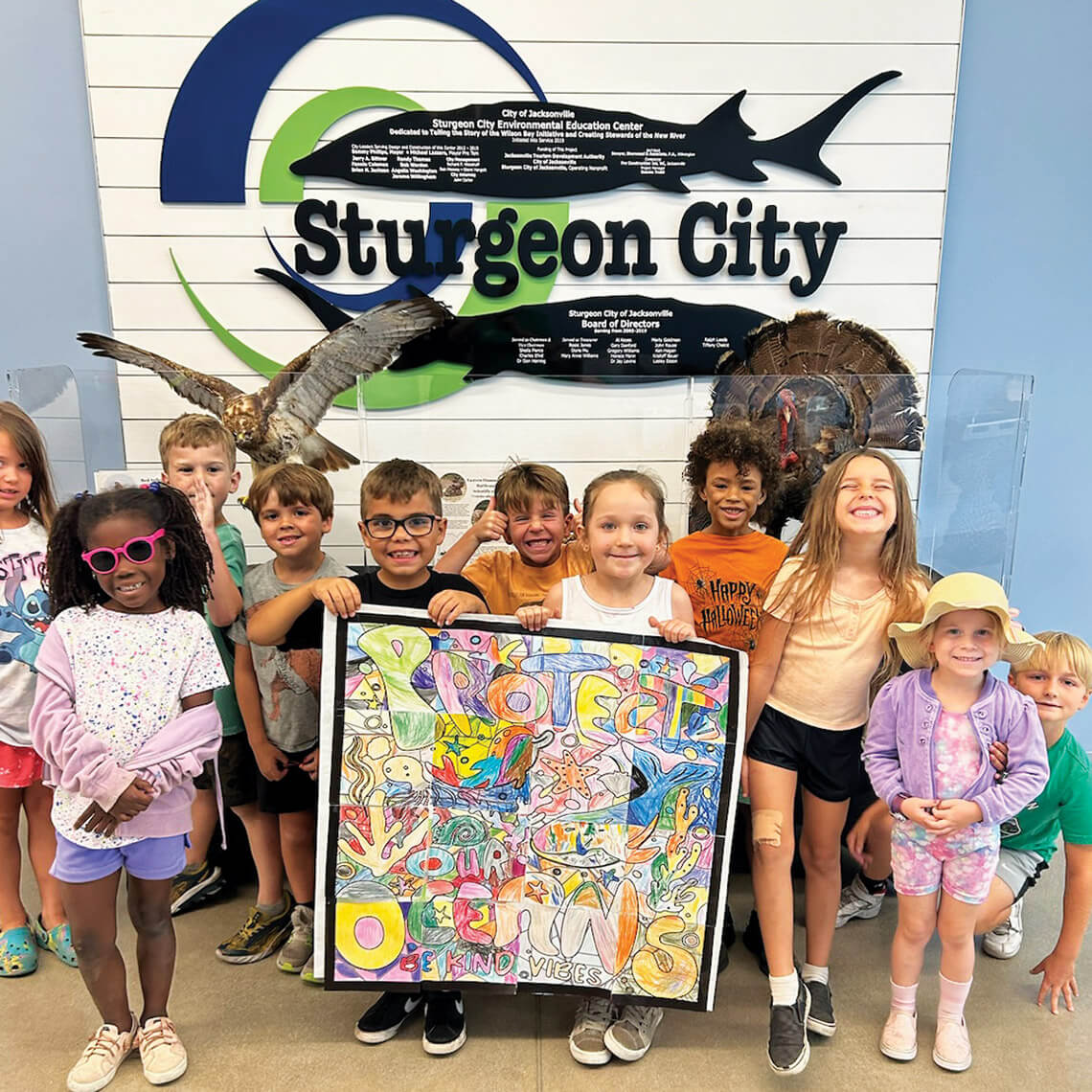
Sturgeon City Environmental Education Center ensures that the community will care for the river for generations to come. Photography courtesy of Sturgeon City Environmental Education Center
The community’s commitment to the health of the river goes beyond the here and now. Sturgeon City Environmental Education Center was built on the site of the city’s former wastewater treatment plant. The nonprofit aims to educate visitors of all ages and foster in them the spirit of environmental stewardship. It hosts events like an Earth Day celebration, programs like Eco-STEM Leaders for high school students, science-focused field trips, and walking tours.
As part of the Wilson Bay Initiative, nine acres of wetlands were restored along Sturgeon City’s shoreline in 2002. As usual, it was a joint effort among volunteers, Marines, and community members, Lisa says. “They just walked in the muck and started planting things.”
• • •
On the water, Pat and her team wrap up a morning of building oyster castles. Pat pulls up their pontoon boat at the dock alongside the wetlands at Sturgeon City. She spots a treasure on the boat deck: a polychaete worm. It’s one of the important benthic organisms that live in the river’s floor.
Pat shows off the invertebrate, then carefully drops it over the side of the boat. It swims down to the bottom and burrows in the sediment, a building block for the ecosystem above — one that’s teeming with life.
print it