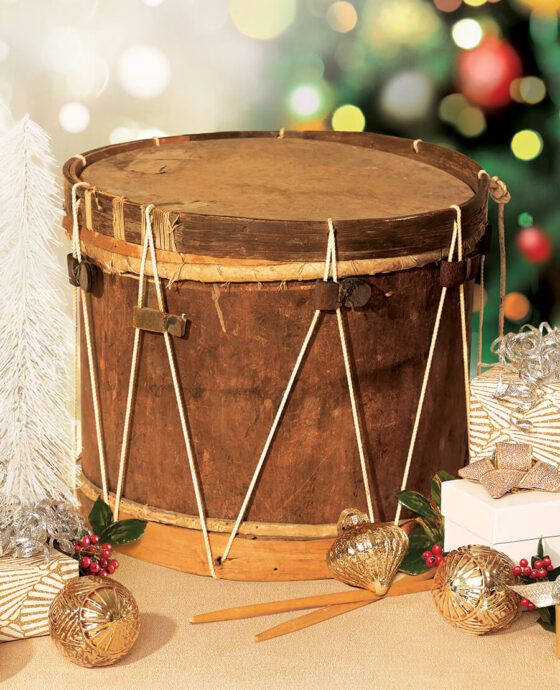
On the corner of the stage in the old Rodanthe schoolhouse sits a drum propped on a metal folding chair. The rope tensions stand in contrast to its cracked and peeling hoops and brittle leather ears. The patinated shell scarred by time and its taut head — worn, torn, patched, and repaired — is a lasting artifact of a steadfast Hatteras Island tradition, unique to its northernmost village wedged between the Atlantic Ocean and Pamlico Sound.
Believed to be the same one used 200 years ago to kick off Old Christmas, the drum is still here to bear witness, with a winding origin story that some say begins in 1746 with the right to the British throne.
“Rodanthe’s Drum of Old Christmas, also known as the Drum of Bonnie Prince Charlie, was used by the Jacobite army during the Battle of Culloden,” explains Ryan Gentry, one of the Midgett family historians.
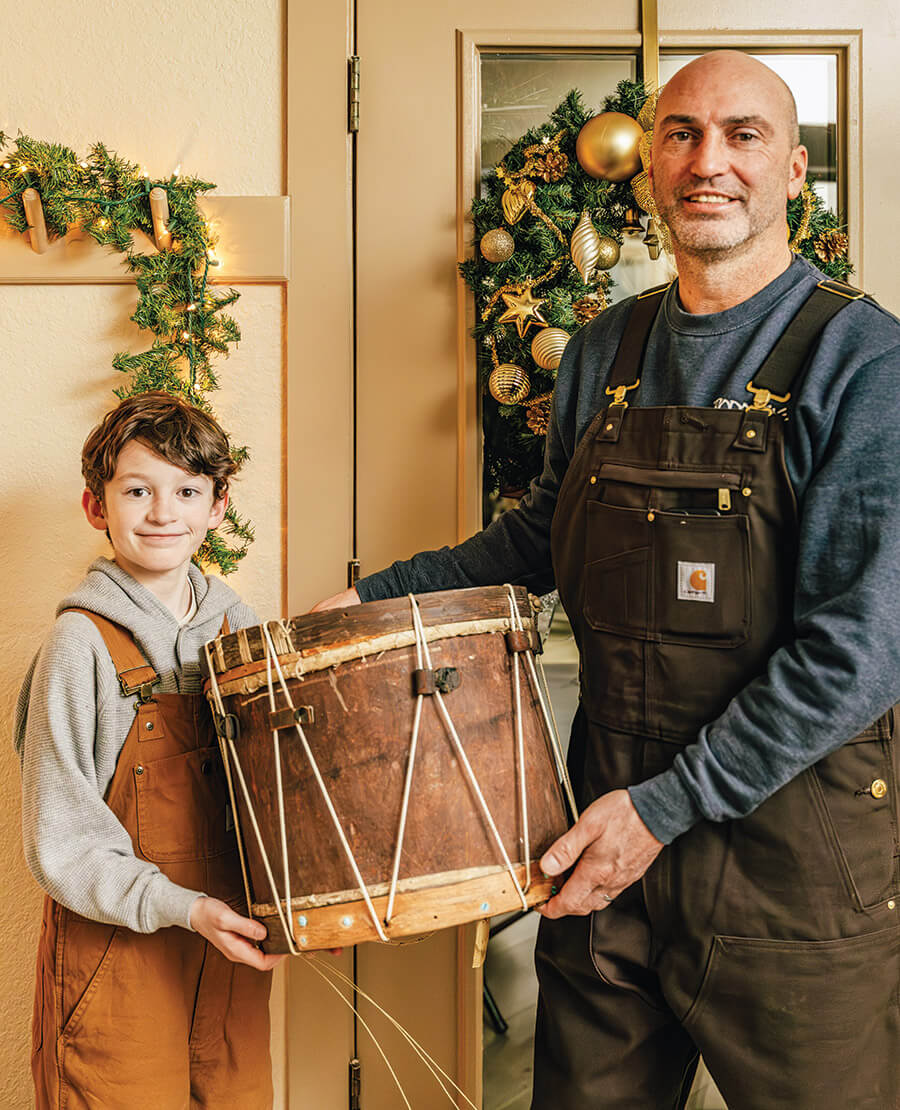
Although the Drum of Old Christmas can no longer be played, it remains the centerpiece of the holiday for Ryan Gentry and his son Mason. photograph by Baxter Miller
As the story goes, during the battle, a nonfatal arrow struck the 12-year-old Scottish drummer, Donald McDonald, in the left shoulder. After his recovery, he set sail to the New World, drum in tow. During the voyage, McDonald fell overboard during a storm and swam to shore using the drum as a life preserver. He arrived at the place where he’d spend the rest of his life: Rodanthe.
The drum is folklore made material. A symbol of persistence and resistance, it bridges past and present. According to legend, decades had passed when news reached Hatteras Island that England had, in 1752, adopted the Gregorian calendar that changed Christmas from January 6 or 7 to December 25. Committed to their ways, the village of Rodanthe refused to go along with the change and continued celebrating Jesus’s birth when and how they always had.
That celebration began with a procession of revelrous villagers, led by the beloved drum and a crew of musicians, to a community gathering. Though the drum is now too old to be played, its spirit carries forward a tradition older than the village itself. Old Christmas in Rodanthe, a ritual of culture specific to place and distinctive in its curious customs, remains a wild, wonderful, and utterly unique event that marches to its own beat.
• • •
The man in red velvet squares his shoulder, placing one black boot before the other, and raises the muzzle skyward. He swings the butt of the gun to his shoulder, the stock landing under his snow-white beard, and shifts it until the gun finds the soft groove below his collarbone. Flipping off the safety, he squints one eye to peer through his wire-rimmed spectacles down the barrel. As his finger grazes the trigger, the bullet races one way and his shoulder the other, the gold trim of his jacket gleaming in the afternoon light. The crack of the gunshot ricochets off the wall of paper targets, and a cloud of gunpowder, white as his beard, drifts from the barrel.
Santa examines the target and confirms what he already knows: He hit the bullseye.
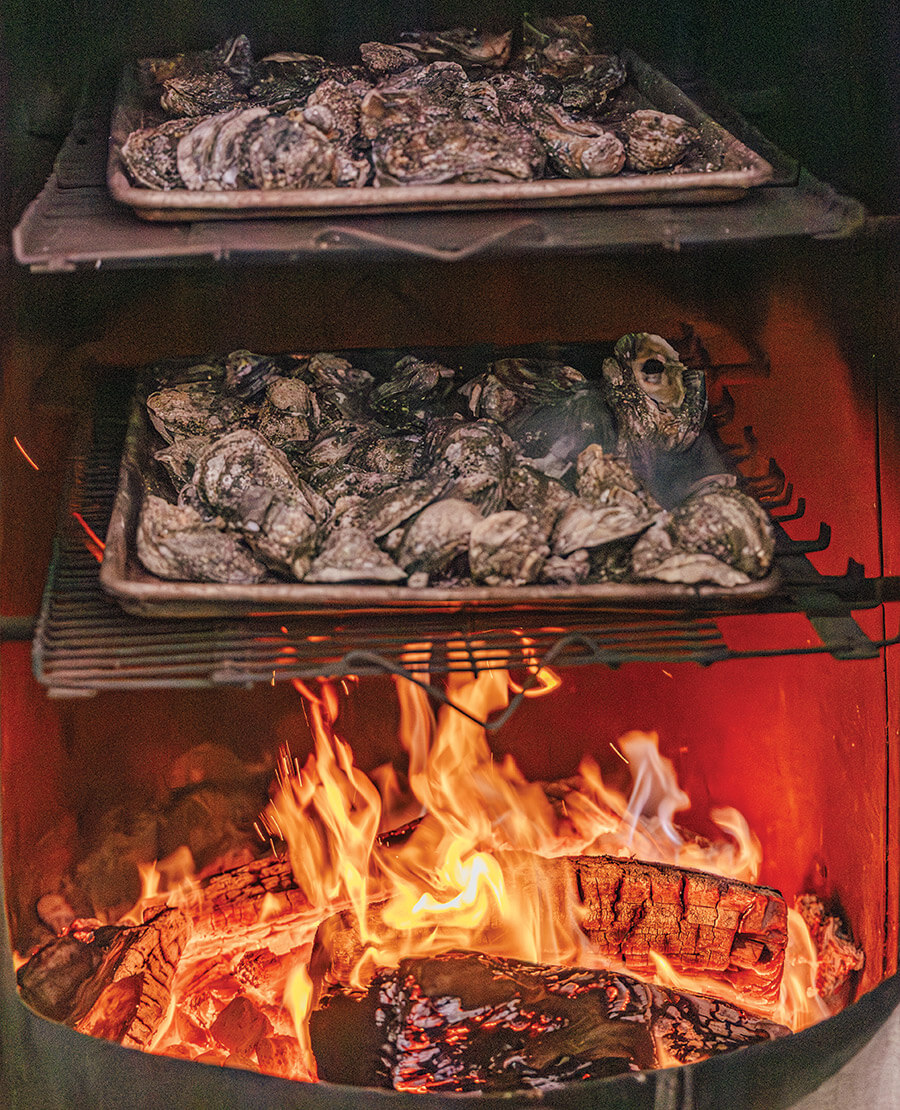
Oysters roasting on an open fire: Local Pamlico Sound mollusks have long been a part of the Old Christmas celebration. photograph by Baxter Miller
These days, 300 rounds of discharged ammunition at the annual Oyster Shoot have replaced the processional drumbeats that once declared the start of Old Christmas.
Connie Midgett Page, Ryan’s mother, peeks out the back door of the old schoolhouse that now serves as the community building for the island’s Tri-Villages: Rodanthe, Waves, and Salvo. The smell of stewed chicken wafts into the yard from the open door, mingling with the scent of gunpowder. The oyster shoot’s next round of contestants, a mirage of marsh grass camouflage, approaches the firing line, aiming to win a half-bushel of oysters.
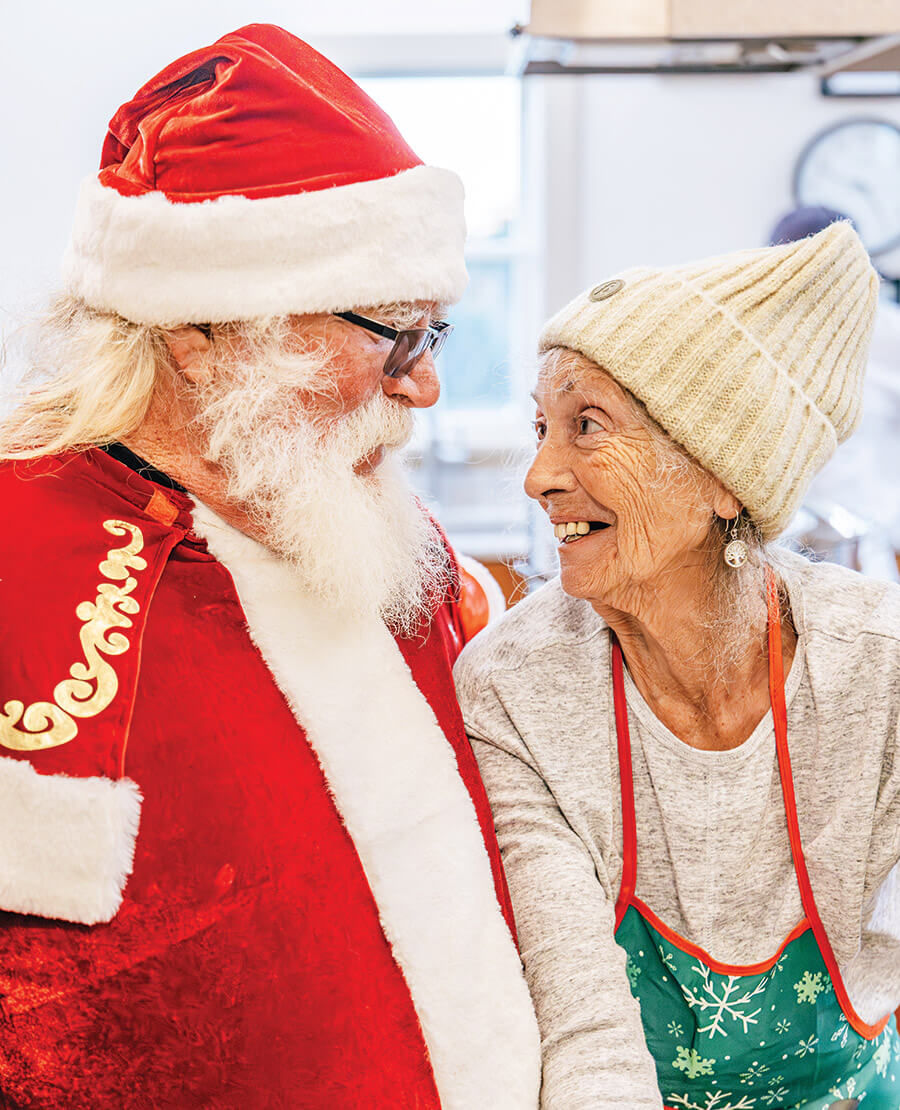
Brent Midgett and Connie Midgett Page share fond memories of holidays past. photograph by Baxter Miller
Connie spots Brent Midgett — today, Santa — and the two embrace. “Happy Old Christmas!” she exclaims warmly. The two reminisce about Old Christmases past, both swelling with pride to have roots in a place for as long as anyone can remember.
“Everybody was kin to everybody. There were no tourists, and there was no bridge. This was our event, for our community,” Connie says. She gives Santa another hug and hurries back to the kitchen, where steam pours out of four 20-quart pots holding 80 pounds of stewing chicken.
“I took over cooking the chicken and pastry when my mother stopped, who took over when her mother stopped. I’ll be three-fourths a century old this year, so it’s about time for me to start thinking about when I’m going to stop,” Connie says, winking at her daughter Lovie Heilig and grandson Noah Gentry across the counter.
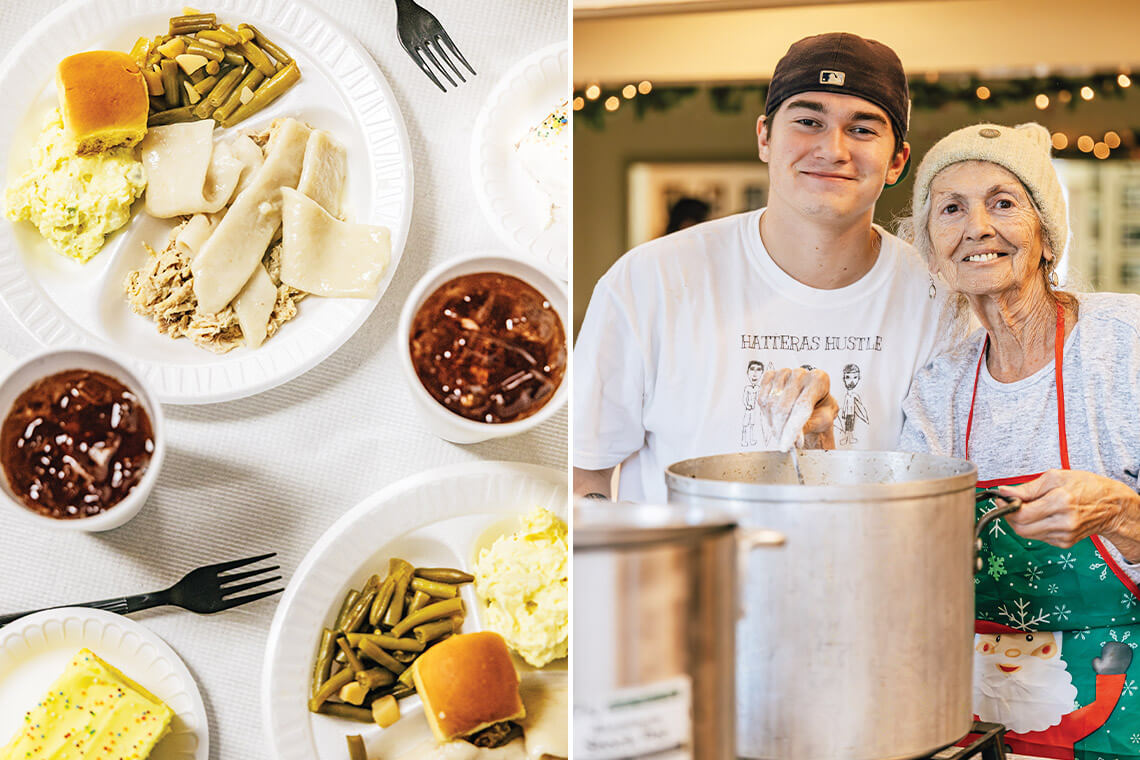
Connie’s grandson Noah Gentry helps her prepare the traditional Old Christmas meal: chicken and pastry, plus green beans, potato salad, and rolls. photograph by Baxter Miller
Chicken and pastry might seem odd for a village whose foodways are rooted in the sea, but it’s a tradition passed down through generations. “Back then, everyone had chickens,” Connie explains. “The young men would go ‘raid’ everyone’s chicken coops for the chicken and pastry, but everyone knew they were coming.”
With the chicken stewed, Connie joins Noah in rolling out 25 pounds of dough for the pastry, just as her mother and grandmother did decades before. One day, he may bear the family torch, but for now, they work as a team. Soon, an orderly line of Tri-Villagers and visitors will wind around the kitchen, waiting for a helping.
• • •
Through time, the merriment around Rodanthe’s Old Christmas grew, and the celebration earned a rowdy reputation. Brawls were commonplace, and the evening became the village’s customary time to settle old scores. Busted lips and black eyes were the means by which grudges were ironed out and slates were cleaned for the new year.
“It was a dry island back then, so the men would keep the liquor in their cars. There’d always be a fight between cousins or brothers, but they’d get up and laugh it off,” Connie says, grinning. While today’s celebration clings to many traditions, civility has prevailed, and there have been no fights in recent years. At least not in public.
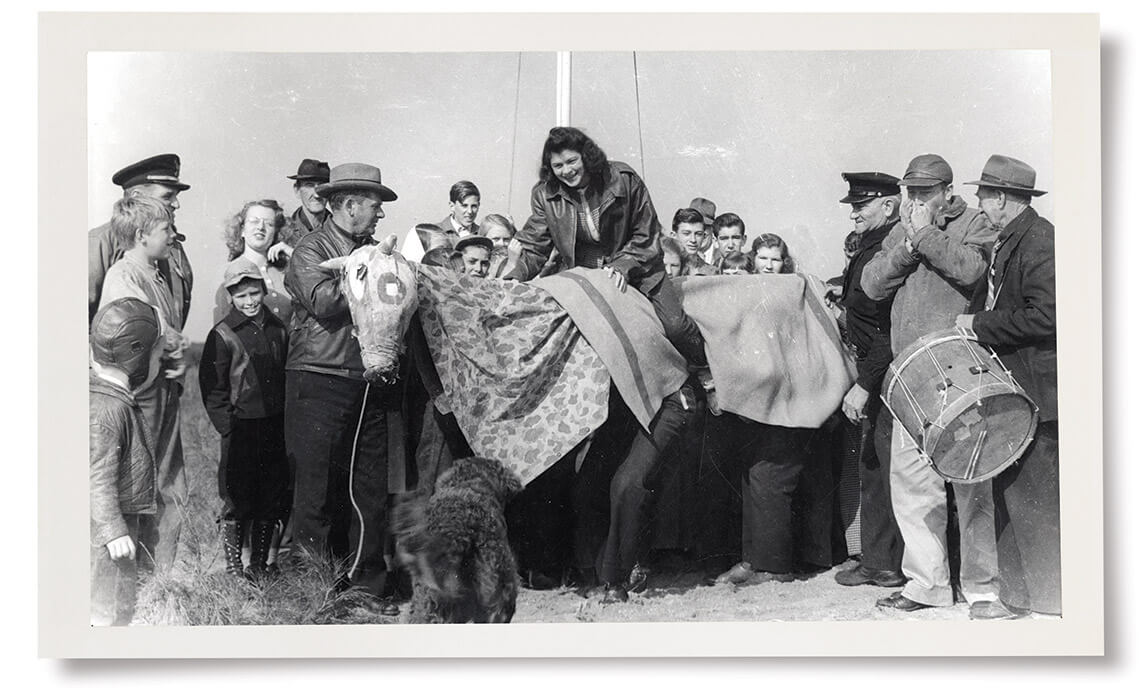
Old Christmas traditions include Old Buck greeting holiday revelers. Photography courtesy of THE OUTER BANKS HISTORY CENTER, STATE ARCHIVES OF NORTH CAROLINA
Among the traditions that survived this rowdy era is one of the more eccentric fixtures — the mythical wild bull whose spirit roams the yaupon and wax myrtle of the island’s maritime forest. According to widely varying folklore, a bull named Old Buck swam to shore on Hatteras Island in the 1700s or 1800s as a shipwreck’s sole survivor. The cantankerous rabble-rouser made himself at home among the island’s many free-ranging cattle, becoming a menace to farmers and fathering a calf with every cow from Oregon Inlet to Hatteras Inlet.
But once a year, on the night of Old Christmas, Old Buck would take leave of his antagonism and join in the holiday merriment, socializing with all villagers, allowing good children to ride on his back, and bucking off those who had been naughty. A hunter’s bullet would fate Old Buck, but his spirit lived on.
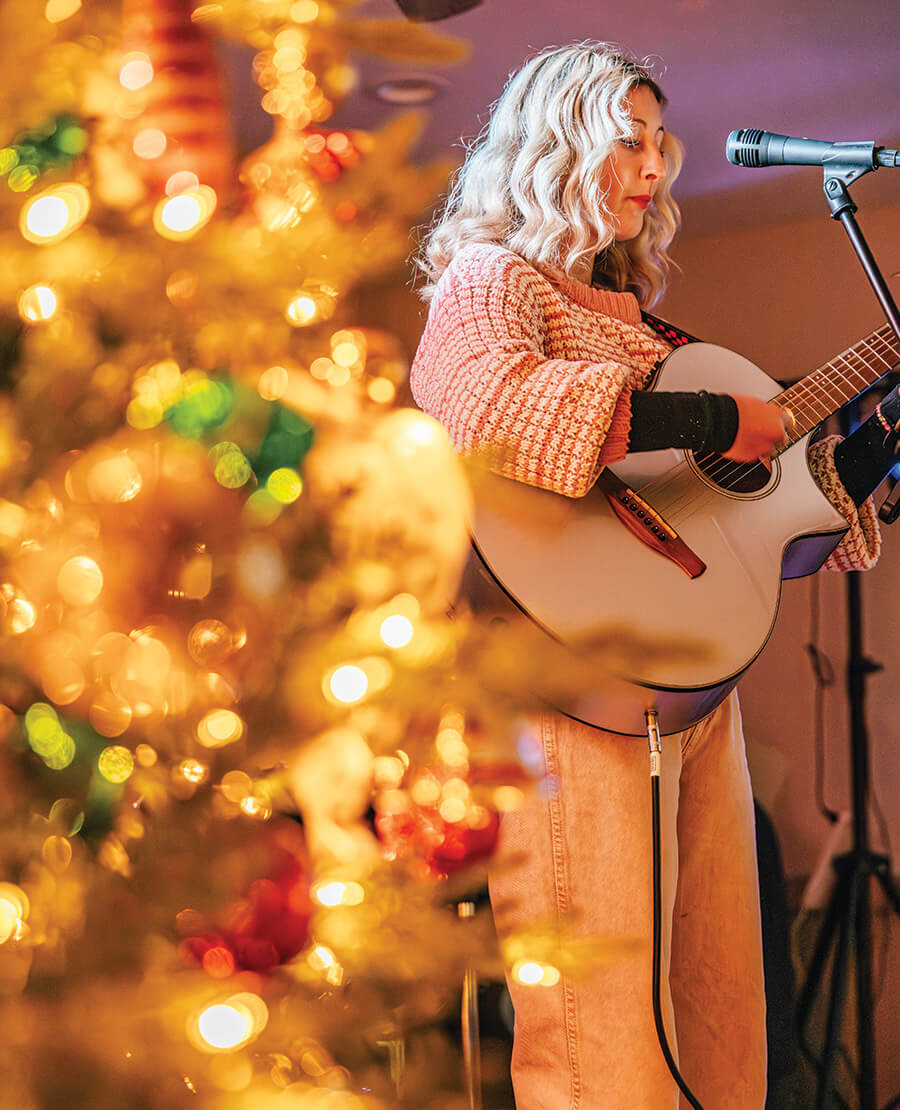
Musicians like Isabella Heilig help make spirits bright. photograph by Baxter Miller
To this day, he still appears every Old Christmas. In years past, summoned as the night’s music was about to begin, a primitive incarnation emerged: two young men beneath a blanket, four legs showing underneath, horns marking where the head should be.
“All of a sudden, Old Buck would come in through the front doors and start knocking down the chairs. Everyone would try to get a pat for good luck,” Connie remembers. “Old Buck’s arrival was the sign to move the chairs out of the way because it was time for music and dancing.”
• • •
Old Buck is welcomed inside by jolly applause, and, after having his rump patted dozens of times, the blanketed creature chaotically exits as quickly as he appeared. With the dance floor now cleared, the night’s band makes its way to the front, where the old drum sits.
Born out of defiance of the Gregorian calendar, today’s Old Christmas celebration, in a way, remains an act of resistance to the changes still occurring all around Rodanthe. Many people here can trace their families back to the 10 households in the Tri-Villages area in the 1880s. Today, that handful of homes has ballooned to more than 500 households, many of which are the second or third homes of folks from inland or out of state.
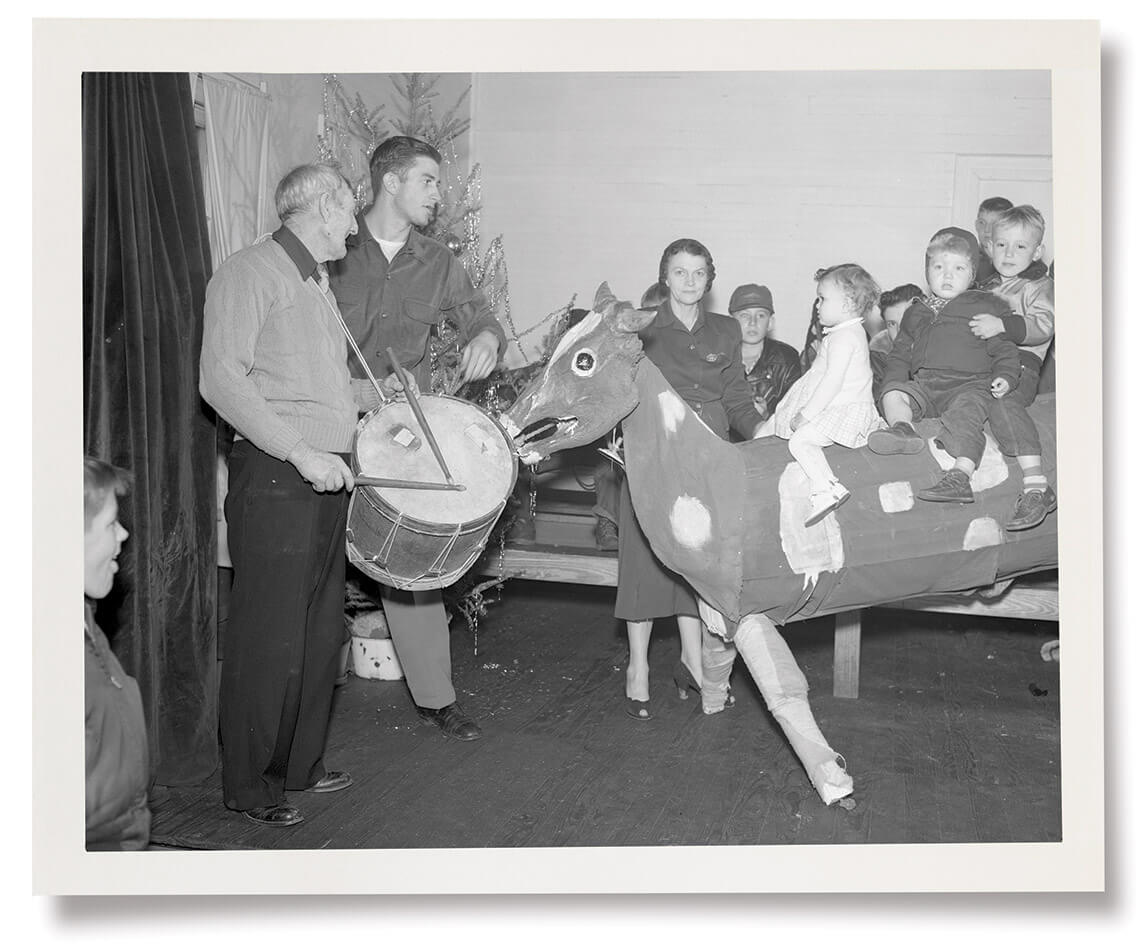
In years past — as in 1953 — Old Buck appeared like clockwork to clear the dance floor. Now, the timing of his arrival is a surprise. Photography courtesy of State Archives of North Carolina
Swift development, significant environmental changes, and evolving demographics have drastically altered the social and cultural fabric that has defined Rodanthe since colonial times. It’s difficult to look around, past the large homes and tourist-based economy, and find the Rodanthe of Connie’s youth. But not on Old Christmas.
Every year near January 6, kinship and centuries-old traditions, no matter how unusual, bind generations of villagers and welcome newcomers. This shared singular heritage is a merry rhythm of resilience and community that no calendar, no amount of development, and no passage of time can dampen. It is the drumbeat that carries them forward.
print it