Old Salts: Whether native or transplant, these folks found their place and passions on North Carolina’s coast, becoming as integral to life here as the sand and sea. Read more about the folks that make the coast thrive.
James Morris Jr.’s tall, lanky figure bends at the waist, his head ducking into the cabin of the 25-foot Parker boat as Nelson Bay stretches out behind him. “Let’s head to Owens Bay,” he says to the broad man behind the wheel, his father, Jimmy, who nods in agreement. James stands and leans his head past the cabin and into the breeze, taking in a deep breath. “Do you smell that change?” he asks, watching the boat slice through the middle of Salters Creek, its banks blanketed in stands of dwarf palmetto shaded by loblolly pines and scrub oaks. “It smells earthier,” he exhales.
It’s the sort of thing a Ph.D. marine ecologist notices — especially when he was raised by the unofficial dean of shellfish mariculture in North Carolina.
The Morris family is part of the vanguard of the state’s burgeoning oyster farming economy. A fifth-generation commercial fisherman, Jimmy was introduced to clam farming in the early 1980s by a North Carolina Sea Grant extension specialist, a moment that changed the course of his career and eventually the significance of shellfish growing in the region. He slowly transitioned and embraced full-time farming — first clams, then oysters, with James.
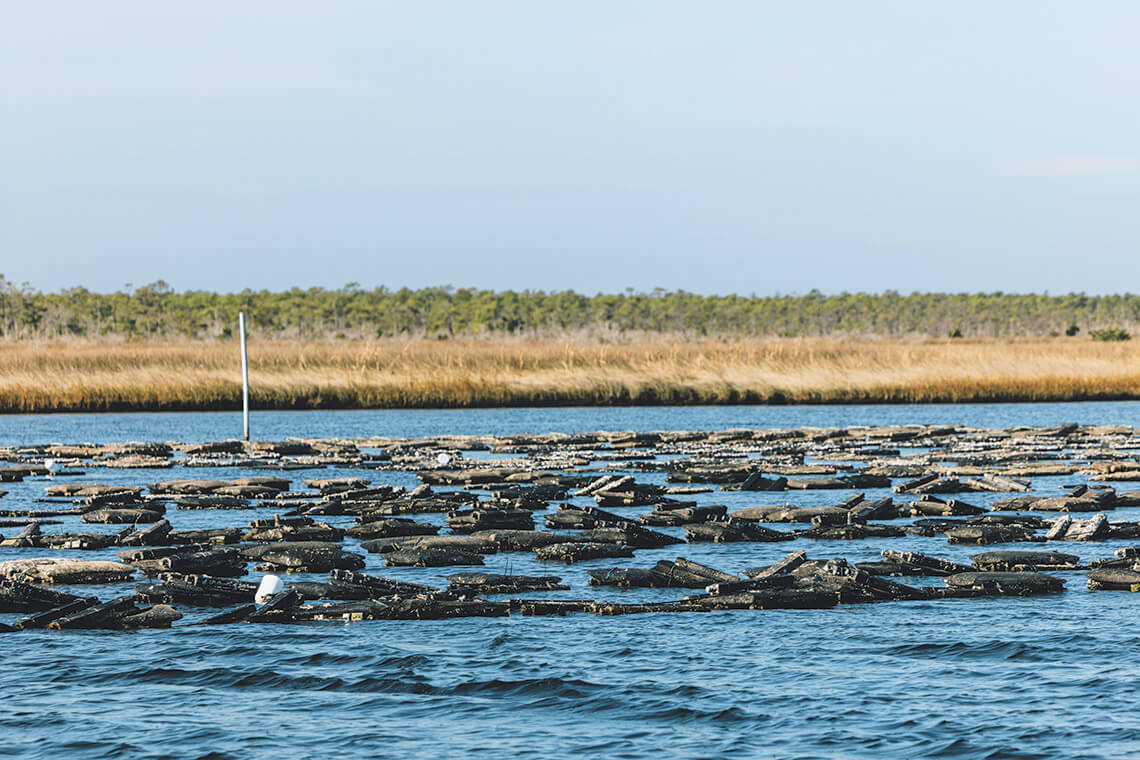
Cages of growing oysters bob in the waters of Pamlico Sound. photograph by Baxter Miller
Today, the family has a million clams planted in Nelson Bay at Sea Level. But those million clams are secondary to the family’s oyster operation. The Morrises lease acreage across four or five different bodies of water with about 15,000 cages and thousands of oysters. “This allows us to innovate and experiment with crop rotation,” says James.
It’s this innovative spirit that has allowed Morris Family Shellfish to thrive. After taking the leap from commercial fishing to farming, Jimmy started the state’s longest-running commercial shellfish hatchery in the 1990s, producing “seed” not only for his own farm but also helping dozens of other farmers in the region get their start.
Novel solutions continue to drive the business forward today. “We’ve been trying different areas and migrating our farms up the estuary to grow high-quality shellfish in areas with different environmental factors,” James says.
Two kingfishers exit the underbrush of the creek, flying alongside the bow of the boat, ushering it north until the sheltered thoroughfare gives way to the southern end of Pamlico Sound. Here, among the open expanse of water and needlerush, the breeze kicks up and the earthy scent turns to brine. There is not a house in sight. No roads. Not even another boat. “It’s complete wilderness. It’s undeveloped. It’s beautiful,” says James. Most importantly, it’s the perfect place for cultivating oysters.
“We like salty oysters, but we also like plump oysters,” James says. “Where we grow oysters, we have to balance salinity and meat quality.”
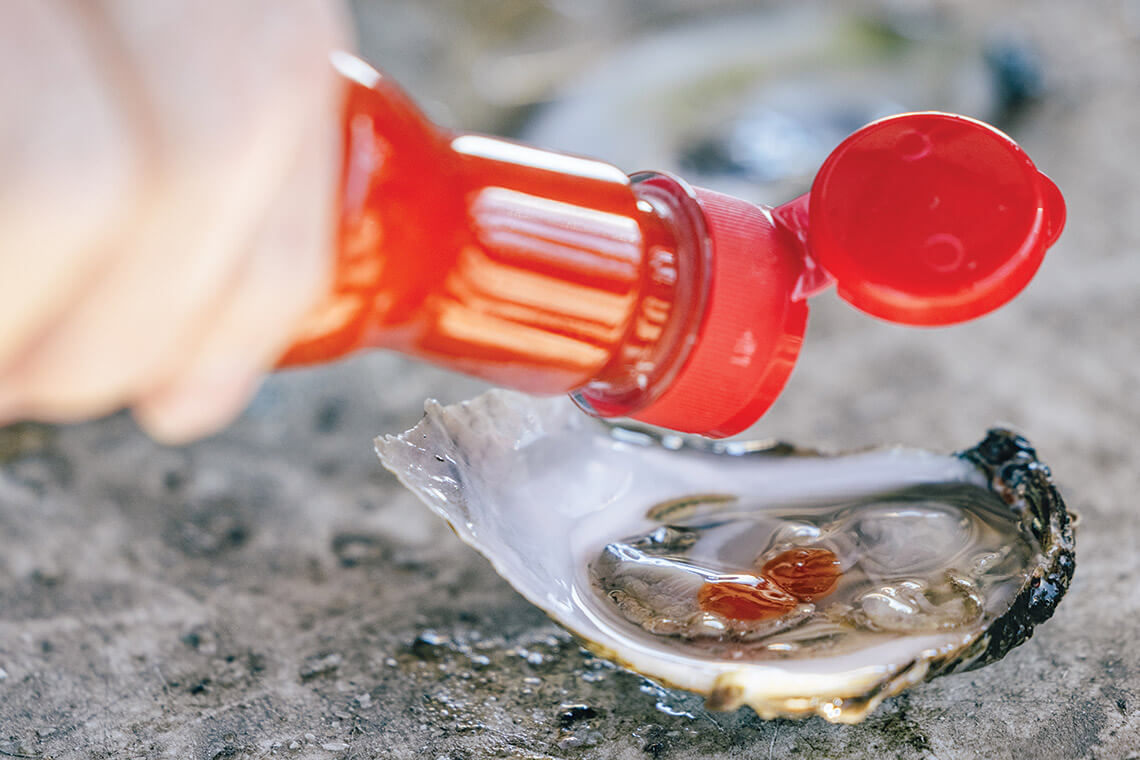
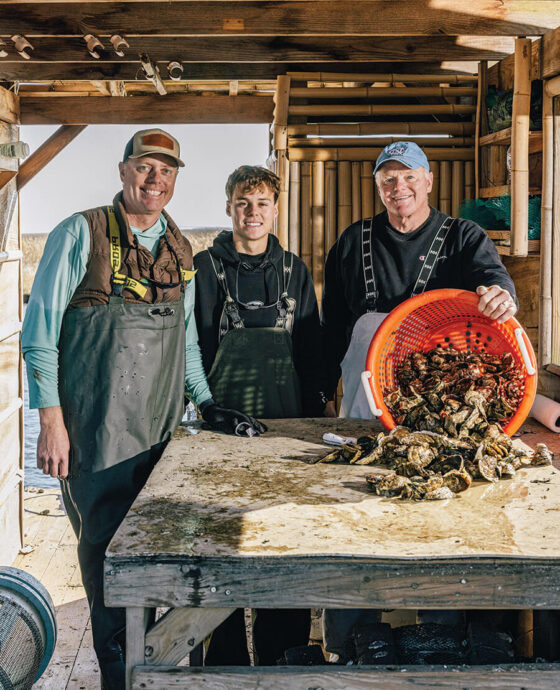
The Morris family partnered with Gourmet Sauces to create Carolina Oyster Sauce, their latest product. photograph by Baxter Miller
As the Cedar Island Bridge comes into view, Jimmy slows the motors, and the wake dissipates pushing the stern forward. Tucked into a cove at Owens Bay, thousands of oyster bags float in succession, spread over nearly five acres. Some are full of thousands of seeds; others are full of a hundred or so fully grown shellfish. “This is my favorite place to come and work,” James says.
The boat approaches a small barge retrofitted as a floating processing center. “Charlie, go ahead and jump on the bow and get that line ready,” Jimmy says to the young man next to him in the pilothouse, his grandson. A senior in high school, Charlie scurries past his dad, ready to tie off. Here, three generations of the Morris family will set about retrieving bags of oysters, sorting them by size, returning small ones to the water, and culling the market-ready ones to bring back to the dock.
A quality assurance test is in order, and Jimmy pulls a knife from his pants pocket. He tucks the tip of the blade into the little divot at the hinge of the oyster and pries against the pressure until the bivalve can refuse no more. Pop! He slips the blade around the edge, the steel scraping against the calcified shell. With the top now separated, he tosses it overboard, then slips the blade under the plump meat, freeing it from the bottom shell.
Nestled in the cup of his hand, he raises it toward his mouth. James stops him, as he passes over a bottle of red sauce, the family’s latest creation. Jimmy shakes free a few drops from the bottle of Carolina Oyster Sauce, raises the shell to his lips, and slurps back its contents. He savors a taste of place, here at its source. It’s a taste of resilience, and for the three generations standing in Pamlico Sound, it’s also proof of what can happen when heritage and science grow together.
print it