Old Salts: Whether native or transplant, these folks found their place and passions on North Carolina’s coast, becoming as integral to life here as the sand and sea. Read more about the folks that make the coast thrive.
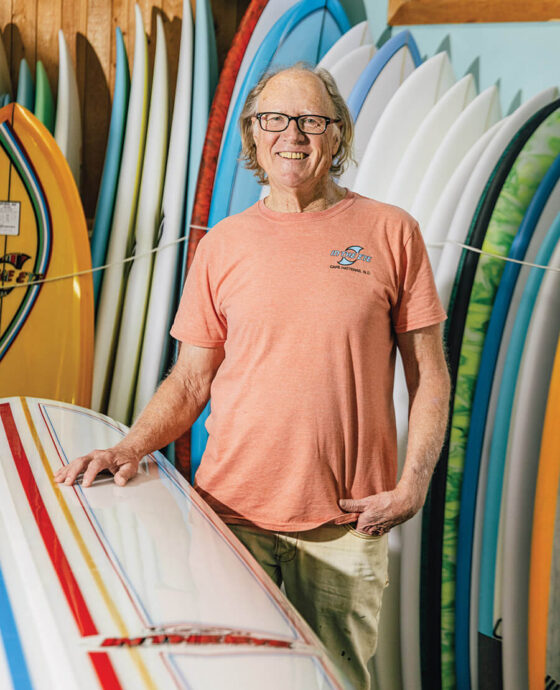
“You know … I’ve never had a real job,” says the shaggy-haired 73-year-old, his T-shirt, emblazoned with a surf brand logo, hanging loose at the shoulders. Scott Busbey plugs in a handheld planer, slips on a pair of earmuffs and a dust mask, and moves the buzzing tool toward a thick slab of foam. He runs the planer along its surface, gliding effortlessly back and forth. With each pass, bits of foam are sent airborne, falling like snowflakes in drifts around him. As he circles the polyurethane blank, the once-flat surface begins to curve.
“The first thing I do is get the rocker right — that’s the curve in the bottom of the board,” Scott says. “If a wave’s got a lot of power and is very fast, you generally want to shape more rocker into it because you’re looking for control.”
While Scott says he’s never had a real job, Natural Art Surf Shop on Hatteras Island — which he’s owned with his wife, Carol, for the past 50 years — and his reputation as one of the sport’s most prolific shapers suggests otherwise. But that’s semantics for a man who never set out to do either.
Growing up in Cocoa Beach, Florida, Scott discovered surfing in sixth grade when an older kid down the street let him use his board. “He pushed me into a wave, and I stood up and rode the soup straight in,” Scott says. He was hooked and begged his parents for a board. Eventually, for his birthday, they paid for half of one. Scott paid the other half. That used board, bought for $75, was his gateway to surf culture.
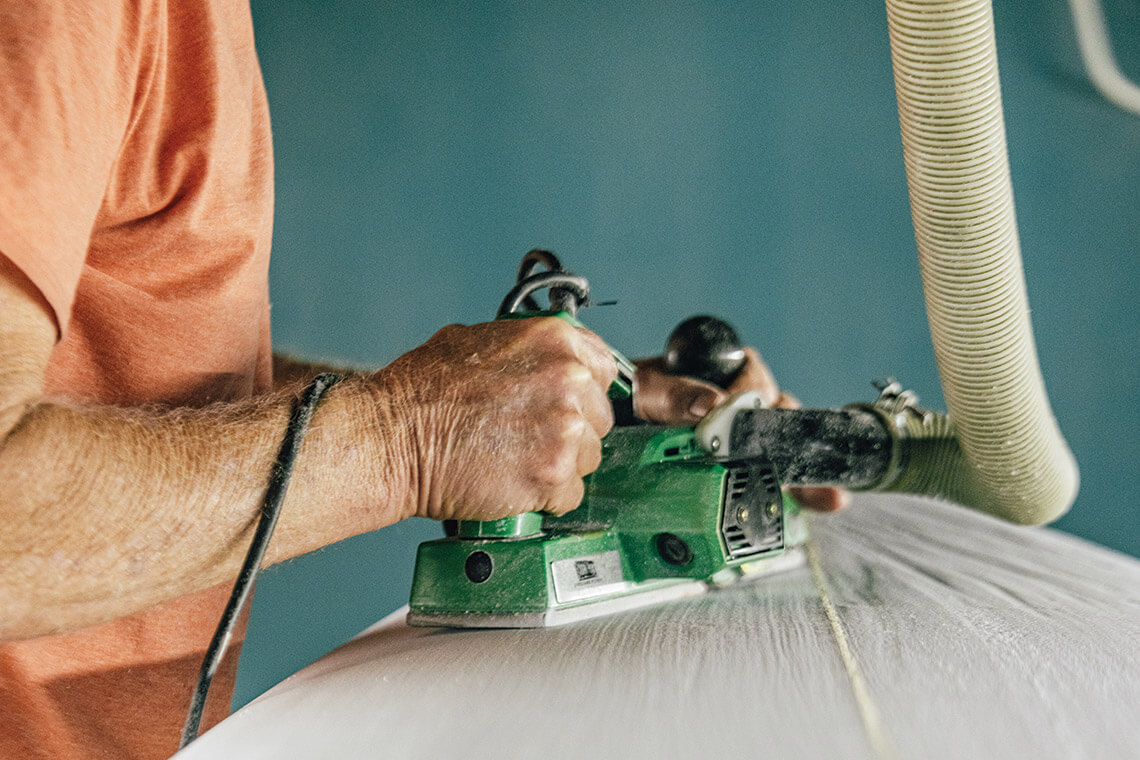
Thanks to the shortboard revolution, Scott taught himself the art of shaping surfboards. He says he’s still learning new things today. photograph by Baxter Miller
When he turned 16, he bought a longboard with money he saved from his paper route, but buyer’s regret was swift, as the shortboard revolution arrived. Impressionable and in need of the latest and greatest, he again saved his money and bought a smaller board.
When his father found out, he hit the ceiling. “I can distinctly remember him yelling at me,” Scott says. “He said, ‘You aren’t going to make a living with this damn surfing.’”
Scott persisted. In three months, shortboards had become even shorter. With little money, youthful resourcefulness rose to the surface. He hatched a plan to shorten his board.
There were no manuals, YouTube videos, or even other board makers to ask; it was trial and error with tools ill-suited for the job. “It was horrible. But we did it,” Scott says.
Word spread quickly. A friend down the street asked Scott to cut down his board and reglass it. Others soon followed. Boards were changing fast, and a beach full of kids short on cash made for steady demand — and ample practice.
“It’s about feeling and measurements at the same time. It’s basically like sculpture in a way.”
“I’m pretty much fully self-taught. You learn a little bit as you go. I’m still learning things today,” Scott says, placing a newly completed board in the rack at In the Eye Surfboards, his business at Natural Art Surf Shop.
When Scott and Carol moved to Hatteras in 1977, they had a thousand dollars to their name. Soon, they rented an old burger joint in Buxton for $150 a month and set out to open a surf shop.
Over time, Scott’s reputation as a surfboard builder grew. He was increasingly sought after to shape custom boards. “There’s a science to shaping boards, but it’s not a specific science. It’s about feeling and measurements at the same time. It’s basically like sculpture in a way,” he explains. “You’re designing for the type of rider and the type of waves. It’s a very individualistic thing.”
The thousands of unique surfboards he’s made are proof of that individualism. He didn’t start keeping track of his boards until 1996, nearly 20 years after he first started. Today, he’s filled two 90-page, spiral-bound notebooks, dedicating two neat lines to each order.
However, the latest board he’s working on will have to wait. Offshore high pressure and a westerly wind beckon him to the jetties. He tucks a board under his arm and sets out to the beach near the old Cape Hatteras Lighthouse site. It turns out surfing in the middle of the day is one of the benefits of not having a real job.
print it