Old Salts: Whether native or transplant, these folks found their place and passions on North Carolina’s coast, becoming as integral to life here as the sand and sea. Read more about the folks that make the coast thrive.
James Melvin gripped his fishing rod, his feet dangling off the tailgate as the warm sun draped over his shoulders. He had never heard of the Outer Banks until that weekend, but now, with his line of monofilament arcing over the sound, he was glad he had accepted his friends’ invitation to visit.
As he waited for the slightest tug on the line, he soaked in the beauty of Nags Head.
That spontaneous trip in August 1981 was the first step in a 44-year journey, one that would shape the artistic landscape of the Outer Banks and establish James as one of the region’s most recognizable artists.
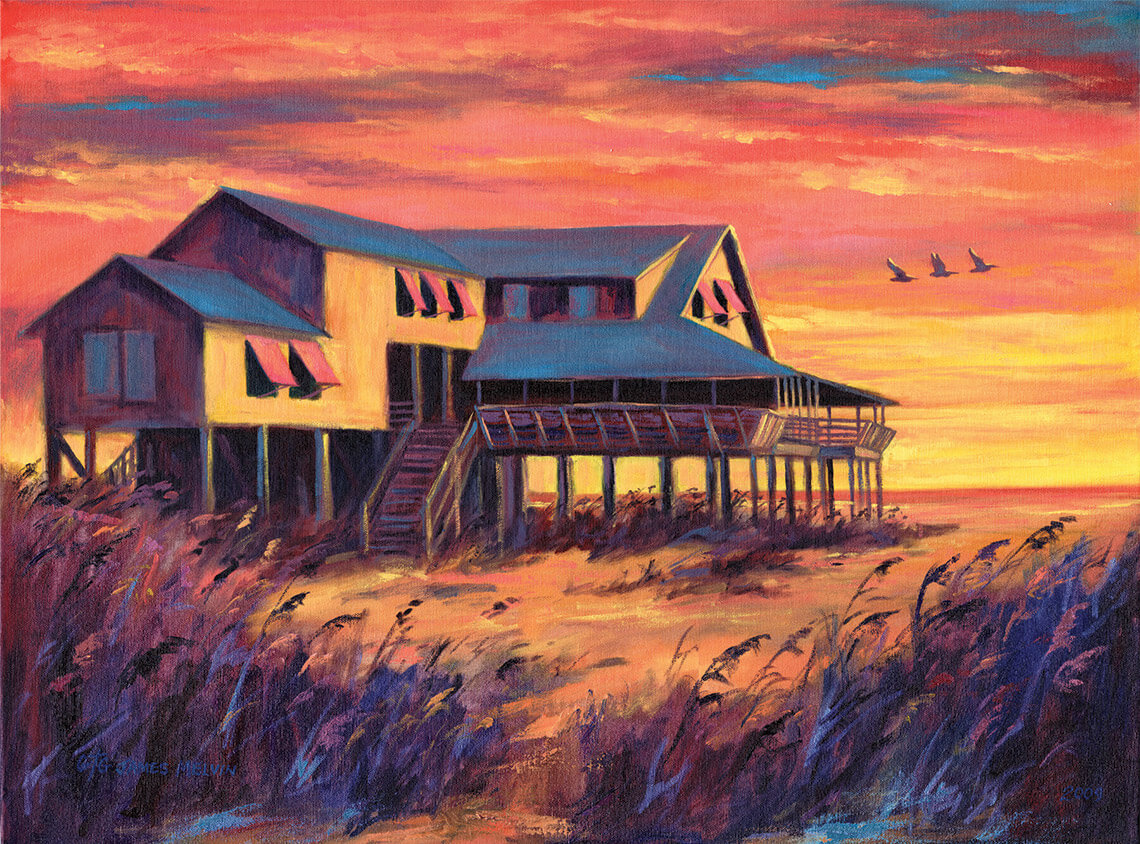
Three Pelicans Cottage depicts the beauty that lured James Melvin to the Outer Banks. For him, it was love at first sight. painting by James Melvin
That weekend’s mess of good-sized spot and croaker, plus the perfect weather, hooked James and his wife, Gladys. “I was like, ‘My God, this place is beautiful.’ The sun was shining. A nice breeze was blowing,” he recalls. Standing atop a high dune overlooking the sea, he turned to Gladys and said, “This place is just so wonderful. Wouldn’t it be nice to live here?”
It’s a thought that has crossed the minds of countless tourists. But for the Melvins, it was more than a notion; it was the main topic during their ride back home to Fayetteville. James worked in advertising, and Gladys was a nurse. She could work anywhere. Perhaps the Outer Banks would offer James a chance to pursue his passion for painting and fulfill his childhood dream of being an artist.
A few weeks later, a second visit sealed their decision. In December 1981, they sold their home in Fayetteville, and the couple rang in 1982 from their new home on the Outer Banks. Gladys found work with the health department. James began taking commissions and teaching art classes in their house, putting his degree in art education from North Carolina Agricultural and Technical State University and his time in the Peace Corps teaching art in Botswana to work.
The dunes, waves, shorebirds, and iconic cottages of Nags Head’s unpainted aristocracy became his muses.
James found inspiration all around him in his new home, from the landscape to the architecture. The dunes, waves, shorebirds, history, and iconic cottages of Nags Head’s unpainted aristocracy became his muses.
His early years on the Outer Banks weren’t always easy as a new artist. He cobbled together a living, supplementing it, when necessary, with funds from his retirement savings.
One winter evening, above the murmur of the crowd at the Frank Stick Memorial Art Show at the Sea and Sound Arts Council, now Dare Arts, James quietly stood by his piece. A woman crossed the room toward him. “I’m Suzanne Tate, and I want to represent your artwork on the Outer Banks,” James recalls her saying.
Their handshake marked a key moment. Suzanne went about placing James’s work in local galleries, and a few years later, she asked him to illustrate a children’s book she was writing — the beginning of a partnership that would be a defining part of his career.
Even if you don’t know his name, if you’ve visited a museum, aquarium, or gift shop on the North Carolina coast, you likely know his work. For 35 years, James illustrated Suzanne’s Nature and History Series, a collection of more than 40 children’s books about marine life and local history that became beloved staples in classrooms, libraries, and bookstores along our coast and beyond.
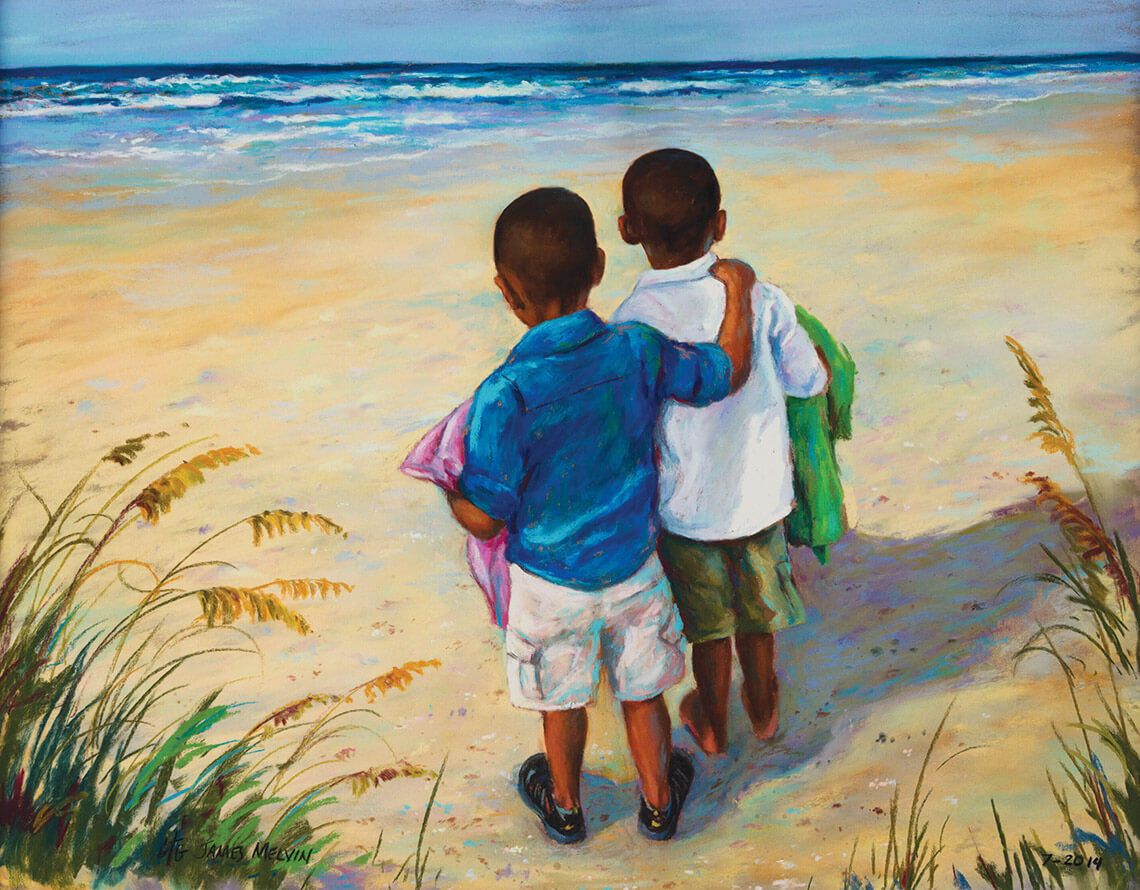
Brotherly Love painting by James Melvin
In 1988, the pair published their first book, Crabby and Nabby, about the life cycle of blue crabs, with simple two-color illustrations. Accurate in text and illustration, this book taught children about science, as well as important life lessons.
“Suzanne would come to me and read the manuscript. I would sit there, close my eyes, and try to visualize the main character,” James says. “That’s how I got inspired. They’re really just basic shapes, and I just give them a little life.”
Soon after the first book came the second. Today, the series has sold more than 3 million copies. It is a cornerstone of many bedtime routines, lesson plans, and museum programs across the country, impacting millions of children.
“It’s very humbling for someone to appreciate your work that much, and to know that it’s still well received,” James says.
Appropriately, the dedication for the last book in the series, released in 2023 when Suzanne was 93 years old, is inscribed: “To James whose art children love.”
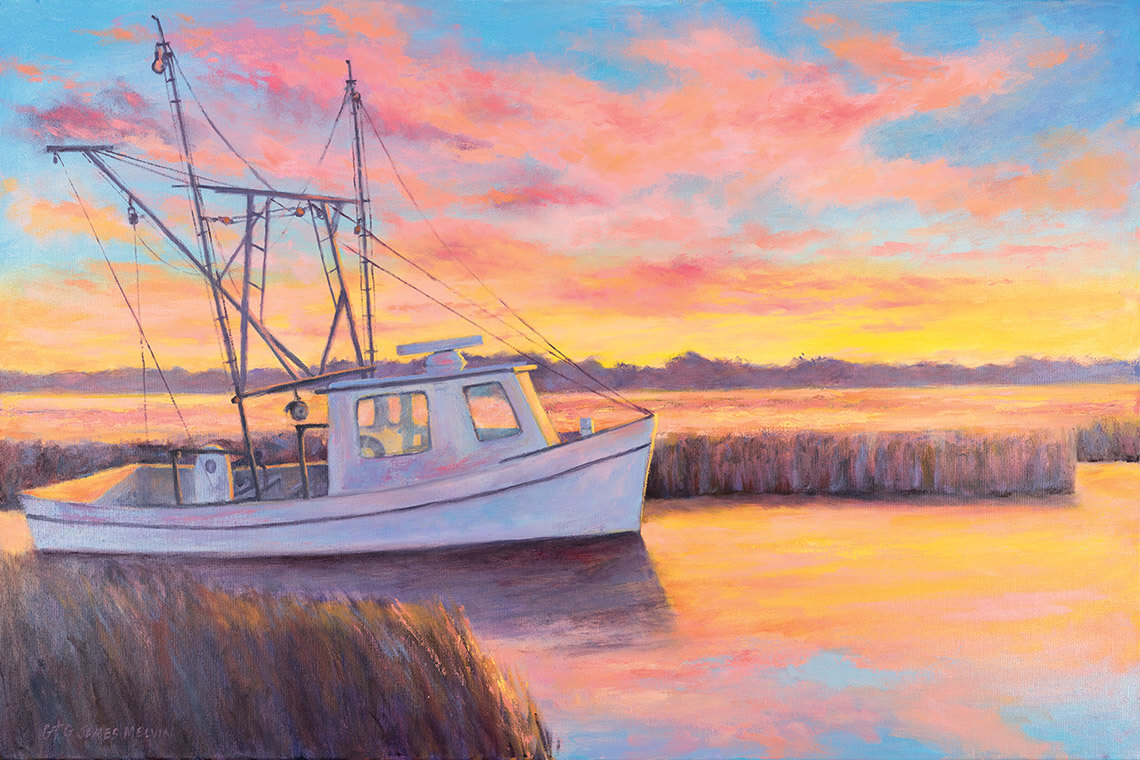
A Happy Place painting by James Melvin
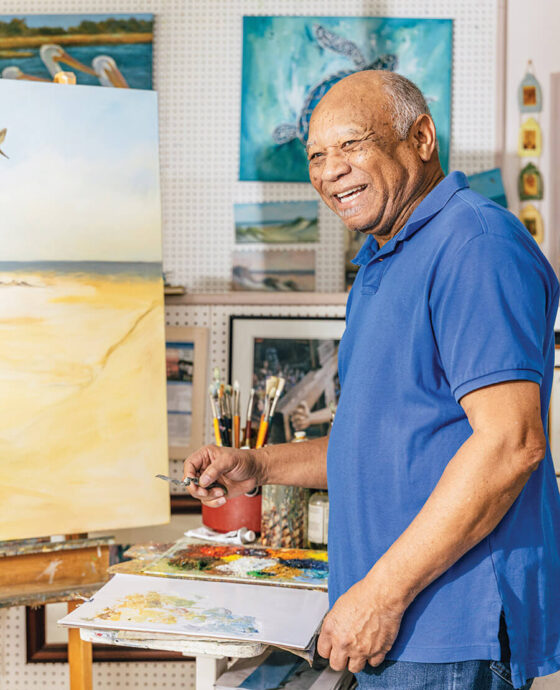
To walk around James’s home studio and gallery is to experience in real time his evolution and versatility as an artist. “In life, we are always searching and trying to find our place,” he says. “I think I found mine when I came here.”
Prints of his earliest works — acrylic hard-edge paintings portraying the old beach cottages of Nags Head — are still available. Occasional abstracts and pastels appear on the pegboard walls. Posters from his Pea Island Lifesavers Series, the originals displayed in the aquarium in Manteo, depict surfmen from the only all-Black life-saving station in the United States. His mainstay, realist oil paintings of the Outer Banks, form the foundation of his portfolio. Scenes of rocking chairs and Adirondacks, pelicans and sandpipers, and the sounds and the sea evoke feelings of serenity and peace.
James has returned over and over to the same muses that first called him to the Outer Banks, his artwork inseparable from the place. Through his varied works, the persistent thread of local landscapes and history encapsulates moments of everyday coastal life along this strip of sand.
At the center of his home gallery stands a rotating rack of Suzanne’s books, a telling location for their place in his work and life. “I feel so fortunate to do this,” James says. “When someone buys from me, I just really feel humbled. It’s like taking a piece of me, my spirit.”
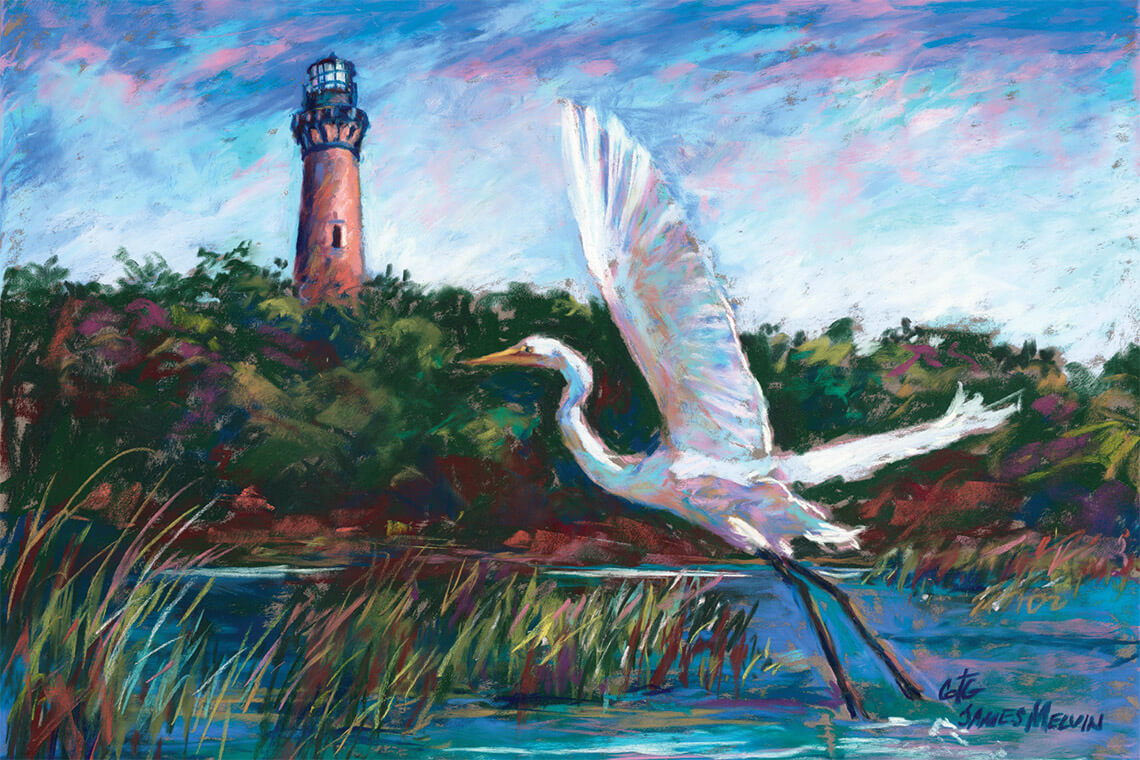
Sanctuary painting by James Melvin
Now 77 years old, James doesn’t fish as much these days. The beach is more crowded, and the fish seem smaller. The cottages he loves are now surrounded by development. But the role art plays in his life hasn’t changed. He makes time to do something creative every day, and there is always a project on his easel.
“I hope my work has added a little joy to people’s lives,” he says. “And for anyone with a creative desire, I hope my work gives them hope that they can do the same thing, too.”
Decades after that first weekend in a place he had never heard of, James’s work now lives in galleries and homes and on bookshelves all along the coast.
print it