Old Salts: Whether native or transplant, these folks found their place and passions on North Carolina’s coast, becoming as integral to life here as the sand and sea. Read more about the folks that make the coast thrive.
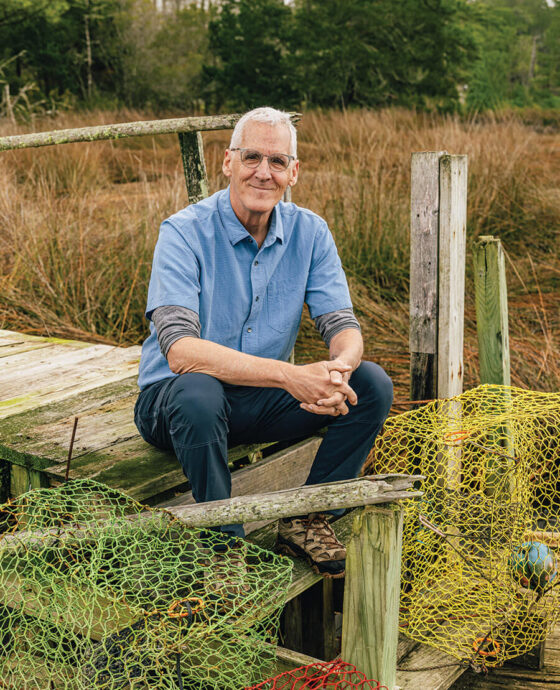
In a second-floor room overlooking Bogue Sound, David Cecelski stands quietly, gazing through a wall of windows, his reflection faintly superimposed on the overcast sky. The chairs behind him fill with graduate students and faculty from North Carolina State University’s Center for Marine Sciences and Technology in Morehead City.
The overhead lights dim, and the host welcomes one of North Carolina’s leading coastal historians. It’s an introduction laced with accolades. Duke. Harvard. Words like “award-winning,” “outstanding,” “distinguished,” and “lifetime achievement” glue together his résumé of books, essays, columns, and professorships. David keeps his eyes lowered, his face painted with the look of a man wishing for this part to end.
“When I’m giving talks in eastern North Carolina, I try to give people, no matter what I’m talking about, just a little sense of where they’re at,” he begins. “In this case, I mean historical things that happened within half a mile of here.”
He charts a map in the audience’s mind, plotting its first point east toward the shore. “The shark factory used to be right up here,” he says. “The company was the first one that figured out how to make leather out of sharkskin.” For the next 10 minutes, he takes a pilgrimage across 200 years of history, ecology, changing economies, foodways, and lived experiences, all radiating from this 1,000-yard nexus.
He warns the room, “This may not be the seminar to which you are accustomed. I’m a historian after all, and a storyteller at heart.” He begins with the story he knows best: his own.
David has dedicated his career to uncovering North Carolina’s hidden and often silenced histories.
A black-and-white photo, taken just 15 miles away but some 60 years back, flashes onto the screen. On his family farm in Carteret County, young David sits on the back of a wild pony, one his grandfather swam across from Core Banks.
Generations of his maternal family have lived in the 1840s house on the farm, set among the soybean fields, pine forests, and shallow creeks of Harlowe. Here, layers of family history converge — white and Black, immigrant and native-born, rural and worldly.
He names the folks in the photos on the mantel: his great-grandfather in a World War I uniform and his great-grandfather’s son, Henderson Godette, born to a Black mother in a segregated world.
Then there are David’s parents. His mother, Yvonne, met his father, John, a first-generation Polish immigrant, while working at Marine Corps Air Station Cherry Point. His already gentle voice fills with admiration when he speaks of his mother. “She had a high school education, but you could start a line of most Shakespeare plays, certainly the tragedies or the histories, and she’d finish it for you.”
Alongside the literary inheritance of his mother, the oral storytelling traditions of his family taught him the value of voices, memory, and place — the currency that would become the foundation of his life’s work.
“There are all kinds of people in the world I come from who aren’t in the history books.”
David has dedicated his career to uncovering North Carolina’s hidden and often silenced histories. From archives and attics, he has sifted through stained ship logs and fragile diaries and spent countless hours listening to the experiences of people whose stories likely would never have been recorded.
“I think some parts of our history help us understand the world we live in today,” he says. “In a way, that makes it easier to imagine making a better one.”
Many of his books and essays highlight the often-overlooked aspects of the African American experience in eastern North Carolina. His writing challenges inherited ideas of culture, complicates nostalgia, and introduces new realities to assumed histories.
“I don’t want to only salute the good and the beautiful. I see it like knowing the scars on your lover’s body,” he says. “If you love that person, you want to know the scars and their story.”
He delivered on that philosophy through his “Listening to History” column, published in The News & Observer’s Sunday edition for more than a decade. Sitting at kitchen tables and visiting working waterfronts across the Coastal Plain, he recorded ordinary men and women — from fishermen to a midwife — whose stories reflect the state’s history.
Illuminated by the projector, David continues his presentation. One after another, he shares the names, faces, and stories of dozens of eastern North Carolinians, bringing compassion to history and giving a more complete understanding of our coast. “I believe with all my heart that there are some things worth fighting for,” he says, “and our coast is one of them.”
print it