Old Salts: Whether native or transplant, these folks found their place and passions on North Carolina’s coast, becoming as integral to life here as the sand and sea. Read more about the folks that make the coast thrive.
One hundred and ten miles of shoreline, 245,000 acres, 9,300 people. One doctor.
When Dr. Walter Holton finished his medical residency and moved his family to Manteo in 1974, Dare County had been without a full-time physician for several years. It had been without an ambulance even longer.
“If you had to take somebody to the hospital, they were put in the back of a station wagon,” Walter recalls. “You couldn’t even hang an IV bag.”
Before it became a tourist destination, the Outer Banks were different. “Back then, it wasn’t a wealthy place,” remembers Walter. “There were no houses on the beach except in the Nags Head area.”
Medicine was different, too. Office visits cost $5, shrimp and oysters were not uncommon currency, and patients didn’t wait weeks for appointments. “If someone called, we’d say, ‘Come in,’” he says. “We never turned anyone away.”
As it turns out, Walter’s first job out of residency became his last. Shaped by the isolated place and the people who called it home, he became a singular kind of doctor — readily available and deeply embedded. His 44-year journey transformed countless lives.
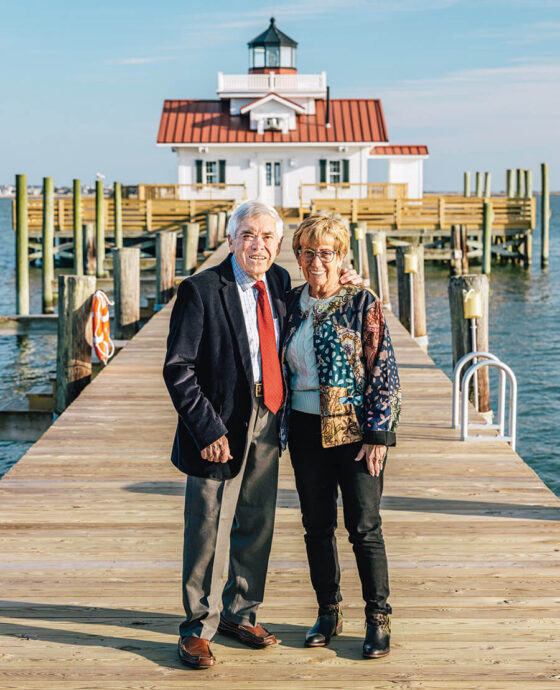
Walter and Barbara arrived at the cusp of the Outer Banks’s first growth spurt, which resulted in a dramatic rise in tourism. photograph by Chris Hannant
Growing up 70 miles west in Edenton, Walter always knew he wanted to be a doctor. After attending Wake Forest University as an undergraduate, he received his diploma, along with an order to report for service. Drafted into the Navy, he was promptly stationed aboard an aircraft carrier in Vietnam. His classroom became a helicopter with the assignment of locating and recovering downed pilots.
“After what I had been through in Vietnam,” he says, “medical school was just wonderful.”
Walter enrolled in an accelerated three-year program at Duke University School of Medicine and completed his family practice residency at Milton S. Hershey Medical Center in Pennsylvania. His career path was set — until he had a chance encounter with an old friend while vacationing in the Outer Banks. His friend shared that Dare County had been without a doctor for some time. Soon an introduction was made, and a delegation from the county began to woo Walter.
They invited him and his family on an official visit. “They were going to take us on a fishing trip and to see The Lost Colony. They even had Andy Griffith coming,” Walter says. “They were doing everything they could to find something to interest us.”
His wife, Barbara, chimes in, “It was a disastrous week.” Walter, a very pregnant Barbara, and their 2-year-old daughter arrived as a nor’easter slammed the coast, ruining their red-carpet itinerary. Aside from a visit to the emergency room in Elizabeth City for their daughter’s case of pneumonia, they mainly sat around inside.
“I wanted to come to a place where I could do everything. Here, there wasn’t another option.”
Still, something resonated, and he took the position. “I wanted to come to a place where I could do everything. Here, there wasn’t another option,” he explains. “The closest hospital back then was an hour and a half away.”
Slowly, the family found their footing, and the community rediscovered the thrill of having a full-time physician. Barbara, a physical therapist, began practicing in the office, and over time, Walter was able to take a day off occasionally, though he was always on call.
The couple became accustomed to their home doorbell ringing in the middle of the night. “If it was late at night, it was often a tragedy,” Barbara says. Sometimes in those instances, Walter was called to serve as the county medical examiner. Other times, the late-night calls heralded new beginnings when an expectant mother couldn’t reach the hospital in time.
“He did it all,” Barbara says. “Deliveries. X-rays. Setting fractures. Many a suture. Minor surgeries. If I wasn’t available to help, he would get one of our daughters to go help him.”
As patients multiplied and demand surged, Walter eventually recruited physician assistants from Duke and, over the course of decades, helped lay a foundation for a modern health care system. He championed 24-hour emergency medical services and worked alongside county commissioners to open the Outer Banks’ first hospital in 2002. When he retired in 2018, he left a system far removed from the one he had inherited. In the end, Walter gained as much as he gave. He shaped the place, and the place shaped him.
“I don’t regret coming here,” Walter says.
print it