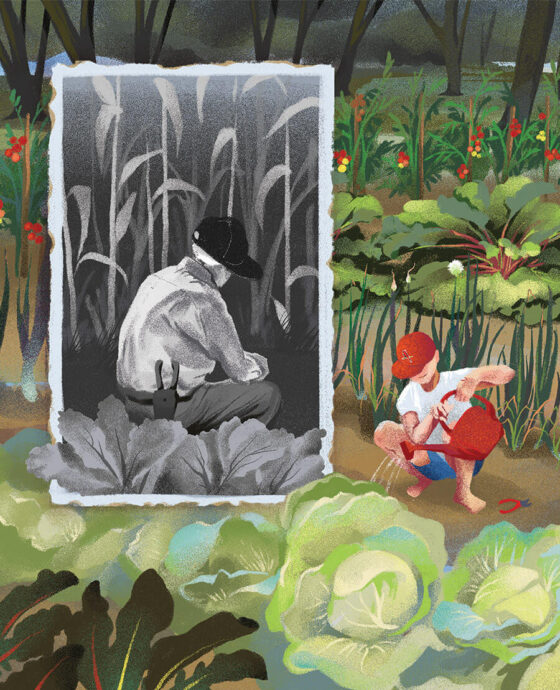
Years ago, I dreamed my granddaddy had been resurrected. There was no fanfare in it. No smoke or mirrors. No trumpets sounding. In the dream, as in the waking world, he’d died, and yet there in the carport behind his rock house, he appeared to my grandma and me on a summery bright day. He took a seat in a folding chair, his ball cap crooked on his head, and gave a little smile. As he did, the fields behind him took root and rose up. Corn and tomatoes and green beans and cabbage and collards and rhubarb — and everything else that had died when he did — stretched out up the hill. His resurrection regrew his garden in a flash.
In the landscape of my childhood, Granddaddy’s garden was a central fixture. When I emerged from the woods, leaving the path from my parents’ house, I’d spot his worn-out St. Louis Cardinals cap poking up as he tied beans or hoed rows or tilled stubborn soil. It seemed like he was always out there in the dirt, his hat off-kilter to block the sun. Before long, he’d return to the house with enough squash and okra to fry, and then turn the sink brown washing his hands.
Like me, my cousins arrived from their respective trails to crash into my grandparents’ house on summer mornings. And Granddaddy’s garden helped fill our growing bellies as we ran wild across the 100 or so acres of our family land. Midday, we sat in folding chairs in the carport, a moment of stillness, and heaped everything we could onto paper plates, a slice of tomato on top. Then we’d rush back into the woods, and Granddaddy would grab his hat to walk back up the hill to the bees and grapes and acres of produce.
After he died, the hayfield began its slow creep into the corn rows, and weeds took up permanent residence everywhere else. But by then, none of us were covered in briar scratches and cockleburs, waiting to be fed in the carport anyway. We’d grown up and set out for college or war, and the garden grew only in memories.

I’d not thought of that dream for many years, not until I looked out the kitchen window last spring and saw my 13-year-old bent over where Granddaddy’s garden had been, pulling weeds and sticking seeds in the ground.
A lot had happened since I dreamed my grandfather back to life. Grandma, too, had passed on. I’d seen the world and gotten married and had kids. For 15 years, I’d been away from the North Carolina mountains, but out of some mix of luck and providence, I returned home, and now my firstborn — tall like my grandfather, red-headed instead of red-capped — had a mind to reawaken land long ago put to sleep.
That’s one way to tell the story. Another way involves a flood and a place tended to take in the lost. It’s no less true.
In that telling, I watched my kid from that kitchen window, in the spot where my grandma had fried the okra of my childhood, because I had nowhere else to go. That fall, Hurricane Helene had lifted the Mills River so high that it overtook our home, washing bits of our lives downstream and leaving us without a place to live. So my family of four landed in my grandparents’ then-empty rock house looking for safe harbor.
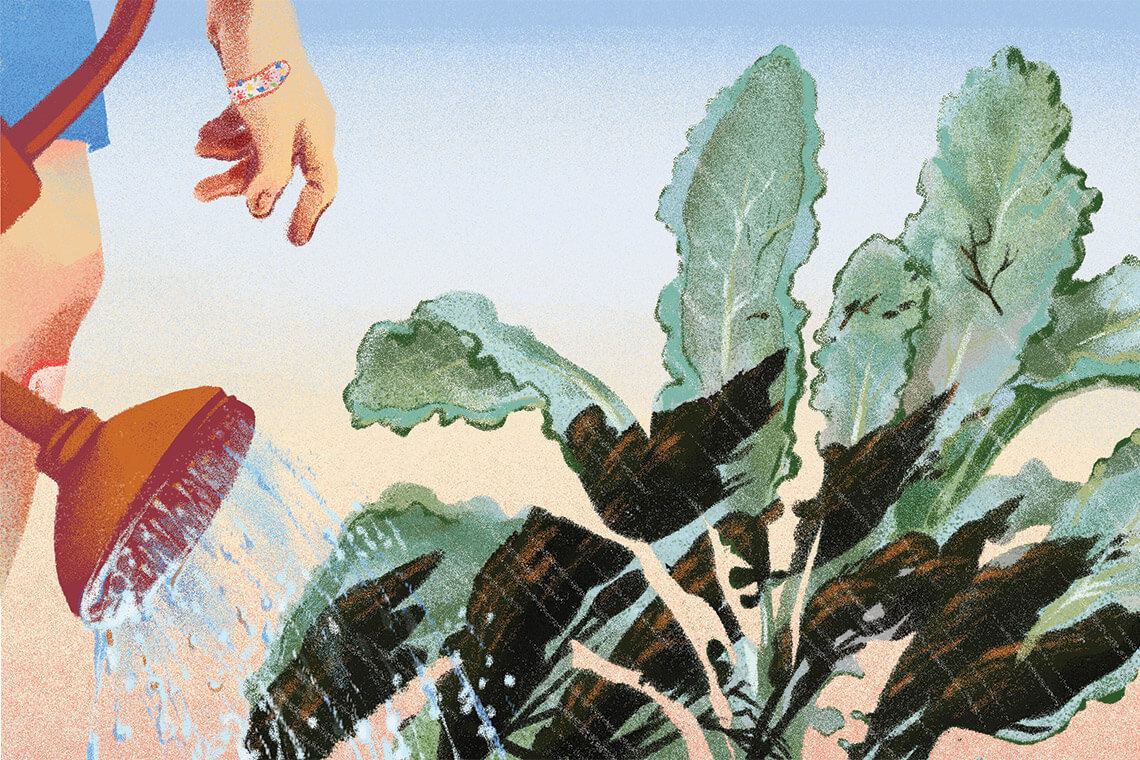
illustration by Andrea Cheung
My kids arranged their stuffed animals and books in the rooms where my dad and his brothers had grown up, and we put seeds into the soil that my people had been turning over for a century.
“I don’t know if I’ve ever told you,” my uncle said on a call out of the blue, “but your great-grandparents took in everyone.” He ran through a list of people I’d never known but who’d lived, at one time or another, with Albert and Azalee Prestwood: down-and-out men, preacher students, young families. Anybody in need.
I hadn’t known of this family tradition of welcoming strangers. At least not fully. I did know the story of a teenage boy named Ray who’d lost his mother and been brought into my great-grandparents’ house in the 1930s. He’d grown into a man who liked to wear a Cardinals cap and grow vegetables. Then he’d lived out the rest of his life on the land that received him as a boy and was laid to rest in it just across the creek — and was, occasionally, coming back to life in my dreams.
“Anyway, thought you ought to know,” my uncle said as he hung up. I wondered what had prompted his call. Did he simply want to pass me stories in my role as unofficial chronicler of family history? Or maybe he’d been thinking about my own family of refugees and our being welcomed onto the family land in our time of need. Whatever the case, the call left me thinking about cycles, about how what’s planted may continue growing for generations, if given the right conditions.
By the summer, we were awash in tomatoes. We sliced them for sandwiches and pureed them for sauce and froze them for winter. We marveled at the size of the cucumbers and failed to get the cabbage before the groundhog did. We weeded and watered, and Granddaddy’s garden kept up its end of the bargain. Those tiny seeds we entrusted to the soil took shape and rose into the light. Even my younger kid’s bean project from school stretched into a massive vine that had me thinking about Jack and a giant in the sky.
Up the hill from our little garden, bees and blueberries and grapes had reappeared. In his retirement, my uncle had taken Granddaddy’s left-behind grapevines and forgotten blueberry bushes and transplanted them. Beside the fruit, he’d arranged the bee boxes so that while we picked yet another batch of tomatoes, he smoked out enough honey for us all.
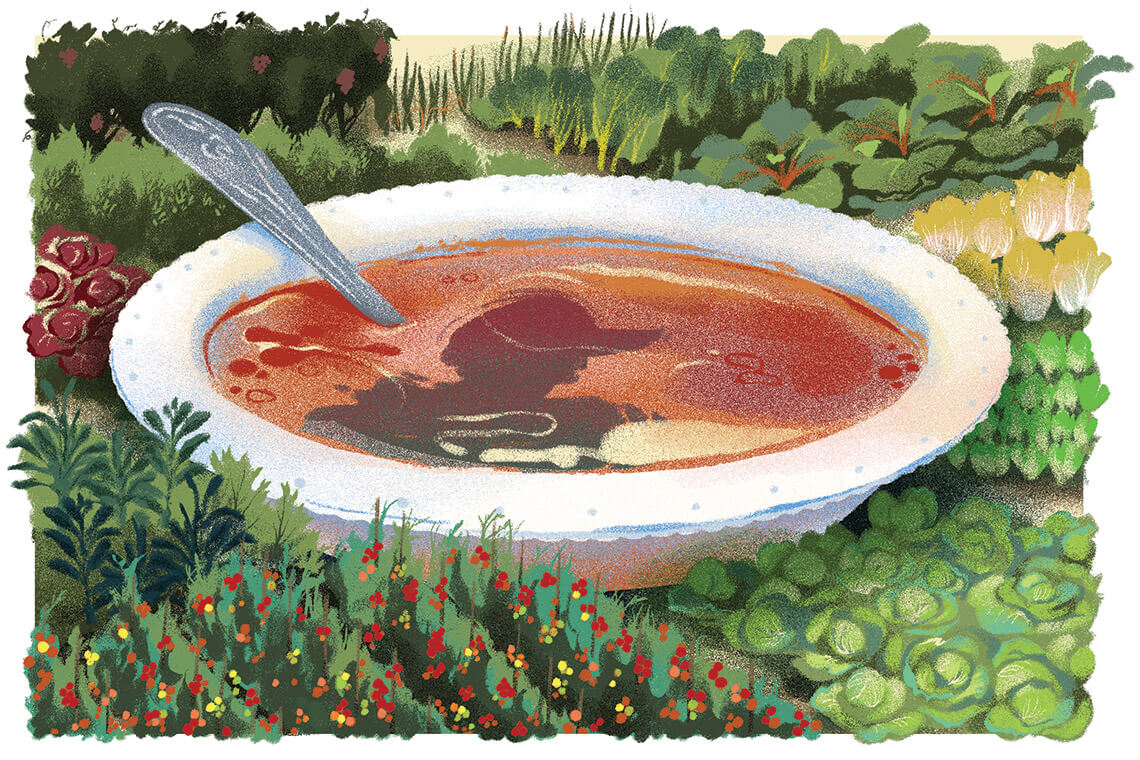
illustration by Andrea Cheung
It didn’t look like the garden of my childhood or my dreams. Our vegetable plots were small and discrete. The grapevine and blueberry bushes had been moved, as had the hives, and the corn rows now grew flowers to feed the bees. And yet this new hodgepodge collection was still the garden of my orphaned grandfather, brought to life by those of us left behind, by my kid whom my grandfather never met but who carries his name. From the school bean project that now threatens to take over the entire county, we learned that some seeds lie dormant for years, waiting for the right moment to take root and rise. Here we were.
Of course, the rock house below the garden wasn’t our home. But we were home, nonetheless. We sat at the table in the house my grandparents built, just up the hill from the house my great-grandparents opened to anyone, and tucked into biscuits covered in honey and soup filled with potatoes and green onions and kale and so many tomatoes. We ate what we were given until we were full and ready again for the world.
print it