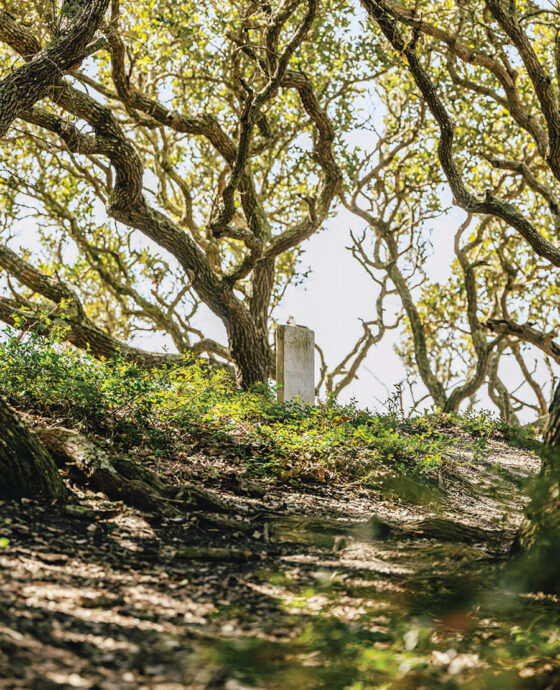
After bumping through deep sand and scrub trees for about a quarter of a mile, Dawn Taylor parks her truck near a hidden cemetery beside Pamlico Sound, which glitters peacefully in the sun, belying its dangerous potential. The gravestones here date back to the late 1800s and early 1900s, marking the final resting places of people who staffed the nearby Little Kinnakeet Life-Saving Station, as well as residents of the community around it.
Live oaks arch overhead, weaving a cozy chapel of branches over the five stones. At one time, the area had been overgrown, some of its graves lost to the encroaching water. Lives forgotten.
But Taylor doesn’t forget.
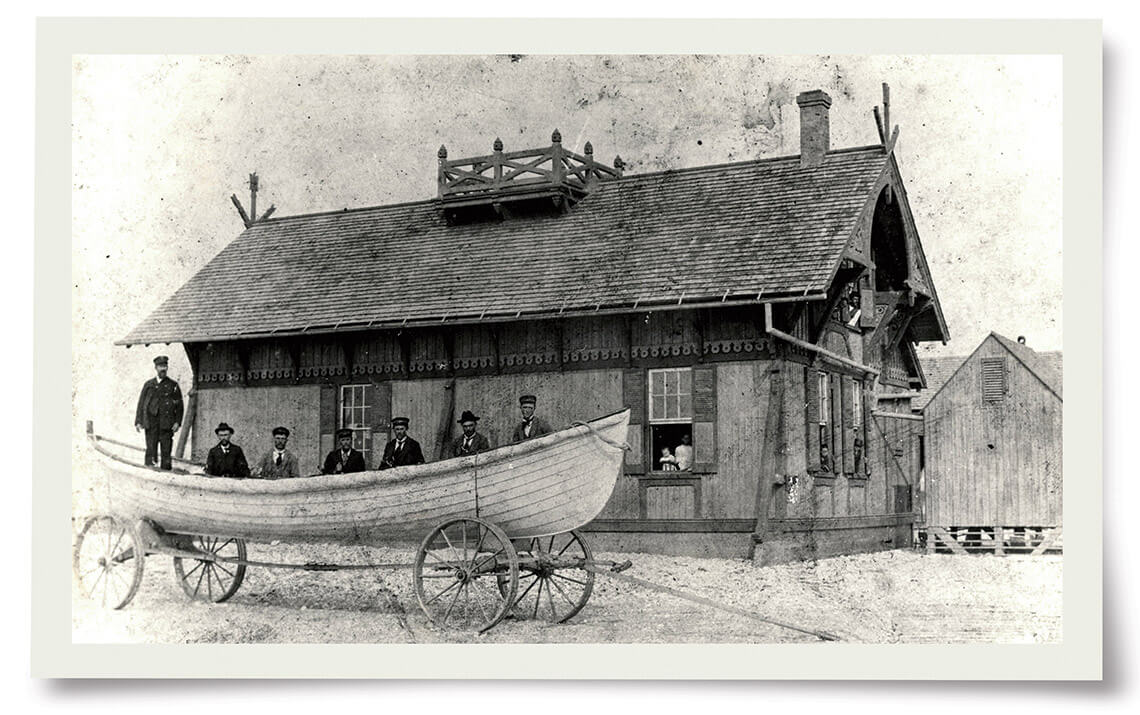
The shoreline of Cape Hatteras National Seashore was home to the former Little Kinnakeet Life-Saving Station. photograph by National Park Service, Cape Hatteras National Seashore
She waves away attacking insects, kneels, and brushes a few leaves from the bases of the gravestones. She checks the small bouquets left at each marker during a recent rededication ceremony. They’re still fresh. If they weren’t, Taylor would remove them, as she does at other cemeteries she tends. She’s all efficient attention, but also keenly aware that these real stones commemorate real lives. She spots every possible problem, pausing at each grave for a brief reflection.
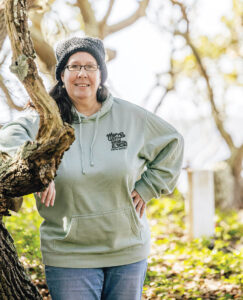
Dawn Taylor photograph by Baxter Miller
Taylor rescues old cemeteries along the Outer Banks from neglect, protecting their markers from black mold, staining, and cracks. She has helped reclaim stones from flooded areas, including beside Pamlico Sound, even when the remains beneath are irretrievable. For her, the work is about commemorating lives lived, about never forgetting lives lost.
“I get so much satisfaction out of this,” Taylor says. “At the end of the day, when I gather up my tools, it’s such a feeling. I feel almost humbled, to help and be sure they’re not forgotten. I hope they’re all remembered, and that I honor their sacred ground.”
Taylor is related, in some way, to many of the people buried in these cemeteries. She is a lifelong resident and kin to about 20 coastal lighthouse keepers, including the first keeper of the Cape Hatteras Lighthouse, who took the post in 1803. She still lives in her family home in Avon. Some 15 years ago, she found an overgrown cemetery on her grandparents’ land and wanted to learn how to maintain it properly. Her desire to honor her own family’s graveyards soon expanded into a passion for preserving others.
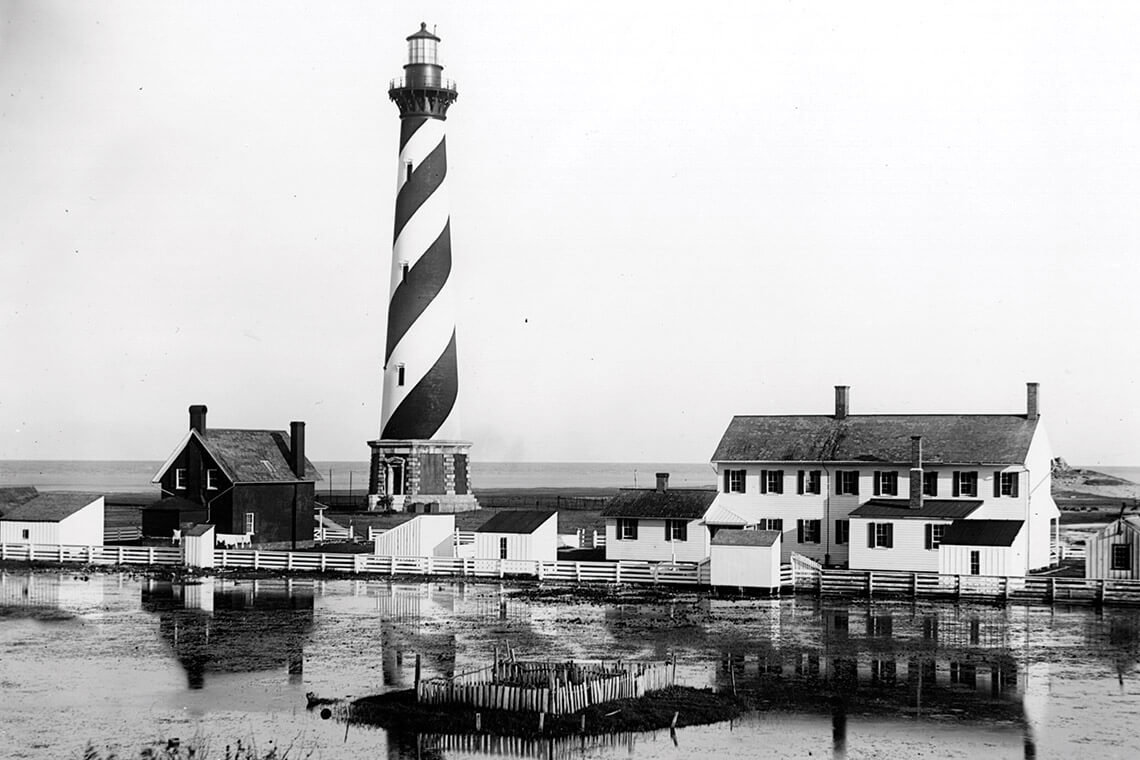
As she cleans a historic gravestone, Taylor carries forward a family legacy that includes generations of coastal lighthouse keepers. photograph by National Archives (26-LG-22-82B)
“Someday, someone will want to know [about these cemeteries], and they won’t be able to,” she says. “I don’t want someone’s family’s stones to just erode away, because it takes their memory with it. When I preserve my heritage, I preserve everyone else’s, too.”
To learn proper cleaning and restoration techniques, Taylor did much. She joined online forums devoted to cemetery preservation; sought information from the Association for Gravestone Studies, an international organization that promotes gravestone conservation; talked with other practitioners; and educated herself about the best cleaning materials to use. She scrubs stones with the same mixture used by the National Park Service and Arlington National Cemetery. Long sleeves and mosquito repellent are essential — it can be pretty buggy in these places.
She also learned what not to do. “If you want to ruin a stone, spray it with a pressure washer,” she says. “Or use an over-the-counter cleaner or Clorox.”
• • •
Down a gravel walkway through a tunnel of branches, Taylor enters a larger cemetery in Buxton, where neat graves show evidence of her frequent visits. “Should’ve gotten a long-sleeve shirt today,” she says, adjusting the brace she wears for a wrist injury.
Bugs swarm the area. She has repellent, but she left it in the truck and doesn’t bother going back. Stopping at a child’s gravestone beneath the shade of some trees, she points to the lamb figure on top, pitted and powdery. The condition is called “sugaring,” caused by damp, salty air whipped by high winds — a coastal abrasion that wears away softer stones. Attempting to clean the lamb would only hasten the erosion. Disappointed to leave behind a stone — and a memory — she settles for brushing away leaves and twigs and takes another moment to reflect.
She stops next at a flat granite marker. Black mold half-obscures the name and an intricate engraving of a fishing boat, a tribute to a waterman. “I’d love to get my hands on that,” she says. “It’s going to get to where you can’t read it at all.” When the name disappears, so does the final link to a life — leaving only a darkened space in the ground.
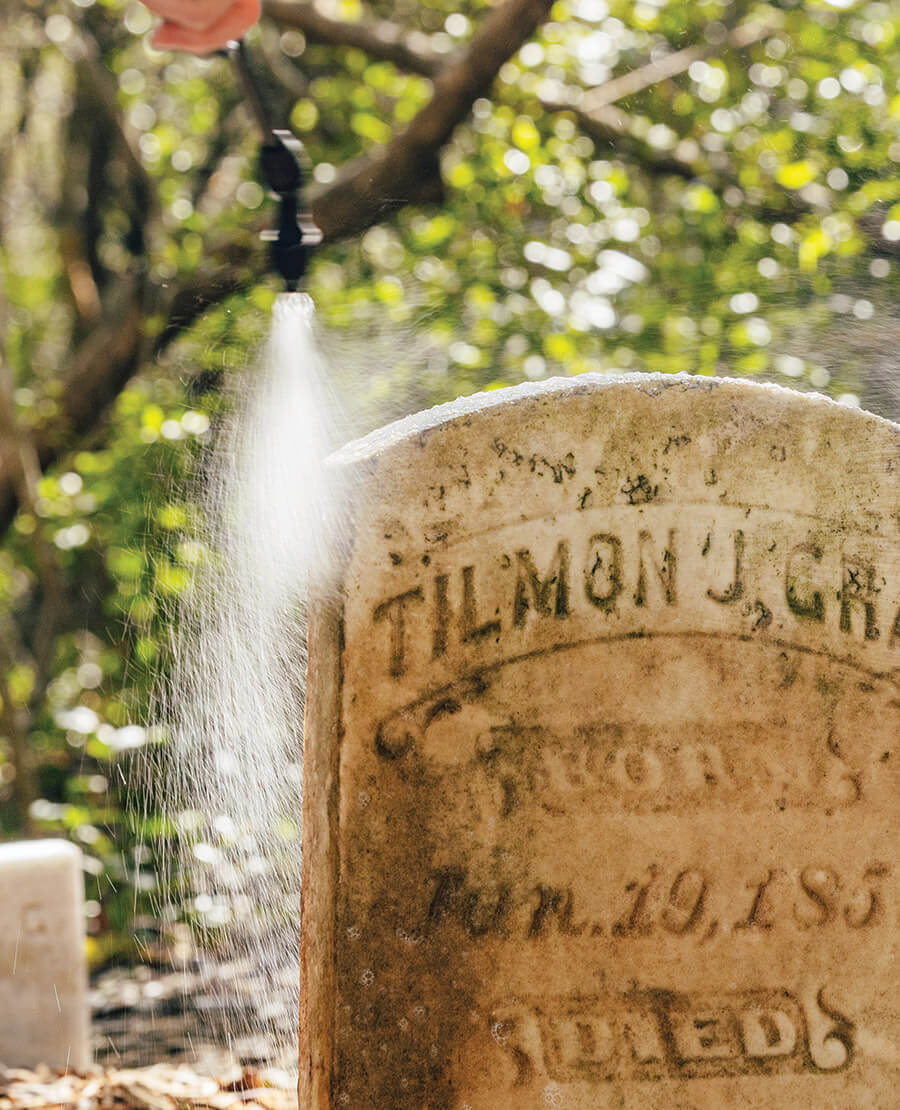
Taylor scrubs gravestones using the same cleaning mixture as the National Park Service and Arlington National Cemetery. photograph by Baxter Miller
Taylor leaves this particular stone alone because she doesn’t have permission to clean it. State law requires gravestone cleaners to obtain authorization from the cemetery authority or family members, says Melissa Timo, historic cemetery specialist at the North Carolina Office of State Archaeology. That can be difficult on Hatteras Island, where many young people have moved away — but Taylor’s deep roots help. She knows practically everyone.
Pat Dailey Rosen, who lives in Indiana, found her family’s cemetery in Buxton choked by weeds and vines. She wasn’t surprised, but she was heartsore: It was the final resting place of an ancestor honored for his service with the area’s life-saving crew — a man whose stories still shape the family’s sense of devotion. Rosen tracked down Taylor and put her in touch with a distant cousin, Jane Ferdon, who now pays Taylor to keep the cemetery tidy.
“I am so, so grateful to her,” Rosen says. “What a gift she is giving the communities there. These names would be forgotten, and these people would be forgotten, but for the work she’s doing. What these people had to do to survive. How they survived. It’s miraculous to me. The graves are touchstones for generations far removed.”
Taylor’s work doesn’t end after the first effort. She returns to keep weeds at bay and stones clean. And she doesn’t just preserve and restore — she honors. In her well-stocked truck, she keeps small American flags to place on veterans’ graves. After cleaning, she gently replaces the seashells visitors have left in remembrance.
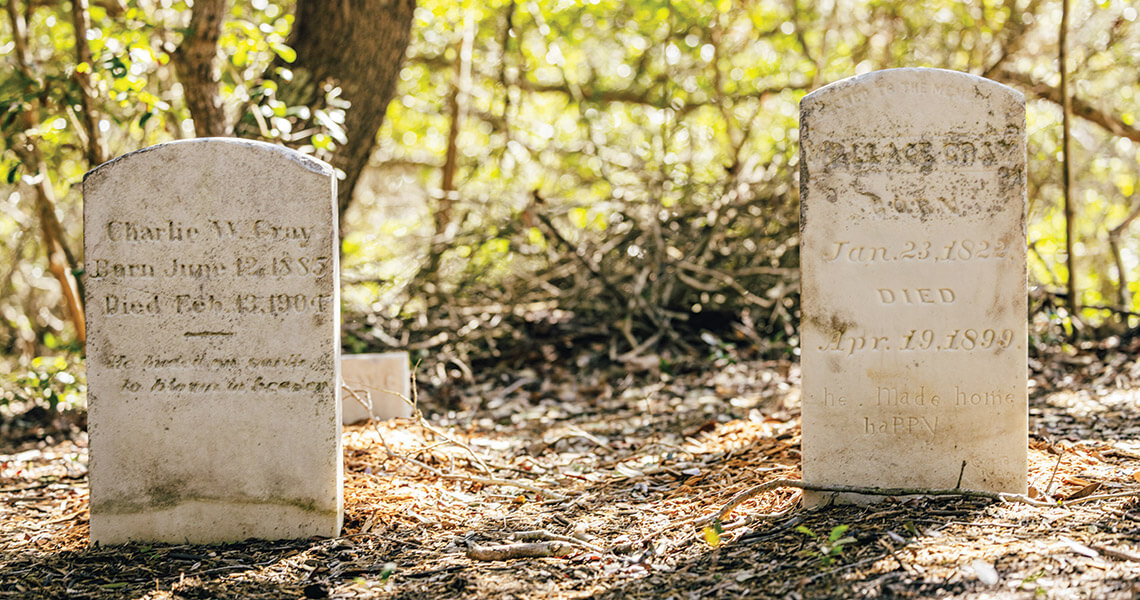
Time-weathered gravestones in Gray Cemetery near Little Kinnakeet commemorate island families, including surfmen and lighthouse keepers whose stories Taylor helps protect. photograph by Baxter Miller
Rosen isn’t the only one to call Taylor. Others do, too — like Daryl Simpson. His ancestors are buried in a Buxton cemetery that’s about the size of a walk-in closet and enclosed by a rusty iron fence. Tree roots had pushed one of the three gravestones from the sandy soil, leaving it in pieces. Taylor first dragged out the overgrowth, then tackled the roots with a battery-powered hand pruner she calls “The Dawnenator.” After several weeks, mostly working alone, she began cleaning, mending, and resetting the stones.
It was a lot of work, but Simpson’s desire to preserve his family’s heritage made every hour worthwhile. Simpson now drives from his home near Sparta whenever he can to help her. He’s inspired by her dedication, and so are the property owners, who welcomed the work and wanted to learn. “It’s important to honor these memories,” Simpson says.
Friends like Simpson do help occasionally, but Taylor does most of the work herself, and she never asks for payment. Some families offer, or she asks them, to cover the cost of cleaning materials, but she doesn’t require it. “I 100 percent put my heart into this,” she says, clunking along in her truck to yet another graveyard.
• • •
After working off and on for almost a year with the National Park Service, which owns the Little Kinnakeet Life-Saving Station site, Taylor gathered last year with uniformed park service staff beneath that chapel of trees beside Pamlico Sound. The Rev. Gina Miller of St. John United Methodist Church in Avon rededicated the cemetery.
A small group of descendants placed flowers on the tidy graves as Miller gave thanks for the generations of people who worked on the water, formed family ties, connected with one another, and passed their faith to those who followed. Miller had never done a service quite like this one, she recalls later. “They lived and were part of the culture of the island,” she says. “That was someone who had children and mattered to someone. They certainly mattered to God. Preserving the cemeteries is about being respectful of that.”
The ceremony honored the ancestors buried there and the people who placed the gravestones, who later moved them away from rising waters, who today makes sure the markers — and the memories — are safe, and the ancestors resting there are always remembered. The ceremony honored people like Taylor.
print it