Asheville, 1895: Winter in the Northeast is a misery, and the friends and family of George Vanderbilt are keen to trade bitter cold and chilly ocean winds for the temperate mountains of North Carolina. Over the past six years, a grand estate that George calls Biltmore has emerged from the hills and woods near Asheville, and soon this hand-picked group of guests will be the first to celebrate here.
Few in their party have seen the house in progress, but each is familiar with George’s grandiose taste, and expectations are high for tonight’s Christmas Eve celebration and tomorrow’s festivities. Although future guests will arrive in carriages, private train cars deliver this group directly up to the house via a rail line left over from construction.
From the train windows, they see the house for the first time. Biltmore stands at the end of a long, green lawn. Its roof is crowned with gilded scrollwork featuring George’s monogram. There, just above the front doors, perhaps, George stands on his balcony, waving welcome …
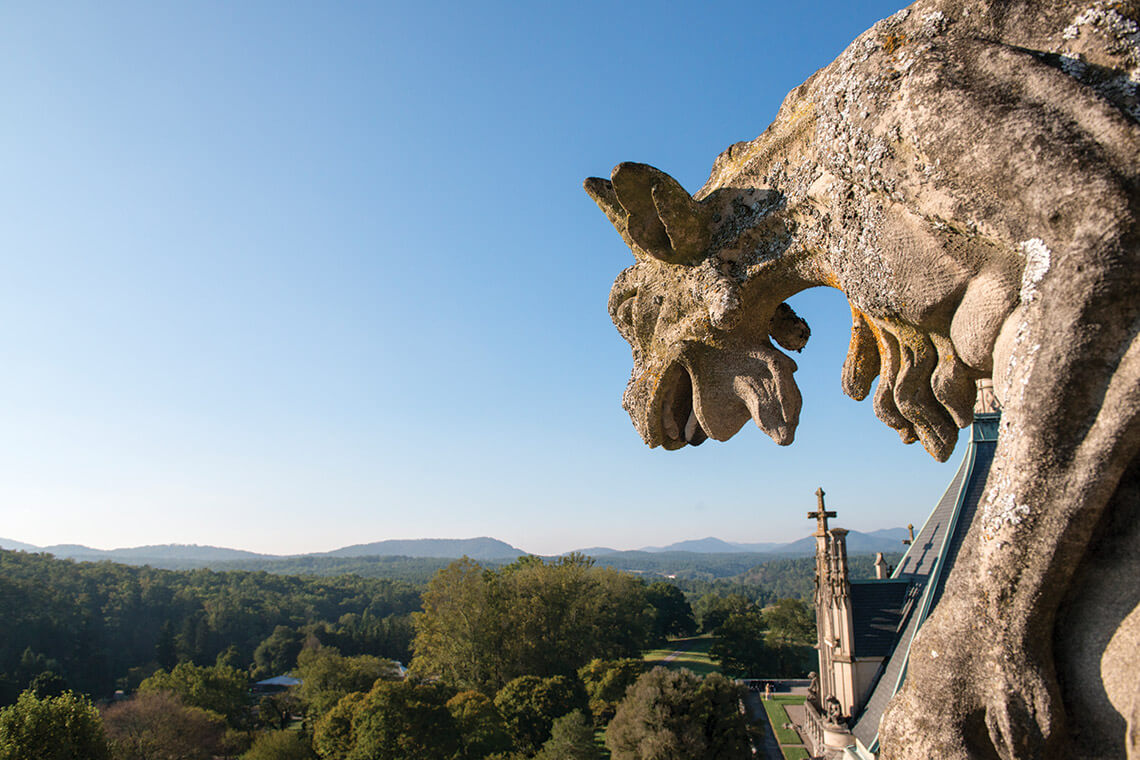
A rooftop tour at Biltmore combines views of the natural beauty surrounding the estate with stories of the man-made art that lurks like a gargoyle around every corner. photograph by Krista Rossow
“… waving from this balcony here in the Observatory, one of George’s private chambers,” says Billy Young, who’s leading a rooftop tour of Biltmore. He pauses long enough to usher his charges onto the spot where George would have stood. Even now, it’s easy to envision a caravan of carriages emerging from the woods.
Young lets spill a secret, one of many he reveals on the tour. “At the top of the upper lawn, there’s a statue of Diana, goddess of the hunt, and as you step onto this balcony — as George did innumerable times — you’re eye-to-eye with her.” From here, Diana looks tiny, her place in the Pantheon reduced to a human scale, putting her on equal footing with the mortals who meet her gaze.
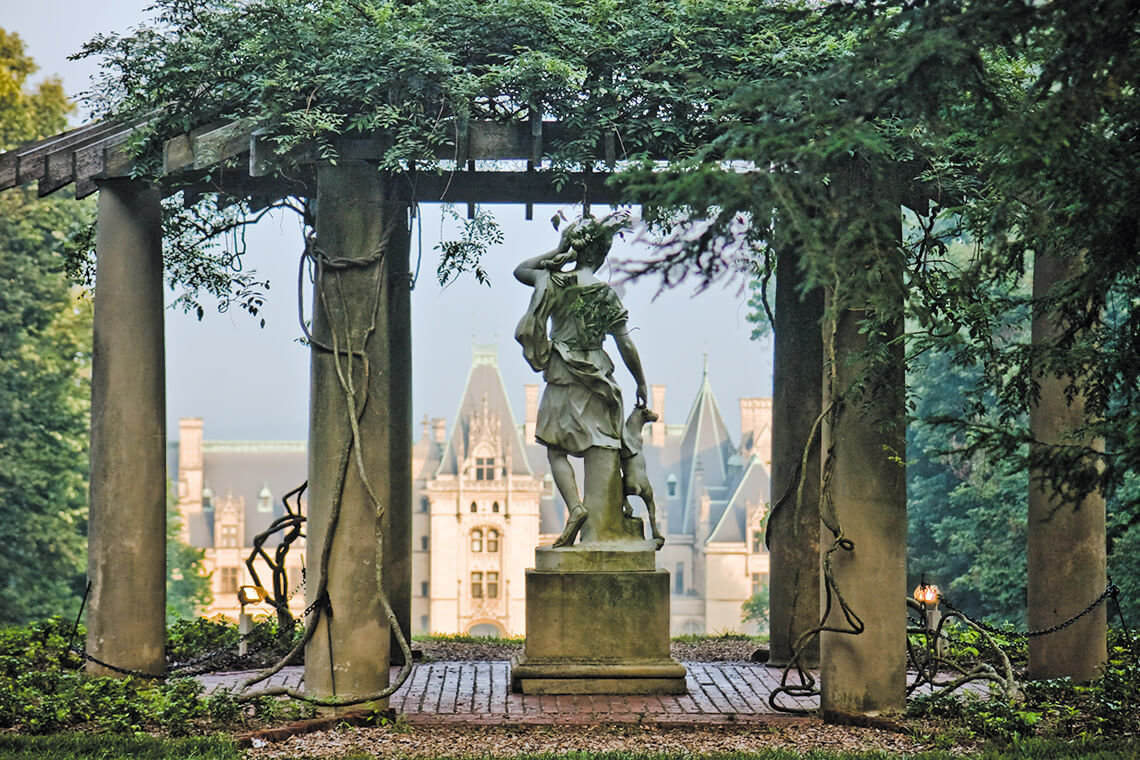
On the upper lawn, a statue of Diana, goddess of the hunt, surveys the Biltmore House. Photography courtesy of The Biltmore Company
Changing direction, Young continues. “Around the corner, we have a cheeky little joke from one of the stonemasons.” The group follows the docent’s gesture and shuffles along the narrow ledge. As each person rounds the corner, sidling past a grotesque, they giggle. The stone figure’s bum — sans tail — is planted firmly on the rail. “This is the kind of detail you don’t see — or want seen — from the ground,” he says.
Indeed, from the terrace outside the Library, you can’t spy the irreverent grotesque, and you’d never know that the bear balanced on the balcony above holds a dripping honey jar. But from the ground to the rooftop, docents like Young reveal details that unlock the secrets and hidden layers living in Biltmore’s artistry.
• • •
At the beginning of each tour, Young gathers his groups around an Italian Renaissance wellhead carved from a single piece of pink Rosso di Verona marble. “We start our rooftop tour on the ground because we want you to experience the house the way those first guests must have, and the way his wife, Edith, did when they arrived after their honeymoon,” he says, “full of wonder and awe.”
Stone latticework wraps around each column, its diamond pattern filled with oak leaves and acorns or fleurs-de-lis, the shapes echoing one another. Young points out a frog, two cherubs with abs, intricate and identical scrollwork, all carved by hand. There, in one corner high above the terrace, perches a cartoonish, wild-eyed chicken.
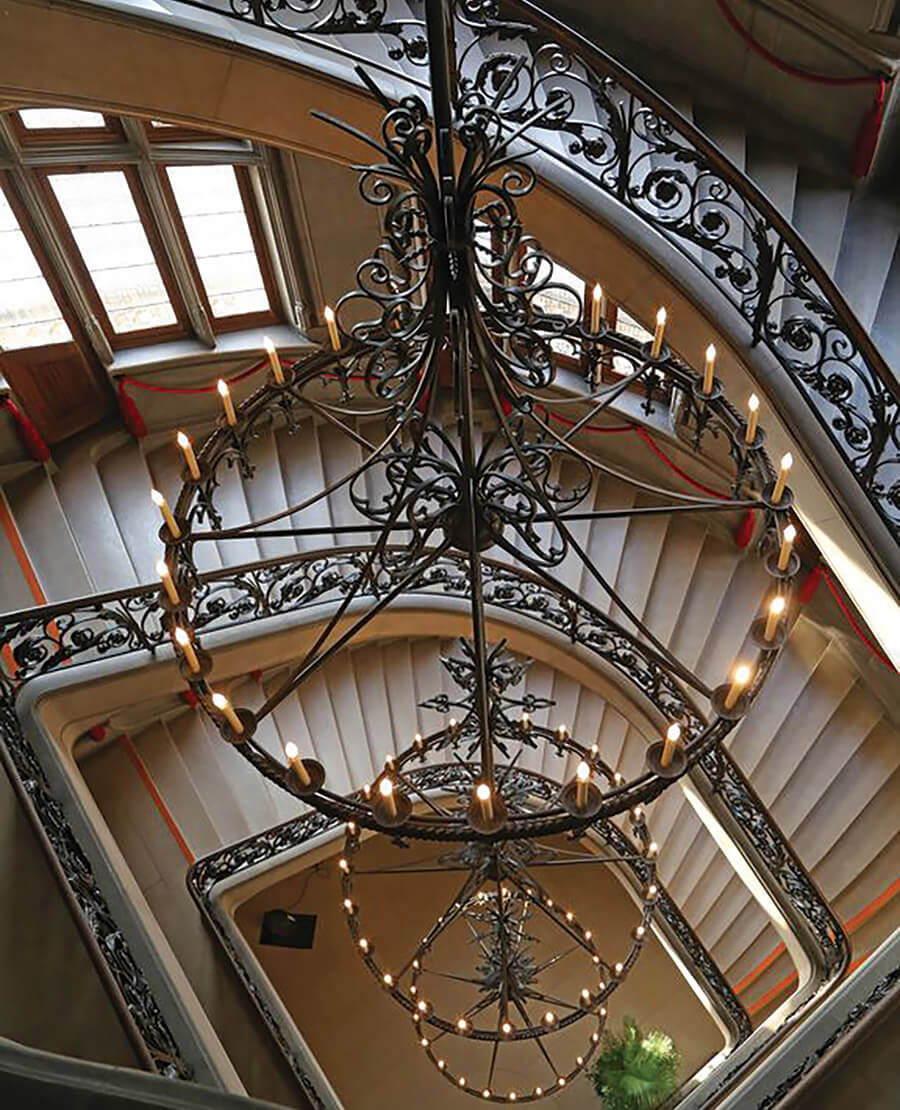
The chandelier in the Grand Staircase is suspended by a single bolt. Photography courtesy of The Biltmore Company
Young walks and talks, pirouetting with practiced grace as he glides into the house and up the spiraling Grand Staircase. He points out faces in the stone, more oak leaves and acorns, and a shield adorned with a boar’s head — “the crest of the Kissam family, on George’s mother’s side,” he explains. His circuitous route leads to the roof above the Grand Staircase.
“We’re on the dome supporting the giant chandelier that hangs in the Grand Staircase,” he says. “It’s a marvel — held in place by one nut — but that’s not the most interesting thing. We know exactly who installed it and when they did the work. The laborers took it upon themselves to carve their names and the date, 12/18, into the plaster. Keep in mind that George opened the house on Christmas Eve, so they were working down to the wire.”
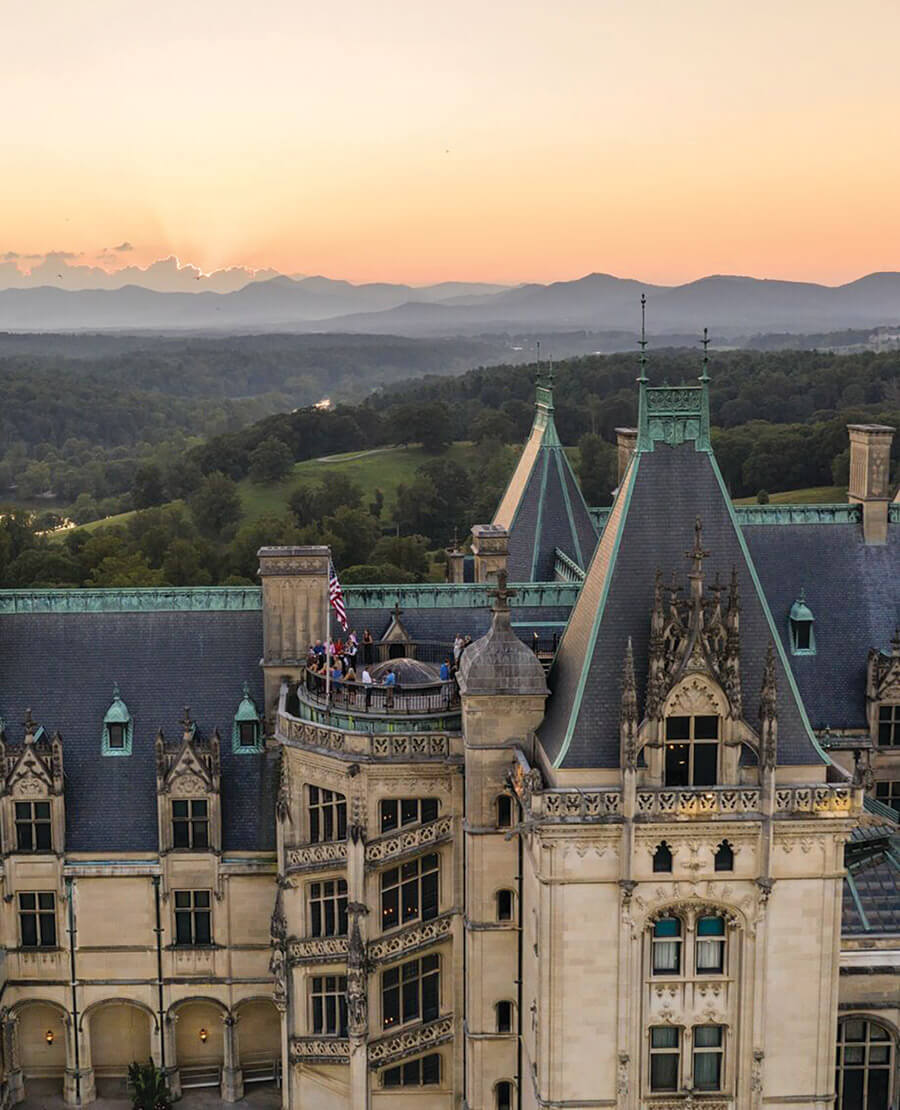
On the Rooftop Tour, guests stand atop the copper dome supporting the chandelier that hangs in the Grand Staircase. Photography courtesy of The Biltmore Company
A patina covers the copper ridge that caps the roof, and on it, panels alternate between a stylized “GV” and the acorn motif. “When those Christmas Eve guests arrived, and when George’s wife, Edith, saw the house after their honeymoon, those were gilded,” Young says. In a few places, you can find flakes of gold leaf clinging to the copper.
One domed roof is shingled in stylized laurel leaves, another in thick slate. And if you follow the improbably steep roofline over the Observatory, you find an outlier: a dual crest — one half acorns, the other half an eagle — combining George’s and Edith’s family crests.
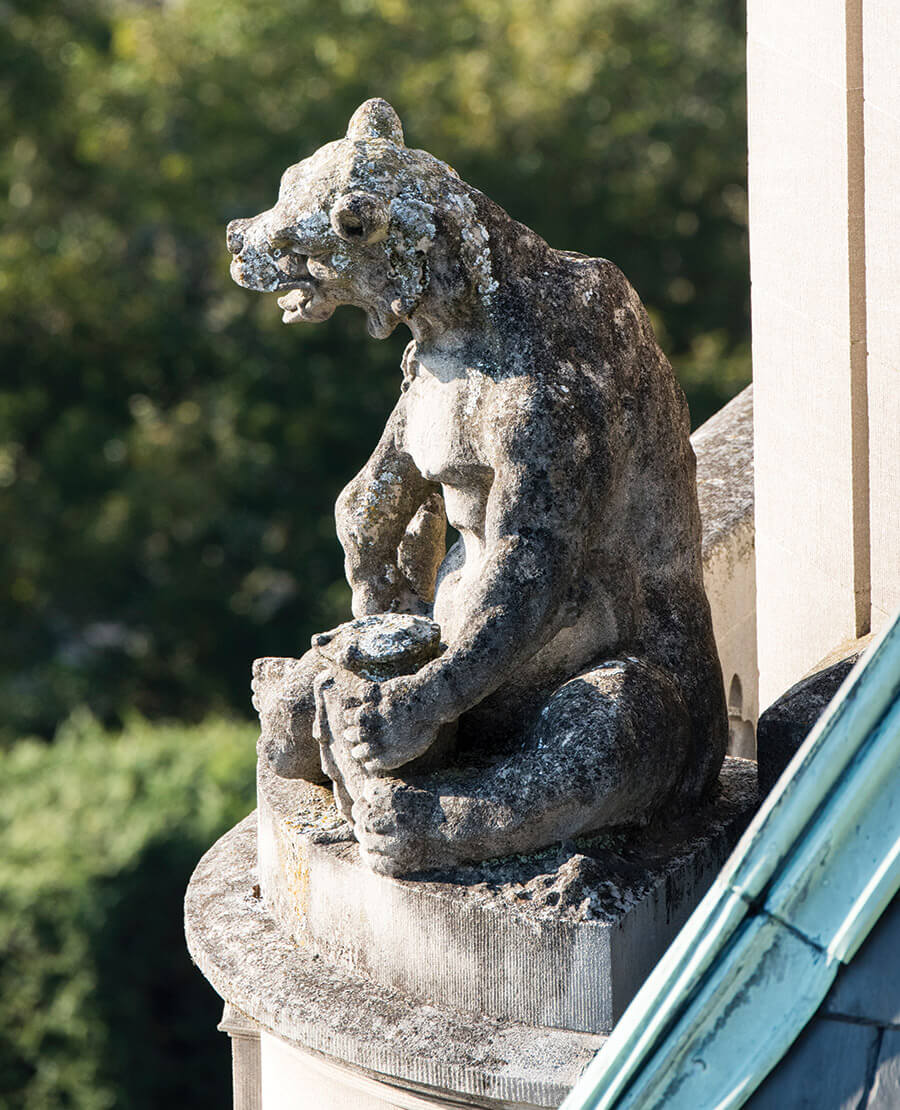
Indiscernible to the naked eye from the ground, a stone bear balanced on the balcony holds a dripping honey pot. photograph by Krista Rossow
Fall 1898: George and Edith arrive in Asheville fresh off a four-month honeymoon spent touring the art museums and galleries of Venice and Vienna while staying in a villa in Stresa, Italy. The couple floats from train to platform to the carriage that will deliver them to Biltmore.
Edith, a Gilded Age aristocrat in her own right, must have an idea of what to expect from her new home. But George, never one to do anything halfway, has surprises in store for his new wife.
It takes their carriage 45 minutes to make the trip up the Approach Road, and every few paces there’s a cluster of employees waving and welcoming the couple. Edith’s anticipation surely grows as they wind through the forest. Despite her efforts to see through the thinning leaves, the house remains hidden.
Then they reach the gate. “GV” stands out in gold, the letters dividing as the gate opens and their carriage turns, giving her the first look at Biltmore. On the lawn, she spots a giant horseshoe of goldenrod flowers and the message “Good Luck.”
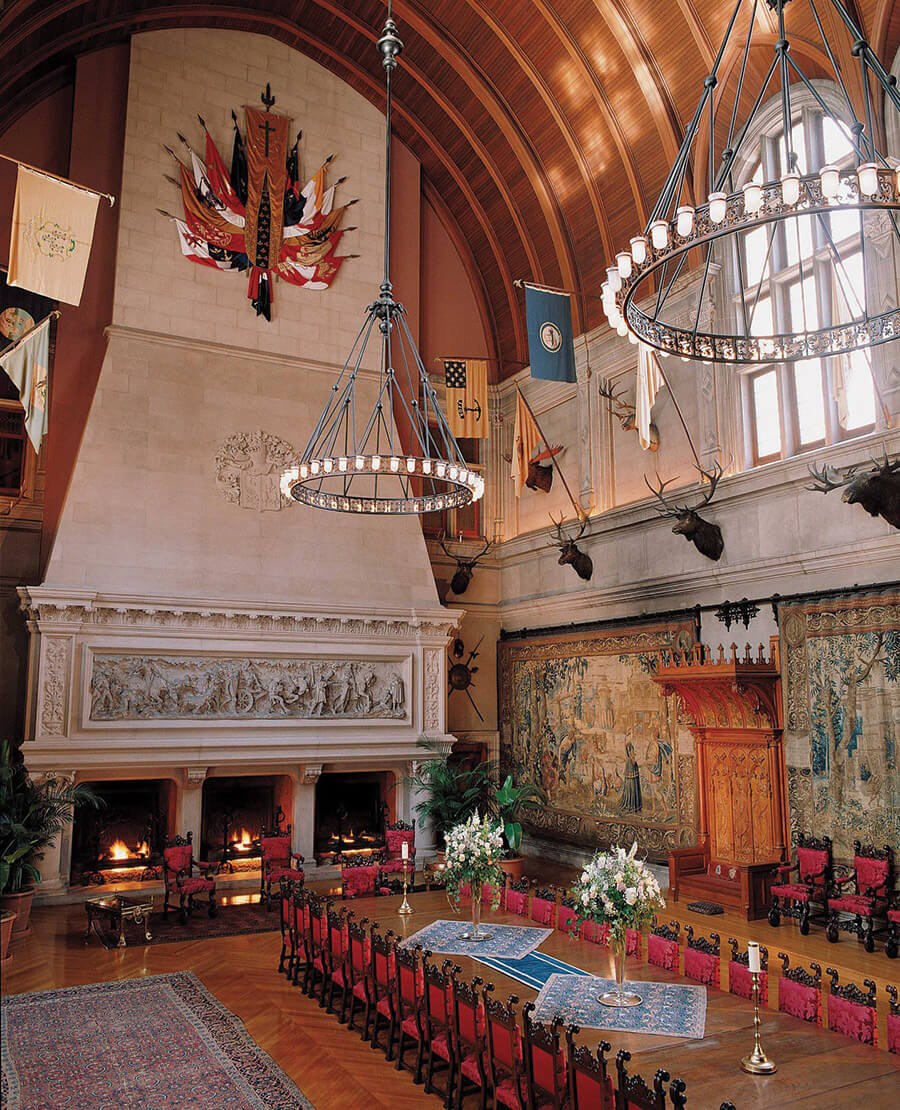
With its 70-foot-high, barrel-vaulted ceiling, the Banquet Hall draws the eye upward. Look a little lower to see the frieze, carved by Karl Bitter, over the triple fireplace, and the 16th-century Flemish tapestries on the walls. Photography courtesy of The Biltmore Company
When Edith first experienced Biltmore, she would have seen the gilded designs along the ridge of the roof, felt at home among the portraits and sculptures inside. But were there details that went unnoticed for a time? Standing in the Winter Garden, did she note the bell tucked away in a high corner like a forgotten secret, or were her eyes drawn to Karl Bitter’s Boy Stealing Geese statue hiding among the foliage?
In the cavernous Banquet Hall hang five tapestries, each as big as a living room. Though they are impossible to miss, the details within them often go unseen by many — they’re too awed by the 40-foot-long table and enormous pipes stretching from the organ on the balcony. In one tapestry’s threads is a classic love triangle: Venus, her lover Mars, and her husband, Vulcan. Vulcan’s nearly caught them in flagrante, but some censor’s brush has applied a few strokes of red paint.
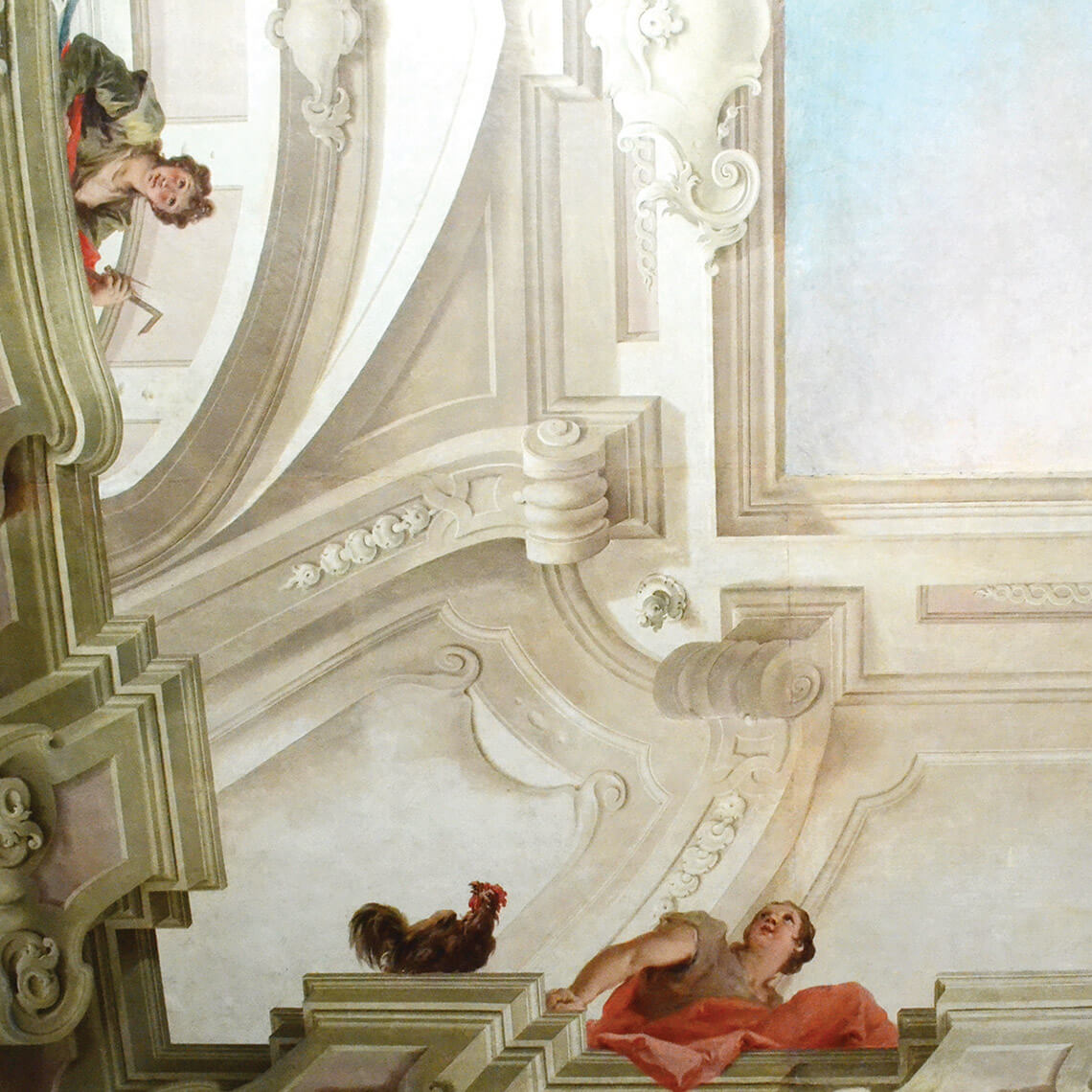
A library crowned with The Chariot of Aurora reflects Vanderbilt’s love of reading. Photography courtesy of The Biltmore Company
Every house tour slows down in the Library, and for good reason. The walls are lined with French walnut shelves. Drawers hold George’s self-devised card catalog and notes on the 3,159 books he’d read. And then there’s the showstopper overhead: The Chariot of Aurora, 62 by 32 feet, fills the ceiling with tempestuous clouds, a host of angels, and Aurora welcoming dawn. Look up as you exit, and you’ll spot a red rooster, caught in mid crow, looking down on George’s 10,300-plus leather-bound tomes.
• • •
At the final stop on Young’s rooftop tour, he gives the group a moment to study the view of Mount Pisgah — once the limit of the Biltmore Estate — and the ocean of hills between here and there. This is the balcony off George’s rooms and adjacent to Edith’s suite. An intimate spot. Stony faces, figures, and crests show at every window. Gryphons frame a shield and its raised “V.” Cherubs hold the oaky crest of the Vanderbilts and the boar’s head motif of the Kissams.
One gryphon clings to the wall in a place where corner meets corner meets roof. It must’ve been near-impossible to carve: You can picture the sculptor wedged into that tight space, hammer blows weak from lack of leverage, dust and chips falling in his face as he coaxed this creature of myth from the stone.
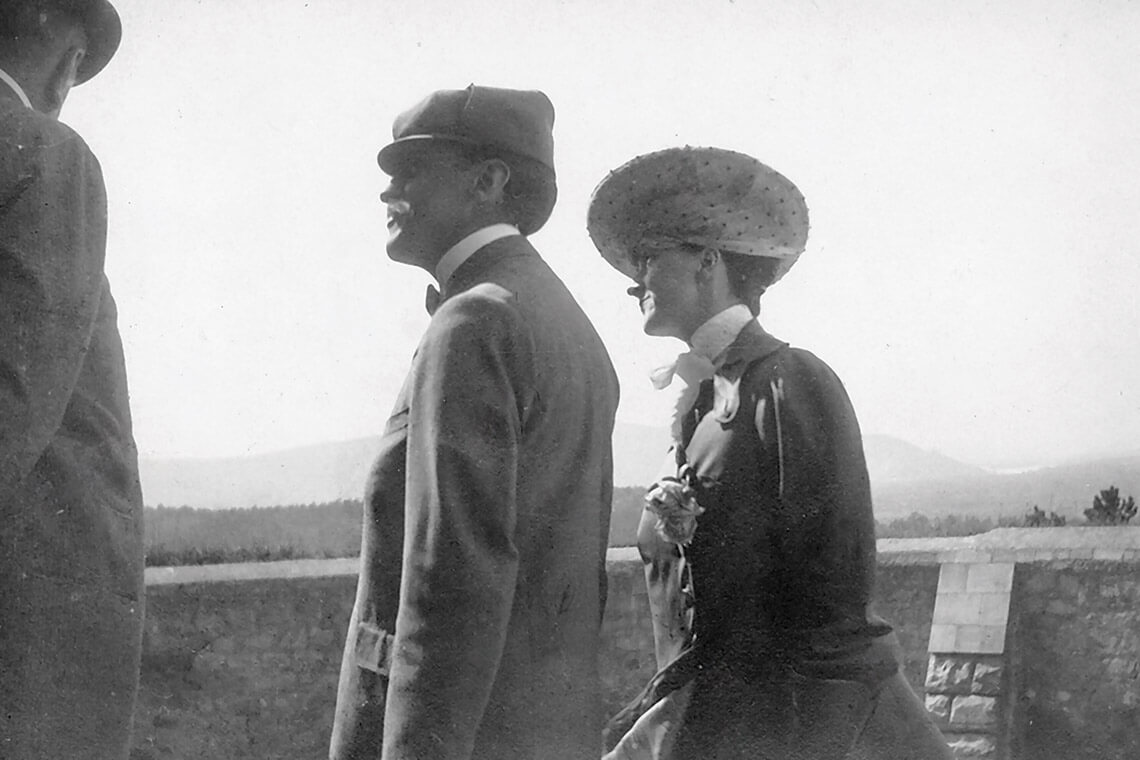
Before George Vanderbilt met Edith Dresser, Biltmore was a tribute to his passions. Photography courtesy of The Biltmore Company
One tour-taker holds up his phone to get a shot of the landscape. He turns and snaps a selfie with his fiancée. She grins and holds up her hand to show off her new ring, with Mount Pisgah and the rolling hills of the Biltmore Estate behind them. It’s not hard to imagine another happy couple standing out on a Biltmore balcony, more than 120 years ago.
Fall 1898: By the end of her first day at Biltmore, Edith has begun to get to know her new home, taking in the architecture and the art that George has selected. She’ll quickly adapt to her role as lady of the house, and in the coming years, her good cheer and skill as a hostess will be well known among their family and friends.
But for now, George and Edith step onto the balcony outside the Observatory. Night has fallen, shrouding the distant Mount Pisgah in darkness. The couple watches as workers carrying torches converge in a parade on the Vista while the Biltmore band plays a march. Overhead, fireworks light up the sky in celebration of the Vanderbilts’ new life together.
Biltmore Estate
1 Lodge Street
Asheville, NC 28803
(800) 411-3812
biltmore.com
print it