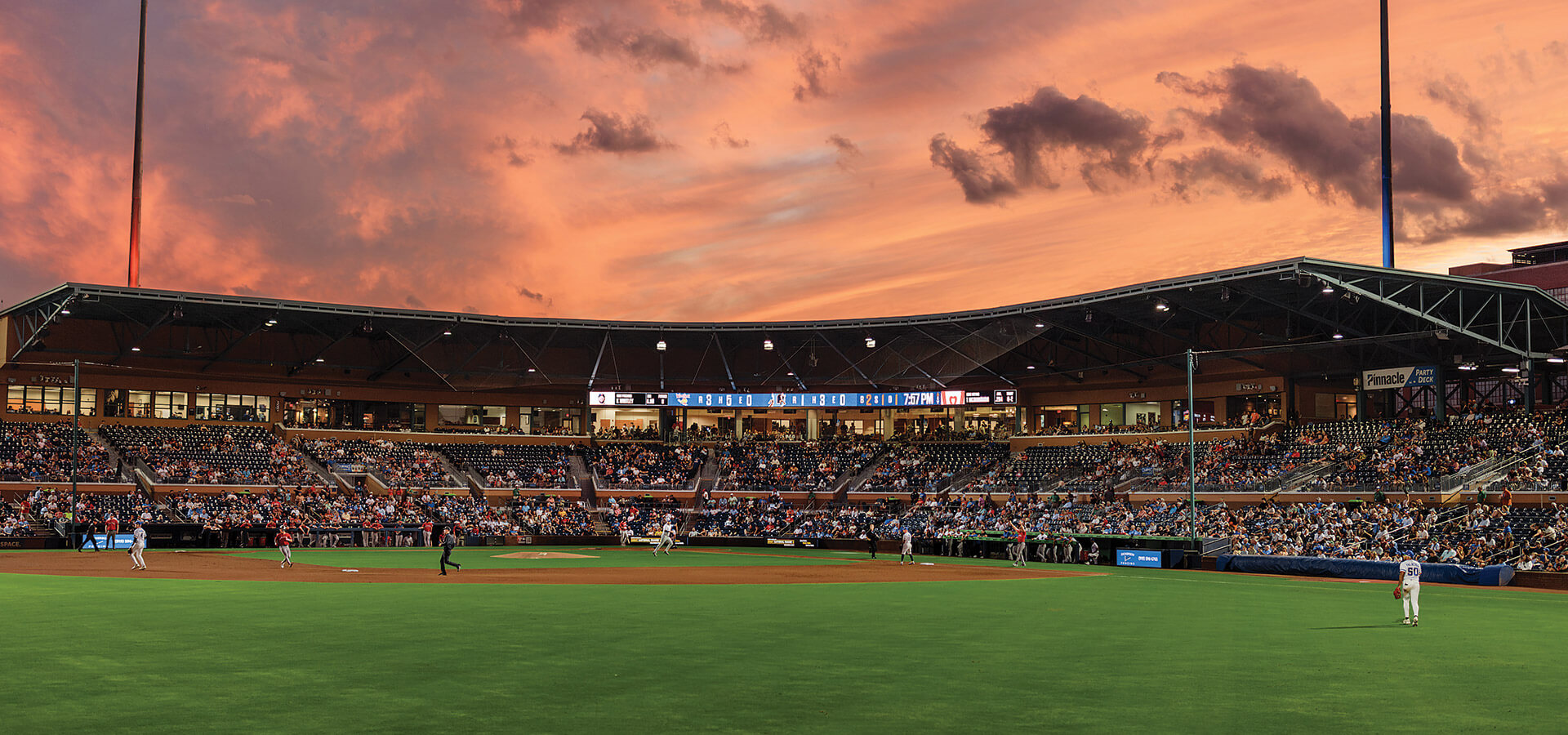
As the sun begins to set, the fading light wraps the city’s skyline in shadow. The moon appears, the stars blink above center field, and Chris Ivy takes it all in from the best seat in the house, his elevated cocoon of wood and steel behind left-center field.
“It’s a gift that no one knows about,” he tells me. “I get to see the sun set.”
Chris has embraced this gift for 19 years while operating the Durham Bulls’ manual scoreboard behind the ball-yard’s own Blue Monster: a left-field wall 32 feet high and 305 feet from home plate. Designed by the same architects behind Baltimore’s Oriole Park at Camden Yards and Denver’s Coors Field, Durham Bulls Athletic Park opened in 1995. But it looks and feels like the secular cathedrals of brick and steel that arose more than a century ago in America’s biggest cities.
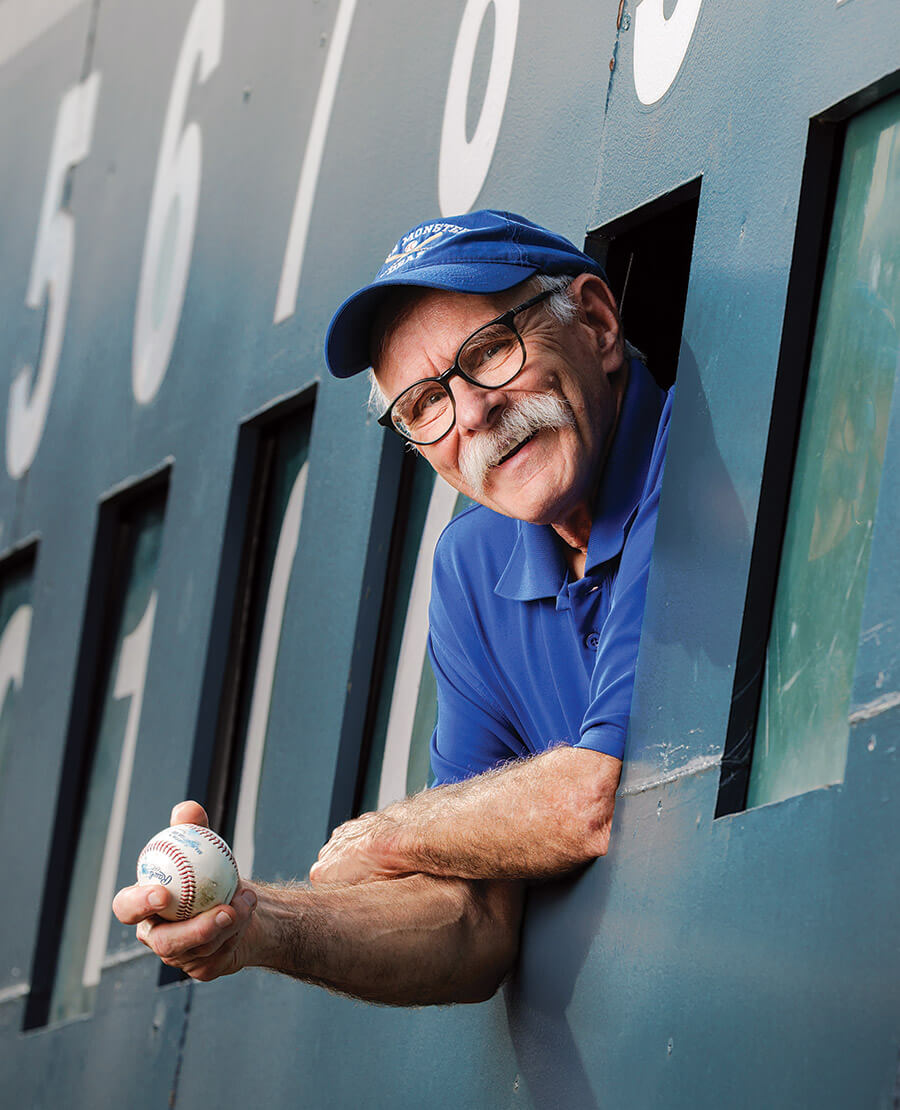
As evening settles over the ballpark, Chris Ivy follows each pitch from his perch behind left-center field. “It’s hard to believe that I’ve been doing this for so long,” he says. “But so many pieces of it click for me.” photograph by Jerry Wolford & Scott Muthersbaugh
Chris does love the game of baseball. I get it. As I stand over Chris’s shoulder, listening to the crack of the bat and the rising raaaah from the crowd at least 300 feet away, my mind rewinds to a time long ago when I slipped a Rawlings glove on my left hand and embraced its musty funk of dirt, stale sweat, and cracked leather rubbed to a burnished glow. Chris understands. He once turned graph paper into scoresheets for games he watched on TV and used cardboard as bases to play pickup baseball for hours in an open field behind his grand-parents’ house. Back then, he was no more than 9. Today, he’s 77, the caretaker for one of the few manual scoreboards operating in baseball today.
“It’s a link to the past,” says Chris, smiling through his broom of a mustache. “Everything is so hustle and bustle these days. But the scoreboard brings it back a little bit to a simpler time. People connect to that.”
So does Chris. But it’s not just about history.
• • •
Two years ago, Chris and a college friend traveled back in time. They visited Boston’s Fenway Park, built in 1912. Boston Red Sox’s front office gave Chris an exclusive tour of their manual scoreboard behind Fenway’s Green Monster — its fabled left-field wall rising 37 feet high, 310 feet from home plate. After a few minutes of talking to the operators, Chris looked around and had an epiphany: “I have a lot more room than they do.”
He does. And that surprises me.
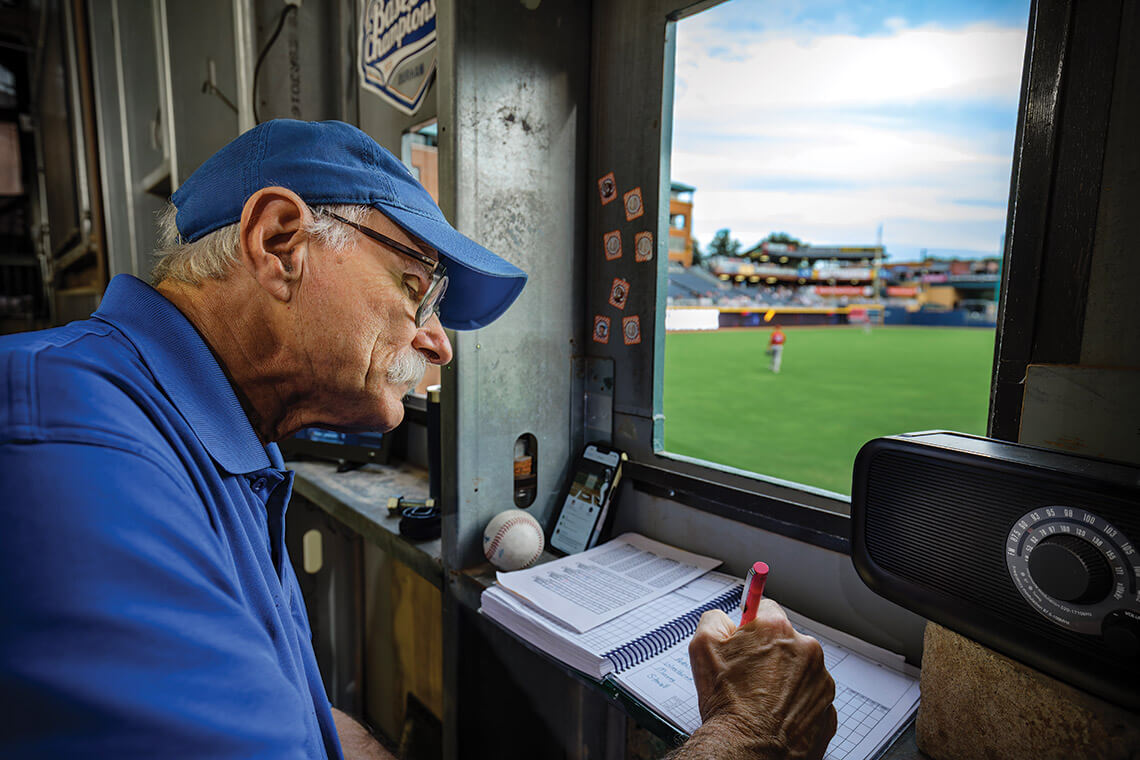
Chris tracks home games in a scorebook — a ritual that began when he was a boy in southern New York, charting baseball on graph paper he got from his stepfather, an electrical engineer. photograph by Jerry Wolford & Scott Muthersbaugh
I’m a few steps behind Chris on a wooden porch that runs the length of the scoreboard. It’s no more than three feet wide. We’re about 10 feet above a dirt-and-gravel floor behind the Blue Monster, and Chris sits in a high-back blue chair surrounded by his essentials: a radio, a small TV, a fan, and his smartphone. He listens to the Durham Bulls game on the radio, watches the WRAL broadcast on a small TV, and peeks out his scoreboard window to check on the game. When a run scores, he springs from his chair, grabs one of the large plastic numbers stacked like playing cards around him, and slides it into the scoreboard’s metal sleeve. He returns to his blue chair, a disciplined student of the game.
Chris fills in a scorebook as the game progresses using two pens — one red, the other blue. When the season ends, he stores them all in his attic. His stack is nearly two feet high.
“It’s still a thrill to go to the ballpark,” he says. “All of it fills those cups that didn’t get filled back then.”
• • •
Chris grew up in southern New York in a small village known as Endicott, where working in a shoe factory paid everyone’s bills. Chris’s parents separated when he was 3. His mom moved in with her parents, and Chris latched onto the only father figure he really knew: his grandfather.
Chris followed him to Danny’s, a local bar, where Chris drank orange soda and they both watched baseball on TV. Chris bought baseball cards from a store down the street. He’d attach a few to his bike’s spokes with clothespins to hear tat-tat-tat-tat-tat as he rode everywhere. The rest he kept in a shoebox or traded with his friends and his cousins, Chuck and Gary. In nearby Binghamton, all three of them caught games played by the Triplets, a farm team for the New York Yankees.
After his parents divorced, Chris’s mother remarried, and when he was 8, they moved into a new house, farther from his grandfather. Chris didn’t see his father again until he was 18 — and after that, not for another 31 years.
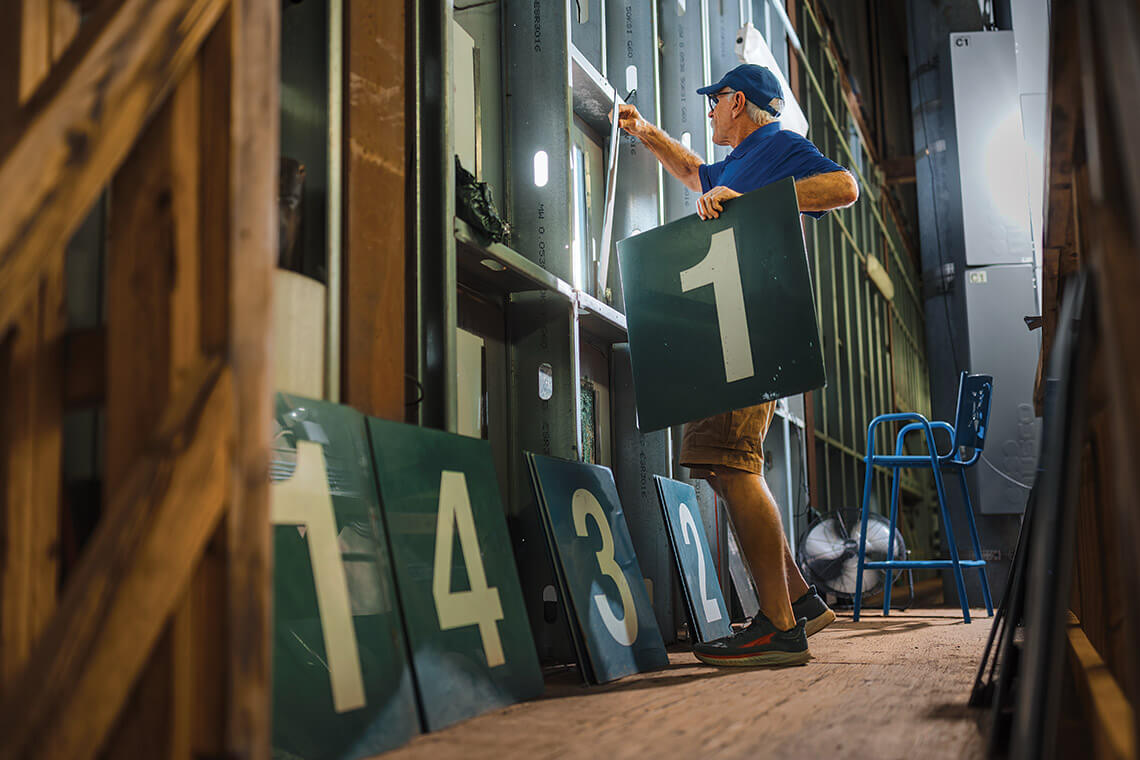
Behind the Blue Monster, Chris tracks the score. photograph by Jerry Wolford & Scott Muthersbaugh
After graduating from Providence College, Chris became a social worker and later married his wife, Virginia. They had a daughter, Eleanor, and when Virginia came to North Carolina to get a master’s degree in social work, Chris applied for a job with Durham County Department of Social Services. He stayed there for 35 years until he retired in 2013 as a supervisor in adult services, working with people in long-term care.
Chris watched the Durham Bulls play as often as he could, and in 2008, the team held a job fair to fill their open positions. Chris knew he had to go. He had always been a fan of the city’s Triple-A franchise, the farm team for the Tampa Bay Rays, and he always wanted to be part of a team. He figured he’d get a part-time job as an usher. But when he saw the opening for the manual scoreboard operator, Chris applied. He got the job.
From sitting in the stands to operating the scoreboard, Chris told himself. I’m stepping into something pretty big for me.
• • •
As Chris works, I daydream, replaying scenes from Bull Durham, the 1988 romantic comedy about minor league baseball that was shot at Durham Athletic Park, the team’s former home for almost 70 years. I recall that great line delivered by Susan Sarandon who played the baseball-loving Annie Savoy, the wise sage of the film. In a voice as lyrical as her character’s Southern accent, she says: “The only church that truly feeds the soul, day in day out, is the church of baseball.”
As scenes from the film unspool in my mind during the game, I hear Chris speak. And he’s speaking to me.
“Bottom of the fourth,” he tells me. “Getting close to the infamous sixth.”
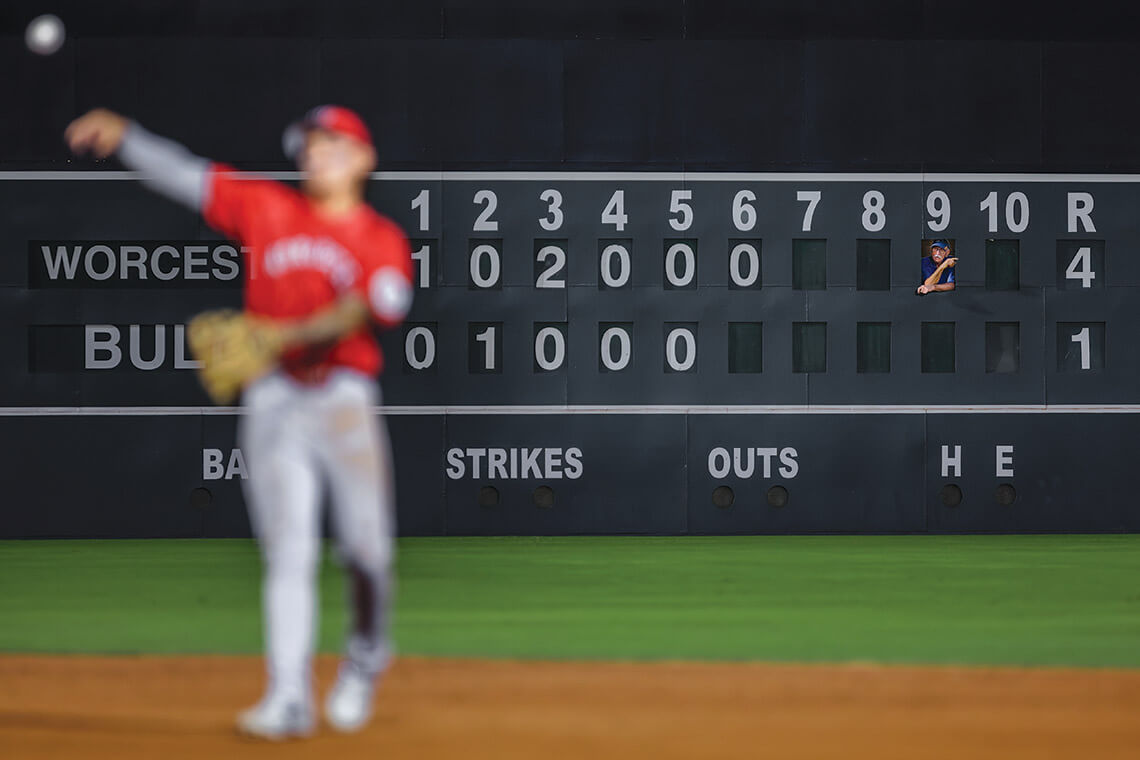
The ninth-inning slot doubles as Chris’s game-day window, where fans catch a fleeting glimpse of the man who keeps the Blue Monster moving. photograph by Jerry Wolford & Scott Muthersbaugh
In the middle of the sixth inning, the game’s announcer directs the crowd’s attention to the scoreboard and says Chris’s name, acknowledging his 19 years on the job. Chris sticks his head out of the scoreboard’s ninth-inning slot, his face filling the ballpark’s two-story LED billboard, and waves to the crowd. Cheers ripple through the stands.
Jim Goodmon, chairman of Capitol Broadcasting Company, which owns the team, started the tradition last year to honor Chris’s many years working behind the Blue Monster. The recognition came soon after Chris helped the Duke Cancer Institute in their “All-Stars” fundraising and awareness campaign. Chris shared in an interview how he was diagnosed with prostate cancer in 2008, his first year as the scoreboard’s operator. After surgery and rounds of radiation, Chris’s latest test results are now in the healthy range. At first, he was reluctant to go public with something so private. But by the end of the hour-long interview, he changed his mind.
“I wanted people to know there is life after diagnosis,” he says.
• • •
A few days later, I hear from Chris once again, and he tells me about meeting a young boy, no more than 9, after a game. Chris introduced himself to his parents, and like he does with Georgia, his 8-year-old granddaughter who calls him “Gramps,” he leaned down for an eye-level conversation. The boy was cradling an empty baseball glove.
“Hi, I’m Chris. I work the scoreboard. Did you get a fly ball today?”
The boy shook his head.
“I think I can take care of that.”
Chris pulled a baseball from his backpack and gave it to the boy. The boy’s eyes widened in surprise. He couldn’t speak. The boy’s mom did. She told Chris they had just left the stadium’s gift shop, but their son hadn’t saved enough money to buy a baseball. Now, thanks to Chris, he got one for free.
“Thank you so much,” says the mom.
“God bless you,” responds the dad.
Annie’s memorable line from Bull Durham often makes me wonder: Can baseball really feed your soul? But Chris doesn’t wonder. He knows.
FOR AUGUST: In Saluda, a brother-and-sister team keeps a historic store and grill humming with burgers, groceries, and the kind of care that feeds a community.