“Does this bring you joy?” my wife, Megan, asks. She’s holding up a dusty glass beer mug filled with a mélange of rocks, shells, and pocket change, a strand of green Mardi Gras beads draped over the embossed image of the wrestler André the Giant, his chest bare, arms akimbo. She half waits for an answer, but she knows without a doubt what’s coming.
From anyone else, the query would be something of a decluttering litmus test: Does this thing elicit some level of elation? If not, why keep it? But from Megan, who’s elbow-deep in a box filled with a lifetime of my junk, er, my memories, it’s more of an inside joke. She knows my penchant for accumulating keepsakes and mementos — my love, or more accurately, my need to collect … things.
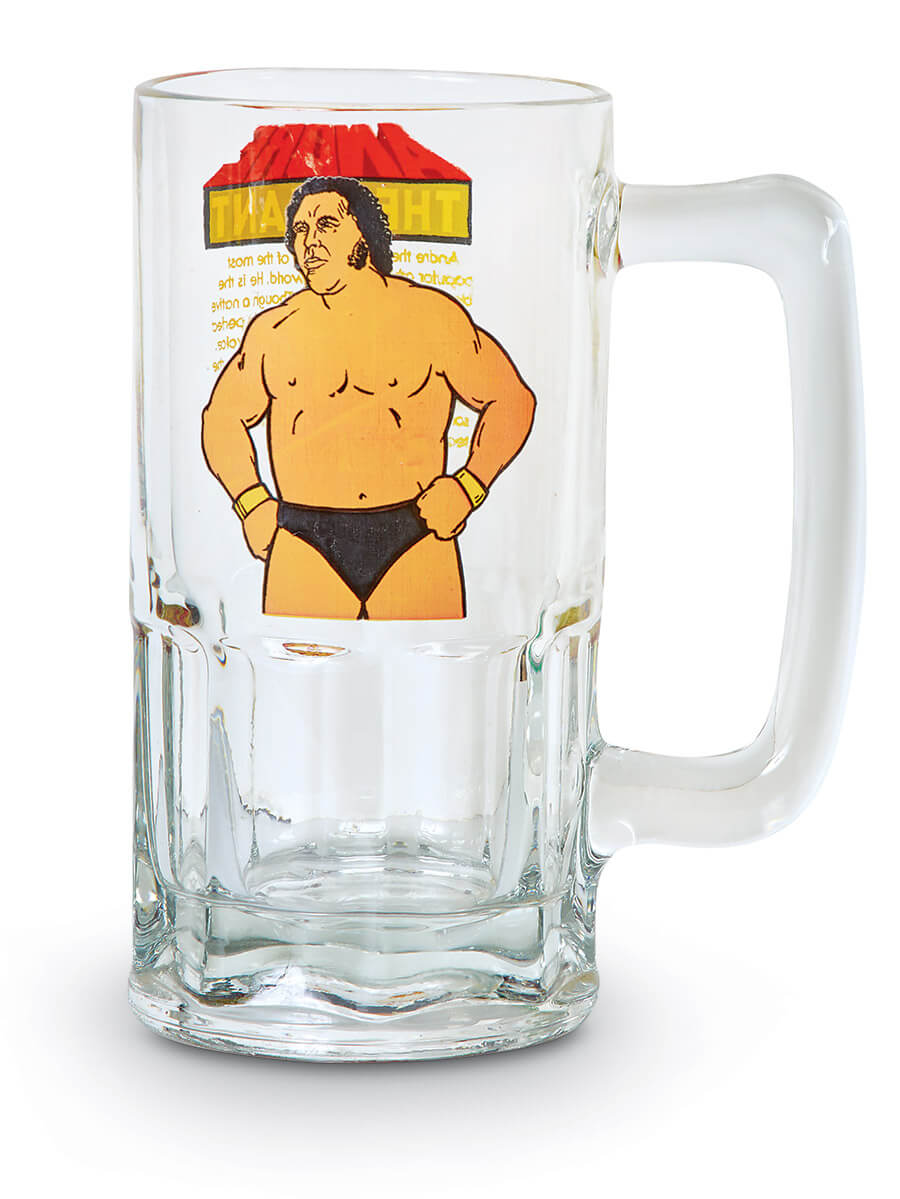
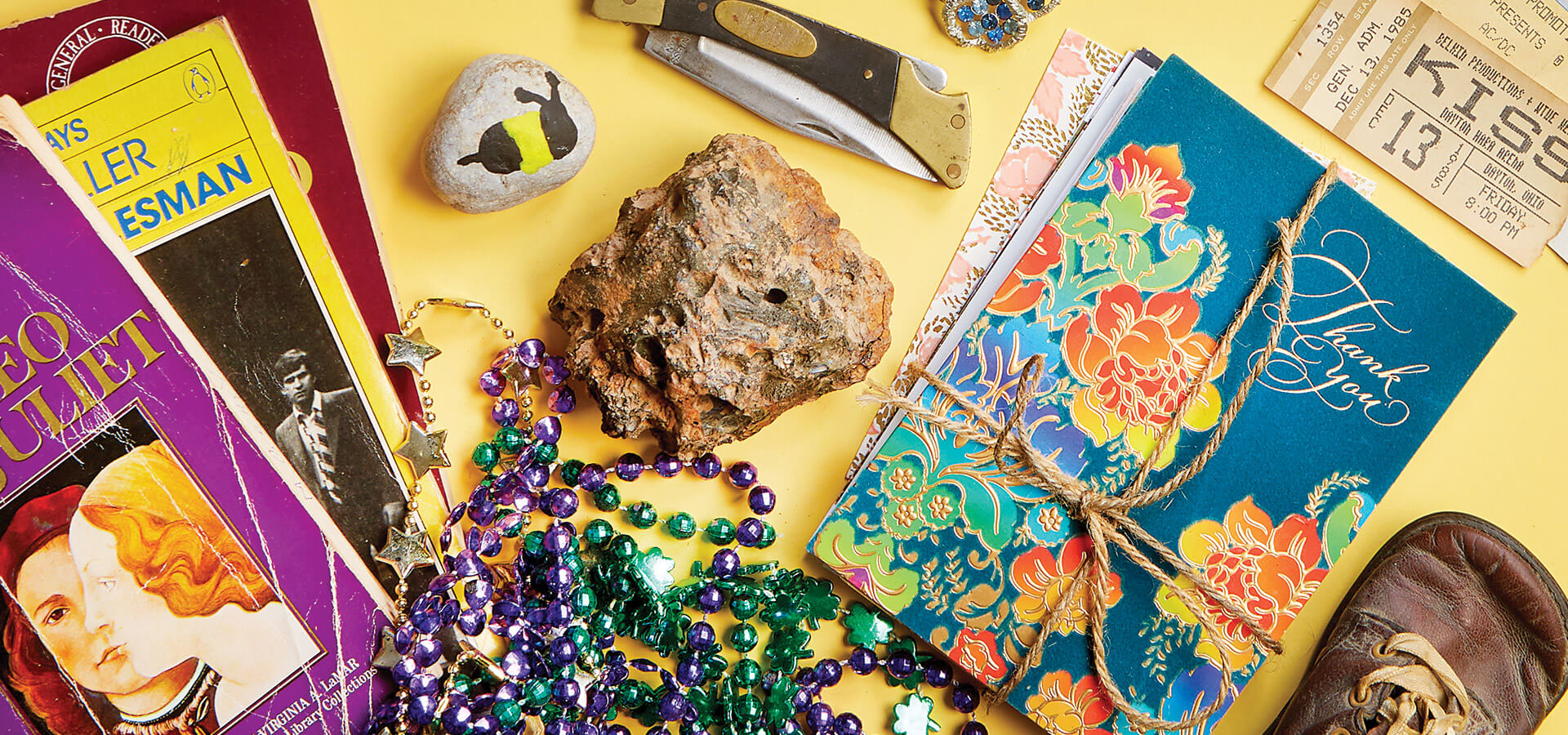
One mug, many memories — proof that keeping things is really about keeping stories. photograph by Matt Hulsman
She has no way of knowing what she’s holding: The origins of the mug — a novelty I bought as a teenager in 1985 from Spencer Gifts in the mall. Who André the Giant is — the greatest wrestler to ever live (a hill I will die on), who just so happened to make his home in Ellerbe, only 50 miles south of our home in Asheboro. Or what’s in it — stones picked up decades ago on hikes through the Uwharrie Mountains after we moved to North Carolina, Scotch bonnets collected on walks along the Outer Banks months after our daughter was born, vestiges of tips earned when I delivered pizza in college. But I can tell that my wife is at least aware of the significance of what she has in her hands. Its significance to me.
There’s no need to inspect the mug’s contents. Same for the cigar box brimming with my late father’s long-ago-broken pocketknives and ticket stubs from every concert I’ve ever attended. The crocodile-skin jewelry box in which my late mother kept her pricelessly worthless costume jewelry and where I now stash my most-prized football and basketball cards. The velvet bag bulging with bundles of thank-you notes, birthday cards, and even postcards from the 1940s and ’50s, shared between my dad and his brother when the latter was in the Air Force. I know what’s hidden inside; I know the amount of joy each squirreled-away artifact holds for me.
And she knows the answer: “Yes, that brings me joy.”
• • •
The trouble with being a transplant is that when you move somewhere new, you usually have every intention of traveling light. When I moved here 20 years ago, all my belongings fit into the bed of my pickup, but before I knew it, I had started collecting a life. Bit by bit, souvenir by souvenir.
There’s the chipped mug I’ve held on to from The Atlantis Lodge in Salter Path. The Grandfather Mountain T-shirt I bought after getting caught in a downpour. A Pepsi-Cola crate rescued from one of the huge antiques shops on Sunset Avenue in Asheboro. Each precious thing has a story, and each story feels like a living root — proof I belonged somewhere.
I acquired that Pepsi crate one Saturday last spring when I wandered into Collector’s Antiques Mall “just to look.” The place smelled of old wood and brass polish, every booth a tiny museum of someone else’s memories. I moved slowly through aisles of milk glass and Mason jars, past a row of rotary phones and stacks of white-and-green Pyrex bowls — the kind that sat in nearly every kitchen in the 1970s.
Then I saw a toy that stirred in me a joy I had thought long buried: a small blue-and-red Hot Wheels replica of The King’s STP stock car, just like the model I’d raced across the linoleum floor of my grandparents’ kitchen 50 years before. I picked it up, and suddenly I was 6 years old again. Of course I bought this reminder of a forgotten memory.
• • •
Somewhere along the way, I stopped pretending I was collecting — beer mugs, Kentucky Derby pins, ticket stubs — and started curating. Now, my shelves look less like chaos and more like a museum: Artifacts of a Misspent Youth, The Great Candle Era, Phone Chargers of the Lost Generation, Books.
So. Many. Books.
How does an English major part with his Norton Anthology of Literature, dog-eared copies of Romeo and Juliet and Death of a Salesman, and all those CliffsNotes?
And then there are the bins labeled with my daughter’s name, age, and corresponding grade, filled with every macaroni art project, every painted rock, every progress report, and every spelling test in English and en Español. I tell myself I’m saving them for her, but I know better. I’m saving them for me. Proof that something’s growing here. Proof that, even as a transplant, I’ve taken root.
Sometimes I wonder if she’ll be a sentimental saver like her father and grandparents. Maybe she’s learning from me that keeping things isn’t just about memory — it’s about meaning. It’s how we say, This mattered.
I used to think clutter was proof of chaos. Now I see it as a trail of breadcrumbs leading back to every place I’ve called home.
Maybe that’s what all this stuff really is — evidence of a life lived, not always neatly, but fully. The chipped mugs, the faded T-shirts, the macaroni masterpieces: They’re markers of time, of love, of belonging.
I used to think clutter was proof of chaos. Now I see it as a map — a trail of breadcrumbs leading back to every place I’ve been lucky enough to call home.
Someday, when my daughter goes through these boxes and bins, she’ll probably roll her eyes and maybe, hopefully, squirrel away one or two things for herself — her grandmother’s gnarled leather baby shoe, my first lock-blade engraved with my initials that I ordered from an ad in TV Guide, a shell from the beach where she took her first steps on sand. Maybe she’ll understand that being a pack rat isn’t about holding on to things, it’s about holding on to who we are, of who we were, and how we got here. Holding on to joy.