Bernard Mumford has long specialized in restoring damaged goods to their original glory, but lately he’s undergone a bit of retooling himself. Call it a reinvigoration of the spirit that came nearly at the price of his life.
At the moment, though, he’s focused on all the tarnished treasures awaiting attention at the 16,500-square-foot warehouse in northwest Raleigh that’s home to Mumford Restoration.
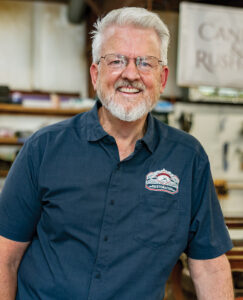
Bernard Mumford photograph by Charles Harris
Many of the pieces elicit a deep reverence in the irrepressible Mumford, 63. Others, not so much.
“Why, why?” he hoots at a battered mid-century stereo cabinet.
“The owners could go to a flea market,” he says, “and find another one like this in working condition for $75.” Instead, they’re willing to pay many multiples of that to Mumford and his team of craftspeople to resuscitate this particular piece.
“Why do they do it?” he asks again. “It’s the sentimental value. Because of what it means to them. But look at this … ”
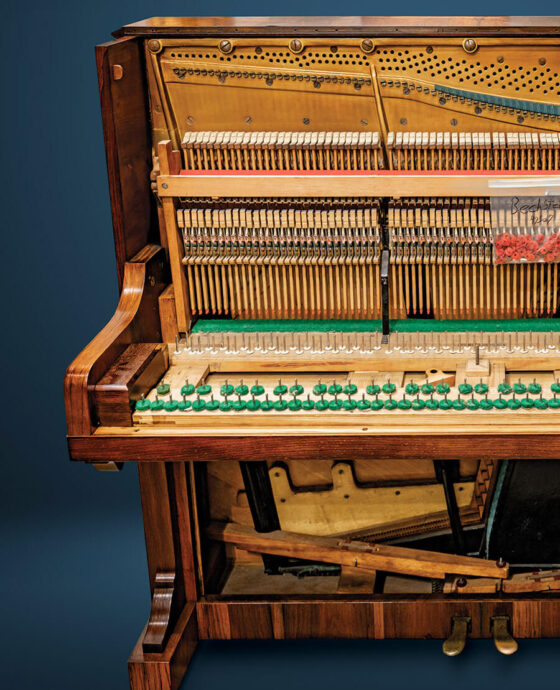
He approaches a late 19th-century Bechstein upright piano — which is, well, no longer upright. Mumford’s team has carefully disassembled it, spreading it across three worktables.
“This is awesome,” he says, rolling his nimble fingers across the rosewood grain. The piano, every strewn part, belongs to a native of England now living in North Carolina, and she’ll be in soon for an up-close assessment.
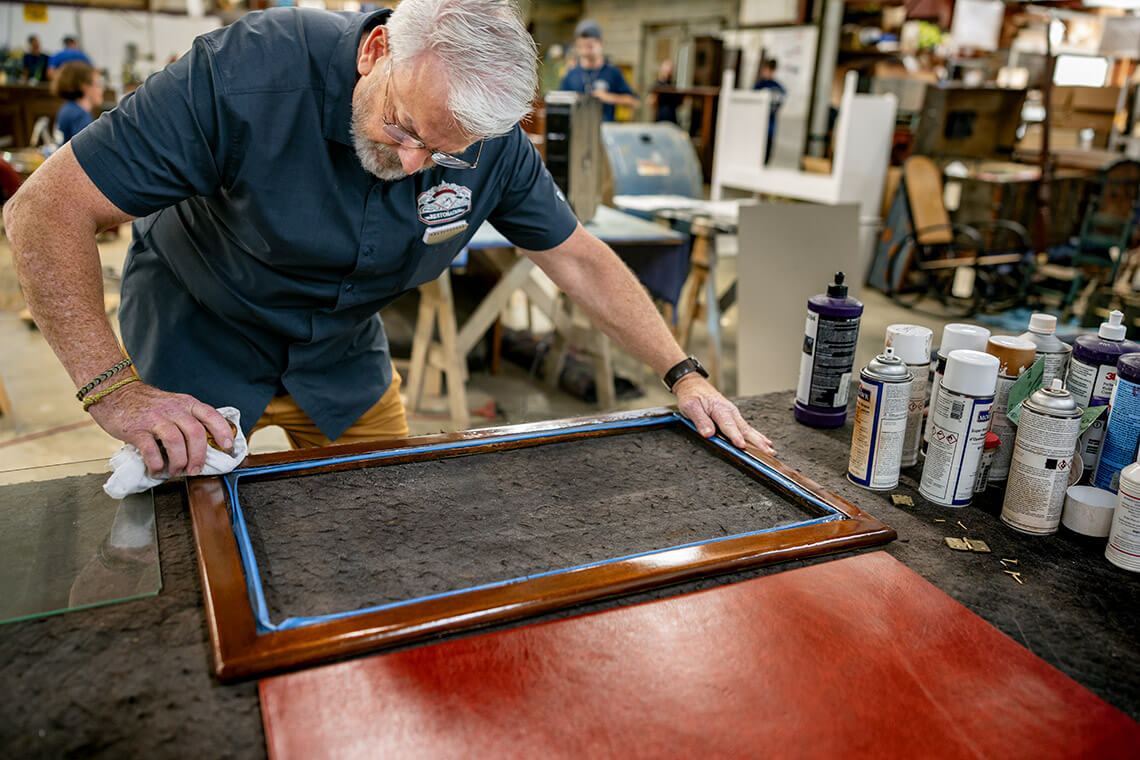
In a notebook where he regularly records his thoughts, Mumford wrote a poem about his work titled “Restoration.” In it, he asks the question: “Who knows what another holds as important?” photograph by Charles Harris
If all goes well, the meeting will move Mumford one step closer to “the smiles, hugs, joy” that bubble forth when customers lay eyes on a prized possession returned to the splendor they remember.
“I’m obsessed with fixing things,” he says with a laugh that bounces out of him like a rubber ball, hitting a couple high notes before dribbling off.
But an accident in 2023 now has Mumford obsessing about another matter beyond the detail work: a dust-up of existential proportions.
• • •
While craftsmanship per se doesn’t run in Mumford’s family, a sweat-on-the-brow kind of devotion does. He grew up the son of a celebrated theologian, Bernard C. “Bob” Mumford, 94, who traveled the world counseling believers.
The young Mumford accompanied his parents on many of these trips, admiring their dedication and stamina. But scholarship wasn’t his calling. He dropped out of The University of Alabama after all of three days.
“He loved working with his hands,” recalls his mother, Judith, 88. “And he was always adventurous.”
In 1985, with a loan from his parents, Mumford bought a small piano restoration business in California and learned the angles of both craft and operations from the original owner. In 1996, he relocated Mumford Restoration to Raleigh and had a minister’s knack for earning people’s trust.
“I once watched him correct some work for a customer who was unhappy,” his father says. “He bent over backward for him. He makes customers part of the process.”
“He loved working with his hands, and he was always adventurous.”
By 2023, the company had become a regional institution. While still welcoming rusty rocking horses, saggy steamer trunks, and moldy family Bibles, Mumford had expanded to larger projects, including removing, restoring, and reinstalling the sleek wood furnishings from a 1901 Pullman train car.
The going was smooth for the master craftsman … until one June evening. Cruising home from work on his BMW motorcycle, Mumford took a familiar curve at around 40 miles per hour. But instead of finding open road, he slammed into a pair of deer. Over the handlebars he soared, somersaulting across the asphalt into a drainage ditch.
Hours later, when he came to in a hospital, he turned his appraiser’s eye on his own life. First, he says, “I was grateful for morphine.” It made dealing with his eight broken ribs, busted right shoulder, two snapped fingers, and swaths of torn skin bearable. But as he mended over 12 “excruciating” months, a bigger challenge loomed.
Motorcycle smashups or not, Mumford and the artisans he employed were getting older. Who would take over the craft? Who would take special care reanimating faded memories? “I saw it,” he says, “as a renewal of my purpose.”
• • •
Water buffalo horn is not as plentiful in North Carolina as, say, squirrel tail. It might even qualify as “exotic.” But the Mumford team needed it to repair a chain mail armored vest dating back to 17th-century Spanish conquistadors.
The task of replacing the vest’s cracked plates fell to Sarah Reese, 44. She’s one of the numerous artisans who came up through the Sentimental Restoration Guild, the apprenticeship program Mumford created in 2021 and threw himself into with renewed vigor following his accident. “I’m now fulfilled watching the apprentices finding their way,” he says.
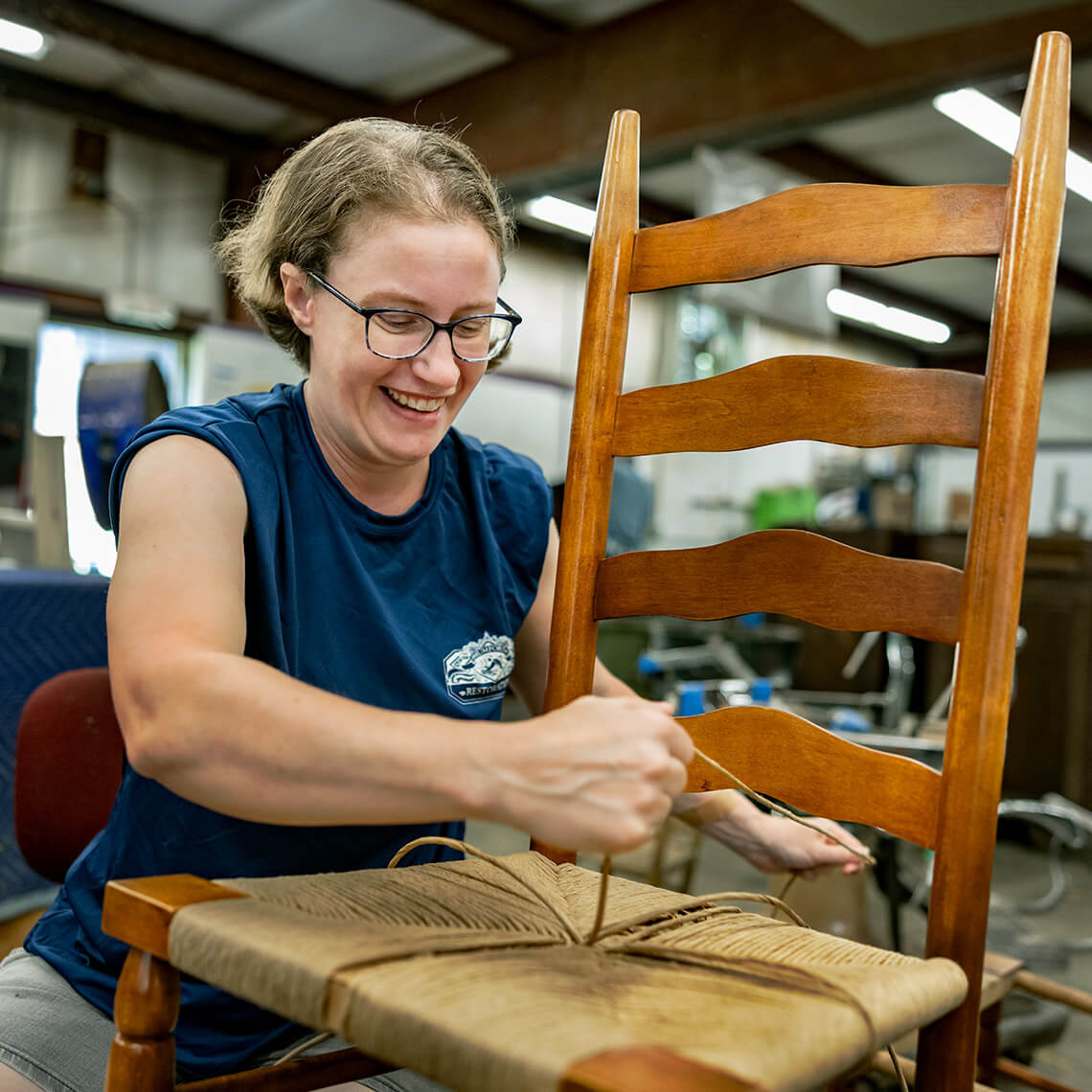
Whenever Sarah Reese canes chairs, Reese relies on her grandmother’s tools she inherited and uses them to teach and mentor others in the craft. photograph by Charles Harris
To source a water buffalo horn, Reese tracked down a supplier who sells it for use in making knife handles. She reveals the replacement plates, now seamlessly fitted into the old conquistador vest. Then, with her T-shirt sleeves rolled up over her shoulders, she turns to an oval paint palette she’s using to touch up a road-weary toy truck that’s been rolling since the ’60s.
“I come from a rural fix-it family where we didn’t always have money to buy new things,” says Reese, who grew up north of Kinston. “It just scratches an itch in my brain to complete something that needs fixing.”
Others have pawed at the same itch. At a worktable just past a stopped Bavarian wall clock adorned with wild boar tusks, apprentice Luke Kayser has been bucking up the backrest on a creaky Stickley chair. He’s 19, and one day, he’d love to open his own shop. If he does, his older brother Ian — a 22-year-old apprentice piano technician at Mumford — might join him.
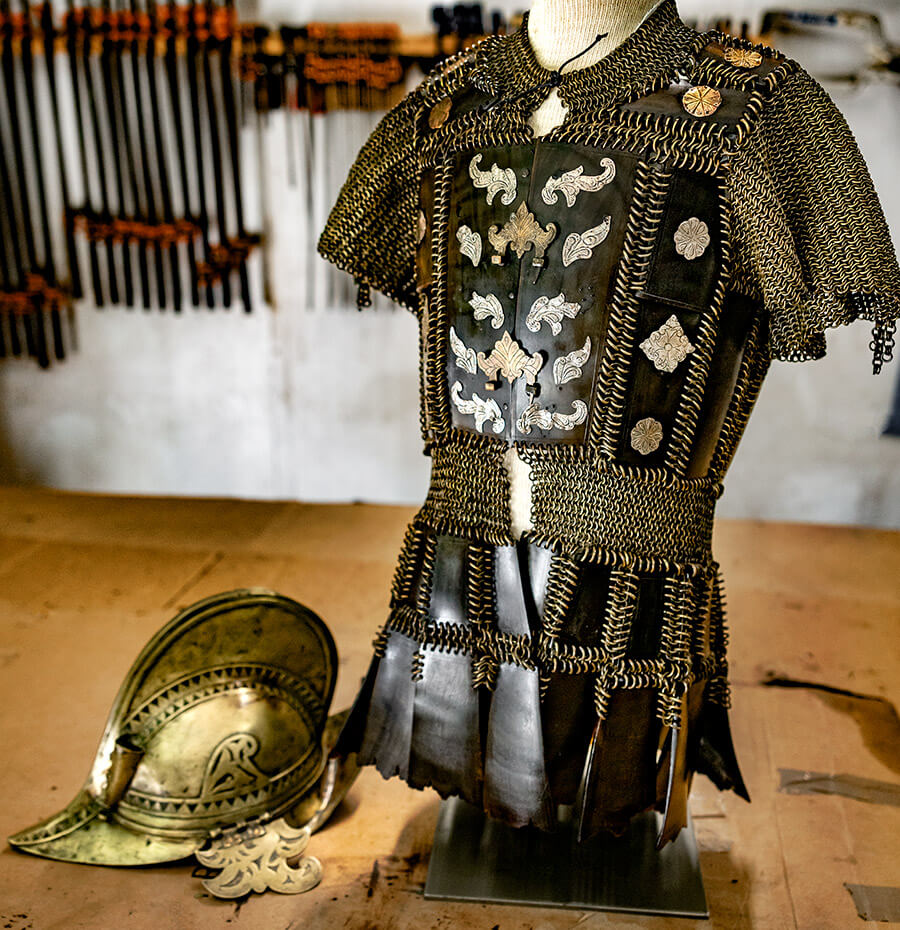
Sarah Reese found a water buffalo horn to repair the front armor of a 17th-century Spanish vest. photograph by Charles Harris
“This is exactly what needs to happen,” Ian says, glancing around the hectic warehouse, fans struggling to churn the soupy summer haze. “A hub for all these technicians and craftsmen.”
As junior partner and general manager, Zach Mumford, Bernard’s 35-year-old son, regularly checks in on apprentices and seasoned craftsmen alike as they labor over everything from squat Depression-era radios to effortlessly chic chandeliers. “We’re one of the few businesses where someone brings in a project and no one person knows how to fix it,” he says. “But together, we can figure it out.”
Now, a full crew gathers around the Bechstein piano for a pivotal check-in. Time to meet the owner.
• • •
Smiling through his trimmed gray beard, Mumford leads Elizabeth Shearer, 72, to her Bechstein. Like he does with all his customers, Mumford greets Shearer with the bonhomie of a teacher welcoming parents to a school pageant starring their children.
Shearer’s merry hazel eyes dance across the piano’s disassembled parts and the glow of its refinished wood. She’s quick with a smile and a question, which usually leads to a quip, and then to another question. But now, she’s quiet. She’s not just appraising, she’s traveling somewhere else, somewhere in her memories.
The Bechstein belonged to her grandmother Flora, who died before Shearer ever knew her. Shearer and her brothers learned to play on it while growing up outside London.
Family lore depicted Flora as an orphan from Germany who came to England and studied piano at the Royal College of Music, where she met her cellist husband. Shearer connected with her through family stories, a few black-and-white photos, and her Bechstein, which Shearer hopes to hand down to her grown son eventually.
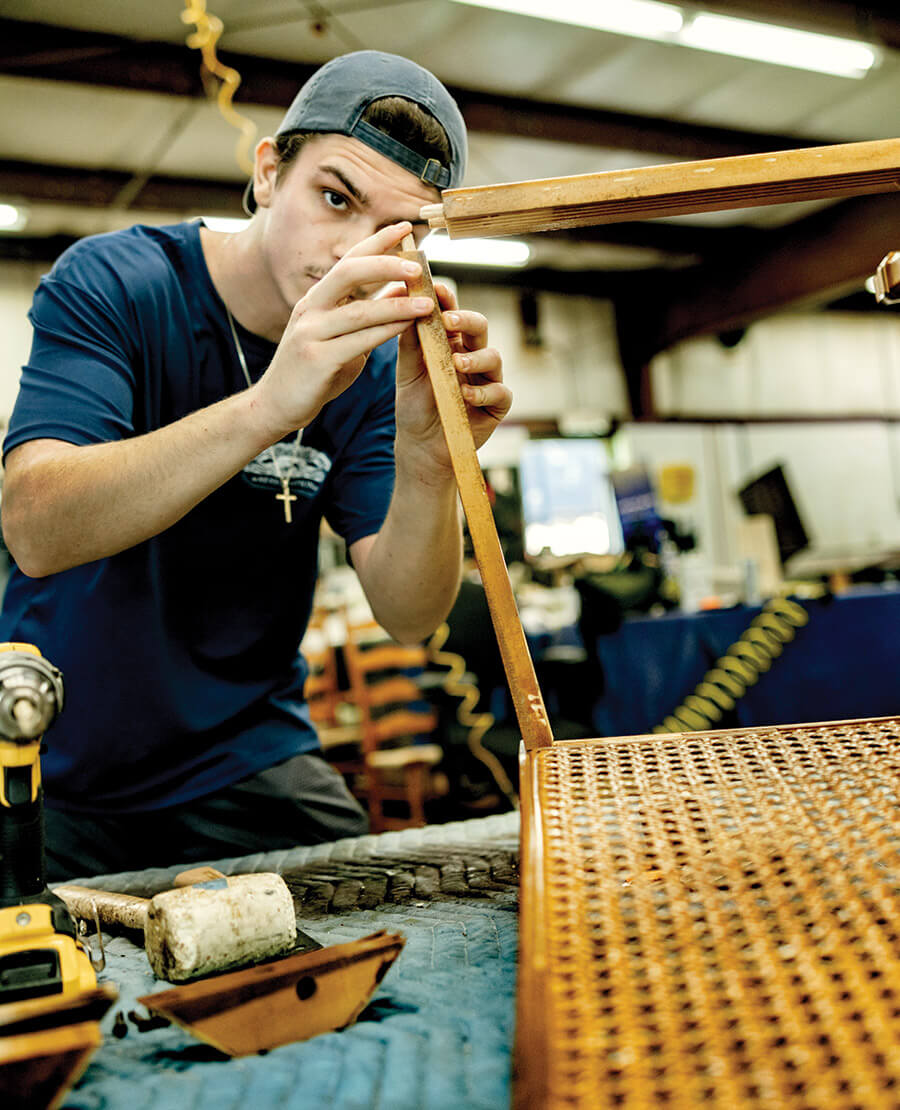
Mumford Restoration has helped Luke Kayser, 19, from Holly Springs, tap into his passion for working with his hands and his dream of opening his own shop . photograph by Charles Harris
Shearer gazes into the piano’s rosewood frontboard, now finished to bring out the distinct textures of the wood in the floral-patterned inlay: ash, elm, and maple. “Oh,” she says at last, bringing a hand to her cheek. “I love this.”
Ian Kayser watches from a few feet away. His hard work, he knows, has paid off. “To be part of helping someone fall in love with their piano all over again,” he says, “it’s very rewarding.”
With the finishing approved, Kayser’s work on the melody-making innards of the Bechstein will commence. Eventually, the instrument will look and sound as it did in its heyday — not brand new, but revived.
Shearer leans into Mumford. “I wish,” she whispers, “I could have myself restored this way.”
Mumford releases his bouncing ball of a laugh. “We don’t offer that!” he says. “Not yet.”
print it