Old Salts: Whether native or transplant, these folks found their place and passions on North Carolina’s coast, becoming as integral to life here as the sand and sea. Read more about the folks that make the coast thrive.
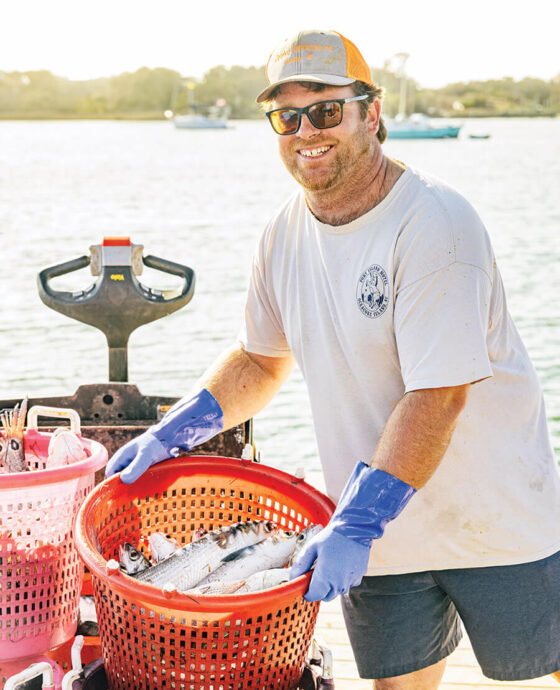
The 20-foot Carolina Skiff idles through the ditch of Ocracoke’s Silver Lake. Maneuvering between moored sailboats, Morty Gaskill points the bow of the boat he’s had since high school toward the Ocracoke Fish House. Behind him at the entrance to the creek, the red roof of the old Coast Guard station shines brightly against the clear Carolina-blue sky.
It’s a familiar path, cut deeply by generations before him, and one he has traveled for as long as he can remember. At age 9, he became the youngest person on Ocracoke with a commercial fishing license. Now 32, he could have done almost anything, but he was born a waterman, and the tides of fate bind him to this place.
“I never really had an idea of what I wanted to do every day for the rest of my life other than fishing,” he says, hoisting a basket of jumping mullet onto the dock behind the fish house.
Morty left the island halfway through high school to attend the North Carolina School of Science and Mathematics and later graduated from North Carolina State University with a degree in history. But Ocracoke called him home. “Going off to school exposed me to a lot of different experiences, people, and cultures that have benefited me in the long run, but in the end, I always really just wanted to fish more than anything else.”
“I never really had an idea of what I wanted to do every day for the rest of my life other than fishing.”
With shorter seasons, fewer fishing days, and tighter catch limits, making ends meet has become more difficult than ever, and the future is filled with uncertainty.
“At one time, a fisherman could get by with a couple hundred crab pots, a few gill nets, and maybe some pound nets,” Morty says. “I have to have way more gear than my dad ever had.”
Current regulations limit what they can catch, when they can catch it, and the gear they use. To stay afloat, they have to be nimble — ready to move from one fishery to the next, often adapting their gear along the way. “These days, I have to have a net for every conceivable situation,” Morty says. “Some of them I only use once every two years, but I have them if I need them.”
Despite the challenges, commercial fishing offers things that can’t be experienced from a cubicle. “The first time I saw a humpback whale surface, flip, and go back down, it was mind-blowing,” he says.
In his backyard by a narrow canal, Morty strings a rope line between two trees to hang a new net. A pair of mourning doves coo in the cedar above him. Old Oriental rugs lay scattered across bins of net to protect them from being bleached by the sun.
The yard is a commercial fisherman’s yard. Looking around at the other houses perched along the canals, Morty says, “Where I’m standing right now, back in the ’40s and ’50s, this is where my dad duck hunted. This was all marsh.”
Morty belongs to a long, proud line of Gaskill and Styron watermen. At 23, he stepped into the shoes of his late father, James Barrie Gaskill, a commercial fisherman and former principal of Ocracoke School. Morty inherited more than most from his father — his thick head of hair, a love of fishing, a belief in education, and a deep appreciation for the coastal environment.
Like his father, Morty champions the protection of wetlands, improved water quality, and responsible development. photograph by Matt Ray Photography
For generations, homes like Morty’s were common sights across Ocracoke. Four fish houses formed the community’s cultural and economic center. Today, there is only one.
Morty stands at the crossroads of continuity and change on Ocracoke. Once-charmed phrases like, “quaint fishing village,” “where time has stood still,” and “one of the coast’s best-kept secrets” are weighted by memory. They ring with nostalgia.
Now, when Morty sets out at sunrise, he is one of only a half-dozen full-time commercial fishermen left on Ocracoke. Commercial skiffs are outnumbered by sailboats and sportfishing boats. The coast’s best-kept secret has been revealed — its economy now dependent on hundreds of thousands of annual visitors.
Time has found the island, and it is moving fast. Old family homes are often replaced by new builds for second homes or short-term rentals. Even the landscape has changed.
“When I was a kid, everything was sandy. You had to watch out for prickly pear cactus,” he says in a slow and steady voice — a voice largely absent of the Ocracoke brogue his father was once known for. “Now it’s just muddy all the time.”
Yet amid these changes, each morning Morty motors out of Oyster Creek and crosses the bar. Ocracoke may no longer be the untouched village promised in old tourism ads, but much of what Ocracoke was, and is, still exists in Morty.
print it