 In the wake of Hurricane Helene, people across the mountains did what they could: planting, building, repairing, creating. These are stories not of grand gestures but of small acts that became the scaffolding of recovery. Read about those who came together to support each other.
From the monitors in his sparsely decorated office overlooking downtown Boone last fall, weather forecaster Ray Russell saw trouble coming 1,500 miles away. A rotating air mass was forming in the southern Caribbean, and it had the potential to become huge.
After 24 years of operating RaysWeather.com, a longtime mainstay for many in western North Carolina, Russell knew hurricanes forming in that corner of the world could be ferocious. A Boone resident for 33 years, he had seen firsthand that hurricanes could be as dangerous for those living in the mountains as well as on the coast.
On Monday morning, September 23, he warned readers that a tropical system was coming their way with the potential for flooding, strong winds, and possible tornadoes.
By the next day, the system would have a tropical storm designation and a name: Helene.
• • •
Maya Nelson, office manager at Ray’s Weather, could see her boss growing more anxious every day. Russell’s wife, Rhonda, saw it, too — an unsettling level of seriousness in her normally upbeat husband.
He was intensely focused on Helene’s path through the Caribbean. Passing over Cuba or the Yucatan Peninsula would weaken it.
But the storm skirted between them, reaching hurricane strength as it approached the Gulf of Mexico on September 25. Russell warned readers to nail it down, bring it in, and board it up.
His tone got people’s attention.
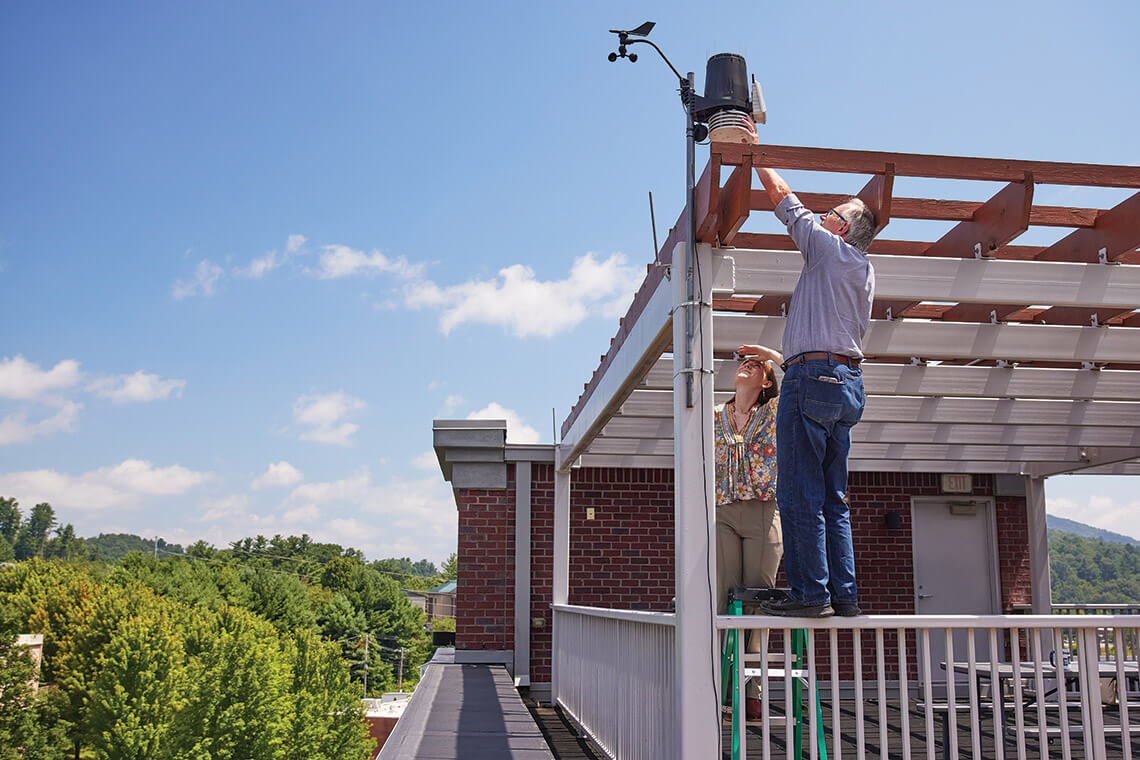
Ray Russell uses 65 weather stations to gather information to help keep people safe. photograph by Joey Seawell
Russell’s forecasts are written with humor, rather than hyperbole, to add a bit of levity to the critical information readers depend on for their livelihoods, vacations, and everyday lives.
“I grew up in a Ray’s Weather family,” says Ruthie Baker, 28, who lives in the Avery County town of Newland. “Before we did anything, my dad would say, ‘Let’s see what Ray says.’”
It’s the weather gospel from a man who started as a minister and spent 30 years teaching computer science at Appalachian State University. In 1993, a childhood fascination with weather was rekindled when a blizzard buried Boone in about 36 inches of snow.
He started posting snow forecasts on his university website and teaching himself meteorology. For Christmas 1998, Rhonda bought him a weather station, which cost no more than $500. Eighteen months later, Ray’s Weather was a business. Today, it’s the most widely read media outlet of any type that originates in northwestern North Carolina.
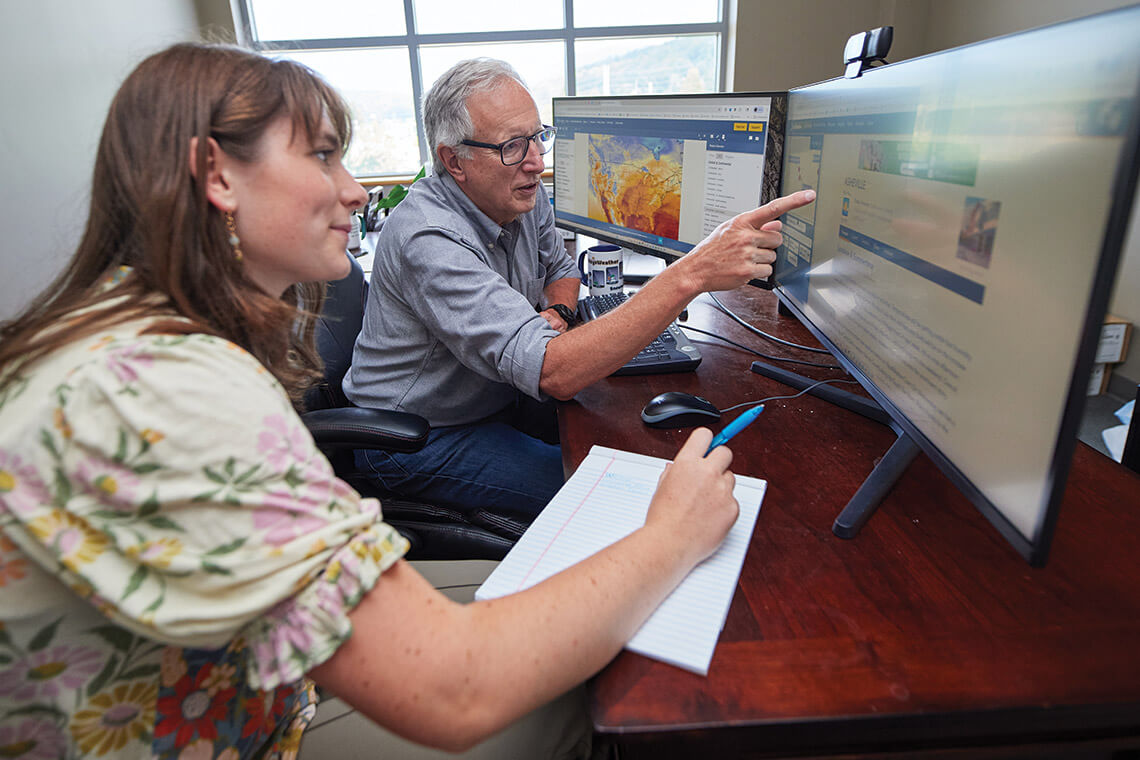
Maya Nelson, who runs the office at Ray’s Weather, says of Russell: “He has a little knowledge about everything, and if not, he researches it. He modeled that for me.” photograph by Joey Seawell
Like most forecasters, Russell and his staff of four part-time meteorologists analyze data from 10 or so global computer models. But that’s not specific enough for the mountains, where lofty peaks and lush valleys create microclimates.
Russell’s home-cooked forecast incorporates live local data from about 65 weather stations and 25 webcams that Ray’s Weather has installed from Hendersonville to southwestern Virginia.
Weather connects everyone, he says, from linemen to resort visitors.
“Everybody’s got to interact with the weather,” Russell says. “My goal for our audience is they can come to the website, spend two to five minutes, and get all the information they need.”
They often get a laugh as well, like when Russell issues a “big-hair warning” on windy days. So, last fall, longtime readers knew the situation was bad when he posted, “This is not a drill.”
Days of rain preceding the hurricane had softened up the region for a body blow.
“The tree roots were sitting in mush. It would be flooding from the first drop.”
“All the streams and rivers were high, and the tree roots were sitting in mush,” Russell recalls. “It would be flooding from the first drop.”
Worse yet, an upper-level low-pressure system moving south as Helene moved north increased the potential for torrential rain and wind. On Thursday, he told residents to expect one of the strongest storms ever to hit the region.
When the upper-level low-pressure system caught Helene’s rotation, the storm catapulted forward. As Helene made landfall in Florida in the early morning hours on Friday, rain and wind were already battering the roof of Russell’s mountainside home.
Before the power went out, Russell posted one more update from his home office with the title: “Historic and catastrophic.”
• • •
Countless people would later say Russell’s warnings spurred them to act, and the credibility he has built in 25 years of forecasting probably saved lives. Yet Russell says he does have regrets. He wishes he could have helped with the rescue and recovery. But he couldn’t because of what he now faces: vision loss.
It’s hard to watch him prepare a forecast these days. Glasses off, he hunches his lanky frame forward until his nose nearly touches the oversize monitor, reading and comparing the endless rows and columns of numbers in one computer model, then another, before checking radar on yet another oversize monitor. His face is always inches from the screen.
But it’s like what Russell told his wife: If legendary blind bluegrass picker Doc Watson could wire his own house, I can do this.
“Whatever day it is,” he says of forecasting the weather, “there’s somebody it’s important to.”
Related: A retired professor, a veteran NPR broadcaster, and a senior at NC State became the go-to sources that helped keep thousands in western North Carolina informed, safe, and secure. Read about them below:
print it