 In the wake of Hurricane Helene, people across the mountains did what they could: planting, building, repairing, creating. These are stories not of grand gestures but of small acts that became the scaffolding of recovery. Read about those who came together to support each other.
As he pored over meteorological models in the small bedroom of his college apartment, Ethan Clark was becoming concerned. He opened Facebook and typed the following post:
Sunday, September 22 ~ 9:49 A.M.
TROPICAL UPDATE: Let me address the elephant in the room, and that’s the high possibility of tropical development along the Gulf Coast this week. … We can’t really afford any more rain in many parts of the state. … No reason to panic. …. I’ll guide you through it like I always have.
Clark is a senior at NC State studying environmental science with a concentration in meteorology, natural disasters, and climate change, but he has been a weather enthusiast since a snowstorm blew through his hometown of Raleigh when he was 10. Inspired to learn more about predicting the weather, he went to the school library and checked out books on the subject. The next year, he volunteered to be the weather person on his school’s news broadcast. He then learned to forecast the weather by reading books and taking online classes. In seventh grade, he started the Ethan Weather Facebook page — now North Carolina’s Weather Authority — to forecast weather for the entire state using the same models that his professional counterparts use. By September 2024, he had built the page to 350,000 followers who trust his forecasts and look to him as an early alarm for natural disasters like hurricanes and tornados, particularly in rural areas with less reliable news coverage.
That’s why, in the days leading up to Helene, when many news outlets were focused on the effect that the storm would have on the Gulf Coast, Clark was warning of the dangers to western North Carolina.
“There’s a cone of uncertainty,” Clark explains of the prediction of the path of a storm’s center. “A lot of people just look at the cone. They think if they’re in the cone, they’re getting it; if they’re outside the cone, they’re not. Most of the mountains were not even in the cone.”
But Clark knew that the mountains would likely get hit, and if they did, it could be catastrophic. He had predicted a pre-event rainfall that would saturate the region on Thursday; the area wouldn’t be able to handle much more. From his apartment in Raleigh, he diligently continued warning his audience.
Tuesday, September 24 ~ 4:00 P.M.
The potential of flash flooding, landslides, and river flooding is increasing across parts of the foothills and mountains. … Western NC, I am worried about this much rain.
When the National Weather Service Forecast Office Greenville-Spartanburg issued a flash flood warning for much of western North Carolina on Wednesday, Clark relayed the warning to his Facebook followers. As the storm gained momentum and barreled toward Florida, his posts became more urgent.
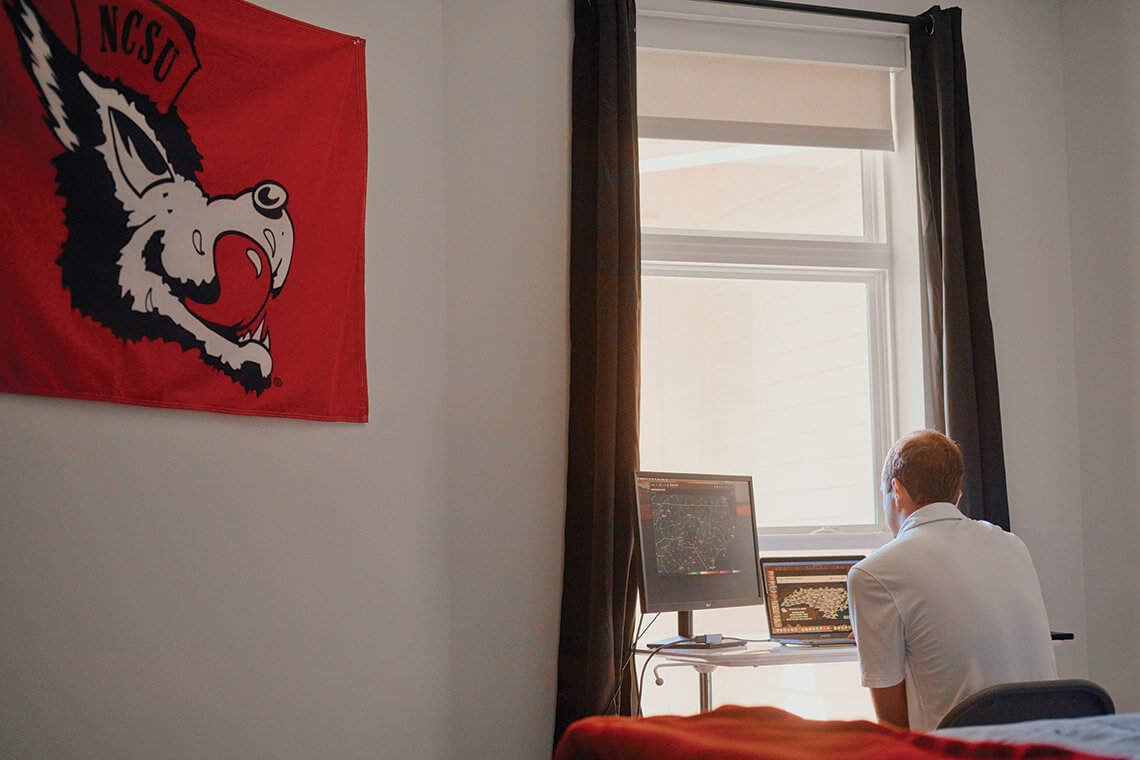
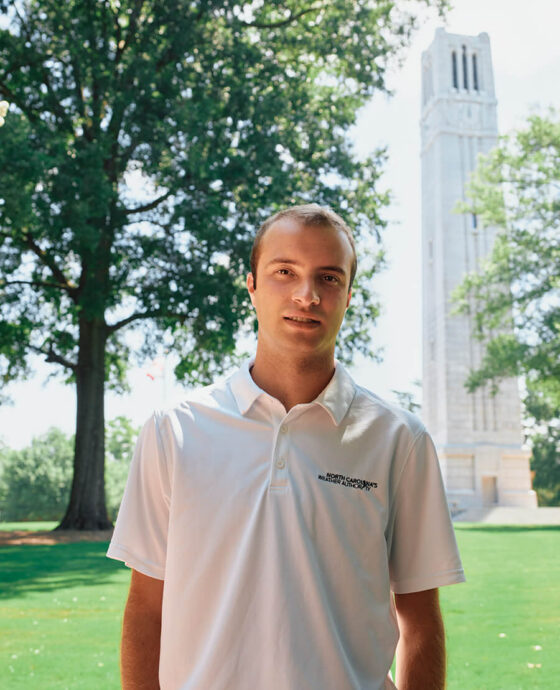
Clark makes his predictions at night before bed and often wakes up at 4 a.m. to recheck the models before posting his forecasts. “I just want to help,” Clark says, “and I really care about my forecasting.” photograph by Joshua Steadman
Wednesday, September 25 ~ 6:47 P.M.
This could be historic. I don’t like to say these words often, but it could be historic.
As the pre-event rain pelted the western part of the state, Clark reported on the many water rescues already taking place on Wednesday and Thursday.
Thursday, September 26 ~ 11:03 A.M.
WOW: All-time record flooding is expected at Biltmore Village. … This is expected to surpass the historic floods of 1916 and 2004. …
As the storm strengthened, Clark stopped studying for classes and continued sounding the alarm.
6:24 P.M.
JUST IN: Hurricane Helene has now rapidly strengthened to an extremely dangerous Cat 4 Hurricane with winds of 130 MPH and a pressure of 947 MB based on the latest Hurricane Hunter pass. A Tropical Storm to a Cat 4 Hurricane in 24 hours, wow!
11:29 P.M.
Major Hurricane Helene makes landfall in the Florida Big Bend area as a Cat 4 Hurricane with winds of 140 MPH and a pressure of 938 MB.
Clark worked to keep calm.
OK, don’t get bogged down in predicting exact amounts of rainfall, Clark told himself. Focus on safety. Focus on the bigger picture. There’s still a chance for people to get out.
Friday, September 27 ~ 4:41 A.M.
Good morning all. The forecast remains on track, and we’re looking over everything right now. We have widespread flash flood warnings for most of Western NC. Wind gusts are starting to ramp up across Western NC, and nearly 55k customers in NC are already without power. There are reports of trees falling from Charlotte west, and wind gusts will continue to increase.
As North Carolina began to see the effects of the storm on Friday, Clark posted almost minute-by-minute updates that he received from his audience online. He reported power outages. Downed trees. Wind gusts. Flash flood emergency alerts. “Do not drive” alerts. Shelter-in-place orders. Road closures. Wiped-out bridges. Mudslides. Collapsed buildings. He stayed at his computer for hours on end, guiding his followers through the worst of the storm.
When the last of Helene moved out of North Carolina on Friday night, Clark began receiving hundreds of Facebook messages asking about the state of mountain communities. As the updates arrived, he shared them on his page and requested his followers do the same. Through his large online network, he passed along information on places news teams couldn’t access yet. His posts have been credited with saving lives, like this message he received and shared:
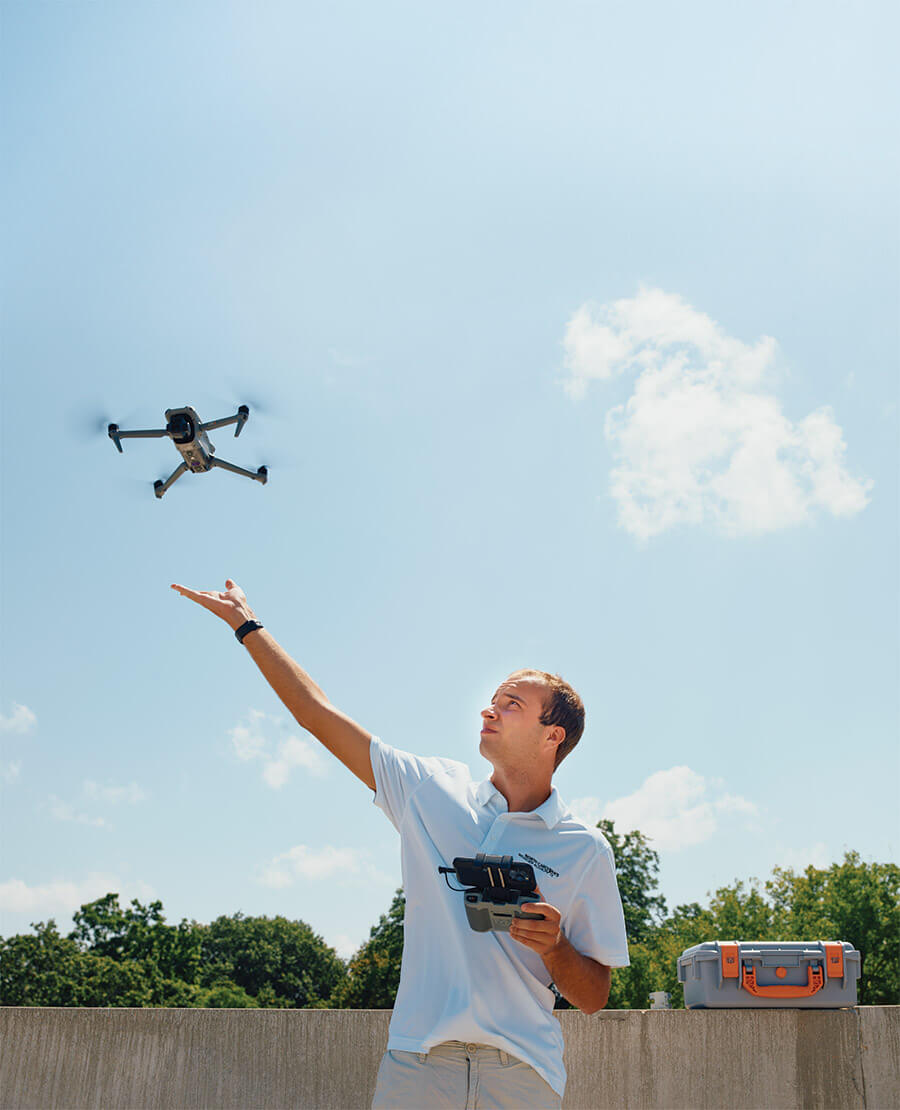
Clark sees the drone he uses in weather forecasting as a crucial tool, especially after Helene, when he learned firsthand the importance of communicating risks and disseminating correct information. photograph by Joshua Steadman
Saturday, September 28 ~ 11:34 A.M.
“100 people stuck on a mountain in Black Mountain, North Carolina. Address is 129 Morning Glory Drive, Black Mountain. They need immediate rescuing. There is a lady giving birth and they will run out of food in the next day or two. Please help….”
Sharing this because I really don’t know what else to do. I am trying.
North Carolina Department of Public Safety Emergency Management saw the post and sent a rescue team to evacuate the mountain.
On the Monday following the storm, Clark reposted a comment from Emily Brewer, who convinced her parents to evacuate Asheville prior to the storm because of his warnings. “They wouldn’t have survived it,” she wrote. “Thank you!”
As news teams started to catch up on reporting the storm’s aftermath, Clark saw his audience nearly double, and several major news outlets had picked up his story. CBS even arranged for Clark to fly to Atlanta to meet his hero, Jim Cantore of The Weather Channel.
Clark is set to graduate in December — after failing a statistics class because of the storm — and he plans to go into emergency management or weather consulting or, maybe, hurricane hunting and flying into storms to collect data. It’s a dangerous job, but, he says, “That’s the research that goes into protecting people.”
No matter what he does, he plans to keep his page active. The people of North Carolina are counting on him.
Related: A retired professor, a veteran NPR broadcaster, and a senior at NC State became the go-to sources that helped keep thousands in western North Carolina informed, safe, and secure. Read about them below:
print it