 In the wake of Hurricane Helene, people across the mountains did what they could: planting, building, repairing, creating. These are stories not of grand gestures but of small acts that became the scaffolding of recovery. Read about those who came together to support each other.
When I first spotted our hellbender, I thought he was dead. I was calf-deep in the South Fork of the Mills River, just down the bank from our house, and I caught the glimmer of his slimy back on the bottom of the stream. Had I not been moving slowly with my kid, seeking out skipping stones, I’d have missed him altogether, nearly two feet long but camouflaged among the rocks, mottled and brown. When I bent down, I did so in sadness, expecting to pull up a lifeless, prehistoric-looking creature. But when I stroked his back, his body jerked, and he was gone.
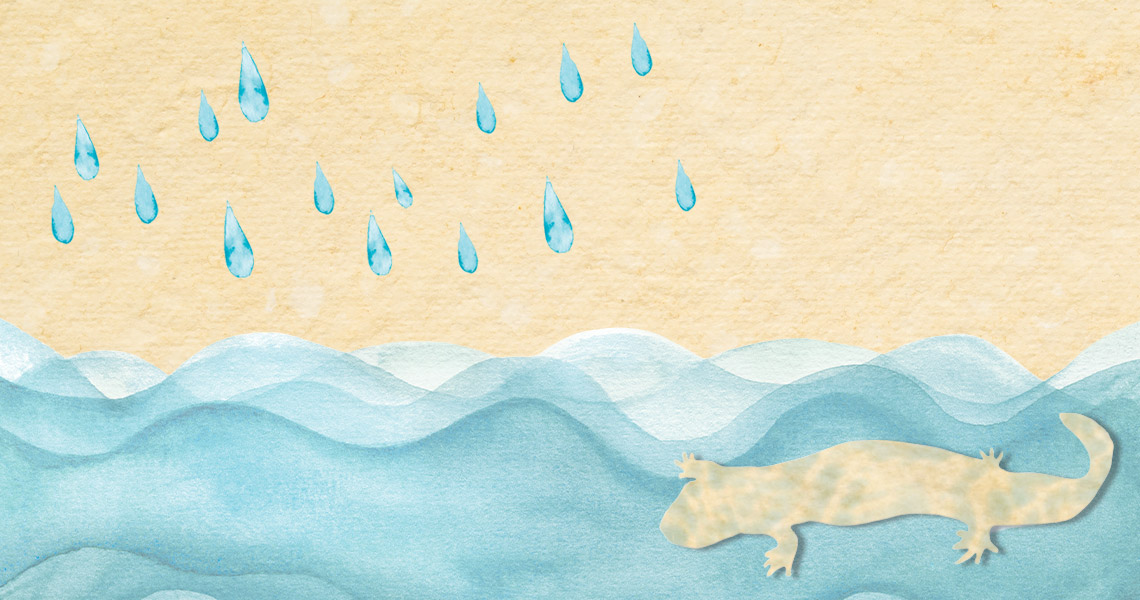
The Eastern hellbender — sometimes called a devil dog or water dog — is elusive, an aquatic unicorn. I’d only seen one once before, and really, it was a cousin of this one: an Ozark hellbender I’d accidentally snagged while catfishing in Missouri. It’s not only the camouflage that makes them hard to spot; they’re also particular about where they live. These giant salamanders have lungs but spend their lives underwater, literally breathing through their skin, so only streams free of excessive silt and pollution can hold them. They’re canaries in the coal mines of small streams in western North Carolina, so I knew that finding one below my house meant our stretch of river flowed clear. What I didn’t know when I bent down to touch one is that they’re also nocturnal. I’d caught him napping. I felt guilty to have roused him but grateful to have seen him, nonetheless.
Hellbenders tend to stick close to one stretch of water, living out their days within a 200-square-meter range. Even when I couldn’t see him, as I sat on our deck or stood in the river, I was sure he was out there, tucked under a rock and dozing. But since Helene, I have no idea where he is.
The last time I saw him, he was crawling across the road, escaping the receding flood waters and scattered trees and home appliances and gas cans. I was surveying my flooded house beside the destroyed bridge and carved-up land, staggered by the power of moving water. I scooped up the hellbender, carried him to a small stream, hoping he might find clean water to breathe somewhere, and let go.
• • •
In the days after the flood, one of the first things my neighbors did was build a bridge. The river had lifted dozens upon dozens of whole trees from the national forest upstream and then pinned them to the bridge. Like a monstrous beaver dam, the 50-foot-high logjam pushed the river anywhere but where it had been, tearing the bridge from the land so that it stood disconnected and useless on wobbly legs midstream. This left my neighbors up the mountain with no way out. So we built footbridges to connect us. We knew we’d need each other for whatever came next.
For weeks, we worked. I tore up everything from the flooded first floor of my house. My neighbors hauled out heaps of wet clothes and muddy dishes and soaked couches to drop in piles in my ruined driveway. Some men tried to cut an old logging road wide enough to get a few trucks over the mountain. Others worked to build a ford in the river to allow linemen and emergency responders access to our land. We tried to figure a way over or around or through the swollen river.
We tried to figure a way over or around or through the swollen river.
Meanwhile, DOT workers perched a trackhoe at the edge of the water and pulled a log at a time from the massive pileup, slowly undoing what had come in a flash. Truck after truck hauled off tons of waterlogged timber, and after a week of constant work, enough had been cleared for the river to finally return to its place, flowing freely beneath the battered bridge instead of around it.
But left in its wake were channels and gashes and scars in the land. Into them, we dropped dirt and rock, knowing we’d not erase them but hoping that we might fill enough of what had been taken to reconnect us to the rest of the world. After a couple weeks, we did. The first truck rolled across the packed-in earth and onto the bridge, and we knew we’d set things a little closer to right.
• • •
The South Fork of the Mills River, the river below my house — the river that was in my house — has changed shapes in the months since Helene. The waters have returned to normal levels, but the bend upstream is a little gentler. The beach near the bridge is gone. The massive rock I liked to sit on while searching for the hellbender was carried off somewhere, maybe all the way to Tennessee. The rapids that whisked my kids on tubes past the house have flattened, the water now deeper.
This is natural. Streams are always changing, often in small unseen ways, but after a massive flood like Helene, there is what one hydrologist called, “a complete reorganization.” For the next several decades, this stream will ebb and flow, searching for a dependable shape. It will need to break up fallen trees and regrow bank vegetation. Strangely, it will also need more storms.
With new storms and smaller floods, the churning up of debris and the redistribution of sediment will help the stream find its center. This natural cycling of the system, the lifting up and setting down of so much stuff, allows the river to become itself again, to settle in more soundly.
Of course, in my search to make sense of the world after Helene, I now imagine all of us as streams. I am a stream. Maybe you’re a stream. The whole of western North Carolina is a stream. We’re all churning, searching for channels, settling into our centers as the world shifts and we’re surrounded by debris. I find endless hope in this image: The piling up of brush and rebuilding of walls are not merely tasks to complete but part of the work to reclaim who we are. We won’t be the same as we were, but we will be ourselves again, settled and centered.
• • •
With our house unlivable, my family of four bounced around for a month or so before relocating to my grandmother’s house just before Thanksgiving. The house had been mostly vacant since Grandma passed a decade ago, so we moved what we’d saved from our house on the river into the little rock house where I’d spent much of my childhood. We settled our youngest kid in the room where my great-grandmother had lived when I was young; my other kid bunked in the room that had belonged to my dad and his twin brother. It was strange and beautiful, and we were grateful to have a place to be. Then a cold snap hit and the heat cut out.
I tried to think of those streams. About how the coming storms — the never-ending piles of blown-over trees, the insurance delays, the failing furnace — will only help to give us a dependable shape, to wash us into fuller versions of ourselves. But it was also cold.
I readied the woodstove and called a former high school classmate who I heard had been cutting and splitting fallen trees to sell as firewood. We hadn’t spoken in at least a decade, but in 30 minutes, his tractor emerged from the tree line across the field, a massive bag of firewood hanging from the pallet forks.
Once he’d dumped and we’d stacked the wood, I tried to pay him. He waved away all my attempts: “We’re neighbors.”
• • •
In the year since Helene, I’ve been trying to wrap my head around the word “recovery.” Even after all this time, it’s easy to find evidence of destruction at every turn: mangled buildings alongside lives’ worth of belongings, once-green riverbanks now more like desert streams. Living in the wake of a natural disaster constantly tests your cup-half-full perspective. When I set out on backroads, should I focus on the freshly rebuilt house, the blurs of kids on the new swing set out back, or linger on the destroyed trailer downstream, upturned cars still waiting in the grass? I’m a natural optimist, but I’ll admit that most days, I still struggle to see recovery. I see devastation; I see indescribable wreckage. I see a cup half-empty. I see a changed world.
But then I remind myself that recovery is not a snapped-finger transformation. “It’s a process, not an event,” our friend who works in disaster restoration likes to say. And the truth is, the world has changed. Recovery will never mean a time-machine return to what was. Instead, recovery means shaping this changed world so it’s better tomorrow than it is today.
Recovery means shaping this changed world so it’s better tomorrow than it is today.
In community centers and libraries and town halls across the mountains, people are meeting to imagine what a recovered version of the region looks like. In Spruce Pine, they meet to envision their Riverside Park, reconstituted post-flood. In Bat Cave and Gerton, a group considers a vision of the Hickory Nut Gorge after so much desolation and damage. These pockets of discussions — full of debates and architectural plans and environmental reports — operate within the realization that even once the culverts are replaced and the roads are reopened, there is still work to imagine what a better world might look like.
We’ve not yet come back home to the South Fork of the Mills River. The work feels endless, but it continues day by day. We will, one day, return. The fish are back, but I’ve not spotted a hellbender. Maybe there are none left. Maybe the river isn’t ready for them yet. But, really, I hope they’re doing what they do best: hiding. Abiding. Whatever the case, I know I won’t stop looking for signs of life amid these ever-moving waters.