 In the wake of Hurricane Helene, people across the mountains did what they could: planting, building, repairing, creating. These are stories not of grand gestures but of small acts that became the scaffolding of recovery. Read about those who came together to support each other.
The FEMA emergency hotline number is still taped up behind her computer monitor. On the walls, posters still catalog the days Asheville went without water. “October 7: Day 11,” says one. A second poster hangs next to the first, where someone wrote in biblical language: “And on the 53rd day, WATER CAME BACK.”
Across the ceiling, twinkle lights offer a friendly ambience, and a clock above the recording equipment keeps military time.
Helen Chickering, whose 11-year tenure at Blue Ridge Public Radio makes her velvety voice one of the most recognizable in western North Carolina, serves as the local host of NPR’s Morning Edition from this room every weekday. Though she’s been reporting on a range of issues for decades, she’s particularly driven by the opportunity to give people context and information they can use to make decisions at pivotal moments. Especially in times of collective uncertainty, like during Helene and its aftermath.
“I remember feeling like we were all so connected,” she says of that time. “Our job was to figure out how to get people what they needed in these little pockets of information we could deliver.”
• • •
On September 27, 2024, Chickering arrived at work at 5 a.m. knowing the conditions would be difficult. The day before, the weather service had issued warnings with words like “catastrophic” and “life-threatening.” But she couldn’t have prepared for the reality coming her way: In a matter of hours, the region would lose power, Internet, and, eventually, water.
“Reports were coming in in real time; it was such sloppy radio,” she remembers. “I was interrupting myself to say, ‘Hold on, we’ve got new information coming through.’ We were learning as we were broadcasting.”
The BPR studio became a refuge for reporters far and wide — from the station’s regular journalists to NPR’s national team, to local outlets and other publications using the brick-and-mortar as a port in the storm.
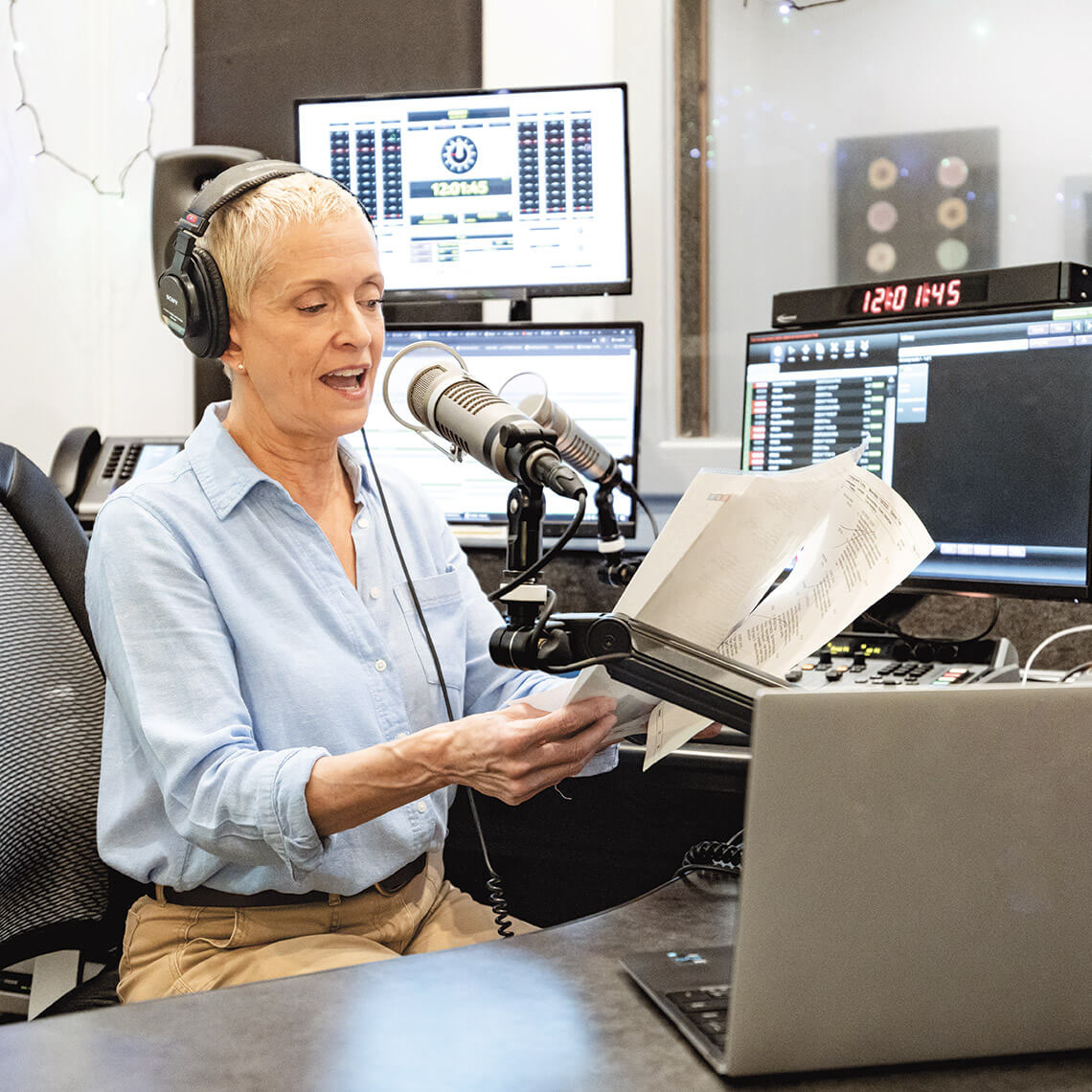
After Helene, Helen Chickering and her team opened Blue Ridge Public Radio to local and national reporters. “In the mornings when I came in,” she recalls, “I would tiptoe because there would be people sleeping in all of these studios.” photograph by Tim Robison
“This floor has seen a lot of tears,” Chickering says of her recording space. “Reporters would sit on the floor, and we’d all listen to the stories they’d collected and process together.” Local reporters would file their pieces, then return to their makeshift home base at BPR studios, sit with Chickering behind the mic, and share those stories with listeners.
She specifically remembers a report from Fairview, where the subject of the interview had begun removing pets and important personal documents from his own home before he saw a landslide bury his neighbor’s. He described watching his neighbor narrowly escape from her house with mud up to her chest, sobbing and knocking on his door, begging for help.
• • •
Twice daily for weeks after Helene made landfall, BPR featured press briefings, wherein city and county officials communicated information to an eager public, many of whom were still without power. The only hope to receive any official reporting was to use a crank radio, if listeners were lucky enough to have one, or to use precious battery or gasoline as they listened in their cars.
Chickering’s soothing voice, leading into and following those briefings, provided unspeakable comfort to listeners as she recapped critical sections of the announcements for those who might have missed them. “So much of our reporting during that time was simply, ‘What do you need?’” she says.

radio controls photograph by Tim Robison
Chickering is eager to credit her fellow BPR reporters and news outlets at large for their round-the-clock work to gather the information that would help people most. “The amazing teamwork that was happening, all the support we were getting from nearby communities or national radio — it was so beautiful,” she says. “People sometimes view National Public Radio primarily as a news source, but we’re community public radio.
“For so many days following the storm,” she continues, “though there were some tourists who got stuck here, it was otherwise very local, and it connected us. Neighbors met neighbors. Communities bonded. Our region rose to the challenge. I hope our listeners felt that we were with them.”
Tomorrow, Chickering will arrive to work at her usual 5 a.m. She’ll settle in, turn on her microphone, and report out to her listeners as we navigate school drop-offs and commutes, our cars full of once-scarce gasoline. We’ll be listening in the background as we switch on the lights, power restored, to our homes and newly reopened businesses. Her voice will be with us to help us through the day, whatever it may hold.
Related: A retired professor, a veteran NPR broadcaster, and a senior at NC State became the go-to sources that helped keep thousands in western North Carolina informed, safe, and secure. Read about them below:
print it