Vicki Basnight pulls her faded orange oilskins, marred with scars and swipes of mud, over her tar-speckled boots. “These old rigs have seen some crabs. I got some new ones, but I like my old ones better,” she says with a deep, genuine, infectious laugh.
Basnight hoists the suspenders over her shoulders and settles in behind the wheel of Old Red, her 22-foot Privateer. She glances at Shallowbag Bay scrolling past in the distance. The mast of the Elizabeth II pierces the sky along Manteo’s historic waterfront. These waters are a highway she’s cruised since before she could drive a car.
“I got my first boat when I was 10, a 16-foot skiff with a 20-horsepower motor on it. I gave that thing hell. She was slow but fun,” Basnight says with a grin. She pushes Old Red’s throttle, its roar lifting the bow, until the boat planes. Buoys dot the water left and right like runway lights, rocking in her wake.
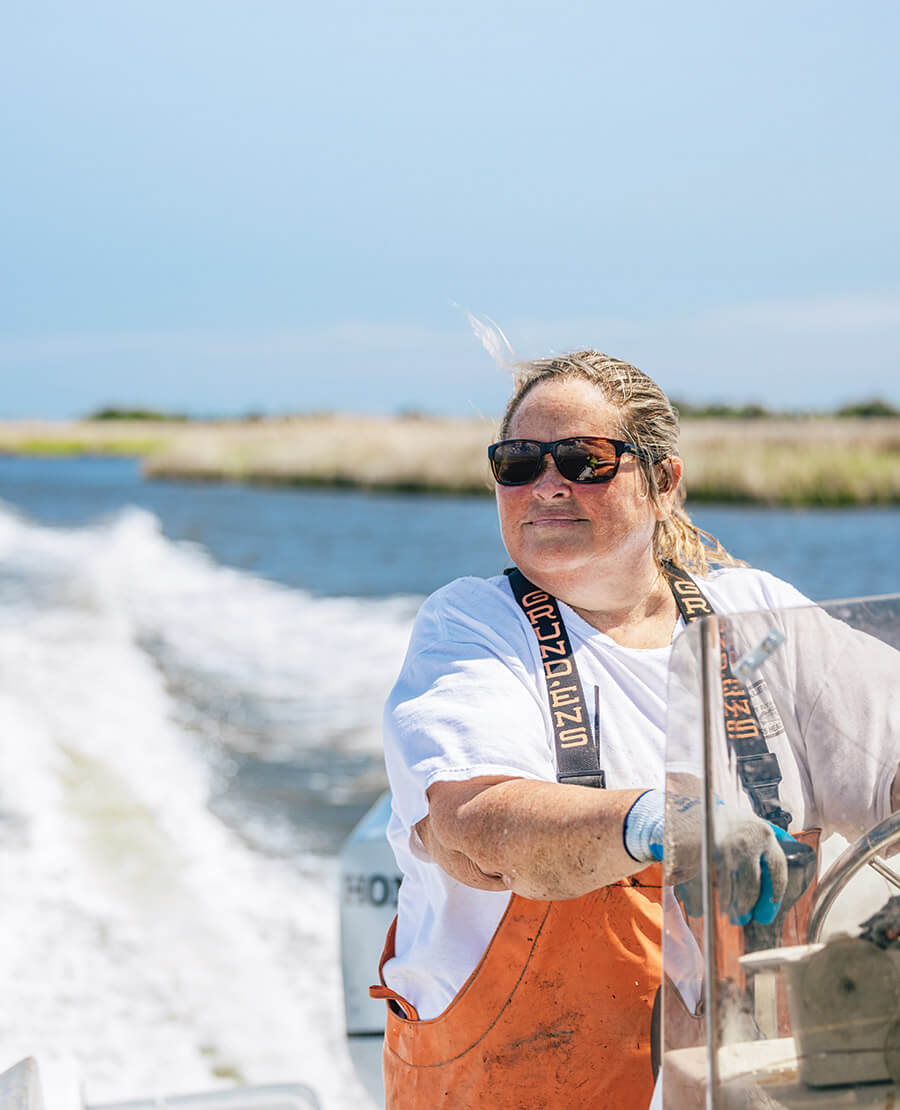
Basnight’s 22-foot Privateer, Old Red, ferries her to her crab pots in the waters around her native Manteo. photograph by Baxter Miller
Basnight set her peeler crab pots a day or so earlier. As her distinctive neon green-and-purple buoys come into sight up ahead, it’s time to determine whether soft-shell crab season has arrived in earnest.
When warming water and a waxing moon come together, the pair bring with them an announcement coveted by many North Carolinians. Eagerly awaited and all too short, soft-shell crab season is a most glorious time of year when the promise of summer brings blue crabs out of their shells — literally — and hopefully onto our plates.
For crabbers like Basnight, who owns Vicki B’s Restaurant & Market in downtown Manteo and co-owns Basnight’s Lone Cedar Cafe — the Outer Banks icon perched along the causeway between Nags Head and Manteo — it also means the beginning of a technical, round-the-clock labor of love.
“I get so excited,” she says. “I mean, it’s really, truly one of the best times of the year to me.”
• • •
Found across North Carolina’s brackish waters, blue crabs tend to congregate in Basnight’s neck of the woods, in and around Pamlico and Albemarle sounds. By both landings and value, the blue crab is the cornerstone of North Carolina’s largest fishery. Its complex life cycle and journey into adulthood bring us the gift of soft-shell crabs.
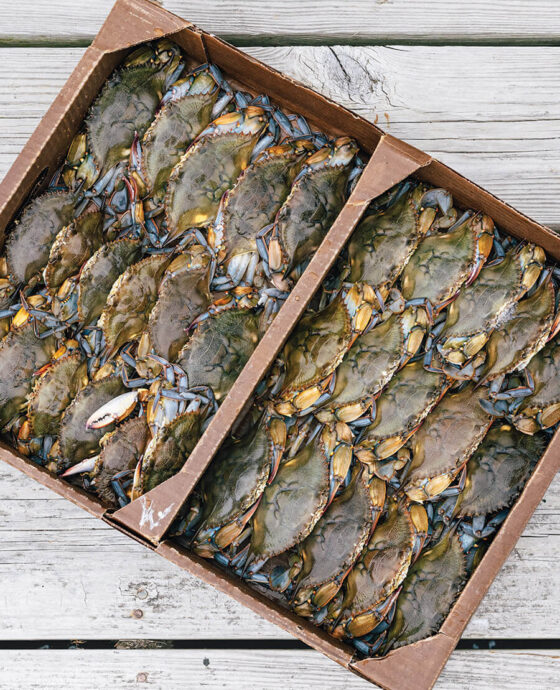
Its hard, bright blue-and-seaweed-colored exoskeleton is incapable of growth, so in order to reach maturity, a crab must periodically shed its old shell and make a new one. It forms a thin, soft inner shell and a fresh set of gills, and when the time comes, it absorbs excess water, splitting the back side of its exoskeleton open in the process. It wiggles backward — body first, legs and claws last — until free, exiting soft and defenseless. It seeks shelter and waits one to several days for its new shell to harden before coming out of hiding.
For young, actively growing crabs, the process begins anew, with another molt in as little as three to seven days. The ritual tapers off in adulthood, with adult males molting a few more times and females completing a final molt at maturity. These masters of reinvention repeat this cycle of rebirth up to 25 times — unless, of course, they find themselves staring through the mesh of a crab pot.
• • •
Despite the fact that tens of millions of crabs shed each year, the likelihood of harvesting them while soft is slim. So crabbers like Basnight set specialized peeler pots to lure them in.
“You bait them with a hard male crab called a Jimmy,” she says. “You want to make sure it’s got some color on its belly. If it’s a nice rusty one, them girls are coming in the house. They won’t come anywhere near a white-belly crab. Size doesn’t matter. You can find a big stud, a little stud, as long as they’re rusty.” She winks. Where the ladies congregate, the males soon follow.
Just as Basnight is about to glide past the first buoy in her line, she dips a metal hook into the water, clinging to the rope dangling underneath the surface. She reaches down and grabs hold of the rope, pulled taut by the weight of the crab pot tethered at the opposite end. Simultaneously, she turns the wheel of the boat hard to the right. The boat slowly circles in place as the mesh wire peeks above the water.
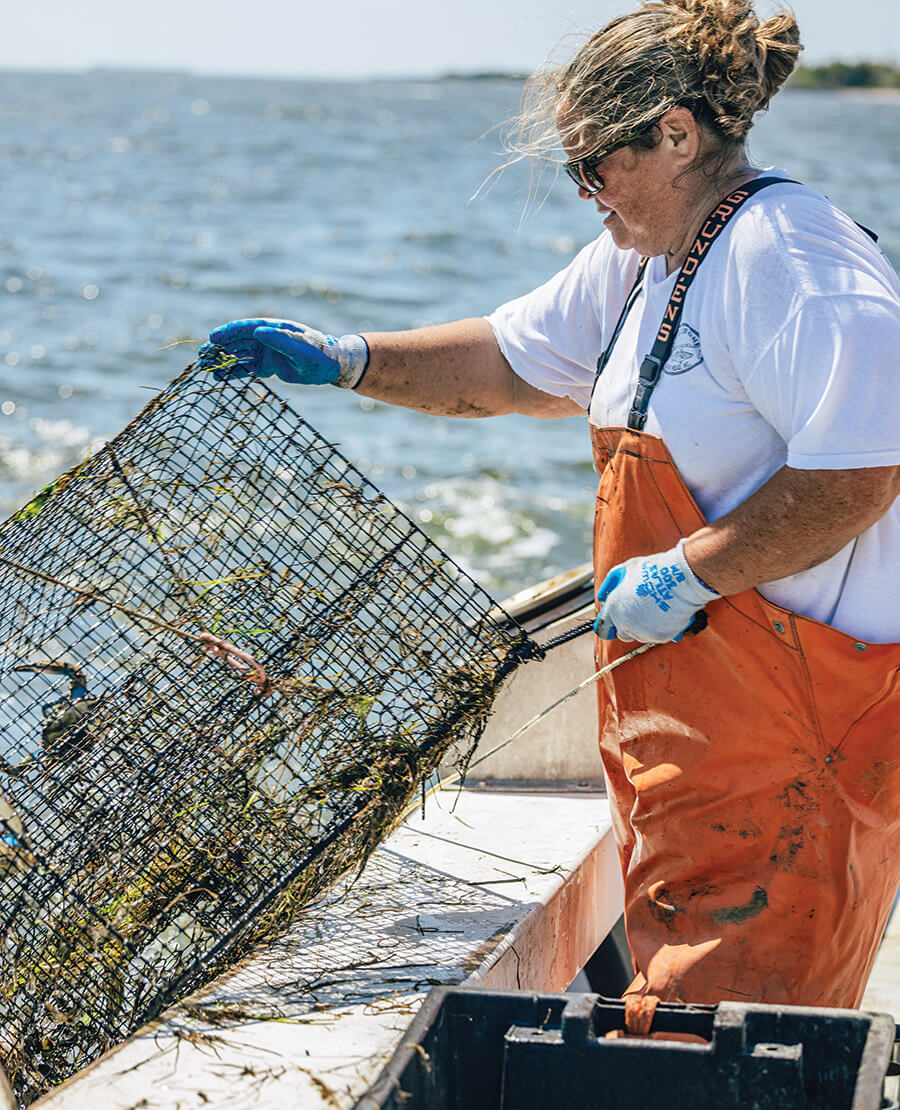
Each pot is baited with a red-bellied male crab called a Jimmy. Female crabs on the verge of molting seek protection and a chance to mate inside the wire cages. photograph by Baxter Miller
Basnight swings the pot onto the gunwale with anticipation. Empty. With a sigh of disappointment, she heaves it back into the water.
She idles to the next. Hook. Hard right turn. Lift. As the pot emerges into the light, a tangled mess of blue crabs carry on inside, some clinging to the wire, others in free fall, most pinching at the air and some at each other.
“Hot damn!” Basnight exclaims. She pulls at the bungee cord that holds the pot’s door shut and turns it upside down, shaking it over a fish tote. A few fall out. A couple of hard taps against the tote encourage the others to join. She latches the door and tosses the pot back overboard, still baited with a lone Jimmy crab, his bright red belly disappearing below the surface.
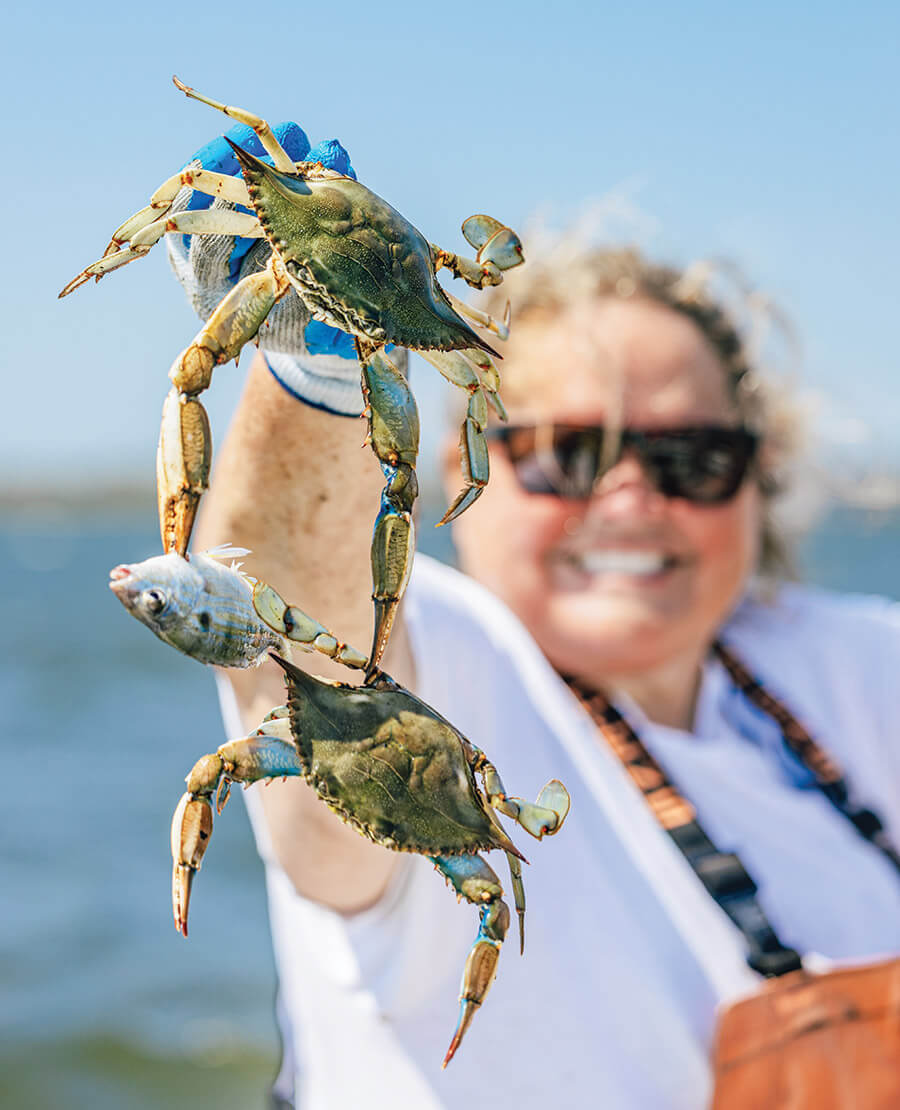
Some fishermen and -women use lunar calendars to figure out when blue crabs are likely to molt, but Vicki Basnight relies on water temperature and other spring signs — like foliage — to determine when to set her pots. photograph by Baxter Miller
Basnight starts culling the haul. Crab by crab, she sorts them. Hard crabs go overboard. She flips one over and points at his rusty belly. “He’s a ladies’ man,” she says, one destined to become a decoy. Others, she pulls by the back leg, raising it skyward to get a good look at the paddle-shaped fin dangling at the end. Here she finds what she’s been looking for: On the back swimming fin, a thin, scarcely visible line hems the outer edge. “She’s about a day from molting,” Basnight says, tossing the crab into a separate basket.
One after another, she searches the back fin. No line. Overboard. A white line, a week or so from shedding. Overboard. A light pink line, two to five days. And the holy grail: a ruby-red line, indicating that the crab is a day or so away from its grand exit.
With hundreds of pots set and hundreds left to check, it’s a rapid process. Grab. Pull. Dump. Sort. Repeat.
And the work has only just begun.
• • •
“My great-grandmama Caroline is who started shedding crabs in my family,” Basnight says. “She was a Scarborough from Duck, and her family owned a section up there, sound to ocean, all the way across. She and her friend Carrie Beals decided they were going to start selling soft crabs. She was the first person in the county on record — not just woman, but person — to harvest and shed soft crabs to sell.” Basnight’s voice swells with matter-of-fact pride.
It’s the kind of lore that some families would trumpet, but not the Basnights. For them, it’s just a fact. A fact that must have felt mundane or worse. “I didn’t even know about it until about 15 years ago,” Basnight says. She read about it in a history book and barely believed it.
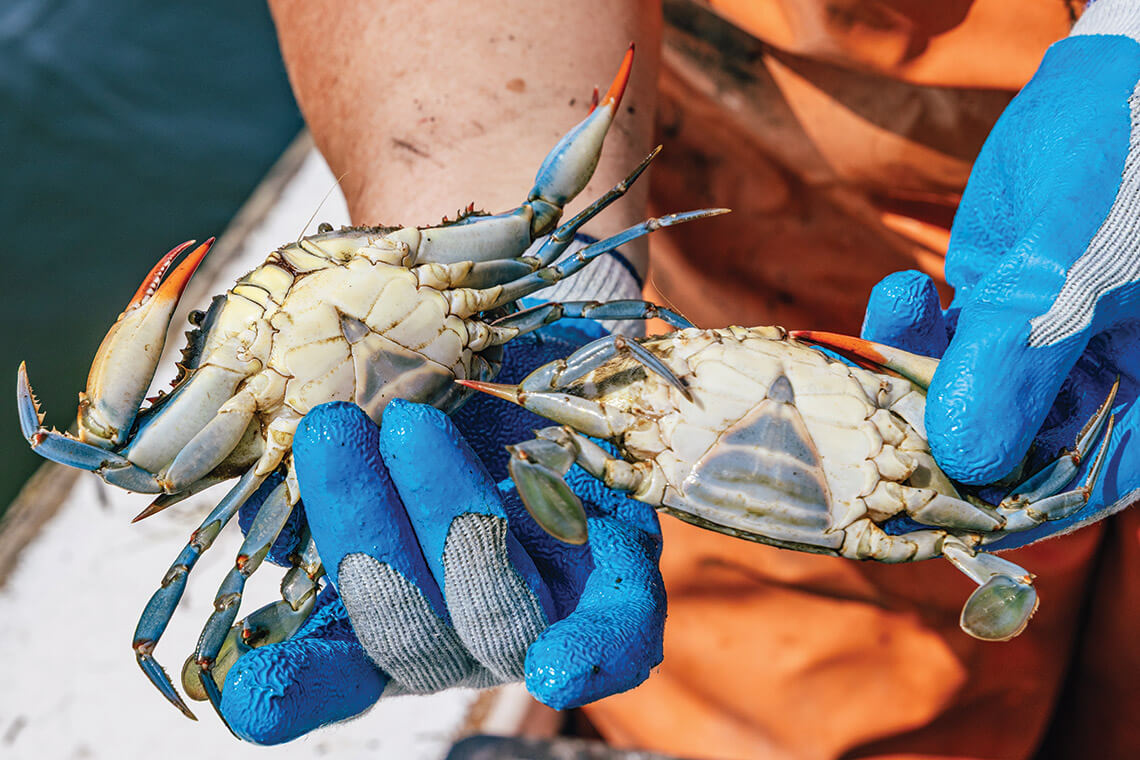
Basnight inspects the back swimming fin of each crab she pulls out of the water: A thin red line along the outer edge means it will molt in about a day or so. photograph by Baxter Miller
For confirmation, she went to the best primary source she knew: her grandma Lessie. “I asked her, ‘Is this true about Great-Grandmama?’ Lessie had a real thick drawl, old-school.” She slows her speech and elongates her vowels in imitation. “She answered, ‘Shew, Lord, she’d made us walk up ’n’ down them shores, pickin’ up them crabs. There was snakes everywhere. It was just awful. ’Course, I’m not gonna tell you a story ’bout that.’”
Basnight was floored. Here was firsthand proof that she was continuing a tradition started by her great-grandmother. The love of shedding crabs may have skipped a generation, but the man her grandmother married picked up where Caroline left off.
“I guess that’s where my love of commercial fishing began, going fishing with my granddaddy,” Basnight says. “My mom would wake me up at 4:30 in the morning, and I’d go shrimping with him. And then I’d shrimp with my mom and dad in the evening.” She laughs, then grows serious. “That gets into you. That’s heritage right there.”
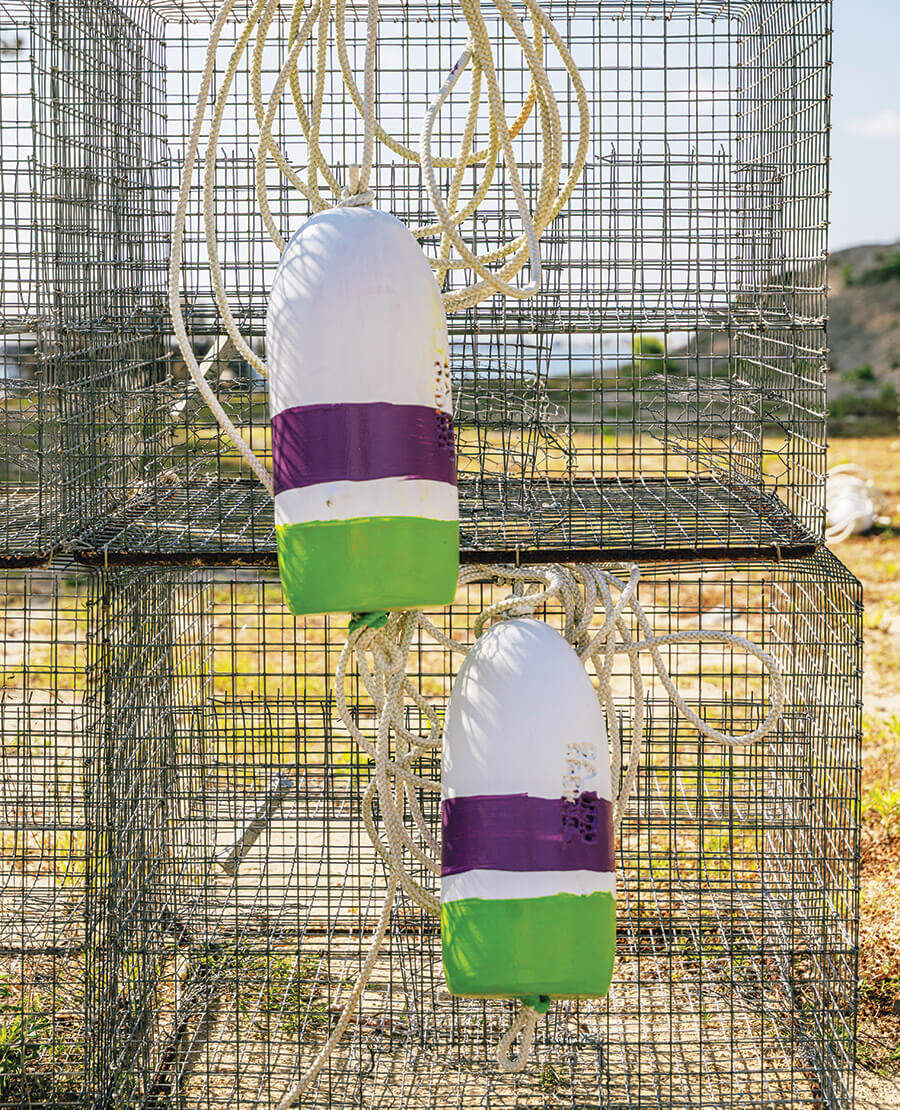
Colorful buoys help Basnight locate and pull crab pots from the water. photograph by Baxter Miller
But it wasn’t just family heritage that pushed Basnight to crabbing; it was also the place she calls home. When she was young, she’d hang around downtown Manteo. “I’d go nag Mr. Jughead Etheridge, who shed crabs,” she says. “He was a character, but the poor fellow had a big head, so that’s what people called him.” She’d mess around in his shedding tanks, plucking the hearts from dead crabs to fish with on the docks. “I had to [have been] a pain. Barefoot, hair wild as hell, sometimes I had a shirt on, sometimes didn’t, ’til my mama chased me down.”
When she got older, she learned to make crab pots from a man she refers to as Snookie Soft Crab Johnson. “I decided I’d never do it again,” she recalls. “I looked like I’d been in a catfight. That chicken wire near about ate me up. It was the worst experience ever.”
But by 19 years old, the foundation had been laid. With a few pots in tow, Basnight started crabbing. “I’ve done it ever since,” she says. “Never looked back. I can’t imagine not doing it.”
• • •
With the pots all checked and crabs sorted, Basnight points Old Red toward her childhood home, the nail on a bony finger of land, wedged between a marshy canal and Roanoke Sound. Perched along the shore, a hundred yards east of the house where her sister now lives, are a series of shedder tanks, a line of large, shallow trays designed to hold live crabs in circulating brackish water pumped from the sound they just left.
Here is where much of the work occurs, a practice in patience, an act of vigilance. When Basnight returns to the dock, she’ll transfer the crabs into the holding tanks, sorted by their willingness to shed. Then she’ll wait for nature to take its course, pushing the crabs toward molting. When they do, she’ll be ready to pluck them from the water as quickly as possible.
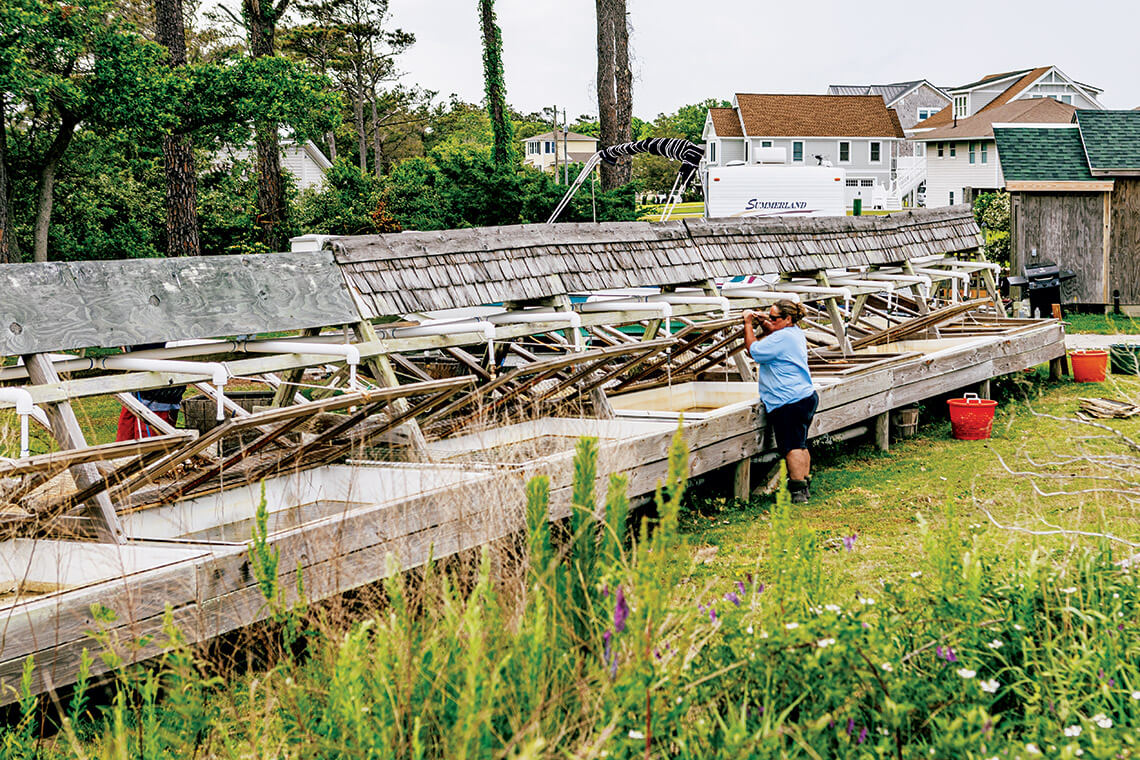
Special tanks keep the crabs in brackish water, pumped from Roanoke Sound, until they molt. Because they begin to harden right away, Basnight stands at the ready to pull them from the water as soon as they shed. photograph by Baxter Miller
Once the crabs shed, they begin to harden, a process only halted if they’re removed from water. The sooner she removes them, the softer they’ll be. Time is of the essence, and round-the-clock surveillance begins. Basnight often sleeps in a 10-by-10-foot shed at the water’s edge, equipped with a window unit, a double bed, and the rest of the floor filled with refrigerators and waxed cardboard boxes to hold crabs.
Today, shedding crabs is mostly a solo job for her, with occasional help from family and friends. But that wasn’t always the case. It used to be a two-woman show — Basnight and her mother, Sandy.
“I would go fish the pots, and my mom would work the shedders every day. She was so meticulous. She’d make sure that we hadn’t missed a single crab. She had her little TV set up in the yard, about this big,” Basnight says, making a small square with her hands. “She’d watch her soap operas while she was going through them. I took care of things at night, but I didn’t have to worry about things during the day because of her. It was just her and me.”
• • •
For a long time, too, it was just mother and daughter at Basnight’s Lone Cedar Cafe, the restaurant they opened together when Basnight was 27. After a day of pulling pots and a stint culling the shedders, it’s 4 in the afternoon and time for her to head to work at the restaurant for dinner service. She finds one last “softie.” Holding it outstretched, she strokes its back. “Feel how soft that thing is. Doesn’t it feel good? It feels so good.”
She gently lifts the crab and tucks it behind the neatly filed line of others in a waxed cardboard tray. Stacking nine boxes of crabs, she loads them in her truck and heads toward the causeway for a six-hour shift at the restaurant.
Her work ethic should surprise no one. She is, after all, the daughter of the late Sandy Basnight. Her father, the late Marc Basnight, was the longest-serving president pro tempore of the North Carolina Senate. For decades, he was one of the most powerful men in North Carolina politics, working with presidents, governors, and political allies and rivals alike. He was known for handing out his personal cell phone number to constituents and stopping all along U.S. Highway 64 to deliver on promises he’d made to the people who sent him to Raleigh.
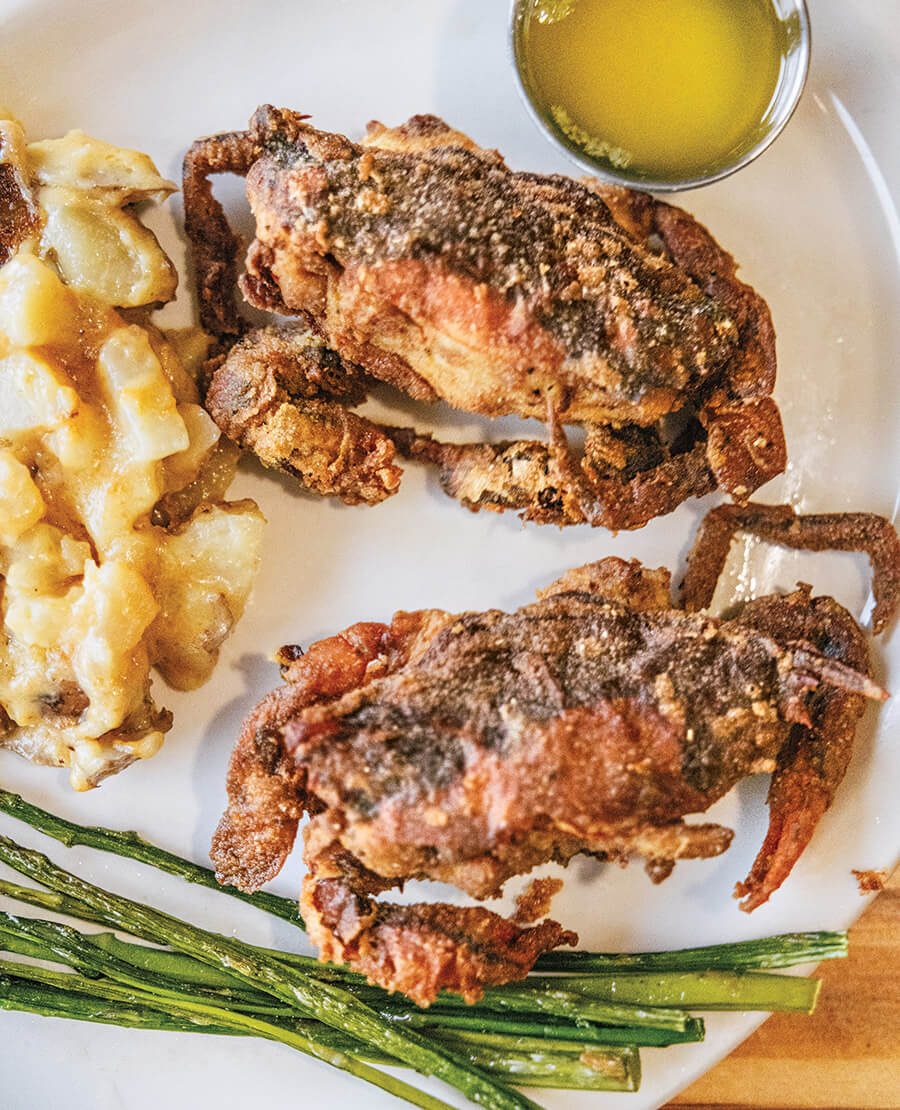
The result of Basnight’s hard work and round-the-clock vigilance: a soft-shell crab supper at Basnight’s Lone Cedar Cafe in Nags Head. photograph by Baxter Miller
When Basnight arrives at the waterfront restaurant she now runs with her sister, Caroline Basnight, she heads up the back stairs into a tiny, windowless office to jot down an idea for a new soft-shell crab dish: two fried claws drizzled in house-made pepper jelly, tucked in a pocket of crispy Bibb lettuce grown out back in the restaurant garden. But as for her, she prefers her soft-shell crab one way. “The same way my dad liked it: two small crabs, fried up, one piece of Wonder Bread folded in half with a little Duke’s Mayo. That’s my favorite,” she says.
Time along the eastern edge of North Carolina is marked less by months and days than by shifts in the wind and the size of the moon. A changing tide trumps the hands of a clock, and mullet runs and bluefish blitzes can say as much as an equinox or solstice. But when the water warms and the moon fills out, and blue crabs begin shedding their shells, a renewal is on the way. The tide carries with it a message of summer, inscribed upon the hearts of those who’ve called these coastal villages and hamlets home for generations.
Within this season, they find meaning and purpose, remember love and loss. They conjure the past and ground themselves in the present, shedding one layer to reveal another.
Basnight’s Lone Cedar Cafe
7623 South Virginia Dare Trail
Nags Head, NC 27959
(252) 441-5405
lonecedarcafe.com
Vicki B’s Restaurant & Market
301 Budleigh Street
Manteo, NC 27954
(252) 305-8117
facebook.com/p/Vicki-Bs-61582513892682/
print it