 In the wake of Hurricane Helene, people across the mountains did what they could: planting, building, repairing, creating. These are stories not of grand gestures but of small acts that became the scaffolding of recovery. Read about those who came together to support each other.
Omi Salavea’s collection of trash began with three nails.
It wasn’t like Salavea, an artist in the mountain town of Old Fort, had been collecting debris for a trash-to-treasure project. It was more that she felt compelled to pick up each piece to keep it from doing any more damage. At the time, she didn’t realize she was about to embark on an adventure — and bring a community with her.
A few weeks after Helene, when Salavea returned to her day job at the McDowell County Visitor Center to inspect her office, the heads of three roofing nails in the parking lot caught her eye. She bent down and picked them up. “I didn’t want them to ruin somebody’s day,” she says.
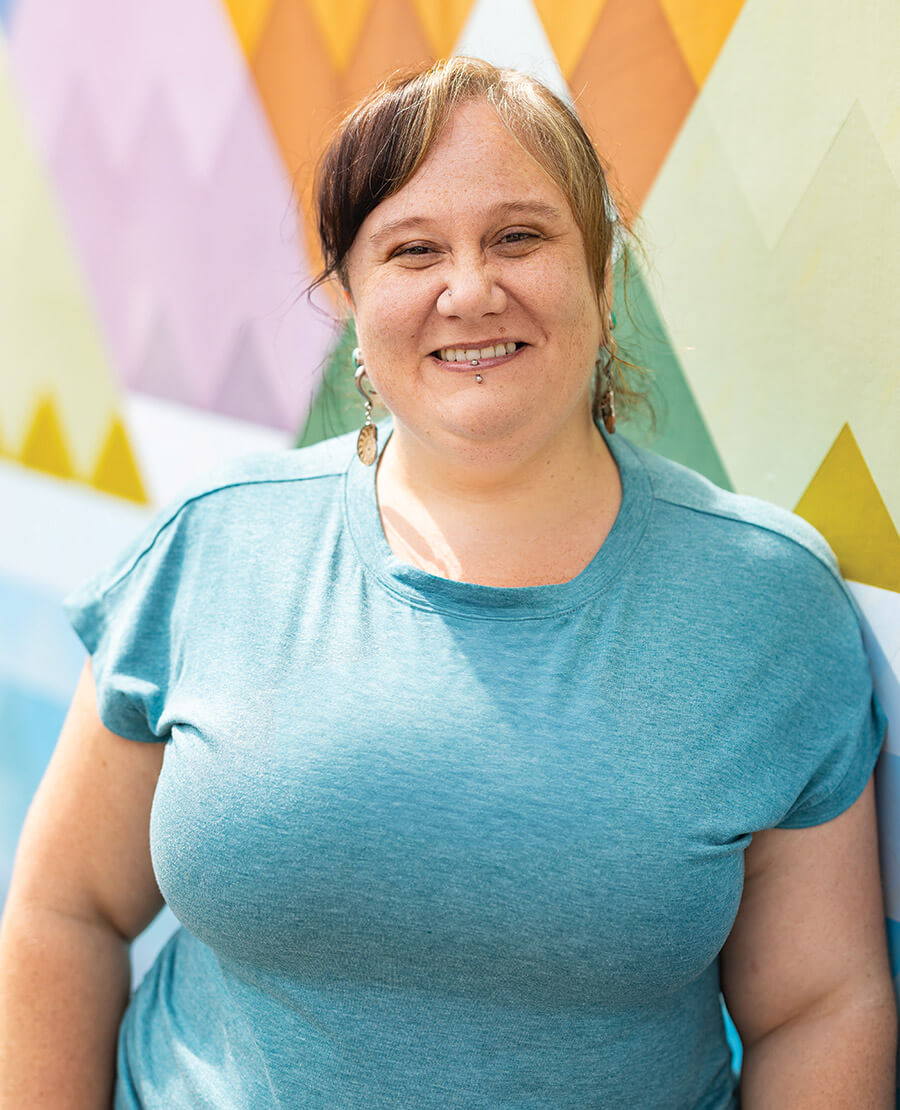
Omi Salavea photograph by Tim Robison
Salavea dropped the nails on the corner of her makeshift desk. Over the coming days, without even thinking, she added to the pile. Bolts, shards of glass, parts of an old insulator from a fallen power line. Eventually, she added them to tall drinking glasses and jars. “It was my coping mechanism, I think. Some of us had our art studios destroyed. Others of us were left homeless,” she says. “Almost everybody is waiting for a paycheck and can’t afford a flat tire. Despite a natural disaster, real life still happens.”
As an artist, Salavea often hears the sentiment that tragedy sparks creativity. “But there’s a time where you’re like, ‘How do I process this?’ ”
For Salavea, the answer came well after Helene.
“I just sat there at my desk and stared into the glass,” she says. “It was an oddly sunny day, and the sun captured a piece of aqua glass just right,” she says. “I realized it’d been two months since I’d physically made anything.”
• • •
Omi Salavea’s Healing Thru Helene sculpture collection began with a skull.
Salavea admits she has a bit of a reputation. “My normal art is described as ‘spooky’ and ‘granny witch’ style,” she says with a laugh. “I go out into the woods and look for plants and mushrooms that I can dry to then turn into resin skulls, made from a mold I use a lot. To me, skulls represent finality and attaining wisdom.”
Typically, September is one of Salavea’s prime foraging months. But Helene stripped away the topsoil, taking the microbial network where mushrooms grow with it.
As she gazed into a glass of trash on her desk — the sun gleaming off the aqua glass — inspiration struck, and Salavea thought about her skull mold and the possibilities it held. It was time to dust it off and get back to making.
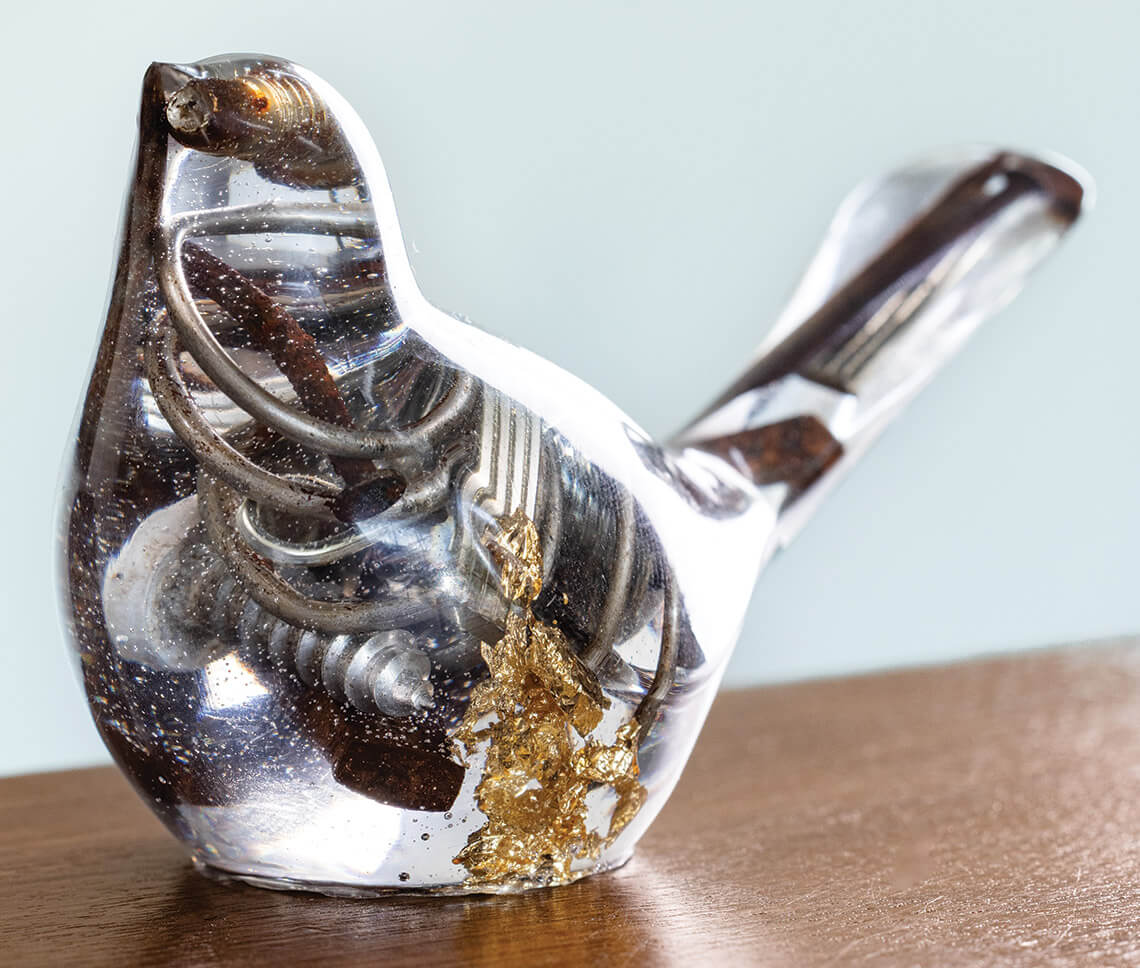
One person’s trash may be another person’s treasure, but in Salavea’s art studio, it becomes works of art. photograph by Tim Robison
Salavea shared with a colleague her first sculpture — a resin skull with sparkling pieces that she’d collected. “My co-worker said, ‘That is beautiful but also very creepy. People feel dreary, and they need hope.’ ”
The conversation then turned to bluebirds. “After Helene, a few weeks went by without the sounds of birds,” she said. “In Southern folklore, the bluebird represents happiness.”
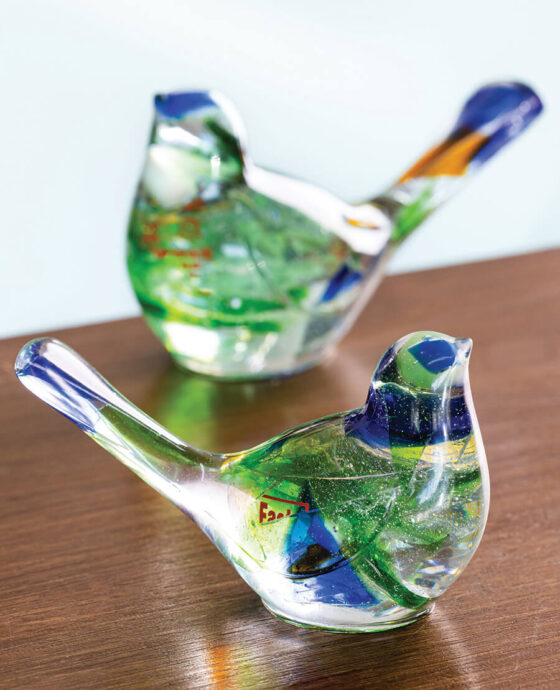
So Salavea bought a bird figurine from a local consignment shop and cast a mold, small enough to fit in the nest of your palm. Into the mold went an assortment of trash: buckles from old shoes, pages of books lost to the floodwaters, glass from broken bottles. Then she poured the resin. “By the end of the weekend, I’d made four bluebirds and a skull.” When she held each bluebird up to the light, the sun reflected through her found objects.
To Salavea, they represented hope. “I decided I would give these bluebirds of happiness to our community,” she says.
• • •
Omi Salavea’s gift to Old Fort began with an adventure.
Tucked along the southern edge of Pisgah National Forest, Old Fort’s peaceful soundtrack — insects chirping, birds singing, and water tumbling over rocks along Mill Creek and the Catawba River — is familiar to hikers.
Almost all of the town’s trails closed following Helene, but over the past year, volunteers and Forest Service personnel cleared trees and removed debris, making many accessible again.
One of Salavea’s favorite places to walk is a path between the Mountain Gateway Museum and the Old Fort Library. “There’s a small mosaic garden at the library and one of those neat signs that shows how far the library is from imaginary places in books, like The Shire and Narnia,” she says. Here, she adds, “you can forget everything for a moment and find a little peace.”
It was the perfect hiding place for Salavea’s scavenger hunt. She hid a bluebird sculpture in the Little Free Library and shared clues to find it on her Instagram (@omi.salavea).
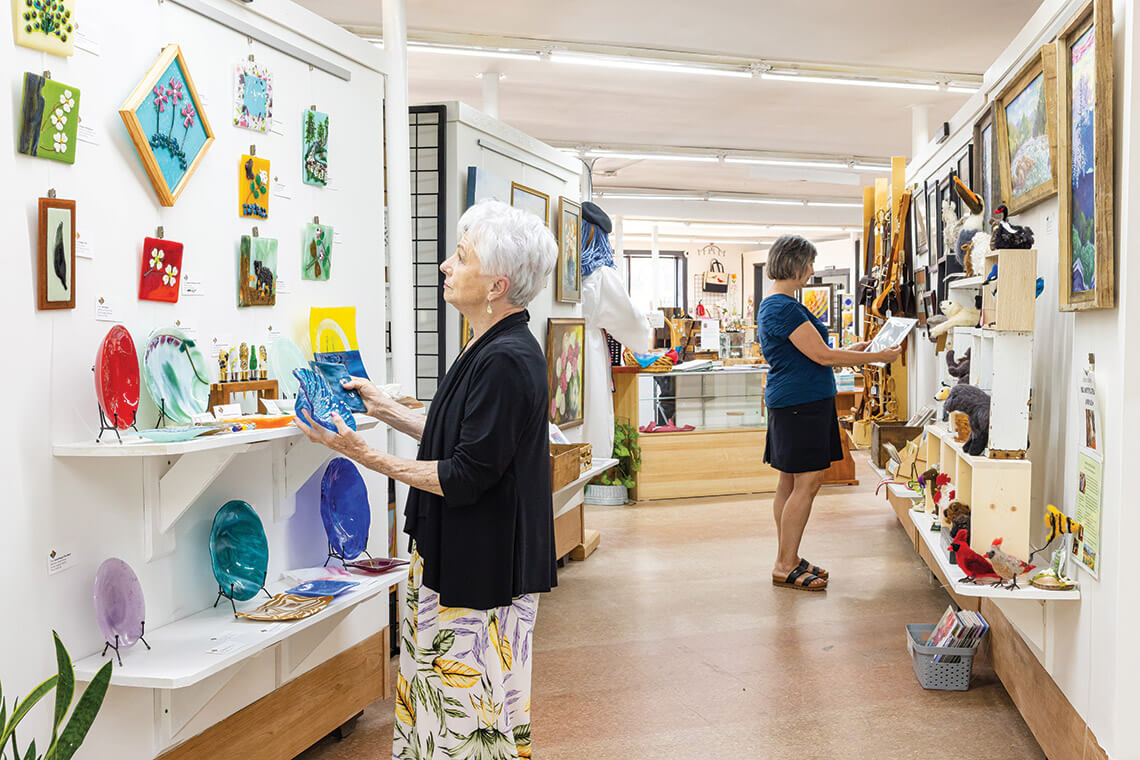
The Arrowhead Gallery & Studio (above) is one of dozens of places that Salavea has stashed her tiny sculptures. photograph by Tim Robison
As her social media engagement grew, Salavea expanded the hunt to the neighboring town of Little Switzerland. Her goal: Drive people to beautiful places that, over the past year, experienced devastation and rebirth.
One of those destinations is Arrowhead Gallery & Studio in Old Fort, which reopened in a bigger space with room for more artists beside the Visitor Center. “They went through all the tough stuff we all went through, and they have room to thrive,” she says.
Since Helene, Salavea has hidden more than 20 sculptures — all love letters to her chosen mountain home. Her goal is to hide and give away at least 30 sculptures by the storm’s anniversary.
Salavea’s scavenger hunt clues have led to places like Mill Creek, in downtown Old Fort; to events like the Rails and Rhythms Bluegrass Night; and to local landmarks like the Arrowhead Monument at the historic train depot, where she hid a small resin heart. “The point wasn’t that the Arrowhead was the heart of the town,” Salavea says, “but that the heart of this town is change and growth. In our hearts, that growth makes us.”
print it