 Listen as the pages of the magazine come to life in the Storytellers podcast featuring the voices of Our State writers. Each podcast episode features a writer reading their column aloud, allowing each distinct voice to shine. Click below to listen to Eddie read his column aloud.
In southern Africa, some 7,200 miles from my backyard in Raleigh, a small mammal called the rock hyrax has a peculiar habit of “going to the restroom” — you have to say this last part very quietly in the South — in the same corners of the same caves, generation after generation. Scientists there have collected 30,000-year-old splotches of rock hyrax pee and poop — polite people would call this a palaeoenvironmental archive — to study the fossilized pollen within as they map out changes in climate and vegetation over the centuries.
Fossilized pollen. That’s sort of like the plant kingdom’s version of forever chemicals.
Is that helpful? Does it make you feel better to know there are stashes of ancient pollen, gazillions of years old, tucked away all over the world?
Yeah, me neither. At the moment, nothing short of a five-gallon bucket of Sudafed pills will make me feel better.
Excuse me while I sneeze 83 times.
OK. I’m back.
Wait a sec. Make that … 84 times.
• • •
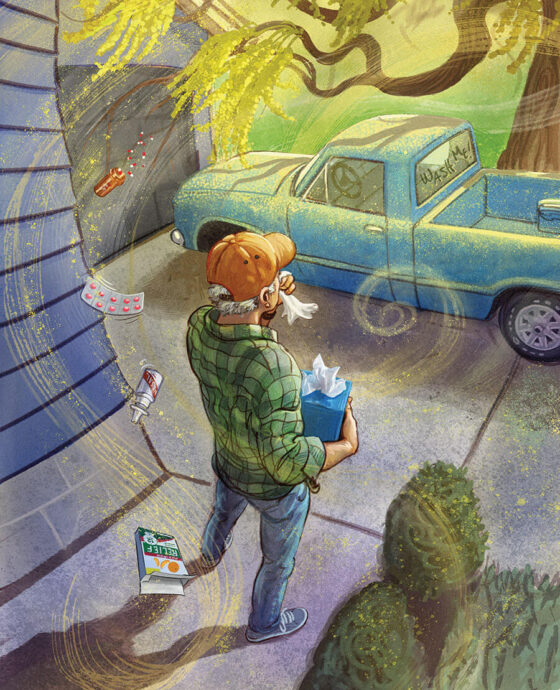
A week ago, I walked out to the driveway, and there it was: proof that for the next few weeks, I would wage war with a tiny, nearly microscopic foe. Overnight, my dark blue pickup truck had taken on a yellowish sheen. It happens that quickly. One morning, you’re eating stale Valentine’s Day chocolates for breakfast. The next, it’s yellow-geddon. The yellapocalypse. Yellastrophe strikes. Pollen season — the fifth season in North Carolina, wedged between winter and spring — has begun.
Like water, sunlight, and weekly fishing trips, pollen is a necessity of life itself. The tiny grains fertilize plants, and without them, we wouldn’t have sweet corn, geraniums, or blueberries. But here’s the rub: Most flowers have relatively heavy, sticky pollen grains, and bees, bats, butterflies, ants, and hummingbirds pollinate these nice, considerate plants. Most trees, however, are wind-pollinated, and their tiny, powdery pollen grains have to be carried on the breeze to neighboring trees. It’s a game of numbers and chance, which is why trees produce SO MUCH FREAKIN’ POLLEN that every errant spring zephyr becomes a yellow tsunami.
And do we even want to start with the catkins? Please no. Not those dangly, innumerable, track-them-all-over-the-house pollen bombs. It’s just too much to think about.
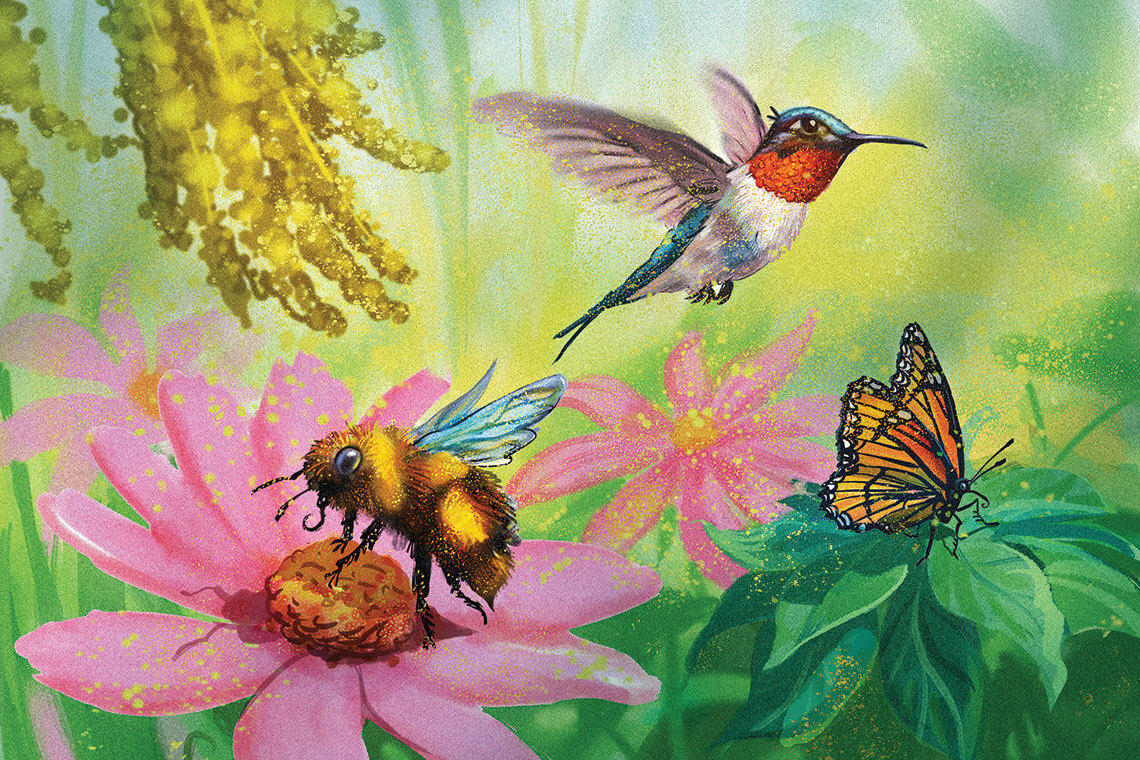
illustration by James Bernardin
For most of my life, pollen was a nonissue. Didn’t bother me a bit. I could bathe in the stuff. Julie, however, was stricken with the first blush of amber in the air. Nose running like a flood tide. Eyes all bleary. Sneezy, snorty, headachey. And cranky? Hoo, buddy. Let’s move along.
What a lesser mortal, I thought. Then, one day a few years ago, I woke up with late-onset seasonal allergies. Nose running like a king tide. So sneezy. So snorty. So headachey. Soooo much worse than Julie ever had it, for sure.
Manallergies. She can’t begin to understand.
Now we fortify our lives once the last Whitman’s Sampler box is empty. Sudafed, Actifed, Allegra. Benadryl, Claritin, Zaditor. Gallons of Flonase. You know the drill. Change the HVAC filters. Load up on tissues. Gulp down handfuls of Vitamin C. Ginseng? Stinging nettle? Powdered snakeskin? Bring it. All of it. We’ll try anything. The ill wind is coming. Prepare thyself.
• • •
What’s so maddening about the pollen conundrum is that the same minuscule modules that usher in mucous and misery are also responsible for such beauty and splendor. And they hardly look mischievous. Through the lens of a scanning electron microscope, a grain of oak pollen looks like Pac-Man. Pine pollen favors Mickey Mouse, with a pair of earlike sails that let it ride the wind for miles. Pecan pollen could pass for a navel orange.
If one or two or three of these characters showed up at the house, I’d welcome them with open arms. But they don’t. They have to bring all their friends.
Even the age-old solution to the chartreuse smog — a steady rain — is fraught. During a thunderstorm, updrafts suck pollen into the clouds, and individual grains are broken into even tinier pieces by electricity in the storm center or by swelling with all that atmospheric moisture until they burst. Now those gazillions of pollen spores have been busted up into bazillions (1,000 gazillions equals one bazillion) of more miniature pollen torpedoes, which are swept toward the ground with cooler downdrafts as the storm front passes.
The same minuscule modules that usher in mucous and misery are also responsible for beauty and splendor.
My schnozz is down there, waiting.
These smashed-up pollen grains can be “inhaled into the intrathoracic airways,” according to a Journal of Asthma and Allergy article, “bypassing filtration by the nasopharynx due to their smaller, respirable size.”
I don’t know about all that, but I do know that all hell breaks loose in my poor head: “This early asthmatic response,” sayeth the scientists, “is characterized by IgE-mediated mast cell degranulation … as well as mucosal edema and mucous production. This may be followed by ongoing Th2 lymphocyte activation, inflammatory cytokine signaling, and/or eosinophilic infiltration, perpetuating the asthmatic response in the individual.”
Yeah. All of that. Mast cell degranulation. Lymphocyte activation. Cytokine signaling. That’s why I’m cranky. Do you understand now? It can literally rain pollen. Don’t say I didn’t warn you.
So Gesundheit, Gesundheit, a thousand Gesundheits. The German word means “health.” Or as we translate the phrase in the South during pollen season: “Good luck.” We’re all going to need it.
print it