 Listen as the pages of the magazine come to life in the Storytellers podcast featuring the voices of Our State writers. Each podcast episode features a writer reading their column aloud, allowing each distinct voice to shine. Click below to listen to Eddie read his column aloud.
Freezing rain is my favorite. A solid few hours of icy drizzle whittles away at the options. What else are you going to do? You’d be crazy to drive a car in the stuff. You need to stay close to home in case the power goes out. Even the front porch steps will push your luck. Given these conditions, there’s only one sane activity to engage in during a steady, sloppy, slippery bout of freezing rain: tying a bunch of flies.
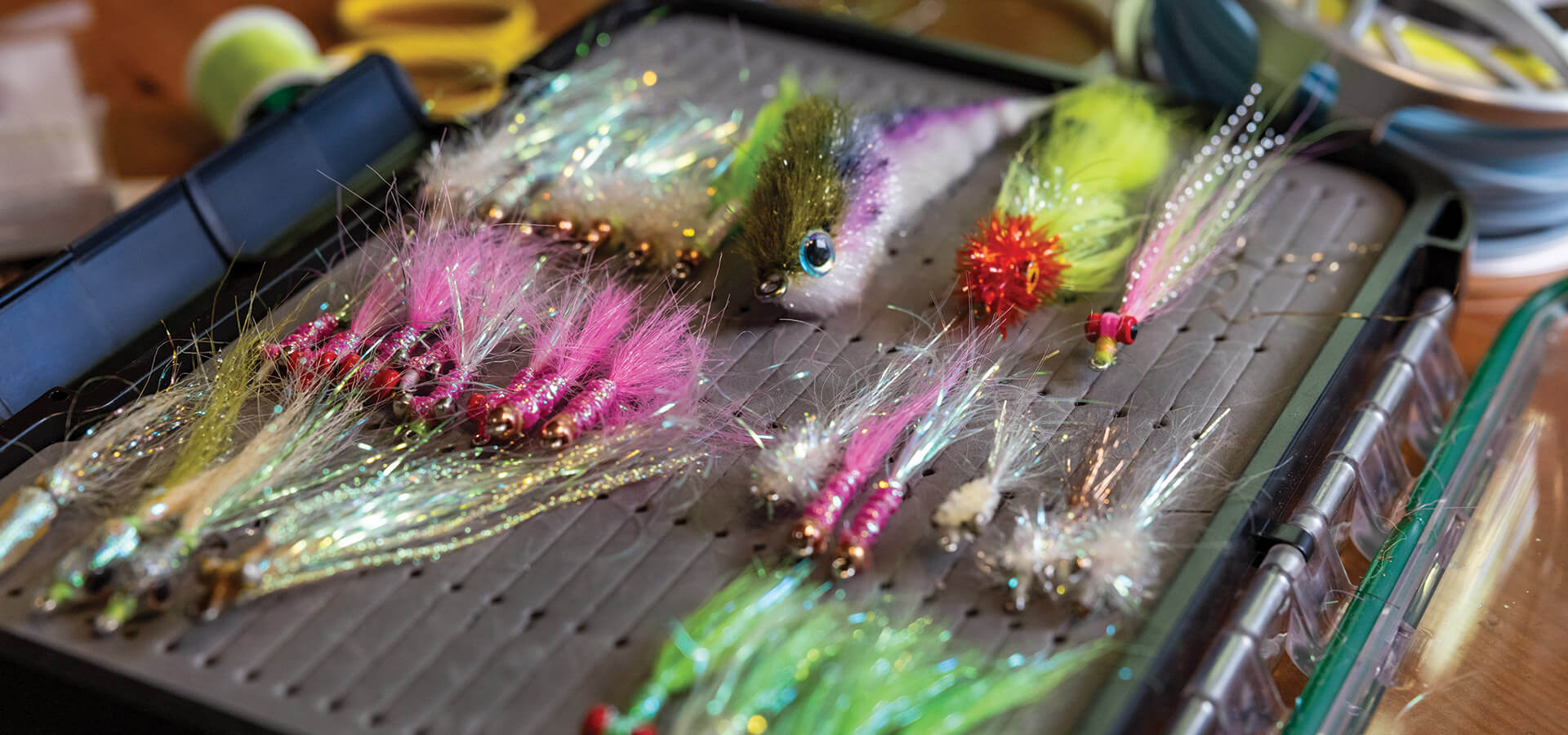
Trout flies, bass flies, flies for saltwater redfish and bluefish — any and all of them. If ever there were a time to spend stupid amounts of money trying to make fake bugs and minnows in the hopes of catching real fish weeks and months later, the stir-crazy days of deep winter seem tailor-made. Add freezing rain, like that glazing the branches outside my kitchen window, and I go running for my tying vise, snips, thread, bobbins, tinsel, glues, and hooks. Fake eyes. Multicolored markers.
If you didn’t know how crazy I am about fly-fishing, you’d think I was opening a Build-A-Bear Workshop. Except for the snoring dog at my feet and Julie in the playroom doing TV yoga. When Julie won’t drive to the yoga studio, the weather must be seriously treacherous.
• • •
Fly-tying is the art, craft, and obsession of hand-making small, even tiny, lures for fly-fishing. It’s a mash-up of knitting, sculpture, macramé, painting, welding, and petit point — a form of needlepoint using even smaller needles. It’s equally a mash-up of science and art, instinct and craft.
To turn a bare metal hook and an assortment of fur, feather, tinsel, and glue into a simulacrum of something tasty — a shiner minnow, a mayfly, a leech (yum!) — is an art form that goes back to Macedonian anglers in the first or second century A.D. They attached red wool and feathers to hooks in the hopes of fooling “fishes of a speckled hue.” Since anglers are doing pretty much the same thing centuries later, it’s safe to say the Macedonians were onto something.
As soon as I hear the words “wintry mix,” I pull my tub of fly-tying materials out of the basement with plans to convert the kitchen into my workshop. I clamp a specialized vise that holds fishing hooks on an arm above the table. Then I heap up a small mountain of dyed deer tails, glittery tinsels, synthetic fibers, duck feathers, squirrel hair, and approximately 67 tubes of various glues. Julie insists that she doesn’t like eating dinner from a plate surrounded by dyed animal parts and stick-on eyeballs, but I know she does. She really does.
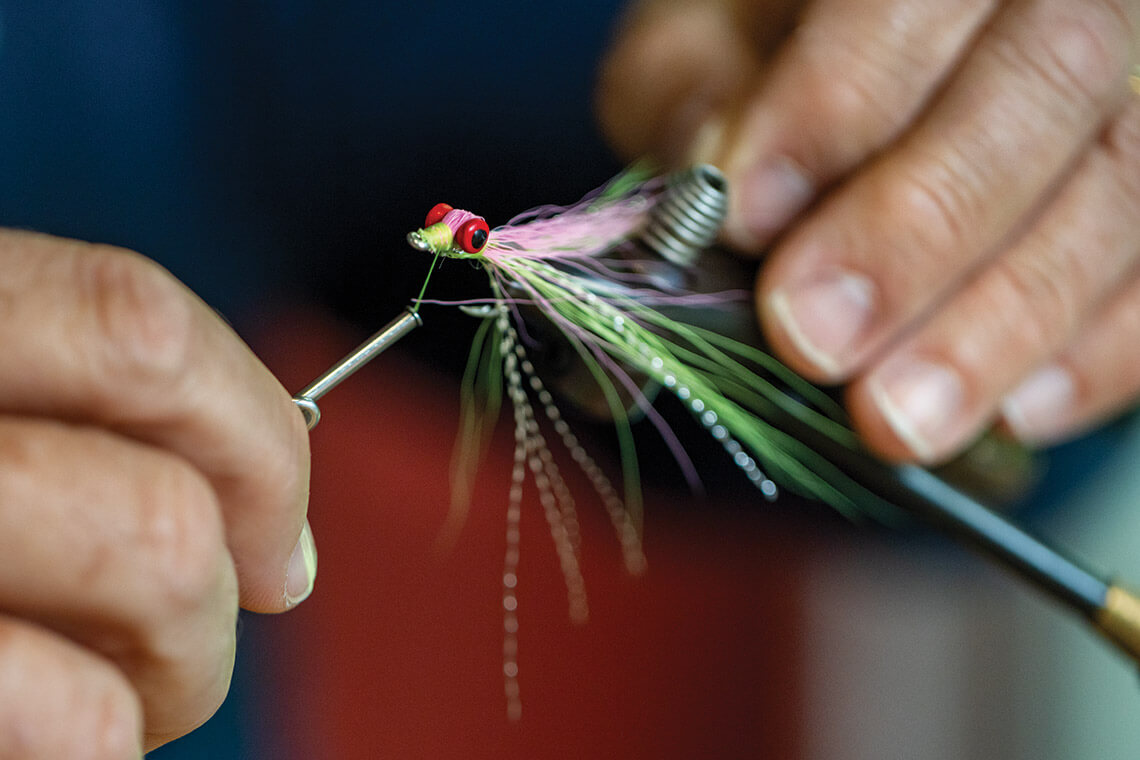
The author puts the finishing touches on a sparkly Tutti Frutti fly, a top choice for catching Spanish mackerel along the coast. photograph by Charles Harris
And then I begin.
The vise holds the fishing hook steady while I wrap the hook shank in waxed thread. It is tedious, technical, and completely absorbing. Had you told my younger self that I would one day spend hours with a thread bobbin in hand, making dainty whip stitches, my younger self would have called you nuts.
Once I cover the hook shank in thread, I wrap it with heavy wire, allowing the fly to dip and dart in the water. Next, I attach a fingerful of chartreuse deer hair with more tiny thread wraps. Wrap-wrap-wrap. There’s a cadence to the process that’s nearly hypnotic. Next comes a hank of glittery synthetic hair. Wrap-wrap-wrap. Dab of glue. Wrap-wrap.
To tie a fly means building the creature from the inside out. I attach a piece of pearlescent tubing to the hook and compress it so the tubing flares into a vaguely minnow-like shape. I gingerly attach a plastic eye. And now comes my favorite part: painting the body with clear epoxy. Scissors, markers, glue — I feel like I’m 4 years old again.
On a dreary, sleety, freezing-rain winter afternoon, I trust that there will be fish in the rivers of spring.
Except this is a dubious business. Tying flies is an act of deception. I am creating something fake so that it will be mistaken for something alive, and I do so out of things that once held life — feathers, hair, strips of fur. I do my best to create a lie so that I can cast my fake to a fish — a second lie — to be followed by a third lie, most likely, when I tell my friends what happened next.
But tying flies is also an act of faith. On a dreary, sleety, freezing-rain winter afternoon, I trust that there will be fish in the rivers of spring. And I have faith that they will be hungry.
• • •
That’s where the real beauty lies in these flies I tie — hardly in my rough attempts at the fly itself. Alone in the kitchen, as freezing rain garlands the backyard trees in shimmer, I think of where I’ll cast these flies on a warm spring day. On the Roanoke River as it tumbles across the fall line, or the Cape Fear where cypress trees crowd the banks, or the wide Neuse as it grades into Pamlico Sound.
Without moving from my fly-tying table, I travel across the state. To my friend’s farm pond in Johnston County, where largemouth bass cruise the tangled banks. To a certain section of a certain mountain stream, where the brook braids into three cascades that tumble into a dark pool bordered by dark timber. I know which rock I have to stand behind to make an accurate cast.
Wrap-wrap-wrap. I know I need a fly that will sink quickly — wrap-wrap-wrap — to lure a brown trout out from its lair of ancient sunken timber. Whipping wire around the body of a fly called a Woolly Bugger, I think: Oh man. That iridescent chenille looks sooo good. My younger self, of course, would not have known chenille from chiffon from a burlap sack.
I cut a snippet of crinkled tinsel and turn it into the glinting scales of a redside dace minnow. White deer hair for the belly of a chub. Crescent of red marker for a slash of gill.
The trees outside the kitchen window bow low with their freight of ice. Branches crack. Overhead lights flicker and pop. I hope I have gas for the generator. You’d be crazy to travel in such weather, but I am nowhere to be found. In my fly boxes are hundreds of flies, each one a passport to a future memory in a distant place, and already I’m halfway there.