Old Salts: Whether native or transplant, these folks found their place and passions on North Carolina’s coast, becoming as integral to life here as the sand and sea. Read more about the folks that make the coast thrive.
A white cinderblock building stands behind a towering live oak near where U.S. Highway 70 ends on the East Coast. Its neat, faded block lettering declares “Harris Net Shop” across its gable as the shop is a living monument to a bygone era when commercial fishing was the backbone of our coastal communities. Built a stone’s throw from Heidi Harris Roberts’s childhood home when she was about 10 years old, the building became the center of her universe. It sparked the beginning of a lifelong love for a dying, traditional craft.
Her father, Roger, started the business in their backyard in the late 1960s and, in 1973, built a proper shop. Business boomed, and the shop supplied fishing families from Wanchese to Wilmington as commercial fishing in North Carolina reached its heyday in the late 1970s and early 1980s.
Now, 20 years after her father’s death, she’s the last net shop owner she knows of in the area. “I didn’t have a choice,” Heidi says. “I had to make it.”
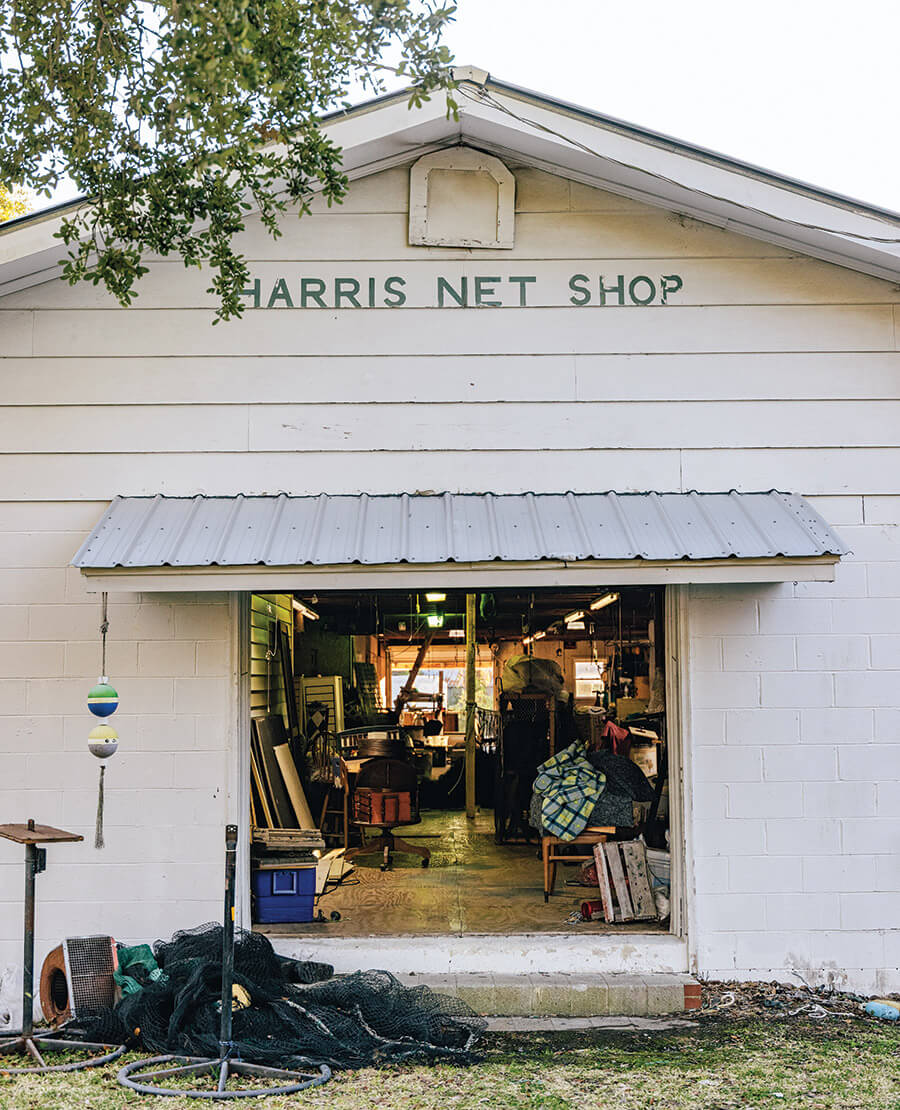
Learning the family business from the ground up, Heidi Harris Roberts has kept Harris Net Shop going since her father’s death 20 years ago. photograph by Matt Ray Photography
The shop is a yardstick by which the health of North Carolina’s working waterfronts can be measured. When the commercial fishing industry succeeded, the shop succeeded. “One time, we made 44 nets in a single week,” Heidi says. “We’ve sold nets as far north as Massachusetts and even sent a damn clam net to Alaska one time.”
But as the community’s lifeblood was siphoned, as regulations increased and the industry at large declined, the shop’s demand waned. Shuttered fish houses, fewer fishermen, and smaller landings meant fewer nets. Eventually, Heidi thought it wise to take a second job working at the Cedar Island Ferry terminal, a job she recently retired from.
As Heidi looks around the shop, she sees walls lined with bins spilling over with bales of black, green, and nylon net. “It’s hard to believe,” she says, “it’s all quiet. This place used to be full of men and women laughing and talking and carrying on.”
The silence is a tough pill to swallow. “When I was young, the whole family was here — my younger brother, my older brother, Daddy, Mama, and me,” she says. “We each had our own job. Sort of like an automotive factory.”
What once proved an efficient method of production nearly became Heidi’s downfall when she took over the family business. Her brothers were fishing full time, and Heidi, who had a young son at home, was the only family member committed to keeping the shop open.
“We still mostly use Daddy’s patterns. That’s what people want.”
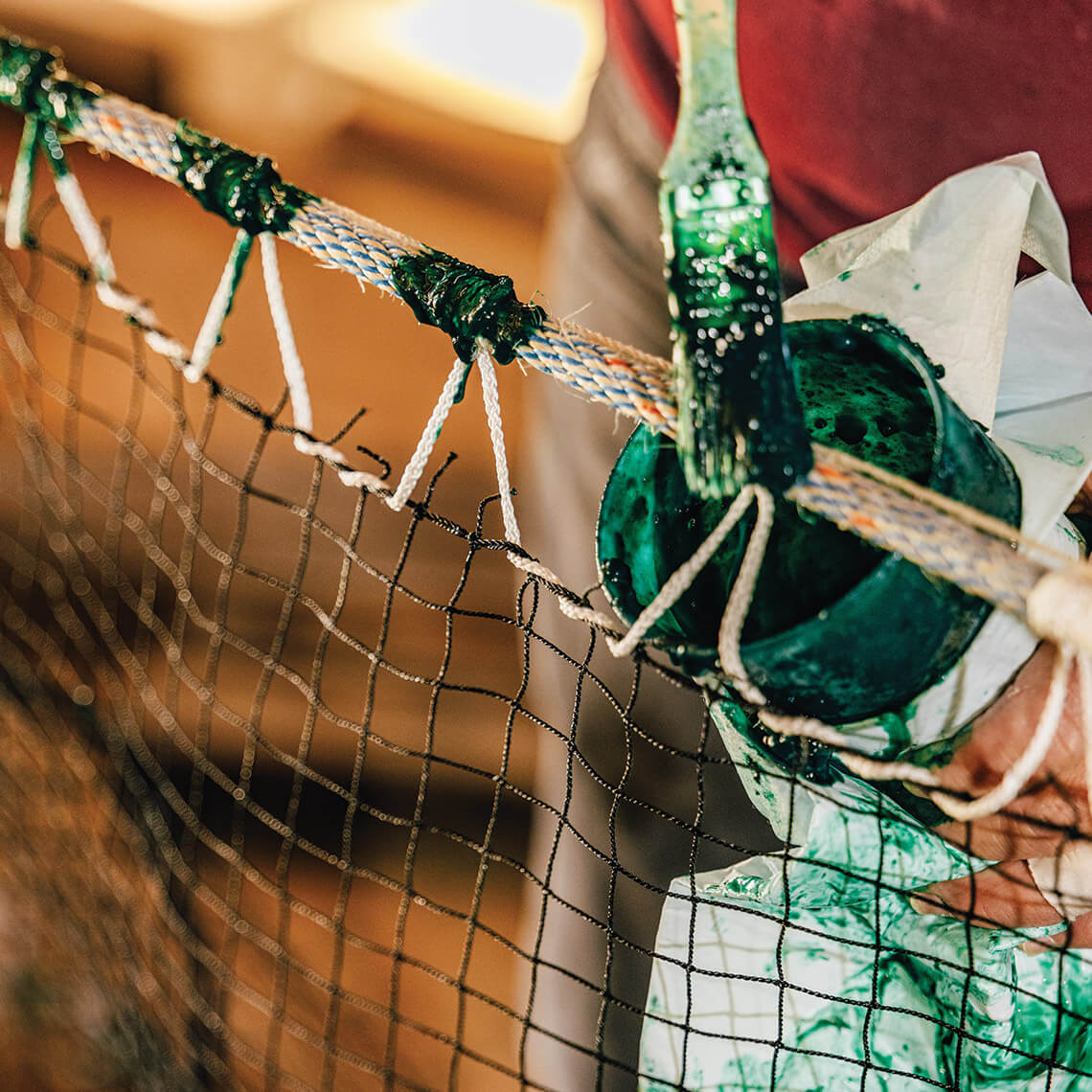
Much like a clothing pattern, building a net is a multistep process shaped by endless variables: the type of material, whether the net is knotted or knotless, mesh size, overall length and width, rope versus cable — and the first and most critical choice: the pattern.
In the past, her older brother cut out the pattern, Heidi sewed the pieces together, her mother strengthened the edges, and her younger brother hung the net — the process of attaching it to rope or cable along the top, bottom, and sides. Each step was executed to ensure the net could withstand tension and hard use.
Heidi had never been taught how to cut a pattern. “I didn’t even know how to read a pattern,” she says, pulling out an armful of expandable binder pockets filled with hundreds of them, hand-drawn.
But Heidi persisted. Her brothers taught her their portions of the job. Customers were loyal and patient. Two longtime patrons, Kenny Rustick and Alan Smith, took time to explain details to her that her older brother didn’t have the patience to teach her.
In the early days, Heidi worked the shop with her mom, dad, and two brothers. These days, she works alone with occasional help from her mother, Rita. photograph by Baxter Miller
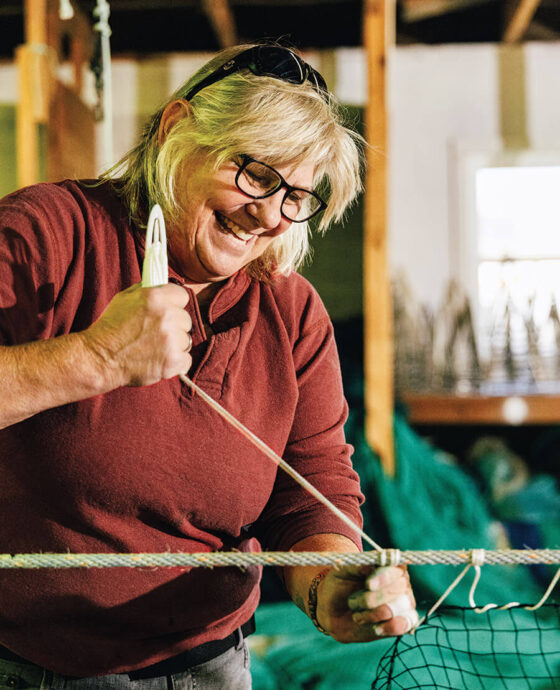
“We still mostly use Daddy’s patterns. That’s what people want,” Heidi says, her hands flashing as the net needle slips in and out of the kelly-green polyester webbing.
Gone are the days of 44 nets a week. Working alone now, it takes Heidi a full week to build a single 45-foot shrimp trawler net. From time to time, her mother, Rita, joins her in the shop to fill needles.
“When Daddy first died, I was sitting back here,” Heidi says as the late-afternoon sun spills through the window, bathing the shop in a warm glow. Pointing toward the open doorway at the far end of the building, she adds, “He always sat up front. I said ‘Daddy’ out loud and looked up to tell him something — and then it hit me. He was gone. You could feel his presence here for the longest time. I believe one day, if I can behave myself, I’ll see him again.”
And when that time comes, it’s likely that Roger Harris will be mighty proud of his daughter for keeping Harris Net Shop going. It has survived, and his patterns have endured. The needles stay filled. Bales of bunt lie ready to be cut. Thanks to Heidi, here along Core Sound, nets continue to be hung. Her perseverance and dedication to the craft have kept the shop alive, as she weaves together her cultural heritage and family legacy, one knot at a time.
print it