Old Salts: Whether native or transplant, these folks found their place and passions on North Carolina’s coast, becoming as integral to life here as the sand and sea. Read more about the folks that make the coast thrive.
A stiff, gunmetal-gray dorsal fin slices through the water’s surface as a six-foot spinner shark glides alongside a commercial vessel. The late August air hangs thick, an invisible blanket over the bright blue-green Atlantic. Several miles off Hatteras Island, the boat rocks gently, a thin strip of sand barely visible on the horizon.
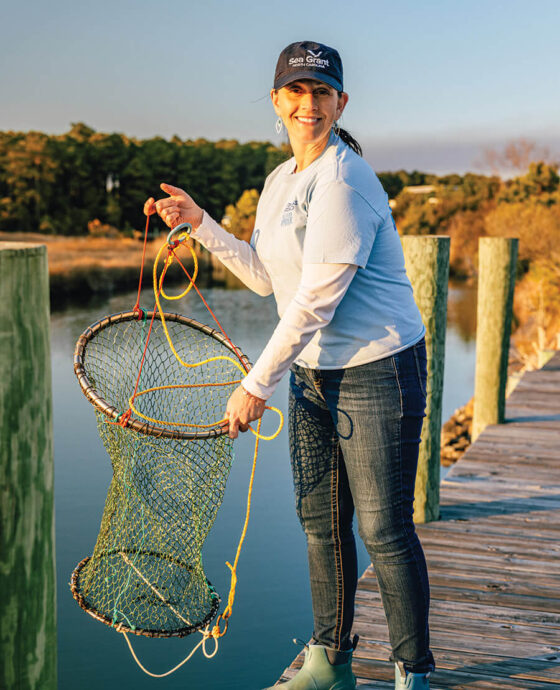
Sara Mirabilio has her clipboard in hand as the longline spool spins to life, hauling in a three-mile stretch of line rigged with 150 evenly spaced hooks. An empty hook breaks the water’s surface, droplets falling from the three-inch piece of curved steel. She unclips the dangling hook as the main line winds onto a giant spool, pulling the next empty hook about 30 yards down the line toward the reel. As it approaches, the dark shape beneath the water keeps pace, heading toward the boat. Dozens of sharks later, Sara, drenched in sweat and salt water, smiles and jots down the final figures on her clipboard.
After months of research and prototype development, she finally has her first set of data for a potentially groundbreaking device that could improve the catch and financial security of fishermen and the communities that depend on them.
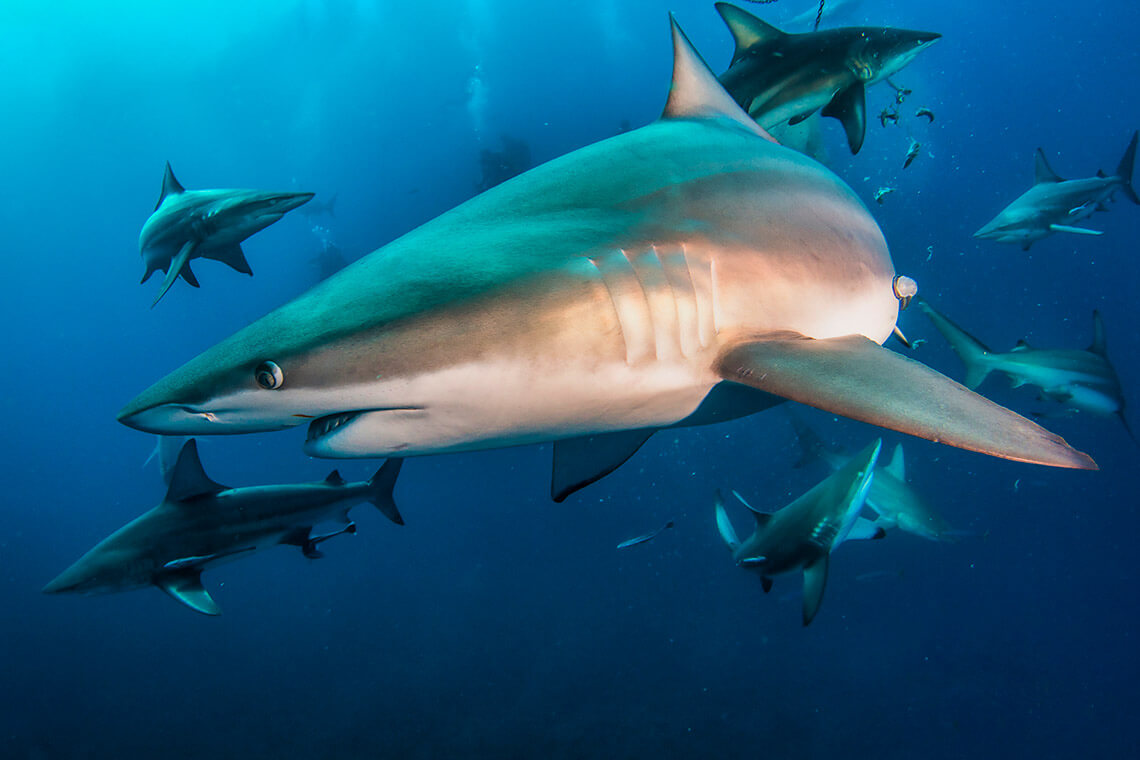
As a marine scientist, Sara works to find solutions that keep fishermen on the water while protecting the resources they depend on. photograph by Aleksandr Golubev/iStock/Getty Images Plus
The barrier island that Sara now calls home is a long way from the Appalachian Mountains of northwestern New Jersey, where she grew up. Her childhood was spent caring for the 100 chickens her family kept, as well as being an active member of 4-H, the USDA’s youth outreach program administered by Cooperative Extension services.
But, more than anything, she loved the ocean. “When I was 4, I went to the Miami Seaquarium and fell in love with dolphins. I was obsessed,” Sara says. “I have always wanted to be a marine scientist. Always. Never wavered. One hundred percent.”
She followed that early curiosity to a master’s degree in marine science that landed her a marine policy fellowship through the National Oceanic and Atmospheric Administration’s headquarters in Washington, D.C. There, she first heard the term “marine extension,” a concept she was familiar with, having grown up in a rural agricultural community. “I was like, ‘Wait, I didn’t know there was something for fishermen like there was for farmers.’ It just spoke to me — the idea of working with fishermen on new technologies to help meet conservation challenges while still staying in business. I like being at the intersection of those win-win solutions,” Sara says.
Her mind made up, she applied for a position as a fisheries extension specialist with North Carolina Sea Grant. After a unanimous decision from the hiring committee, she packed a Manteo-bound pickup truck and moved to the Outer Banks sight unseen. She swallowed a pay cut and accepted a position that allowed her to work with people again, no business suit required. That was almost 23 years ago, and she hasn’t looked back.
Sara is a bridge between research and real-world application in North Carolina’s coastal communities. A commercial fisherman’s knock on her office door launched a multiyear research project on ways to reduce shark interactions and depredation — sharks biting or eating a hooked fish before it is landed. It’s a growing problem that frustrates recreational anglers and has serious consequences for commercial fishermen whose livelihoods depend on their catch.
“Sharks can sense electricity, and we’ve shown they can actually navigate by magnetic north. So, how could we harness their unique sensory biology as a deterrent? How could we use their own behavior against them?” Sara asks.
To answer that question, Sara worked with Outer Banks fishermen to develop a device that creates an electric field around their hooks, using the sharks’ electrosensory systems to deter them. The idea made sense in theory. But would it work in practice to prevent sharks from stealing fish and damaging gear?
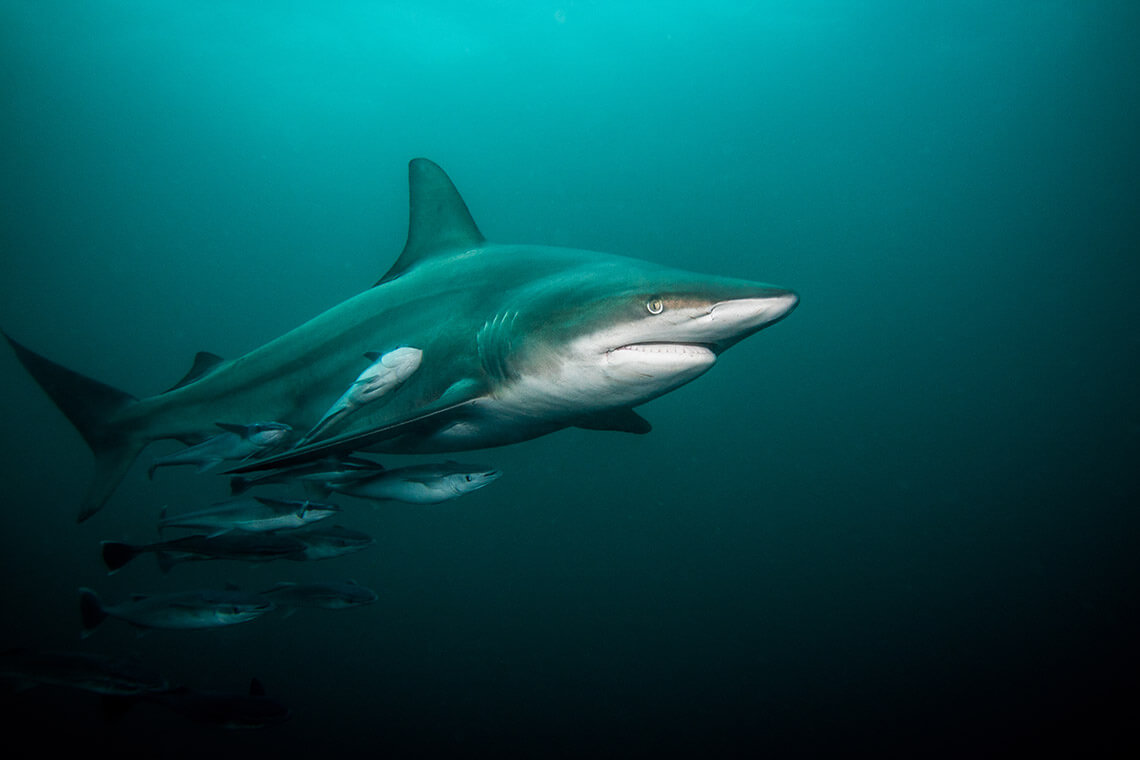
Hooks equipped with a device Sara developed with fishermen have shown to reduce shark interactions by 52 percent. photograph by Madelein_Wolf/iStock/Getty Images Plus
With a prototype in hand, Sara spent hours at sea on several trips, in state and federal waters, testing the device aboard commercial fishing boats. The result: The technology worked. Hooks equipped with the device reduced shark interactions by 52 percent. With further development, the bycatch reduction device could turn would-be losses into more fish at the dock and fewer sharks caught as bycatch.
“It’s beneficial for fishermen and for conservation, since some shark populations are still trying to rebuild,” Sara says. “As the population grows, the problems they cause fishermen are only going to get worse. So, keeping them away from gear altogether is the ideal thing, right?”
The device reflects Sara’s core mission: working side by side with fishermen to solve problems while protecting the resource. She collaborates closely with the industry to tackle challenges that might otherwise put them out of business. But research, and its impact, takes time.
A decade of working alongside fishermen led to a net modification that reduced the capture of sea turtles by 97 percent — a genuine success story. The devices were introduced and updated in the 1980s and 1990s, but female loggerhead turtles in North Carolina don’t begin reproducing until around age 30. Almost 40 years later, Sara says you see headlines touting “Banner Nesting Year at Cape Hatteras National Seashore.”
“It’s been a banner nesting year for the last five or six years, every year beating the last,” she says. “Do the math. Sometimes it takes that long to see your efforts make an impact.”
Conservation and preserving the traditions and heritage of those who make their living on the water go hand in hand.
Other ways Sara has made an impact is by helping launch an apprenticeship program at Carteret Community College. There, she gathers young fishermen together to understand how to run a successful business, manage its operation, and better educate the customers they feed. Through her work, Sara ensures a brighter future for our working waterfronts.
Finding solutions that keep fishermen on the water while protecting the resources they depend on is at the heart of her extension philosophy. Conservation and preserving the traditions and heritage of those who make their living on the water go hand in hand.
Back on the boat, Sara stands on the deck watching as the spool draws a blacktip shark toward the surface. She readies a tape measure to record its size. More data for her clipboard. This isn’t science for science’s sake. It’s science in action — science happening miles offshore, in soundside fish houses and roadside seafood markets up and down our coast.
print it