Put ramekins on a baking sheet. Bake for 25-35 minutes, until puffed and golden. Remove from oven, and let stand for 5 minutes. With a flexible spatula, remove strata to
Listen as the pages of the magazine come to life in the Storytellers podcast showcasing the voices of Our State writers. Each podcast episode features a writer reading their column
Listen as the pages of the magazine come to life in the Storytellers podcast showcasing the voices of Our State writers. Each podcast episode features a writer reading their column
Listen as the pages of the magazine come to life in the Storytellers podcast showcasing the voices of Our State writers. Each podcast episode features a writer reading their column aloud, allowing each distinct voice to shine. Click below to listen to Brad read his column aloud.
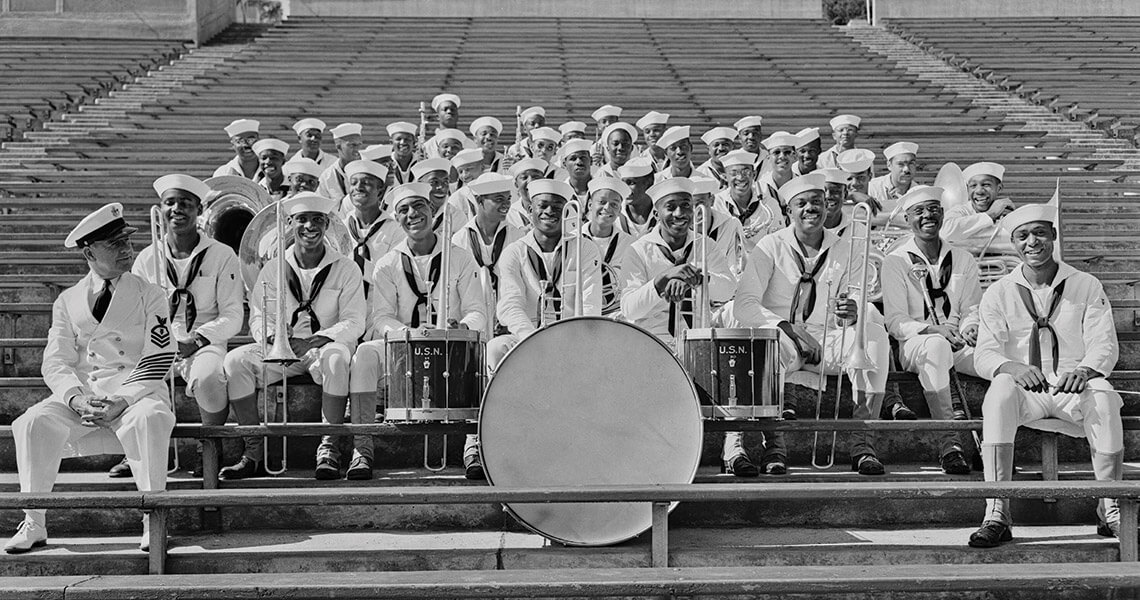
For years, Pam Carlson never knew that her father, Walter, had made history. As a trumpet player in the Navy’s first all-Black unit band, he was one of the first Black men to enter the modern Navy at general rank. “He didn’t really talk about it,” Carlson says. But when she began attending the B-1 Band’s reunions after her father’s death, she was amazed: “It was just so mind-blowing. I had such pride in what they did. And most people didn’t know about them.”
Gregory Drane, who today directs the 315-member Penn State Marching Blue Band, had a similar epiphany. He was so inspired by the B-1 Band’s story that he decided to attend the 70th anniversary of its formation in Chapel Hill. At the time, there were eight surviving members. “I instantly had eight new grandfathers,” Drane says. “I was pulled in as if I was a family member.”
So much so that he decided to write a dissertation about the band for his doctoral degree. That dissertation, along with Alex Albright’s The Forgotten First: B-1 and the Integration of the Modern Navy, illuminate a largely unsung chapter in North Carolina’s history.
• • •
After the attack on Pearl Harbor in 1941, the nation mobilized. The military draft caused shortages in manpower that leaders hoped could be filled by women and Black Americans. Yet Jim Crow laws still prevailed in the South, and the Navy was especially hesitant to enlist Black service members beyond the traditional role of messmen.
But the selection of UNC Chapel Hill as the location for one of the Navy’s four new Pre-Flight Schools presented an opportunity. The Navy planned to have a unit band at each school. North Carolina was considered more progressive than other Southern states, and there was an outstanding band program just down the road at the Agricultural and Technical College of North Carolina, now NC A&T State University.
“African American academic leaders, white academic leader Frank Porter Graham, and the governor were all sort of pulling together to make this thing happen,” Albright says. “At the push of Eleanor Roosevelt, who had a very good relationship with [UNC President] Graham.”
A rigorous audition process resulted in the selection of 44 musicians by retired Navy Chief Bandmaster C.E. Dudrow. Most of the recruits came from NC A&T or James B. Dudley High School, both in Greensboro. After basic training in Norfolk, Virginia, the band arrived in Chapel Hill, marching down Franklin Street in parade formation. Accounts vary, but many of the members recalled being pelted by food, rocks, and epithets from the crowd that gathered to watch.
“That was not a pleasant experience, no doubt,” says S.Y. Mason-Watson, daughter of French horn player John Mason. “They had to handle it in a certain fashion. And I marvel at the courage it took, and the fortitude and the confidence they had to endure that.”
Because of segregation laws, band members were not allowed to dine or reside on UNC’s campus. A recently built community center a mile away was transformed into their barracks. James B. Parsons, who’d previously served as the band director at Dudley, was named their leader.
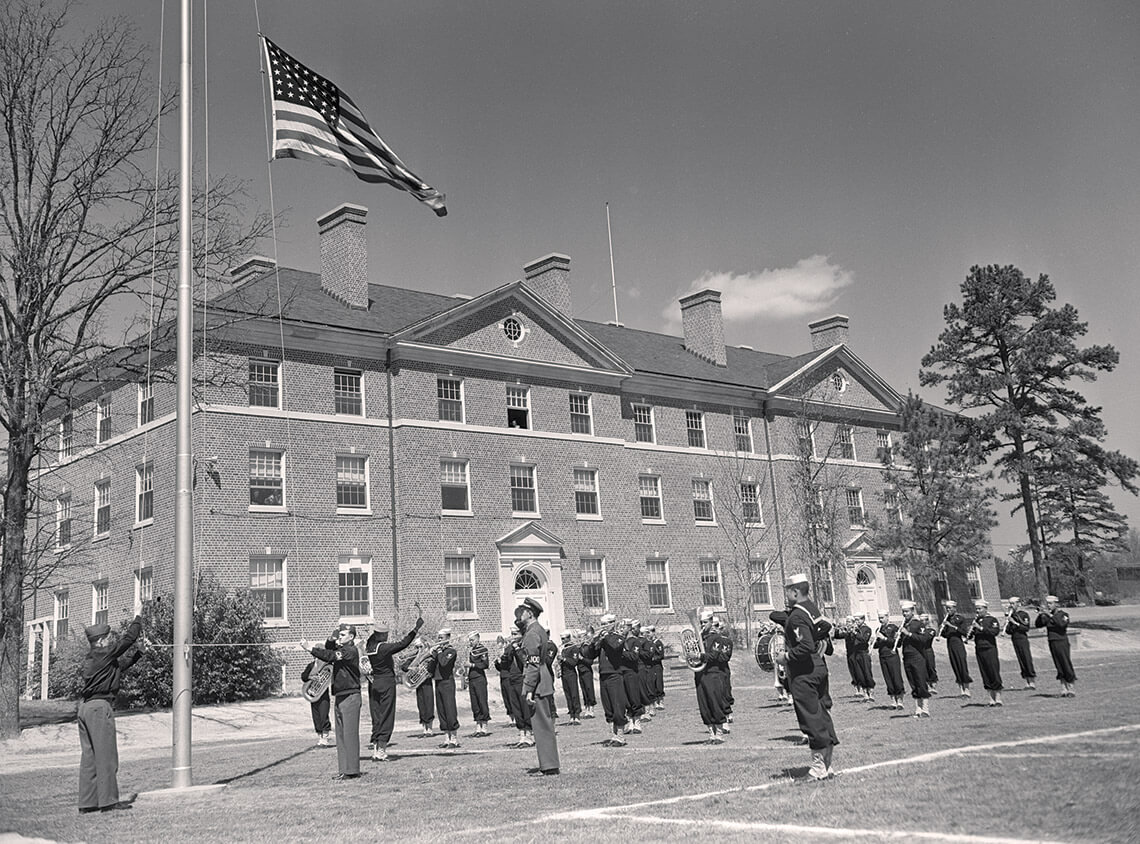
Among the B-1 Band’s performance duties were daily flag-raising ceremonies (pictured on UNC’s campus). Photography courtesy of United States Navy Pre-Flight School (University of North Carolina) Photographic Collection #P0027, North Carolina Collection, Wilson Library, UNC Chapel Hill
Parsons instituted a rigid rehearsal routine to prepare his men for the almost nonstop duties that followed: daily flag-raising ceremonies, playing as Pre-Flight School students marched to and from class, commencement exercises, bond rallies, Sunday afternoon concerts, and more.
Because the musicians were housed off campus, the Navy offered transportation, but Parsons declined. Instead, he marched the band to and from campus, sometimes multiple times a day.
“They felt the pressure of knowing that they were trying to prepare the Navy for other Blacks to join,” Drane says. “No one had ever seen a Black Navy band, and here it is, daily marching back and forth.” Calling Parsons’s decision “brilliant,” he adds, “It was a counter to the narrative that had been going on — that Blacks couldn’t do, that Blacks aren’t able to.”
• • •
The band’s impact was most felt in a Black community that welcomed them with open arms, preparing daily lunches for the men and taking pride in their musical excellence and military bearing. “All the kids would hear them coming and would love seeing them march from Carrboro to Chapel Hill and thinking it was the greatest thing,” Carlson says.
At first in small ways and then in larger ones, the band’s constant and commanding presence began to change perceptions and break down stereotypes. B-1 members soon formed a dance band that became a local favorite. Bassist Charles Woods joined several white musicians in a dance band that played to an integrated audience after the musicians, prior to the show, removed the hooks for a rope intended to separate the races.
“I see it all the time,” Drane says. “Music transcends so many of the human barriers we have in place. Music is inherently positioned to help tear down walls of race, of gender, of whatever other barriers you want to name, just by its nature.”
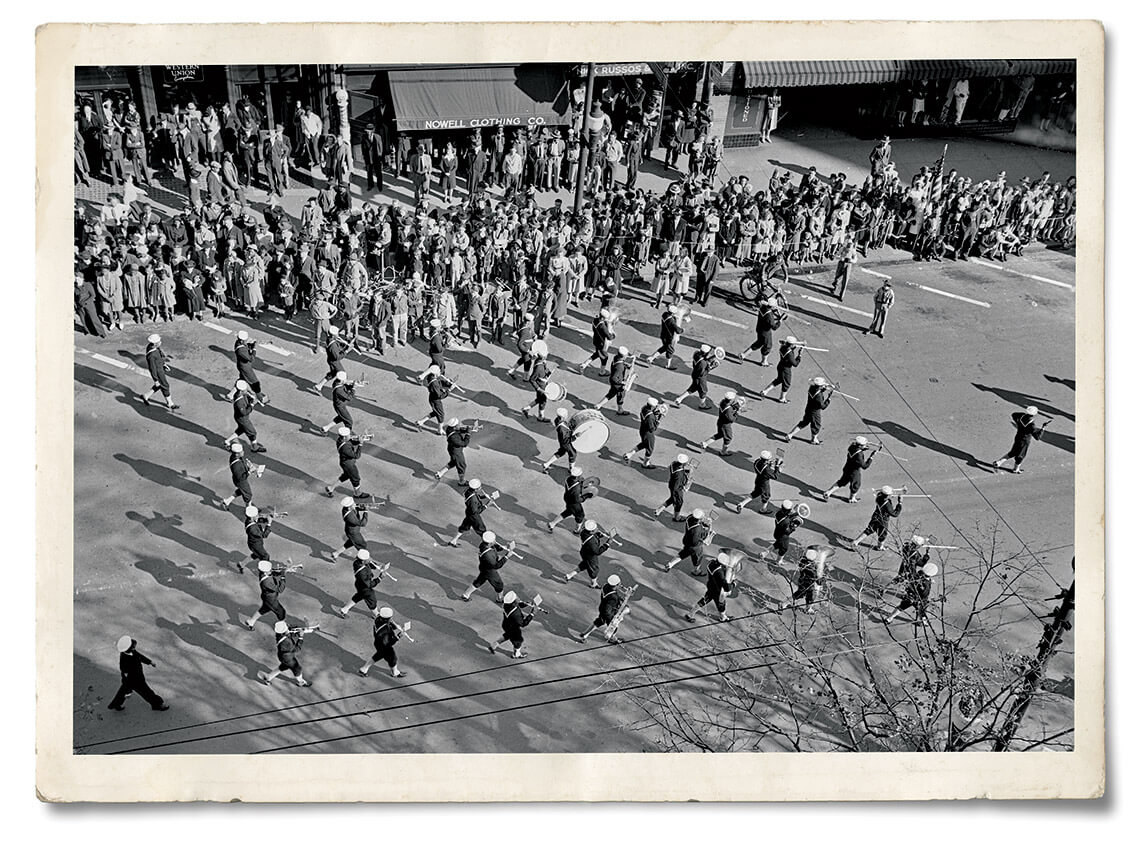
Months after its debut in Chapel Hill, the B-1 Band performed at Navy Day in Raleigh on October 27, 1942. Photography courtesy of United States Navy Pre-Flight School (University of North Carolina) Photographic Collection #P0027, North Carolina Collection, Wilson Library, UNC Chapel Hill
Charles M. Jones, the white pastor of Chapel Hill Presbyterian Church, became a friend and ally of the group. He welcomed them to Sunday services and advocated for their equal treatment with university leadership. Then, a few months after their arrival, Parsons and his men were honored by the Navy with a formal dinner hosted by the captain of the station, Cmdr. O.O. Kessing.
Despite the improving relations, Jim Crow still held sway. “Every time I left campus, or later, when I’d leave the base, I was walking around like on eggshells,” piccolo player Abe Thurman told Albright in Forgotten First. Yet the B-1 Band carried on, establishing a reputation for excellence that led to a performance with legendary singer Kate Smith.
In May of 1944, the band was assigned to duty at Manana Barracks in Hawaii, despite the Navy’s promise that they would spend their entire enlistment in Chapel Hill. There, they continued to entertain Army and Navy troops and were one of the star attractions of Honolulu’s VJ Day Parade after Japan surrendered.
• • •
After the war, many B-1 Band members returned to North Carolina to find that conditions hadn’t changed as much as they’d hoped. On his train trip home, Calvin Morrow was turned away from a military dining hall in Norfolk because of his color while German prisoners of war ate side by side with white soldiers.
Additionally, the Navy didn’t recognize B-1 as the first official all-Black band members to serve in its ranks. The distinction was mistakenly given to other musicians who came into service more than a week later.
“They didn’t complain,” says Albright, who interviewed 23 B-1 Band alumni while researching his book. “They had some bad stuff happen, but they embraced the idea that too much time looking backward prevents you from looking forward. That was kind of what their creed was.”
Trumpeter Huey Lawrence took a job at South Ayden High School, where he taught, coached football, and served as band director for 25 years. “He ended up teaching in Ayden because he saw a need,” says his daughter Evetta Lawrence-Davis. “He never knew about the negative. He focused on the positive.”
Even after he lost his vision to glaucoma, Lawrence remained as upbeat as his favorite song, “What a Wonderful World.” And his trumpet was a constant companion. “He played every day. He played in churches. In the neighborhood. Ringing in the new year,” Lawrence-Davis says. “He played his trumpet until the last three months of his life. He was 93.”
Walter Carlson went on to become a band director at multiple schools, including his alma mater, serving on NC A&T’s faculty for 47 years and tutoring more than 1,600 students. He also founded The Rhythm Vets, a group of former B-1 members. They regularly played live shows — including the B-1 reunions that began in 1954 and continued until 2023. Their children sometimes attended the get-togethers, too. “It was a great experience to see them all still relishing that brotherhood and bond after all those years,” Mason-Watson says.
• • •
Seventy-five years after the band’s formation, the Navy corrected the official record and acknowledged the B-1 members as the first Black enlistees at general rank in U.S. Navy history.
Attending B-1 reunions over the years, Pam Carlson became close with the last two surviving members, Calvin Morrow and Simeon Holloway. “Their greatest fear was that when all of them died, their history would die,” she says. “The only way for it not to die is for us, their children and grandchildren, to keep it alive.”
Since their deaths, she and others have worked diligently to honor the members’ legacy, including the placement of a historical marker on Franklin Street and making plans for a 2027 celebration to honor the band’s 85th anniversary.
In a 2018 story in All Hands, the magazine of the U.S. Navy, Calvin Morrow recalled those daily marches and the change in attitude he and his bandmates experienced as the Chapel Hill community grew to accept — and appreciate — their presence: “It was a privilege to walk down the streets of Chapel Hill and see the white faces, just in awe. Because this was something different. It was an awakening. A tiny awakening for our country to see us in this role in the U.S. Navy.”
Get our most popular weekly newsletter: This is NC
From the expanses of needlerush at Cedar Island to the lush spartina feathering the shores of Bodie and Roanoke islands, our salt marshes are the threshold to a watery world — the heartbeat of our coastal ecosystem.




 Listen as the pages of the magazine come to life in the