 Listen as the pages of the magazine come to life in the Storytellers podcast showcasing the voices of Our State writers. Each podcast episode features a writer reading their column aloud, allowing each distinct voice to shine. Click below to listen to Sheri read her column aloud.
When I lived in North Raleigh more than 25 years ago, I tended two raised garden beds in my fenced backyard. I had no idea what I was doing, so I was unafraid to try to grow almost anything. My success rate defied the odds. I planted vegetables I hoped to eat but favored those that looked pretty as they grew. None outshone the okra. Their blossoms looked like hand-painted porcelain: five creamy petals with striations as delicate as watermarks radiating from deep burgundy hearts. The centers were like scepters, a ring of bright yellow around a dark orb that reminded me of the sun’s corona during a full eclipse.
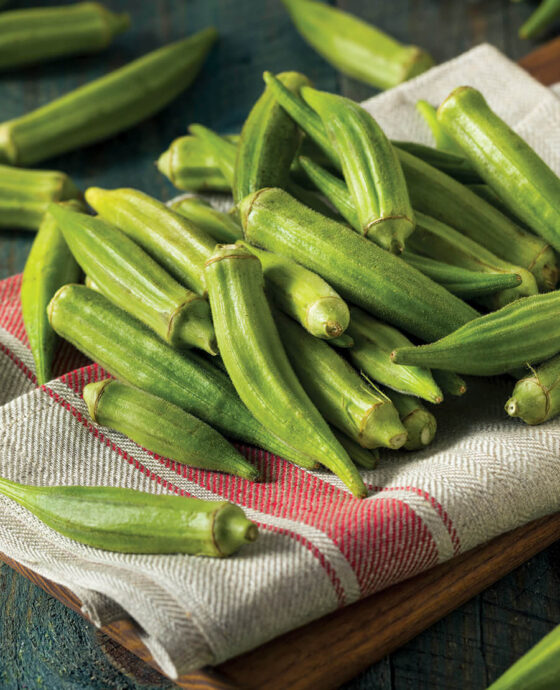
After the first year of ogling those blossoms, I planted okra in the big ceramic pots that flanked my front door. They would reach six or seven feet tall and supplied us with fresh produce all season long, as okra does. Visitors who didn’t notice or recognize the pert green pods poking out often mistook the plants for hibiscus or hollyhocks, which wasn’t quite right, but not that wrong. Like those two flowering plants, okra is part of the mallow family, along with cotton and cocoa.
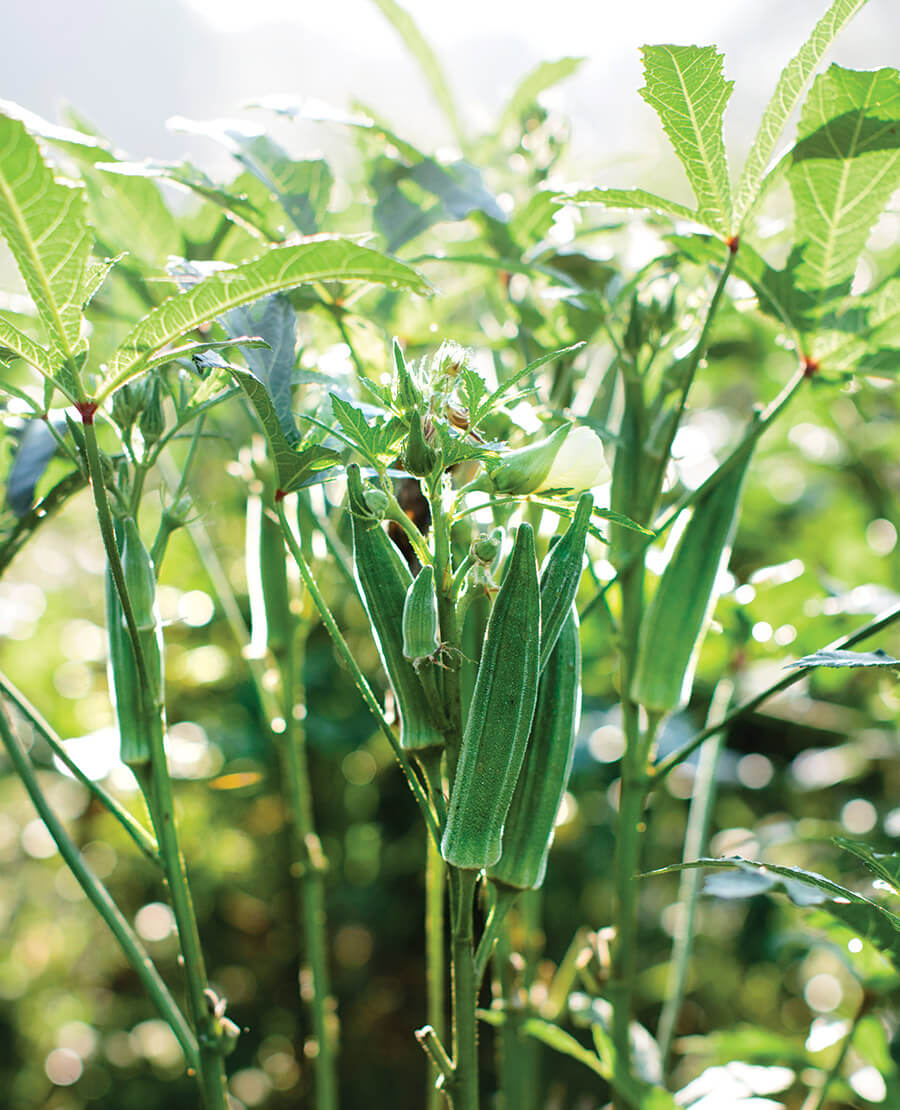
Okra plants love the summer sun and thrive in the heat. Even though the fruit is what’s most often found on plates, the leaves and flowers are edible, too. photograph by Anna Routh Barzin
The heat- and humidity-loving vegetable wasn’t suited for my family’s garden up in the mountains, so it never appeared on our table. I first tasted okra when I was around 12 at a Morrison’s Cafeteria in Charlotte, the fanciest restaurant in the largest city I’d experienced by then. It was among several menu items that I’d read about but never seen until I glided my tray past all those novel possibilities. It was cornmeal-clad and fried, and it imprinted on me. To this day, I can’t pass up crisp okra in a place where they do it right. Nor can my daughter. At some point, we started referring to the iconic Southern side dish as “the grand old okry.”
I rarely fry okra at home but have developed a respectable recipe repertoire as I learned more about how it’s enjoyed across the South and in global kitchens. We claim the vegetable as our own, but so do parts of Asia and Africa. The USDA lists 1,700 okra varieties, called accessions, around the world. American seed savers prize Grandma Edna’s Cherokee Long Pod, Cajun Jewel, Choppee, and other beloved heirloom varieties. But most Southerners enjoy the prolific Clemson Spineless, introduced in 1939.
Of course I’ve heard people dismiss okra based on their not-unfounded, but usually unwarranted, wariness of its goo. But well-prepared okra has none of that. With the right attitude and in the right hands, it’s a just reward for tolerating a blistering North Carolina summer, turning us into grateful members of the okra pod cast.
• • •
There is zero gardening space where I live now, so I turn to farmers markets. Some growers tumble handfuls into paper sacks to order, while others line up tidy rows of pods in paper cartons like a new box of crayons. Turns out, okra pods range in hue from pale green to deep burgundy. I can see why they inspire art. Many North Carolina craft shows sell those cute ornaments where dried pods are painted to look like Santa’s face, with the curled tip serving as his beard, or perhaps like little angels wearing flowing pod robes. My friend and founder of the Utopian Seed Project in Asheville, Chris Smith — a self-proclaimed okra enthusiast, though a visionary expert in my eyes — ties vibrant twine around dried pods to hang like wee piñatas. (He’s also growing okra prized for delicious seeds, leaves, and oil.) But my favorite is when someone sees the vegetable’s natural artistry and arranges dried pods with the silvery patina of aged teak in a tabletop bowl for us to admire.
It seems that I’d rather gaze at okra than eat it. Fair point. I might argue if my mouth weren’t full.
photograph by Tim Robison
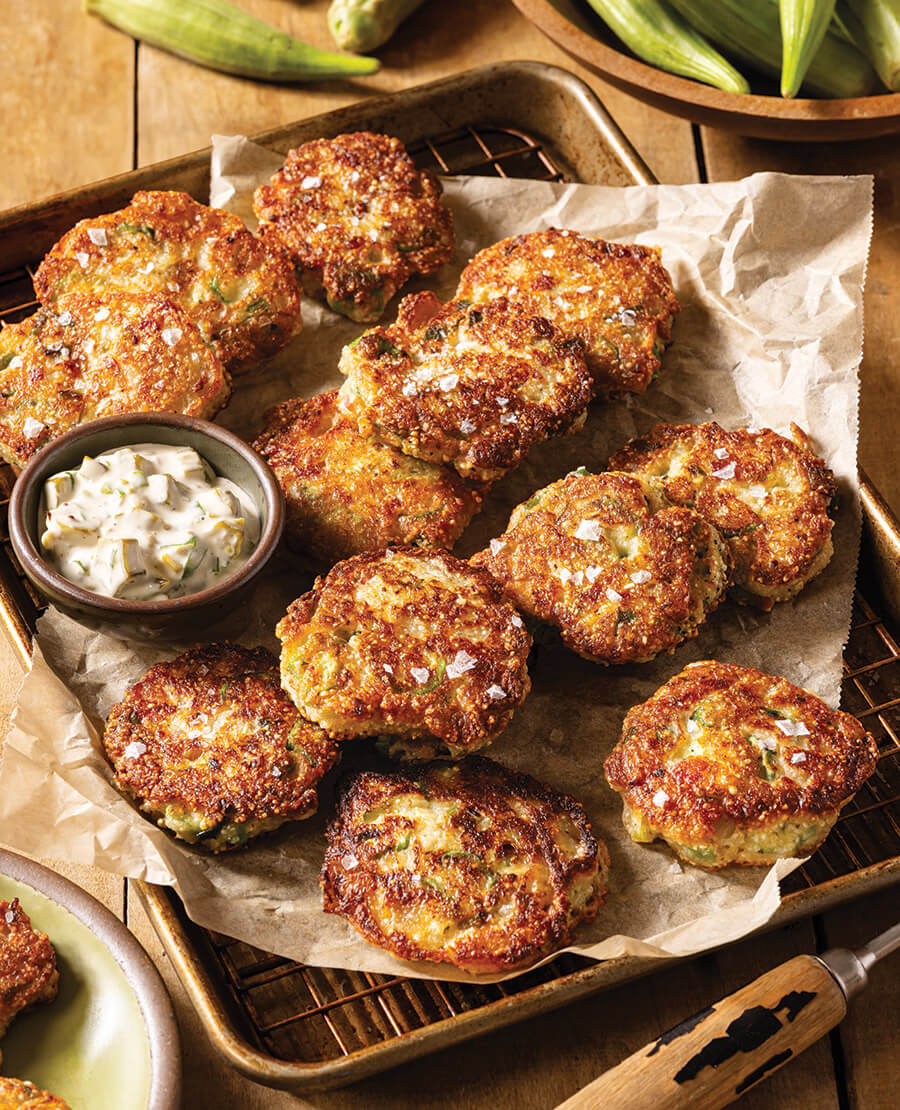
Okra Fritters
These cornmeal fritters studded with okra, onion, and bacon remind me of both cornmeal-crusted fried okra and hushpuppies. Although best served hot, people will nibble on room-temperature leftovers. I’ve been known to eat them stone-cold out of the fridge on a hot summer night.
These are delicious served with Pickled Okra Rémoulade (recipe below), tomato jam, pepper jelly, cocktail sauce, or a couple fat drops of hot sauce.
Yield: About a dozen.
4 slices (3 ounces) bacon, cut crosswise into ½-inch pieces
⅔ cup finely chopped sweet onion or scallions
2½ cups very thinly sliced okra (from about 8 ounces fresh whole pods)
1 cup fine stone-ground cornmeal
1 teaspoon baking powder
1 teaspoon baking soda
1 teaspoon kosher salt, plus more for sprinkling
1 teaspoon sugar
¼ teaspoon ground cayenne pepper, or to taste
1 large egg
1 cup buttermilk, well-shaken
Unflavored oil with a high smoke point, such as peanut, canola, safflower, or avocado, for shallow pan-frying
Lay a wire rack lined with paper towels or a flattened brown paper bag in a rimmed baking sheet to hold and blot the cooked fritters.
In a large skillet over medium heat, cook bacon until rendered and browned, about 10 minutes, stirring occasionally. Transfer with a slotted spoon to drain on paper towels, leaving the drippings behind. Finely chop the bacon and set aside.
In the skillet over medium heat, cook onion and okra, stirring until they begin to soften, about 5 minutes. Remove from heat, and stir in bacon.
In a medium bowl, whisk together cornmeal, baking powder, baking soda, salt, sugar, and cayenne.
In another bowl, whisk together egg and buttermilk until there are no ropy strands of white. Pour into cornmeal mixture and stir until blended. Fold in okra mixture.
Wipe the skillet clean. Add oil to skillet to reach 1/2-inch depth and heat over medium-high until a small pinch of cornmeal dropped into the oil immediately sizzles. If the cornmeal sinks, the oil is too cool. If it blackens or pops, the oil is too hot.
Working in batches of 3 or 4 fritters at a time, spoon about 2 tablespoons of batter per fritter into the hot oil, spacing them evenly. Cook the fritters until bottoms are firm and golden brown. Flip and continue to cook, about 2 minutes more. Transfer cooked fritters to rack and sprinkle with salt.
Between batches, adjust heat to keep the oil at a steady temperature, and use a slotted spoon to skim away any debris that’s left behind; this will eventually burn and ruin the oil.
Continue with remaining batter. Serve fritters hot, although they’re pretty good after they cool, too.
Pickled Okra Rémoulade
Many rémoulade sauce recipes call for pickles or capers, but I like to change its personality by using pickled okra. I’ll often mix this in a glass jar for easy storage.
Yield: About 1½ cups.
¾ cup mayonnaise
2 tablespoons Creole or whole grain mustard
1 teaspoon finely grated lemon zest
1 tablespoon fresh lemon juice or brine from pickled okra
¼ cup drained and finely chopped pickled okra
3 tablespoons chopped scallions (white and tender green parts)
Hot sauce, kosher salt, and black pepper, to taste
In a glass jar or small bowl, whisk together mayonnaise, mustard, lemon zest, and lemon juice. Fold in okra and scallions. Season with hot sauce, salt, and pepper. Cover and refrigerate until chilled. Store in refrigerator for up to one week.
print it