Dave Mitchell is not a morning person. Longleaf Swine, the downtown Raleigh restaurant where he works as the chef, is not open today. And yet, a few minutes before 8 a.m., he comes barreling in the front door, eager to get a fire started.
Without pausing, Mitchell power walks to a two-top table, flipping down the chairs perched atop it and swinging a gray bag off his back into one of them. He hastily removes a black pinstripe apron and slips it over his head before marching into the kitchen and grabbing a butane torch and a stick lighter.
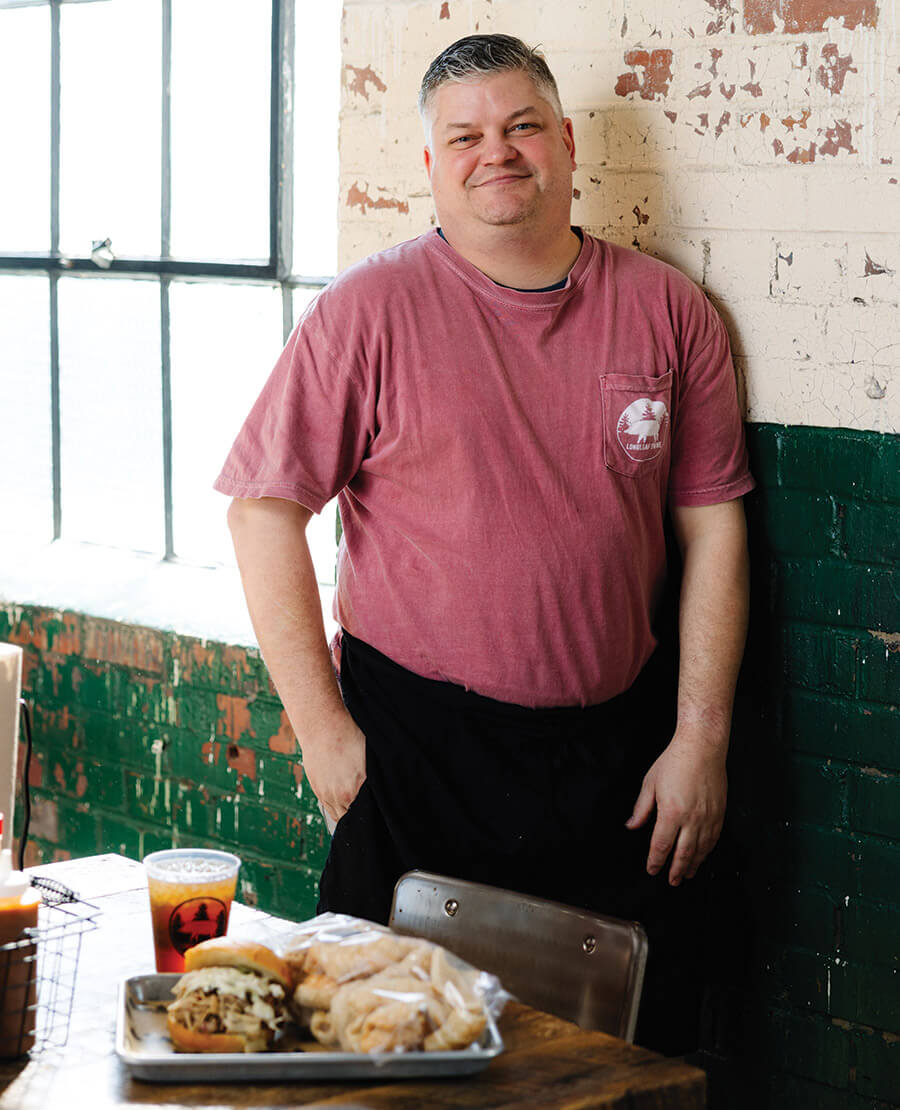
Chef Dave Mitchell photograph by Anna Routh Barzin
Mitchell isn’t late, despite what his swift movements suggest. It’s just that Tuesdays are his days to prep the barbecue restaurant for the week ahead, with the closed restaurant affording him the time and quietude to begin a full-day cooking process — and just as long for some of the meat to rest before serving.
After pulling two reams of brown butcher paper almost the length of his wingspan and crumpling them up, Mitchell opens the back door to the kitchen, revealing a pile of neatly stacked — and already split — dried oak. He snatches seven pieces of firewood and places them on the floor inside. Squatting on the balls of his feet, he assembles them Lincoln Log-style in the back of the smoker pit, adding the paper.
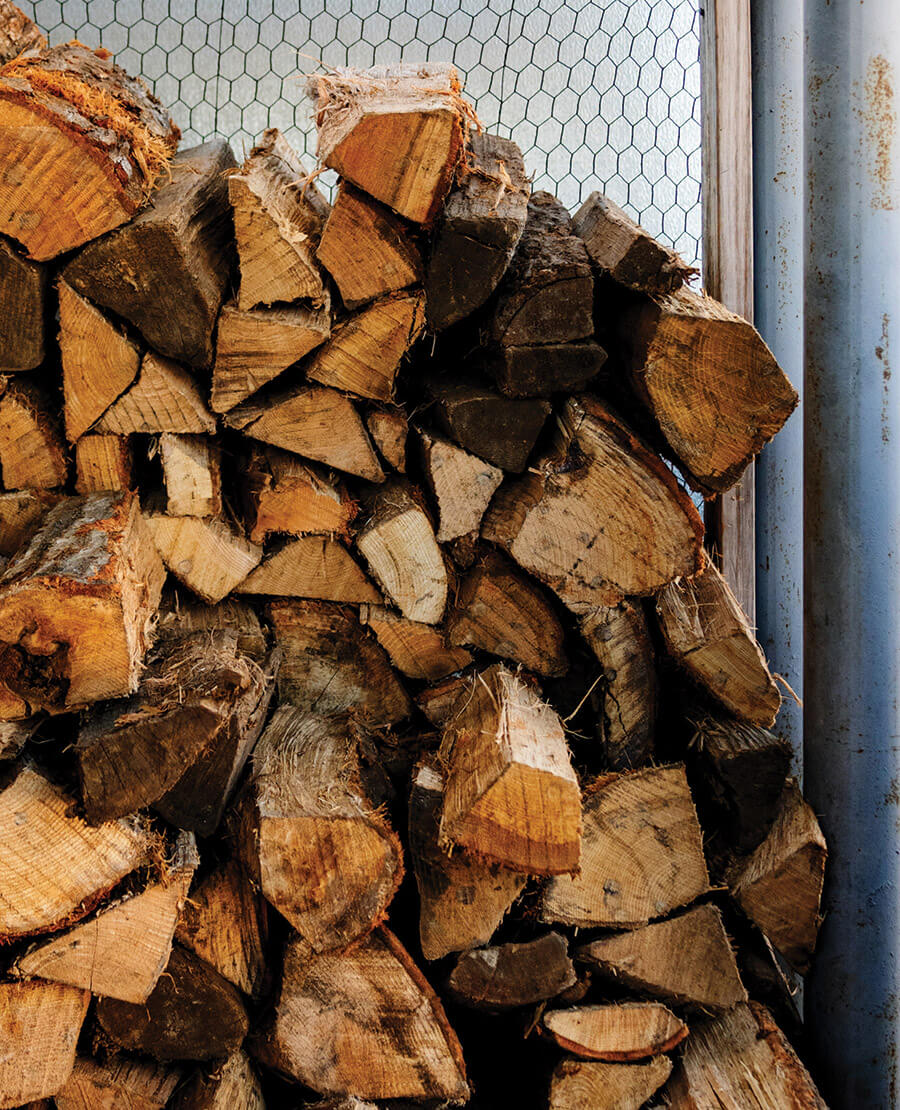
Chef Dave Mitchell has found that high-quality pork, cooked low and slow over dried oak, produces the ideal barbecue. photograph by Anna Routh Barzin
By 8:03, he’s ready to light it. Right on schedule.
Within moments, the butane torch is helping orange flames embrace the oak. Smoke begins to dance seductively upward toward his nostrils. For now, it smells like a backyard firepit. Mitchell closes the firebox door, sets a timer to check on the wood, and heads to retrieve some brisket. Pork shoulder and butt will follow, along with chicken legs and wings once they’ve brined.
• • •
There is no family secret or magic rub that makes good barbecue, Mitchell will tell you.
“Everyone is playing in the same sandbox,” he says. “It really just comes down to time and persistence.” And, he adds, quality and consistent ingredients. He starts to rattle off details of the meat he sources, but with any of the best barbecue places, a core raw ingredient is the wood.
Longleaf sources wood that’s as dry as possible. The restaurant used to use a mixture of green and dry oak, but the smoke gave the meat an astringent taste. For something cooking slow and low, that didn’t work as well, Mitchell says.
“We were getting much darker smoke before,” he explains. “We found the green and dried were getting mixed before, and we didn’t know what we were putting in, necessarily. All dried is more consistent.”
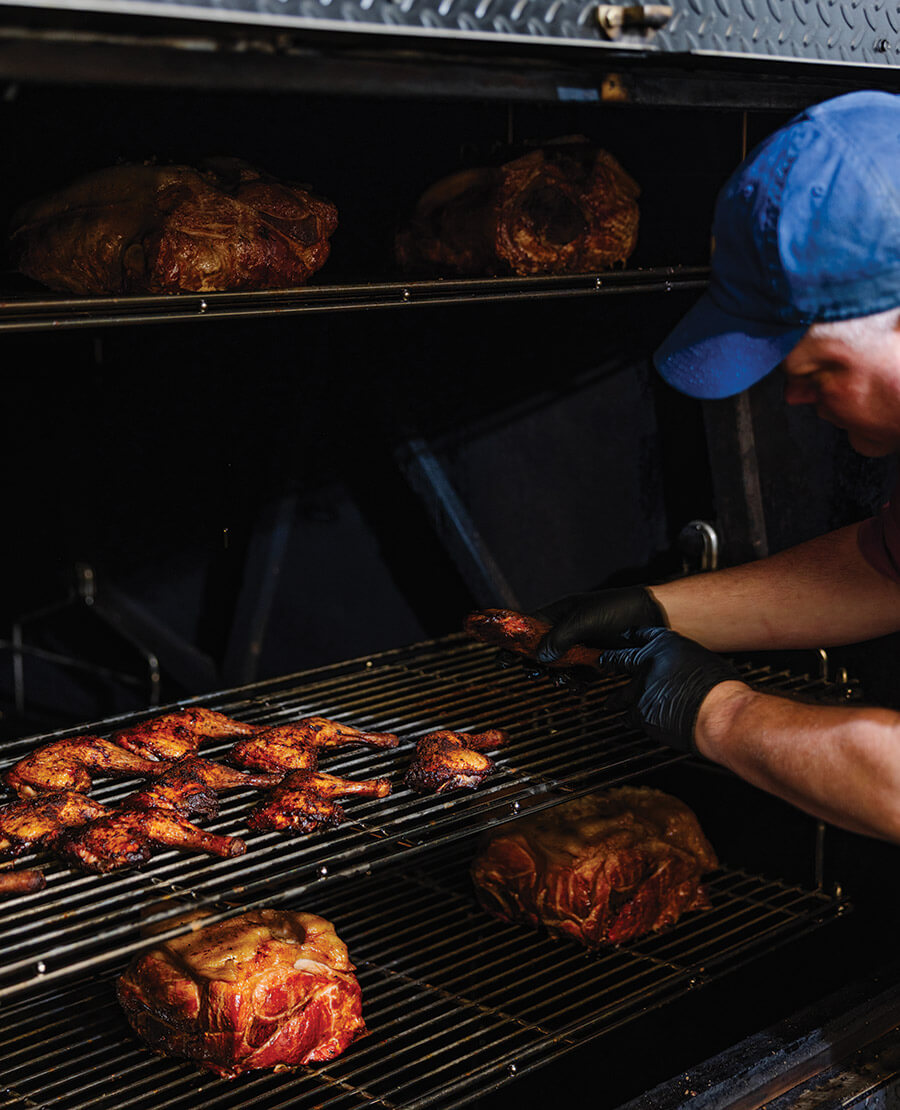
Longleaf Swine specializes in North Carolina staples like pulled pork and smoked chicken. photograph by Anna Routh Barzin
Mitchell — who arrived at Longleaf in November 2024 after a long career at some of Raleigh’s most iconic and bygone restaurants, including Busy Bee Cafe and Plates Neighborhood Kitchen — has emphasized the importance of consistency in the kitchen. Using one type of wood offers some of that. So does buying it already chopped, which he believes is worth the saved time for the added cost.
When Mitchell opens the firebox again at 8:15, the fire has mostly caught, thoroughly engulfing all but two pieces. He’s pleased, though his all-business expression doesn’t reveal it. A few minutes later, he’s rubbing a 50-50 mix of black pepper and salt onto briskets that are nearly the size of his torso and loading them into the hulking smoker.
• • •
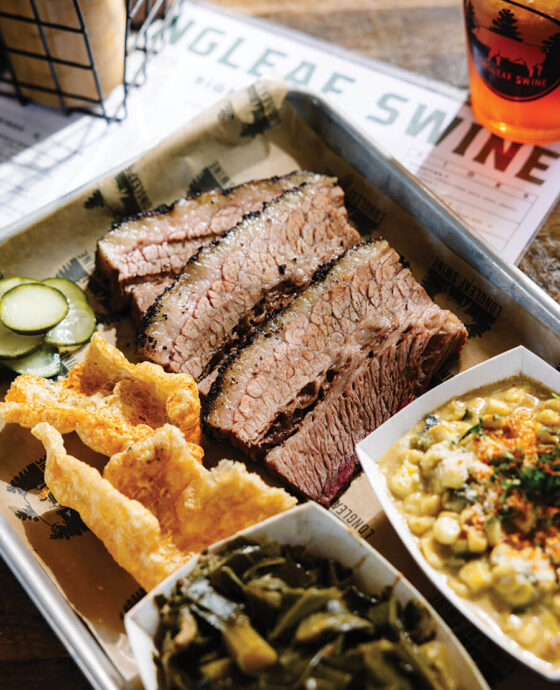
Since before this nation’s independence, “barbecue” looked like a slow and deliberate process of cooking whole animals over smoldering hardwood coals. Whether North Carolina-style hog or Texas brisket — both of which Longleaf serves — the method of cooking traces its roots to a cross section of Indigenous, African, and European approaches. It evolved, taking on different forms and flavors that varied by location and the hands feeding the fire.
As Adrian Miller recounts in his authoritative book Black Smoke, published by UNC Press, for centuries enslaved Africans were the primary ones tending those coals and fine-tuning the cooking methods in this country. More recently, barbecue’s popularity in North Carolina exploded after World War II, Andrea Weigl writes in the anthology Edible North Carolina. Whole-hog barbecue enjoyed a modern renaissance thanks, in part, to pitmasters like Ed Mitchell, who helped open The Pit in Raleigh in 2008 and expanded the style’s appeal.
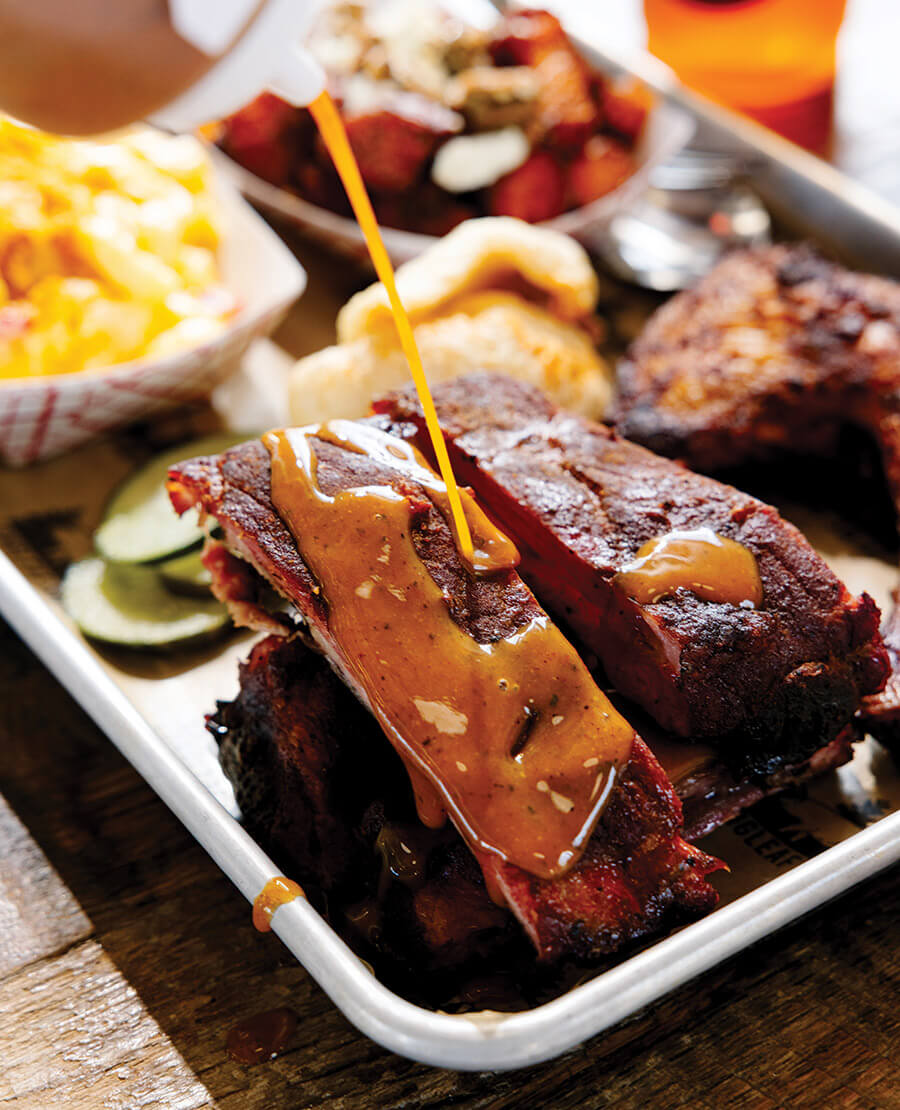
The restaurant offers four sauces, including a tangy barbecue option that pairs well with ribs. photograph by Anna Routh Barzin
Today, many barbecue purveyors lean on the convenience and speed of electricity. Purists eschew it entirely. Pragmatists who are unwilling to give up the flavor that smoke provides land somewhere in the middle.
That’s where Longleaf stands. The restaurant relies on a smoker with a rotisserie-style oven that rotates meats through smoke generated by burning wood. The machine also offers an electric-based heat assist function that prevents the oven’s temperature from dropping below a specific threshold.
Despite checking his fire regularly, Dave Mitchell has on occasion found it dwindled down to just embers. With the heat assist, such fluctuations aren’t a reason to panic. For a restaurant with high demand the five days a week it’s open and a chef who prizes predictability whenever possible, it’s an ideal way to deliver the comfort and flavor diners expect.
• • •
By 8:28 a.m., the smoker has reached its 250-degree target. “That was quick,” Mitchell remarks as he opens it. The scent of smoke creeps into the kitchen, as if nonchalant about making its presence known. Sometimes the plumes are visible, he says, and will practically punch you in the face. Today, Mitchell is lucky. He begins muscling two briskets per rack into the cooker.
Once done, he hustles through the restaurant and outside to a detached walk-in refrigerator. The stream of morning commuters sliding past is likely missing the first tendrils of what he’s cooking, as wisps of smoke stretch through the air and knock against their closed car windows.
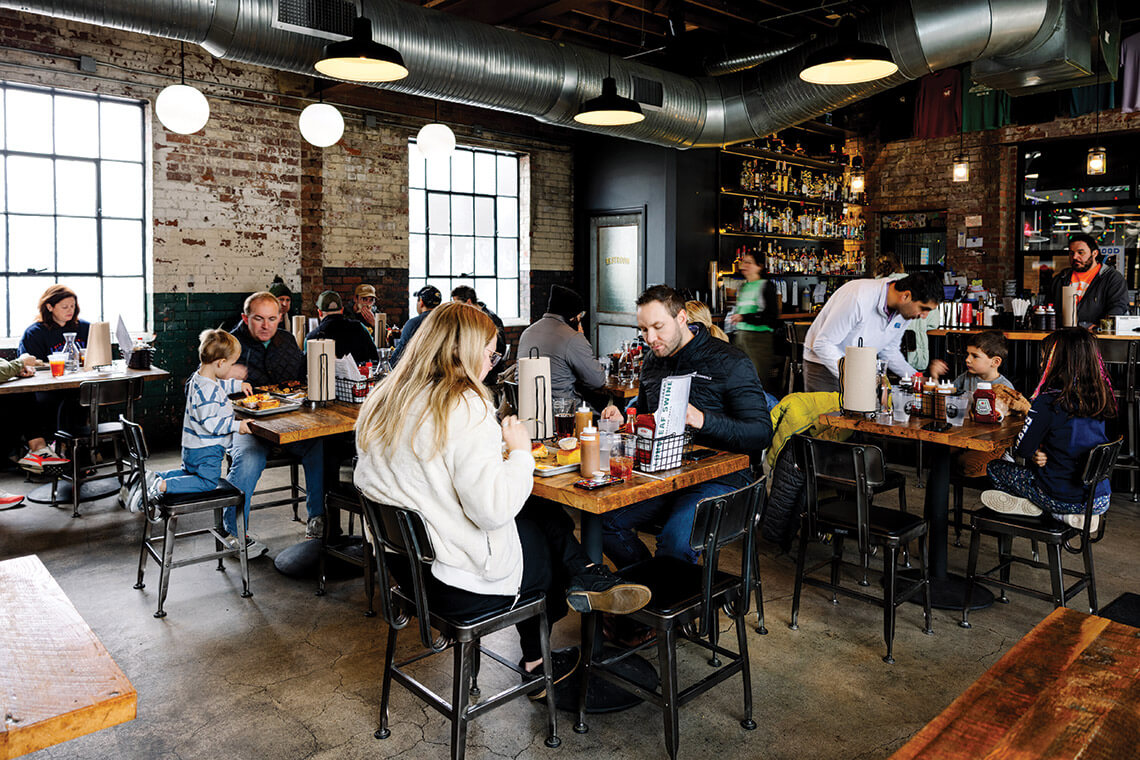
Longleaf Swine’s dining room honors the building’s roots as a 1930s-era service station, built in the style developed for Texaco by the industrial designer Walter Dorwin Teague. photograph by Anna Routh Barzin
Mitchell is in the heart of the city, two blocks east of the State Capitol, but hardly anyone knows he’s inside this metal box, breaking down boxes and pulling out pork butts and shoulders that were dropped off moments before he arrived. Stacking three plastic-sealed cuts of pork and a box of chicken onto a dolly, he turns on his heels and wheels his way back in the front door.
By 8:54, when Mitchell cracks open the smoker, the brisket has taken on a little color, though not much more than a hint. If all goes according to plan, he’ll have scored and seasoned the pork butts with a heavy dose of kosher salt in the next five minutes.
Then, Mitchell will toss some smaller, fibrous pieces of wood onto the beckoning flames, plus some bark for good measure, adding a heavy hit of smoke to the newly added pig.
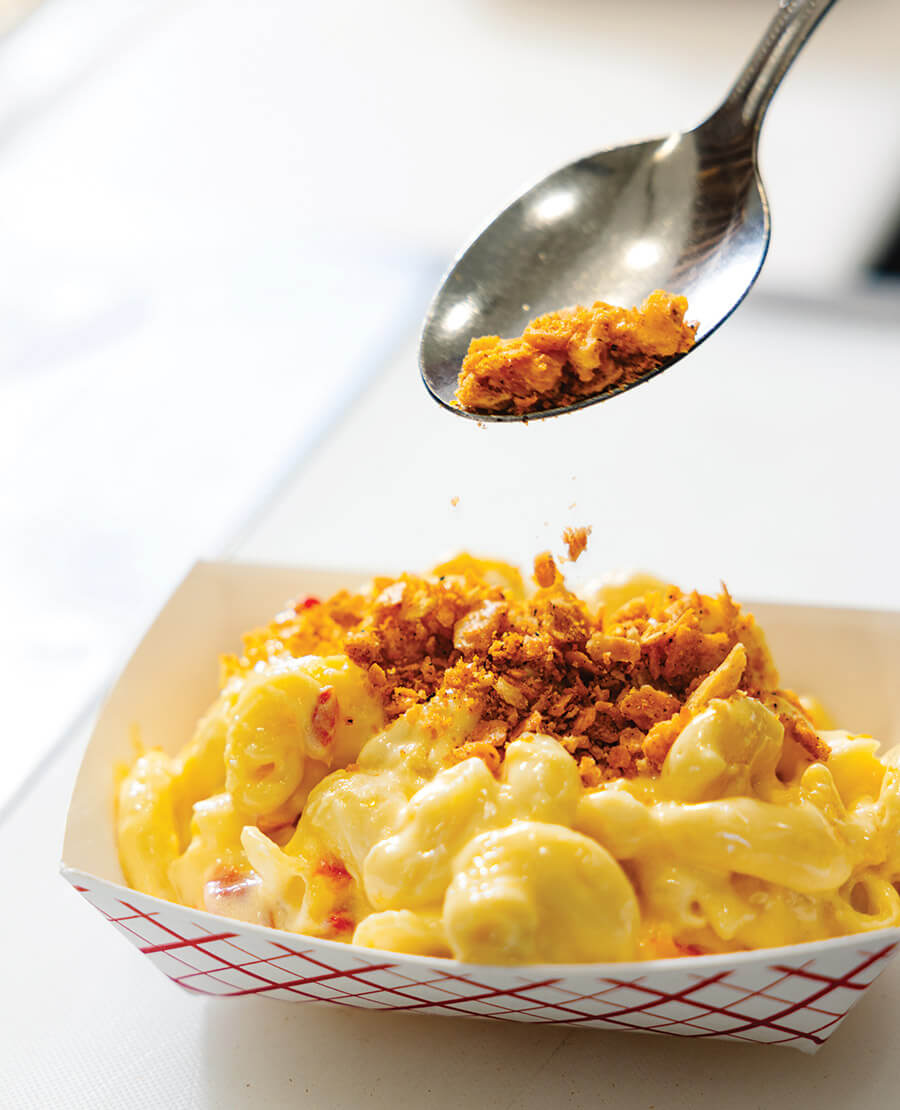
Longleaf Swine’s crowd-pleasing pimento mac ’n’ cheese gets a golden crown of fried saltines. photograph by Anna Routh Barzin
It will go on like this all day, alternating between a range of kitchen prep tasks and checking on the coals and the meats. More cooks will arrive, sharing the labor, like washing a sink full of sweet potatoes. This is Mitchell’s first role focused so singularly on smoked meats, but years spent leading kitchens mask any vexation. He’ll continue through his mental checklist quietly. Methodically. Like the restaurant’s own heat assist.
As the hours wear on, smoke and the scent of cooking meats will tangle themselves in Mitchell’s close-cropped silver hair and weave their way into his sweat-stained baseball cap featuring a cheerful pink pig. Maybe they’ll wash off. Or maybe they’re a part of him now, too.
Longleaf Swine
300 East Edenton Street
Raleigh, NC 27601
longleafswine.com
print it