Hollies can be prickly — a guaranteed ouch for gardeners’ bare hands. Their berries are somewhat toxic; their branches unwieldy. If you’ve ever tried to move one, impossible might be the word that comes to mind. Even from a stump ground level to the earth, jabbing shoots arise.
Still. When the world outside feels cold and tired — all grays, browns, and whites — we deck our halls with holly’s festive, deep-green boughs. For many of us, those pointy evergreen leaves and bright red berries symbolize life and resilience.
This was the time of year in the 1920s when young Fred Ebersole, growing up in western North Dakota, gazed out at drifting snow collecting on a hardy English holly. “If I ever grow up to have a garden of my own, I am going to plant it with this kind of God’s plant,” Ebersole wrote.
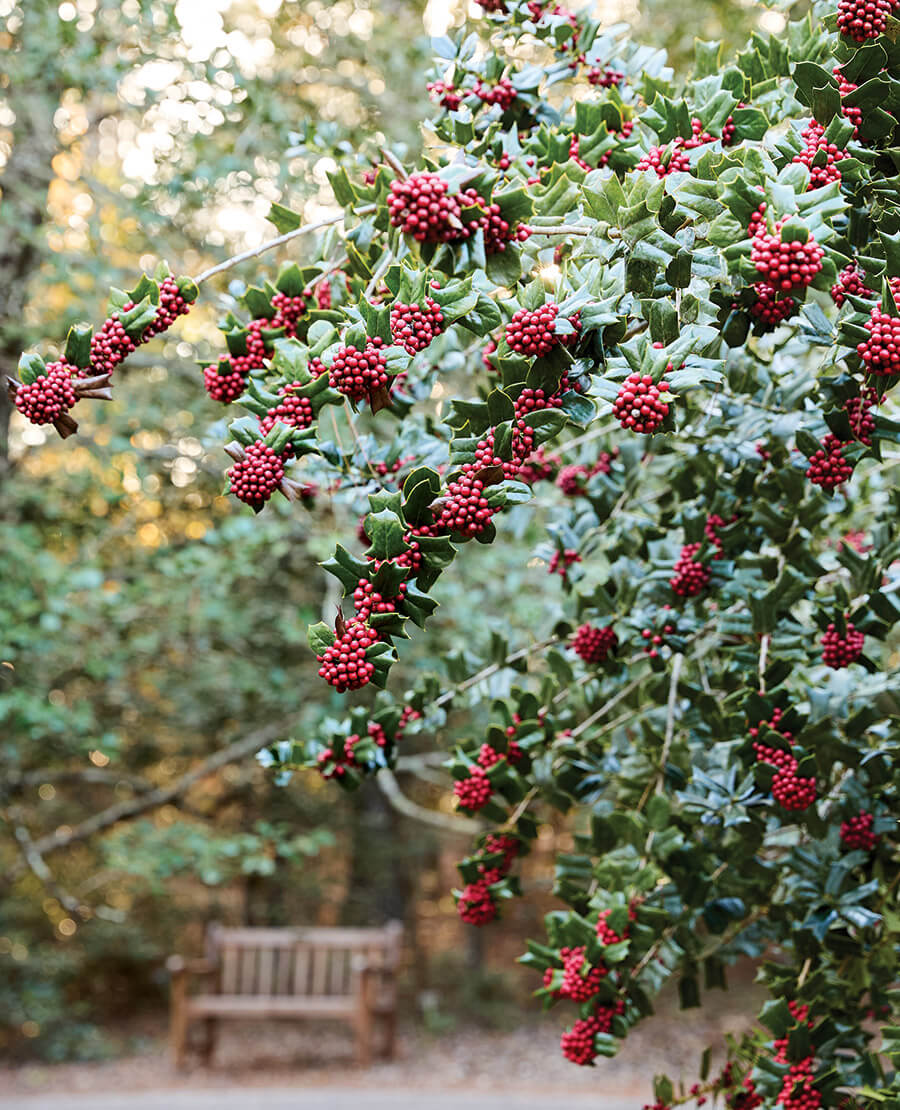
Established in the 1970s and now comprising 32 acres, the Sandhills Horticultural Gardens began with one familiar plant: holly. photograph by Stacey Van Berkel
Ebersole didn’t become a horticulturist; he became a chemist. Even so, plants — especially hollies — remained his quiet passion.
“Ebersole had a successful career that took him all over the country,” says Lee Bunch, executive director of the Sandhills Horticultural Gardens.
After Ebersole retired to the Pinehurst area in 1968, he’d expanded his botanical collection to more than 300 cultivars.
Ebersole’s childhood dream came to fruition at the Sandhills Horticultural Gardens, a public garden tucked in next to Sandhills Community College. Like the leaves on his beloved holly, Ebersole’s dream contained a few pricks and snags. Also like the holly, it persisted.
• • •
The first time Bunch saw the Ebersole Holly Garden, he was a landscaping student at Sandhills Community College. “That was in 1995, and by then, it had already gained international status as one of the world’s largest and most impressive collections,” he says.
To Bunch and the other students, Ebersole was a local legend. “In the late 1970s and early ’80s, when Ebersole’s health was declining and he had to sell his house, he gave his collection to the college,” Bunch says. “It took three years for the landscaping students to transplant them.”
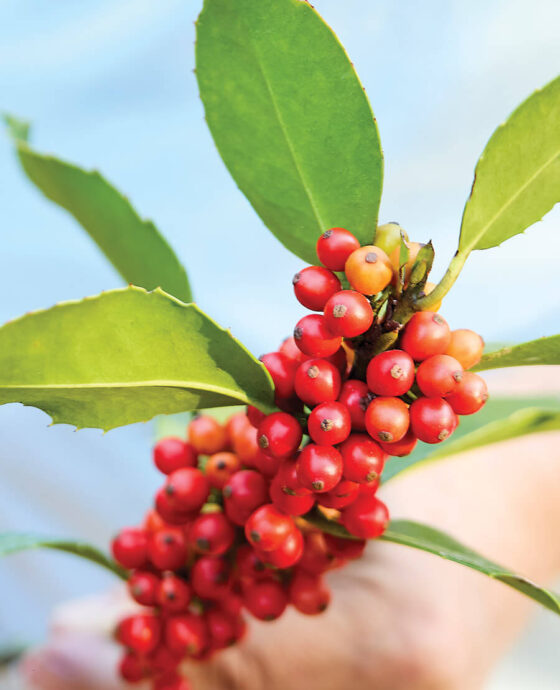
Holly berries here aren’t just red. In winter, plants reveal burgundy, magenta, yellow, cream, orange, and even black berries.
In the Ebersole Holly Garden, manicured grass pathways once connected collections of English, Japanese, Chinese, and American hollies. A star-shaped gazebo overlooked a pond that anchored the gardens. From its peaceful reflection perch, visitors back then stood in awe at the collection ranging from small to gigantic, evergreen to deciduous.
“The garden’s curator, Pat Joseph, was always in the garden. She would tag each plant and show us what she thought was cool,” Bunch recounts. Holly berries here aren’t just the expected red, for example. In winter, plants reveal burgundy, magenta, yellow, cream, orange, and even black berries. Their leaves aren’t always bright green and spiky; some are more gentle, variegated, or smooth.
Not only did Joseph label each holly for the public, she also presented cuttings to the Holly Society of America. “She was in constant contact with different professors and curators across the country,” Bunch says.
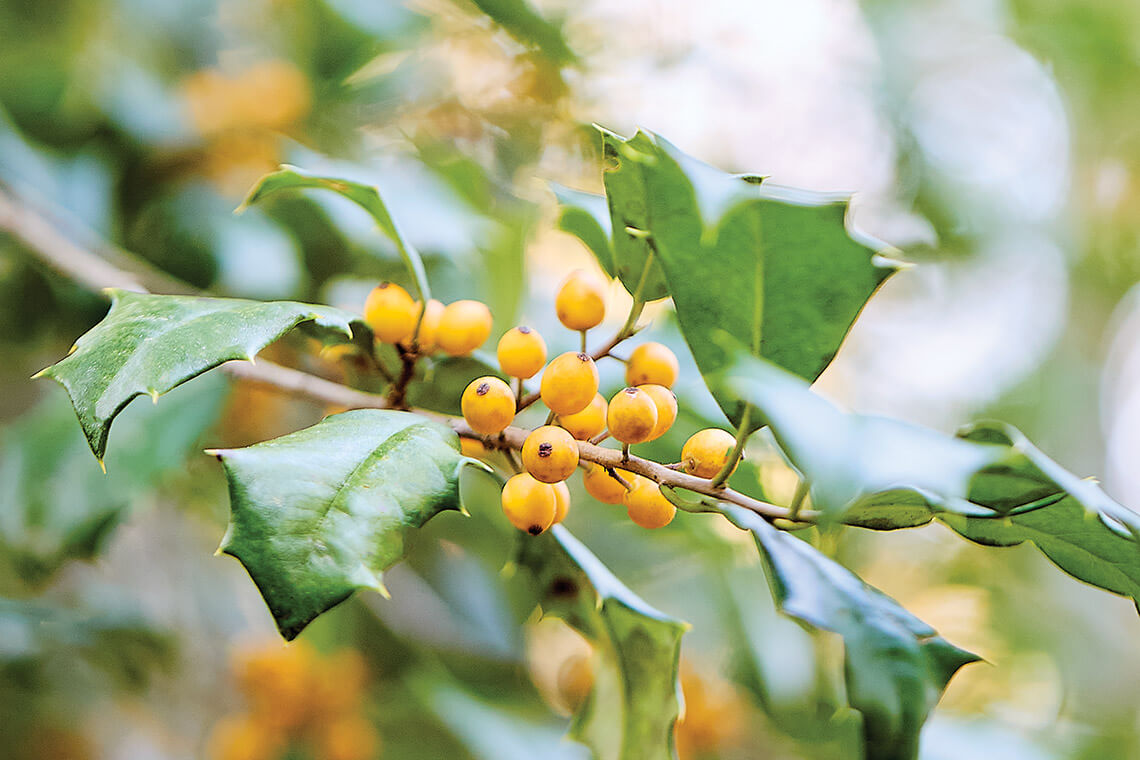
Depending on when you visit, the colors of holly leaves and berries will vary among the dozens of species and hundreds of cultivars growing at the Ebersole Holly Garden. photograph by Stacey Van Berkel
The Ebersole Holly Garden was so impressive that it paved the way for new, lush spaces at the Sandhills Horticultural Gardens: the Sir Walter Raleigh Garden — over an acre of formal English plantings — the Hillside Garden, and the Desmond Native Wetland Trail Garden.
After Joseph left in the early 2000s, the position went unfilled. Two decades later, when Bunch returned, he found one side of the garden covered in weeds and vines. The surrounding wetland had encroached into the garden, and many of the labels Joseph had painstakingly applied to each plant had fallen away.
“No one’s to blame,” Bunch says. It was only the product of a forgotten dream. Bunch remembered, though. He wanted everyone else to remember, too.
• • •
Most people think they can identify a holly. “You imagine that evergreen, Christmas-tree shaped bush at the corner of your house,” Bunch says.
To expand that notion, he takes visitors over to one of his favorite spots in the Ebersole Holly Garden, a section filled with massive trees, some boasting 40-foot-tall canopies. Bunch encourages them to look up. “These huge, beautiful hollies have white-and-gray bark, different from any other trees — a stark contrast to our native pines,” he says. “To get underneath them is a different experience than from looking straight on to the holly bush in your yard.”
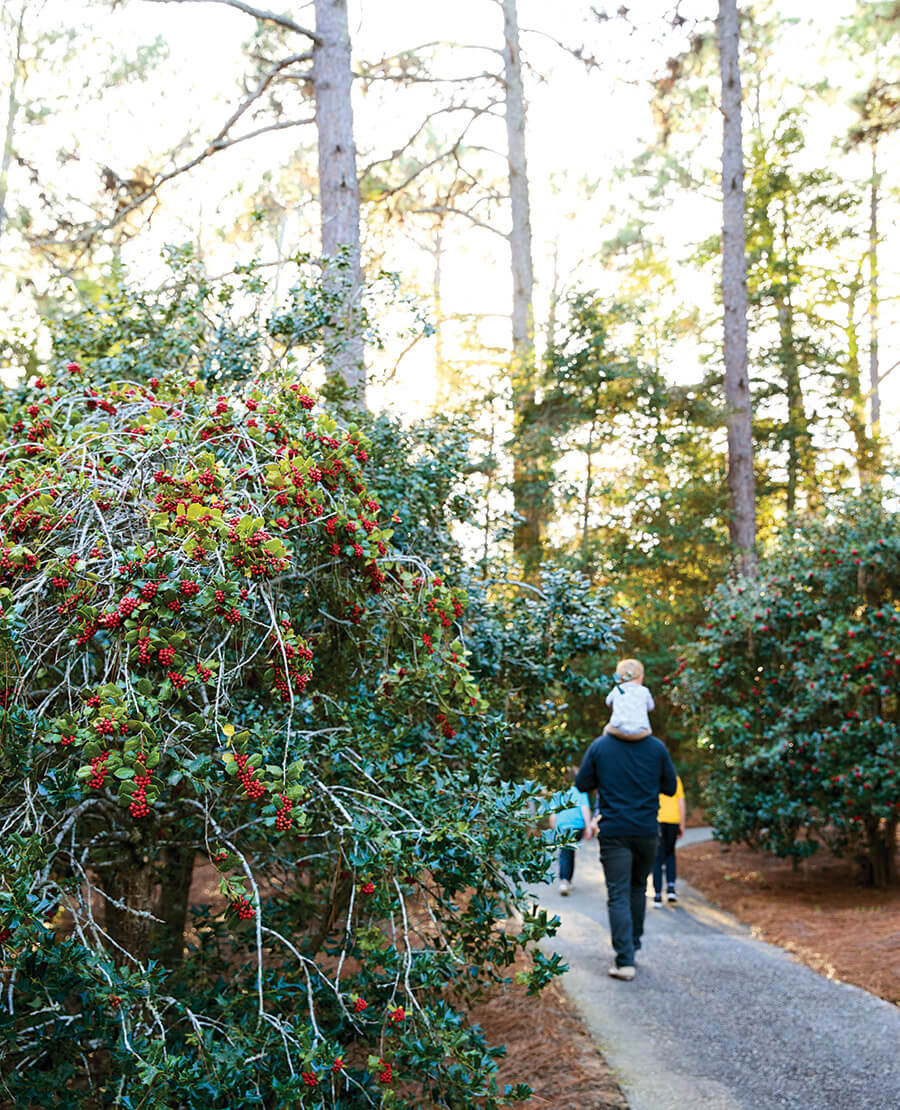
Thanks to the concrete paths winding throughout the Ebersole Holly Garden, it is the largest accessible holly collection on the East Coast. photograph by Stacey Van Berkel
Bunch points out one of the students’ favorite selfie spots: a picture-frame shape formed by branches that stretched and twisted together over the years.
“This one over here is called a peach leaf holly because its leaves look like peach tree leaves,” he says, showing visitors another of his favorites. “Look at these leaves,” Bunch says, pulling down a low-hanging branch of another tree so a disbeliever can touch its leaves, about as long as a man’s hand. “They’re massive because this tree is just that old. But look: there are no spines; it’s very smooth.”
• • •
Ebersole Holly Garden’s grand, old holly trees witnessed the garden’s past glory, and they give Bunch hope for the future. This is holly, remember? Holly lovers know all about resilience and renewal.
Along with Sandhills Community College’s landscaping students and a team of local volunteers, Bunch is restoring and rejuvenating the garden’s collection. Some of the hollies are nearly a century old and, even under the best conditions, they won’t live forever. “There are so many new holly varieties that I’d love to bring to our garden and set amongst the older, mature hollies.” They will have a legacy growing among the new hollies that arrive.
Bunch wants the next generation of holly enthusiasts to walk among the hollies and, like Ebersole, dream of possibilities for their own gardens. “I hope they’ll come to the garden to see, genetically, where these new varieties came from — and take cuttings,” Bunch says.
For years, visitors have admired azaleas in spring and breathed in tea olives in summer, unaware that nearby, a year-round dream waited. Now they see it for themselves — proof that hollies, and the dreams of those who love them, can be stubborn and resilient.
Sandhills Community College
3395 Airport Road
Pinehurst, NC 28374
(910) 692-6185
sandhills.edu/horticultural-gardens
print it