Imagine working in a North Carolina cotton mill during the 1920s, when factories dotted the state’s landscape. The dry, earthy smell of cotton dust hangs heavy in the air. The large, industrial contraptions that fill the plant — endless rows of spinning frames, weaving looms, winding machines, and more — roar to life, creating a constant hum in the mill.
Women, teens, and sometimes even children stand close by the machines like sentries. There’s no air-conditioning, no cafeteria, and, in most cases, no sympathy. You’re hot, tired, dirty, hungry, and thirsty. The noise is oppressive, too. If you don’t have a headache yet, there’s a good chance you’ll have one soon.
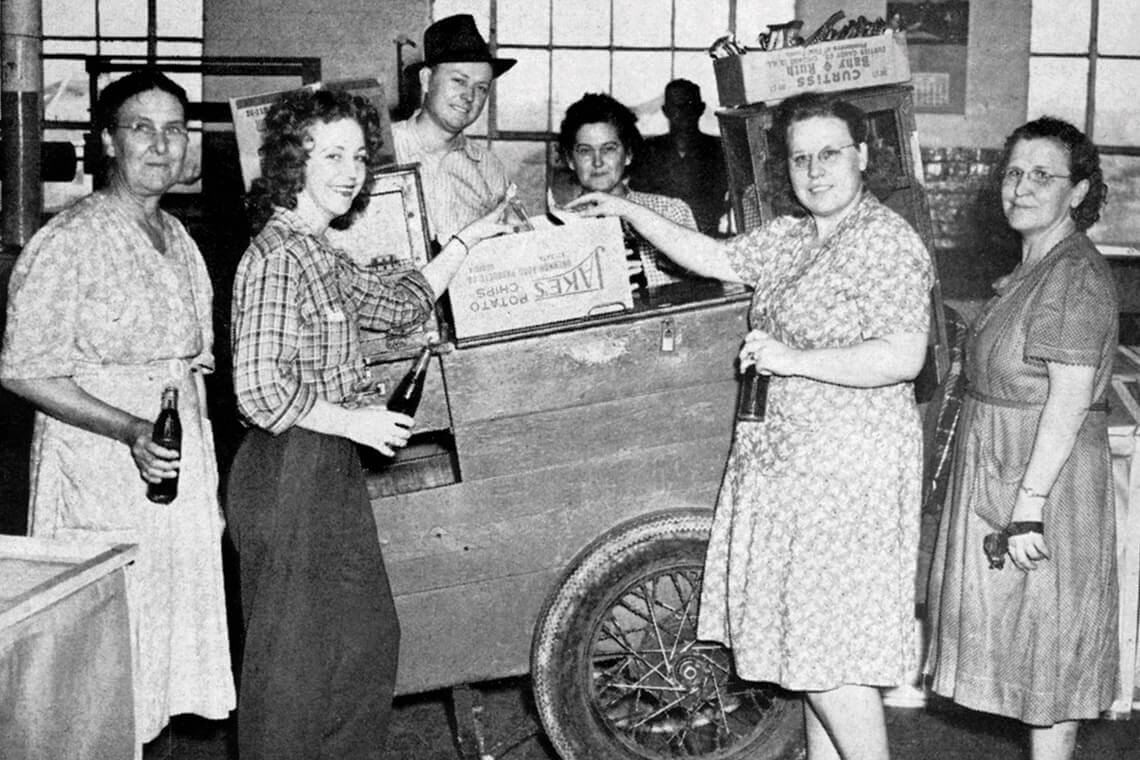
Before vending machines, workers in North Carolina textile mills — like those at Gastonia’s Victory Mills in 1948 — turned to dope wagons for refreshments. Photography courtesy of Millican Pictorial History Museum (millicanpictorialhistorymuseum.com)
Even worse, you’re barely halfway through your 12-hour shift. But you don’t dare leave your post because, well, it’s your post. You need the job, no matter how tough it is. The good news is the most popular man in the building — the dope wagon pusher — is headed your way, steering his cart of goods from one machine to the next.
No, he’s not that kind of dope pusher. But to an overheated, physically drained mill worker, his products — ice-cold drinks known as “dopes,” an assortment of sandwiches, and pick-me-up snacks, all selling for a nickel or dime apiece — sure are addictive.
That’s what cotton mills were like during the textile industry’s heyday, when workers labored through grueling shifts with limited breaks. The dope wagon was an oasis in a desert of humidity and cotton dust.
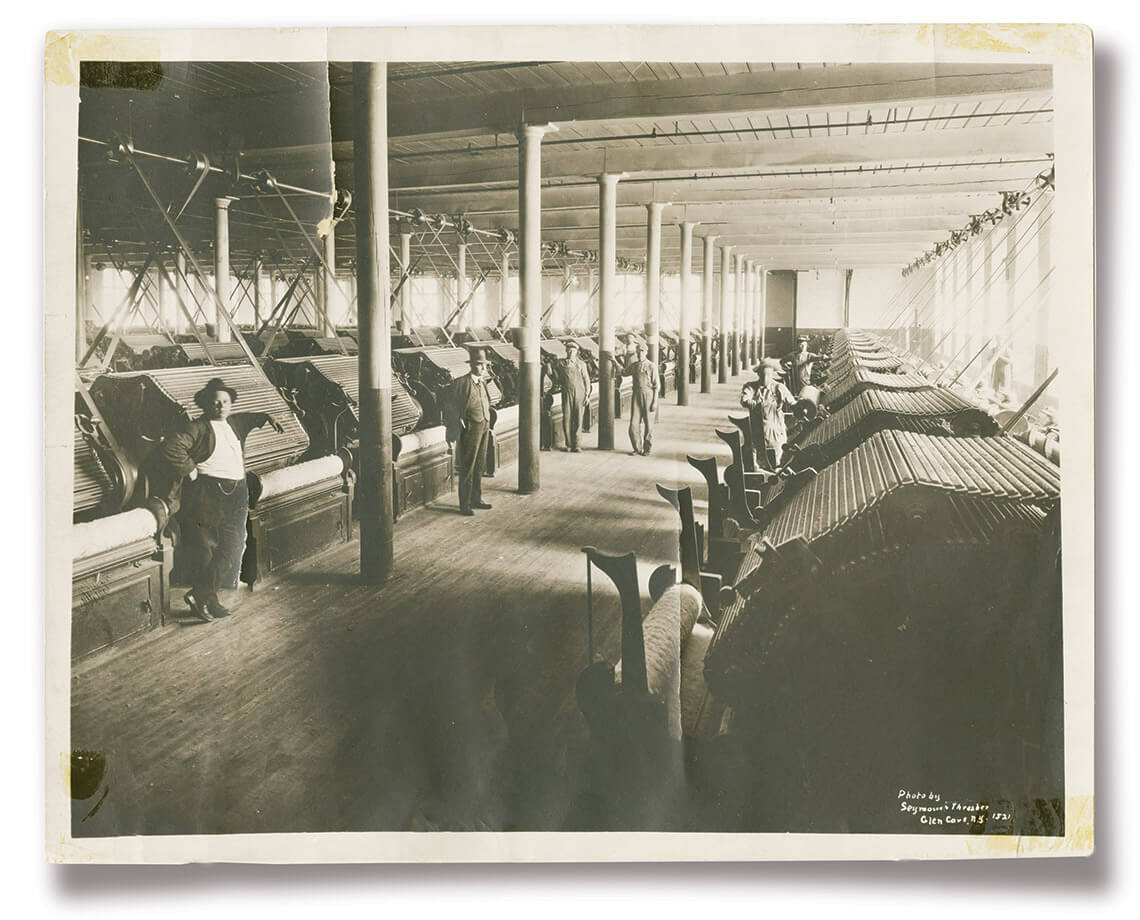
Without air conditioning, long shifts at the mill were usually dusty and hot. Photography courtesy of Gaston County Museum of Art & History, Dallas, North Carolina
“It doesn’t seem like much now, but prior to the dope wagons, you were on your own for nourishment during those 12-hour shifts,” says Kent Hester, a Gaston County Museum of Art and History guide who specializes in textile history. “They were part of a movement to improve the worker experience in the mills.”
Dope wagons were essentially mobile concession stands that brought refreshments directly to workers. The long, rectangular carts were narrow enough to navigate the 24- to 36-inch aisles between the endless rows of machinery. They were mounted on sturdy tires — sometimes ones from old Model A or Model T automobiles or motorcycles — for easier pushing. “When the wagons were completely full,” Hester says, “they could easily weigh 700 to 1,000 pounds or more. That’s why you didn’t see any women pushing dope wagons through the mills.”
Dope wagons were typically handmade and fashioned with numerous drawers and cubbies that stashed everything from sandwiches, crackers, MoonPies, and candy bars to chewing tobacco. More important, every dope wagon had a compartment lined with tin or some other metal where ice could be stored to keep drinks like Pepsi, Cheerwine, and orange and grape Nehi cold all day.
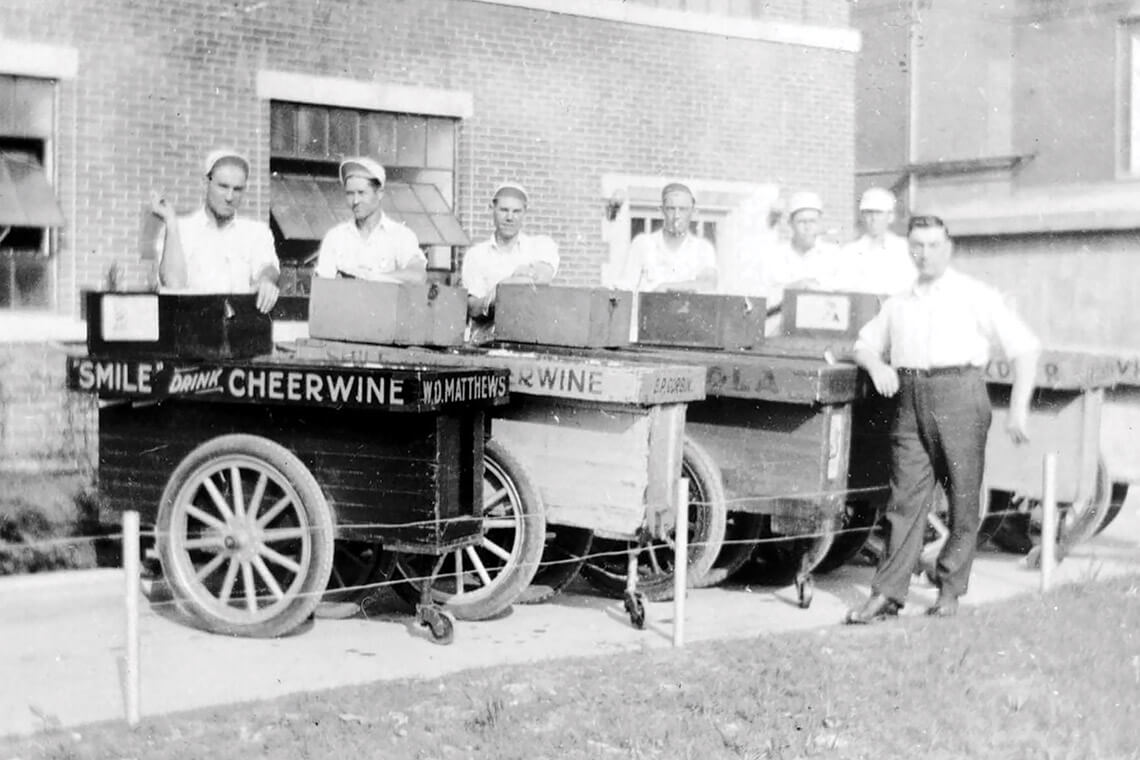
In the 1920s, several carts were needed to accommodate all the employees at Cannon Mills in Kannapolis. Photography courtesy of Kannapolis History Associates
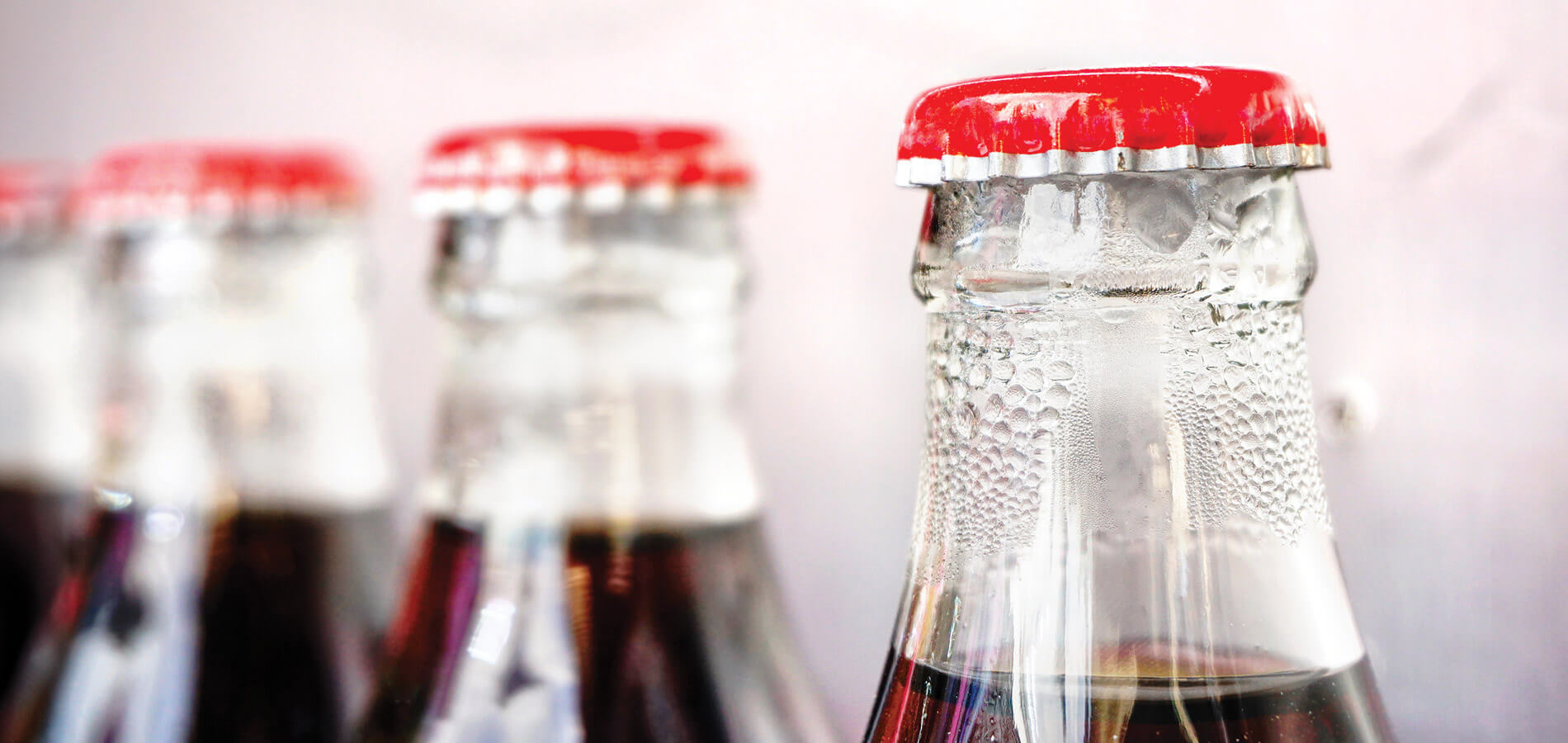
It’s Coca-Cola, however, that is believed to have given dope wagons their name. “Coke had small amounts of cocaine in it, which even back then was called dope,” Hester explains. “Even after 1929, when cocaine was outlawed and removed from Coca-Cola, people still called any cold, caffeinated soft drinks ‘dopes.’ You wouldn’t ask for a Coke — you’d ask for a dope.”
While most historians believe that’s where the term originated, Hester points out that there’s a second, less popular theory: “In a hot, dirty, loud mill, people would often get headaches, so a common product the dope wagons sold was headache powders, such as Goody’s, BC, and Stanback,” he says. “They were a kind of dope, and some people think that’s where dope wagons got their name.”
According to Hester, dope wagons were not exclusive to textile mills, but that’s where they were introduced in the early 1910s and where they were mostly found for decades.
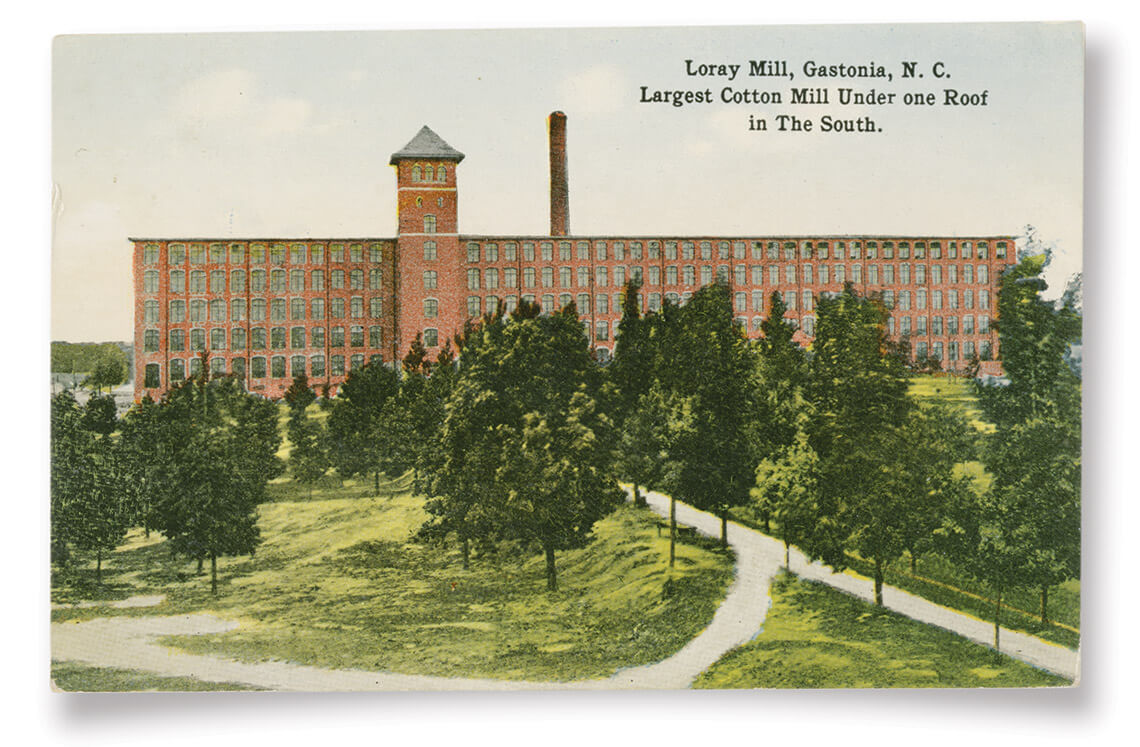
Once the South’s largest cotton mill, Loray Mill today houses residential apartment spaces. Photography courtesy of Gaston County Museum of Art & History, Dallas, North Carolina
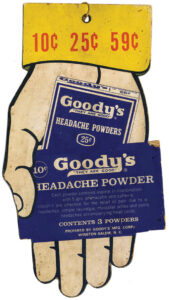
Mills were often loud and stuffy. In addition to sodas and sandwiches, dope wagons provided workers with headache powders. Photography courtesy of Lew Powell Memorabilia Collection, North Carolina Collection, The Wilson Library, UNC Chapel Hill
The carts were especially prominent in Gaston County, which had more than a hundred textile mills in the 1920s, including the behemoth Loray Mill, a plant with some 3,500 workers at its height. And mills across the state — Clinchfield Mill in Marion, Cannon Mills in Kannapolis, Burlington Industries in Alamance County, Pilot Mill in Raleigh — all likely had dope wagon pushers.
While they were a respite for employees, the carts primarily benefited the mills. They were facing labor shortages due to low wages and poor working conditions: “The mills had to think of ways to attract and keep employees, such as better equipment and sometimes a little better pay,” Hester says. “One amenity that came about was the introduction of the dope wagon.”
Some companies paid an employee to push the dope wagon throughout the mill two or three times per shift, while others contracted with outside vendors — say, a local grocery store owner — who already had the merchandise in stock. And owners didn’t have to provide a lunch break because dope wagons could come to workers on the job.
After the start of the Korean War, dope wagons gradually began to disappear. “Companies replaced the wagons with vending machines or small cantinas,” Hester says. “By the 1970s, there were still a few dope wagons around, but most of the mills had switched over to coin-operated vending machines, and eventually all of them did.”
Mention dope wagons today, and most people will respond with a blank stare. But a century ago, they were as indispensable as the mills themselves.