Put ramekins on a baking sheet. Bake for 25-35 minutes, until puffed and golden. Remove from oven, and let stand for 5 minutes. With a flexible spatula, remove strata to
Listen as the pages of the magazine come to life in the Storytellers podcast showcasing the voices of Our State writers. Each podcast episode features a writer reading their column
Listen as the pages of the magazine come to life in the Storytellers podcast showcasing the voices of Our State writers. Each podcast episode features a writer reading their column
In 1917, more than 2,000 German officers, sailors, and civilians were taken in by a small town in Madison County, finding common ground amid a global conflict.
Listen as the pages of the magazine come to life in the Storytellers podcast showcasing the voices of Our State writers. Each podcast episode features a writer reading their column aloud, allowing each distinct voice to shine. Click below to listen to Brad read his column aloud.
As a child in the 1930s and ’40s, Jacqueline Burgin could look out the living room window of her family’s home in Hot Springs and see across the French Broad River to the grassy lawn where a resort hotel had once stood. In her wildest dreams, she could not have imagined a time when she would have heard the sounds of a German orchestra floating across the river or watched a small European village taking shape on that broad lawn. Yet, half a century later, she would conjure up those experiences — not as dreams but as the unlikely reality of an extraordinary moment in North Carolina history.
In May of 1917, the townspeople of Hot Springs had barely gotten over the shock of the United States’ entry into World War I when they learned that more than 2,000 Germans were about to storm their peaceful community of 650.
Photography courtesy of BUNCOMBE COUNTY SPECIAL COLLECTIONS, PACK MEMORIAL PUBLIC LIBRARY, ASHEVILLE, NC
No, it wasn’t an invading force with rifles and cannons, but these interlopers certainly had the potential to create a clash of cultures. The U.S. government had just selected Hot Springs as the site for an internment camp for officers, sailors, and passengers who’d been on civilian German ships caught in U.S. and U.S.-controlled harbors upon America’s entry into the war.
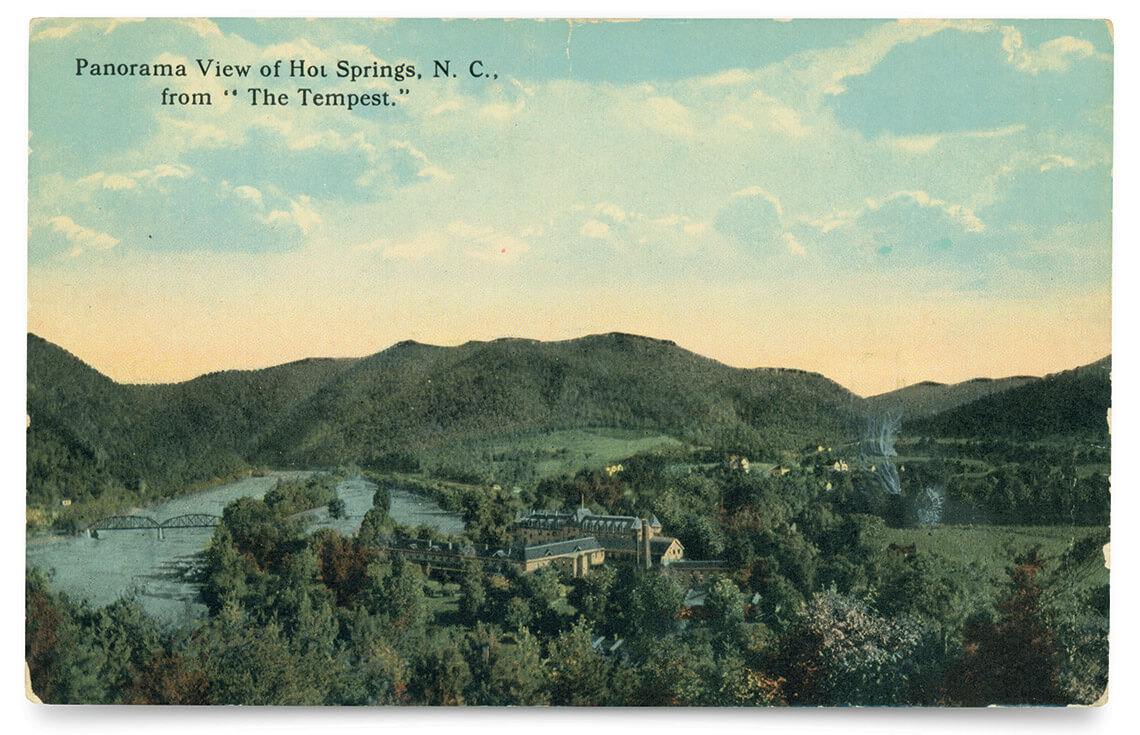
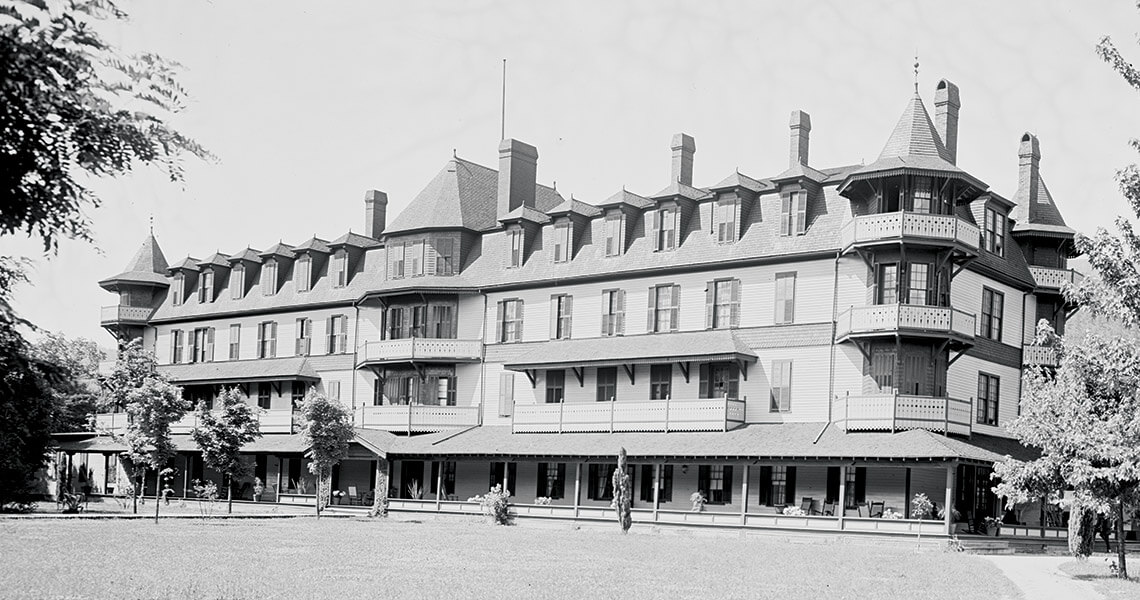
The arrival of the German seamen was like a life preserver tossed to James Edwin Rumbough, owner of the Mountain Park Hotel. Once a tourist destination — writer O. Henry had honeymooned here — the grand, 200-room hotel had fallen on hard times. For the sum of $1,500 a month, Rumbough offered to house the internees in the hotel and on the surrounding grounds, which included the site of the Wana Luna, North Carolina’s first organized golf club.
While detained at the Mountain Park Hotel (pictured) in Hot Springs, German internees built Old Heidelberg. Photography courtesy of Detroit Publishing Company photograph collection, Library of Congress, LC-DIG-det-4a09534
Locals were justifiably suspicious of the invaders, having spent the previous three years hearing about the barbarity of the German army. But the internees who began arriving in June were anything but the Teutonic stereotypes frothed up by the newspapers of the day.
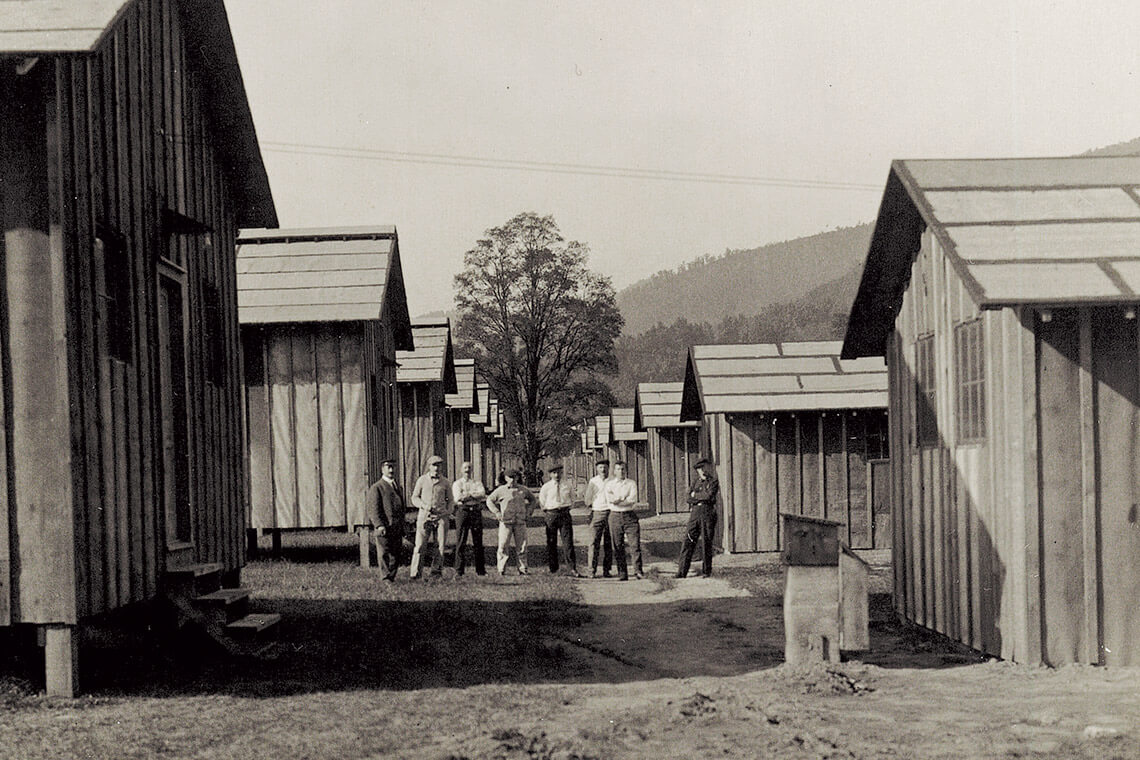
Within a few weeks, a fence had been erected, barracks built, and guards hired. A steady stream of internees began arriving by train, including the 35-member German Imperial Band. Despite the barbed wire and the language barrier, relations between the locals and the Germans flourished.
Camp B featured barracks, built by the internees, on 13 acres. photograph by Adolph Thierbach, Courtesy of the State Archives of North Carolina
German wives and children who’d traveled to be with their officer husbands and fathers were allowed to find lodging in town. The German Imperial Band gave twice-weekly concerts that were as popular among the townspeople as the internees, with Hot Springs residents lining up outside the fence to enjoy the performances.
Friendships between the men and their guards took root in the fertile river valley. Many of the prisoners had engaged in artistic pursuits — painting, woodworking, model shipbuilding — to pass the time productively on long voyages. They continued that work in Hot Springs, often gifting their handiwork to townspeople.
• • •
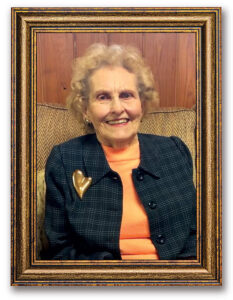
This chapter in Hot Springs history would only exist in long-forgotten newspaper files had it not been for the young girl who grew up across the French Broad from the campsite. Not only had her great-grandfather worked as a guard there, but her family also owned an original painting by one of the internees. These were the catalysts that sparked an enduring fascination with the camp’s history.
After marrying and raising a family, Jacqueline Burgin Painter began tracking down the few details that were known about the camp. “I was afraid the story would not get preserved if I didn’t do it,” she said in a 1992 interview.
Jacqueline Burgin Painter authored The German Invasion of Western North Carolina. photograph by Matt Hulsman
Jacqueline Burgin Painter photograph by Linda Burgin
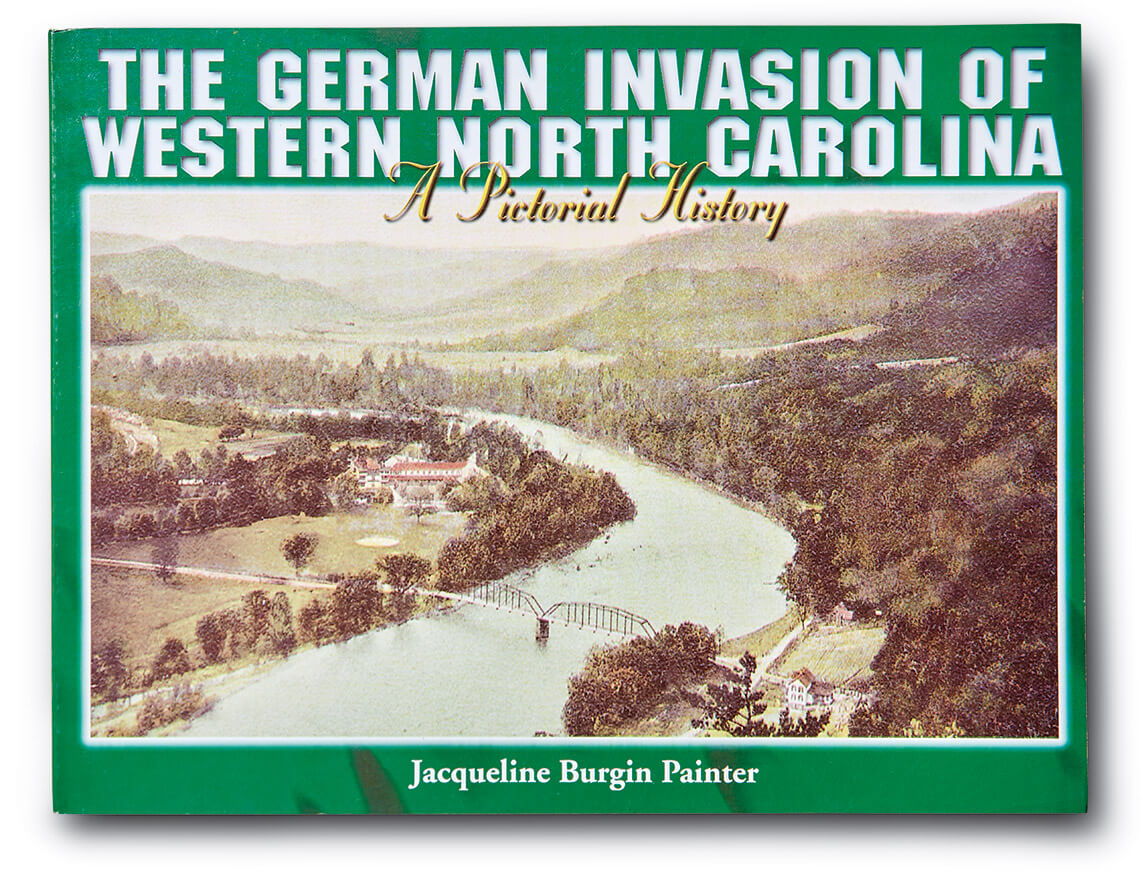
At the time, Hot Springs was still home to a few townspeople who remembered the Germans’ sojourn, and she sought them out. She scoured government archives. And after about 10 years of research, she published her pictorial history, The German Invasion of Western North Carolina, in 1997.
For Painter, who died in 2025, the book was a labor of love. “She loved chasing down the details,” says her daughter, Debby Painter Cowan. “She was very driven. Like a detective, wouldn’t give up. I think she was proud she was able to put a spotlight on Hot Springs.”
While most physical evidence of the camp has long since disappeared, one substantial reminder remains, referenced by Painter in her book: A gazebo said to be built by internee labor still stands watch in a leafy neighborhood above Spring Creek.
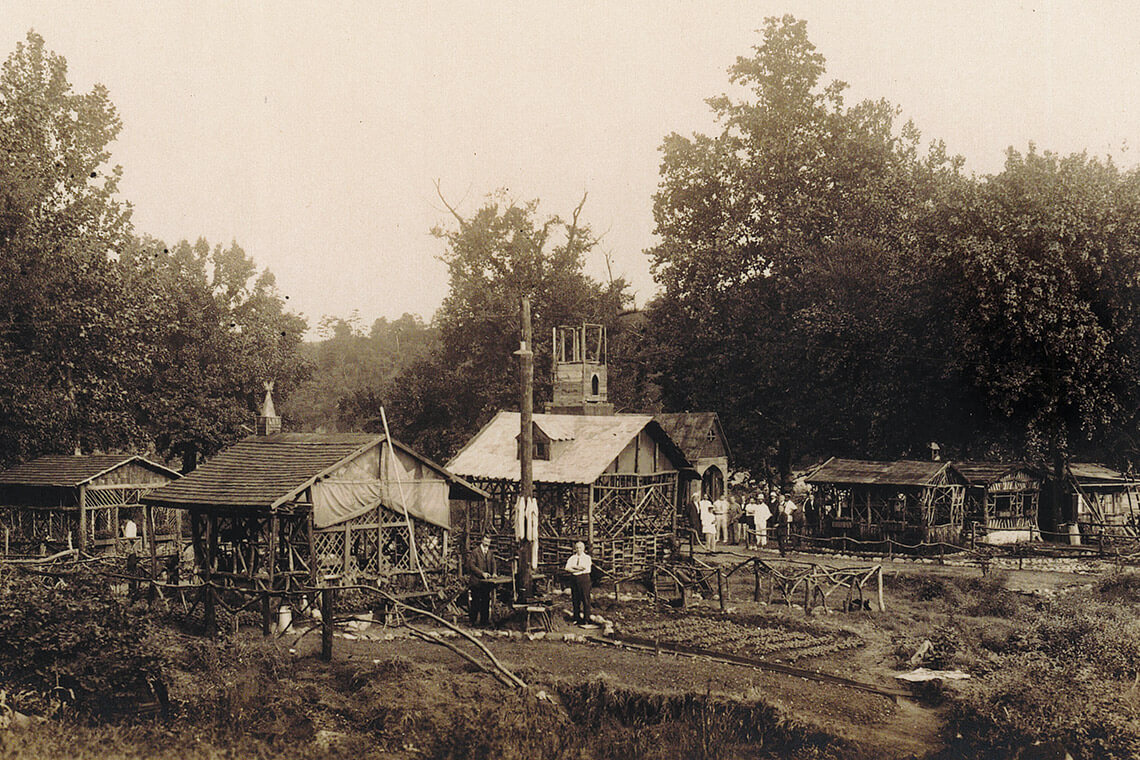
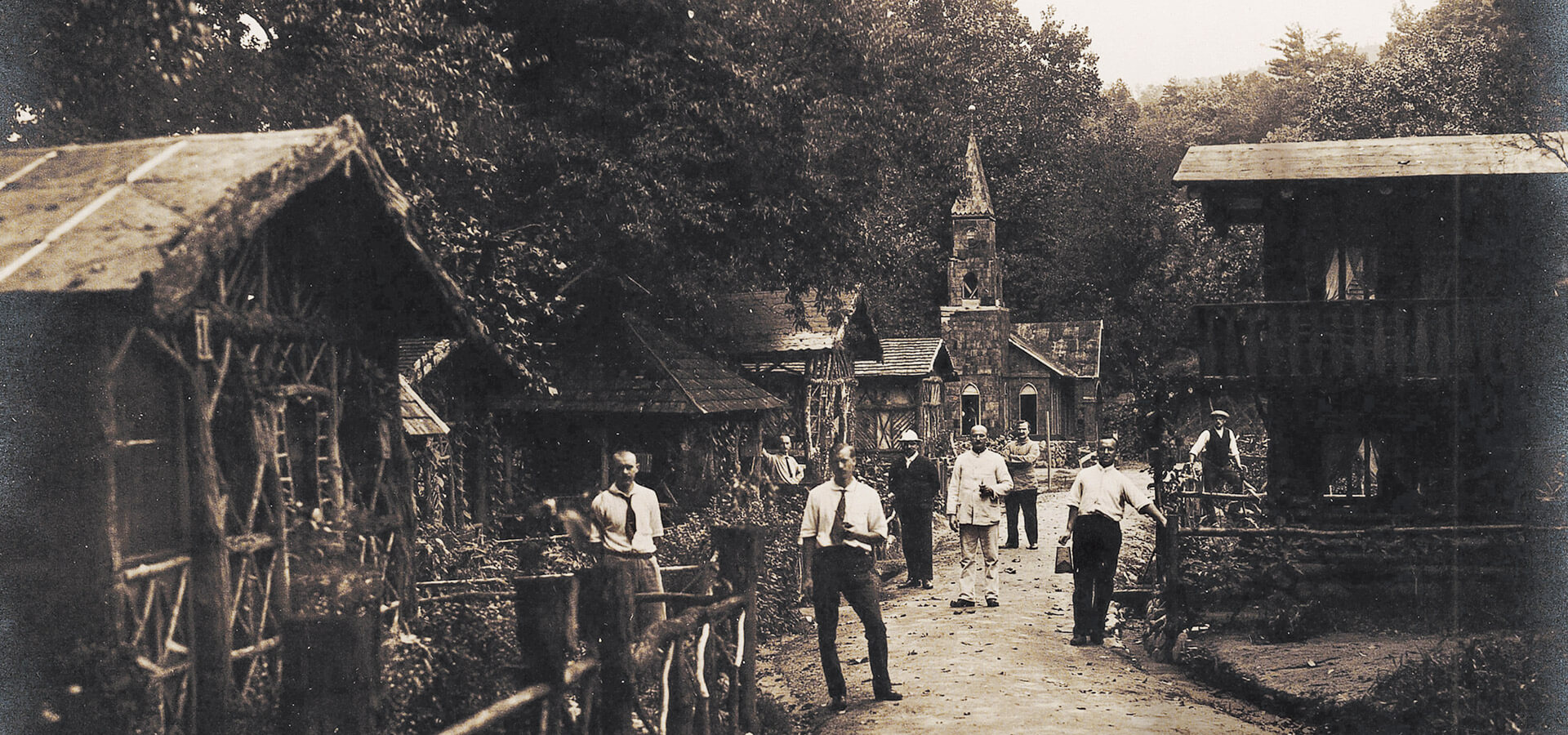
The Germans’ handiwork in Old Heidelberg included houses, gardens, and community structures. photograph by Adolph Thierbach, Courtesy of the State Archives of North Carolina
Despite the cordial relations, the idea of German prisoners being housed at a North Carolina resort hotel rankled many beyond the town limits of Hot Springs. In 1917, a newspaper article claimed that the German flag was flying prominently over the camp, that food was being wasted — at a time when Americans were being asked to do without — and that the Germans were living in the lap of luxury. A tempest in a teapot ensued until The Asheville Times published a lengthy rebuttal, putting the rumors and exaggerations to rest.
Regardless of the controversy, the camp continued to draw interest from newspapers across the country. Both The New York Times and The Washington Post published pictorials of the camp after the industriousness of the German internees took a fascinating turn — resulting in one of the most unique and charming building projects in North Carolina history.
• • •
Using abundant driftwood and debris from the adjacent French Broad River left behind by the flood of 1916, enterprising German sailors began to fashion a village of small bungalows and chalets they called Old Heidelberg. A grid of orderly streets was laid out by internee Arthur Ludwig Schlimbach, captain of the SS Präsident, who could have embarked on a second career as a city planner. The main thoroughfare through the village became known as Hamburg Street.
Some of the cottages were rustic, crafted with the gnarled branches of laurel, willow, and rhododendron. Others would have made Hansel and Gretel feel right at home — little chalets with ornamental railings, decorative fences, flower boxes, and bark baskets.
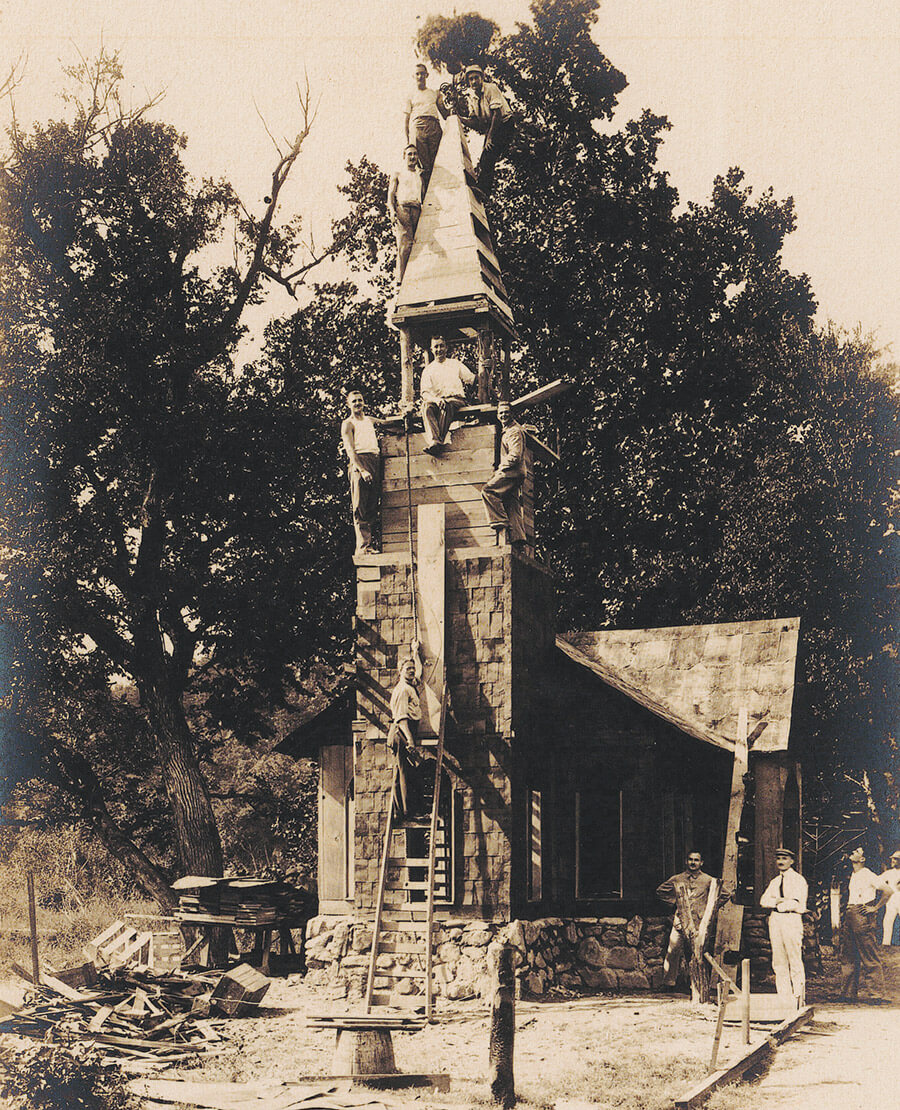
Old Heidelberg included a church whose roof and siding were made from flattened tin cans. photograph by Adolph Thierbach, Courtesy of the State Archives of North Carolina
What the Germans created was a kind of four-season Shangri-La. Curtains in the windows billowed in the springtime air. Wildflower gardens framed by whitewashed rocks flourished in the summer. Vegetable gardens yielded a bounty all the way through autumn. And fireplaces and primitive woodstoves took the edge off winter’s chill. These buildings became private clubhouses for the men, where they read, drank coffee, played chess, and smoked.
But most remarkable of all were the “community” structures, like a church with Gothic windows and a tall spire fashioned from flattened tins, and a working carousel with four passenger cars that swung round and round on long chains. A multilevel fountain, described in one newspaper as “an architectural wonder,” featured statues of Neptune and five mermaids sculpted from plaster of paris.
• • •
Almost two decades after Painter published her book, Kevin Kennedy, professor emeritus of German literature at Appalachian State University, became enthralled with the story. With Painter as a resource, he produced a documentary about the camp, German Enemy Aliens in the Land of the Sky.
“Not only was she so kind, but she was so knowledgeable,” he says. “The amount of research she had done was mind-boggling.”
Both Painter’s book and Kennedy’s documentary include the tragic aspects of the Germans’ stay. Toward the close of the war, the U.S. government decided to move the men nearly 200 miles away to Fort Oglethorpe in Georgia. But before the transfer could be made, a typhoid outbreak occurred, killing 26 men. Following a delay, the camp was finally emptied, and plans were made to turn the Mountain Park Hotel into a hospital for wounded American soldiers.
Old Heidelberg became a ghost town. On November 11, 1918, an armistice was declared. Across the country, church bells rang and celebrations erupted. In an act of misguided enthusiasm amid this atmosphere of jubilation, the Hot Springs guards dynamited the little village as a final rebuke to the kaiser of Germany.
Yet that violent act wasn’t enough to destroy the goodwill that had developed between the people of two warring nations. Fourteen years later, 4,000 people gathered at Riverside Cemetery in Asheville. A nationwide radio audience listened as a monument was dedicated to the men who’d been interned in Hot Springs and were buried at Riverside. The German ambassador to the U.S., F.W. von Prittwitz-Gaffron, said, “In front of the graves of those who died during the war, it becomes self-evident that love should guide the world and prevent further willful destruction of human lives and civilization.”
The same day The Asheville Times reported on the peaceful gathering at Riverside, another headline would later catch Painter’s eye, the irony of which she could not ignore, and with which she closed her book: “Hitler now looms as Chancellor.”
Despite this dark harbinger, Painter remained proud of her hometown’s peacemaking role in World War I. In an Asheville Citizen-Times story commemorating the 100th anniversary of the camp, she echoed the words of another notable world leader: “I think it was one of Madison County’s finest hours.”
Get our most popular weekly newsletter: This is NC
At both the turn of the century and today, Beaufort’s waterfront has attracted a hum of commerce and community. At its heart, a historic avenue tells that history, from the stately double-porched homes to the sound of ships announcing their arrival at port.



 Listen as the pages of the magazine come to life in the