Put ramekins on a baking sheet. Bake for 25-35 minutes, until puffed and golden. Remove from oven, and let stand for 5 minutes. With a flexible spatula, remove strata to
Listen as the pages of the magazine come to life in the Storytellers podcast showcasing the voices of Our State writers. Each podcast episode features a writer reading their column
Listen as the pages of the magazine come to life in the Storytellers podcast showcasing the voices of Our State writers. Each podcast episode features a writer reading their column
Listen as the pages of the magazine come to life in the Storytellers podcast showcasing the voices of Our State writers. Each podcast episode features a writer reading their column aloud, allowing each distinct voice to shine. Click below to listen to Brad read his column aloud.
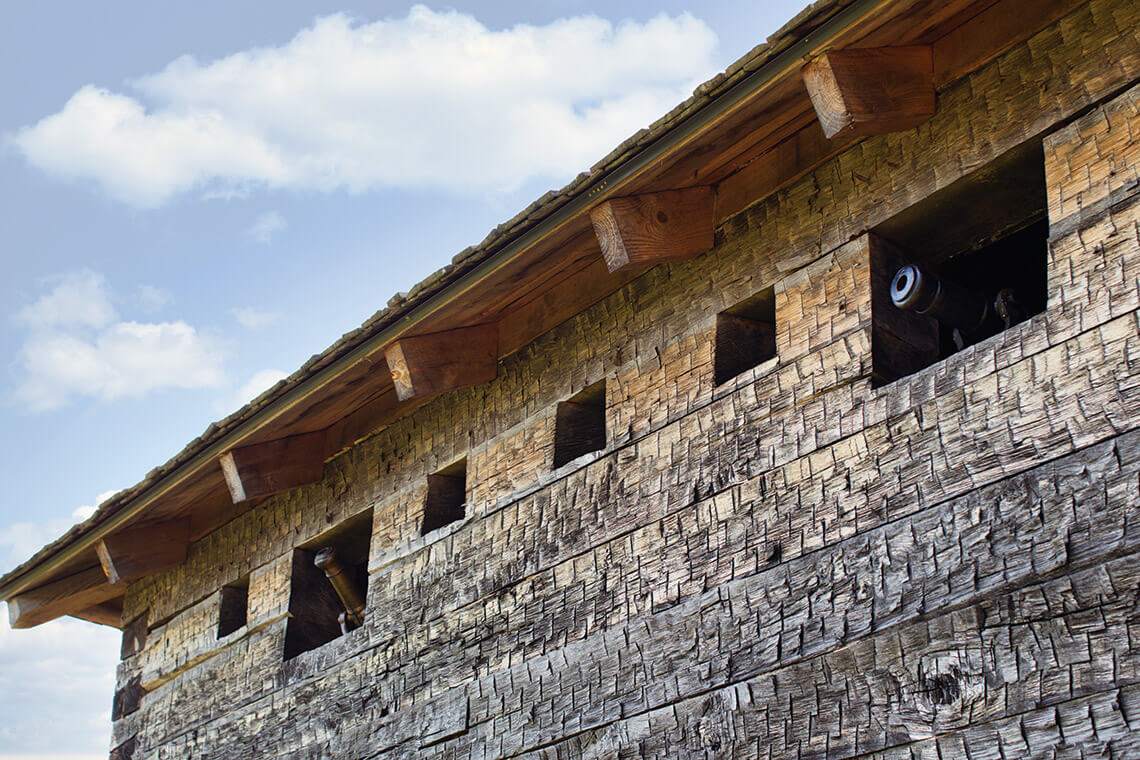
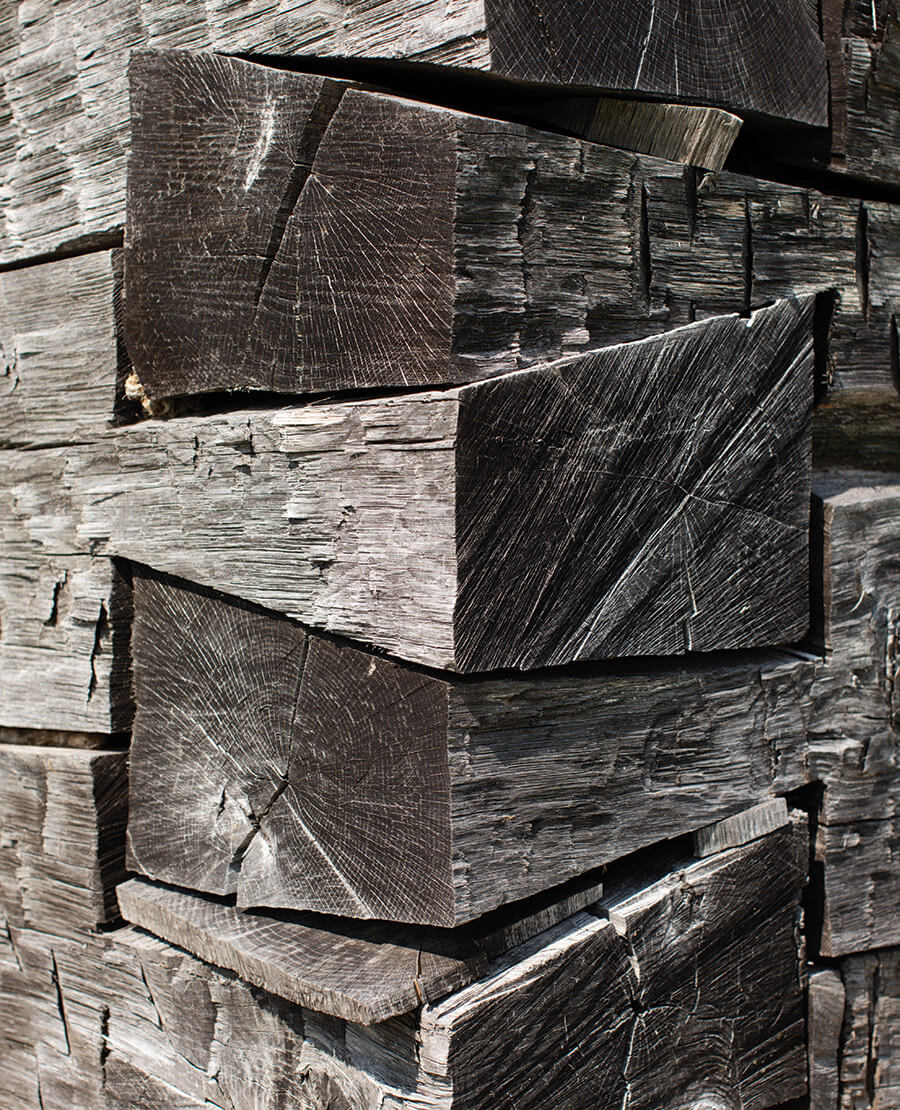
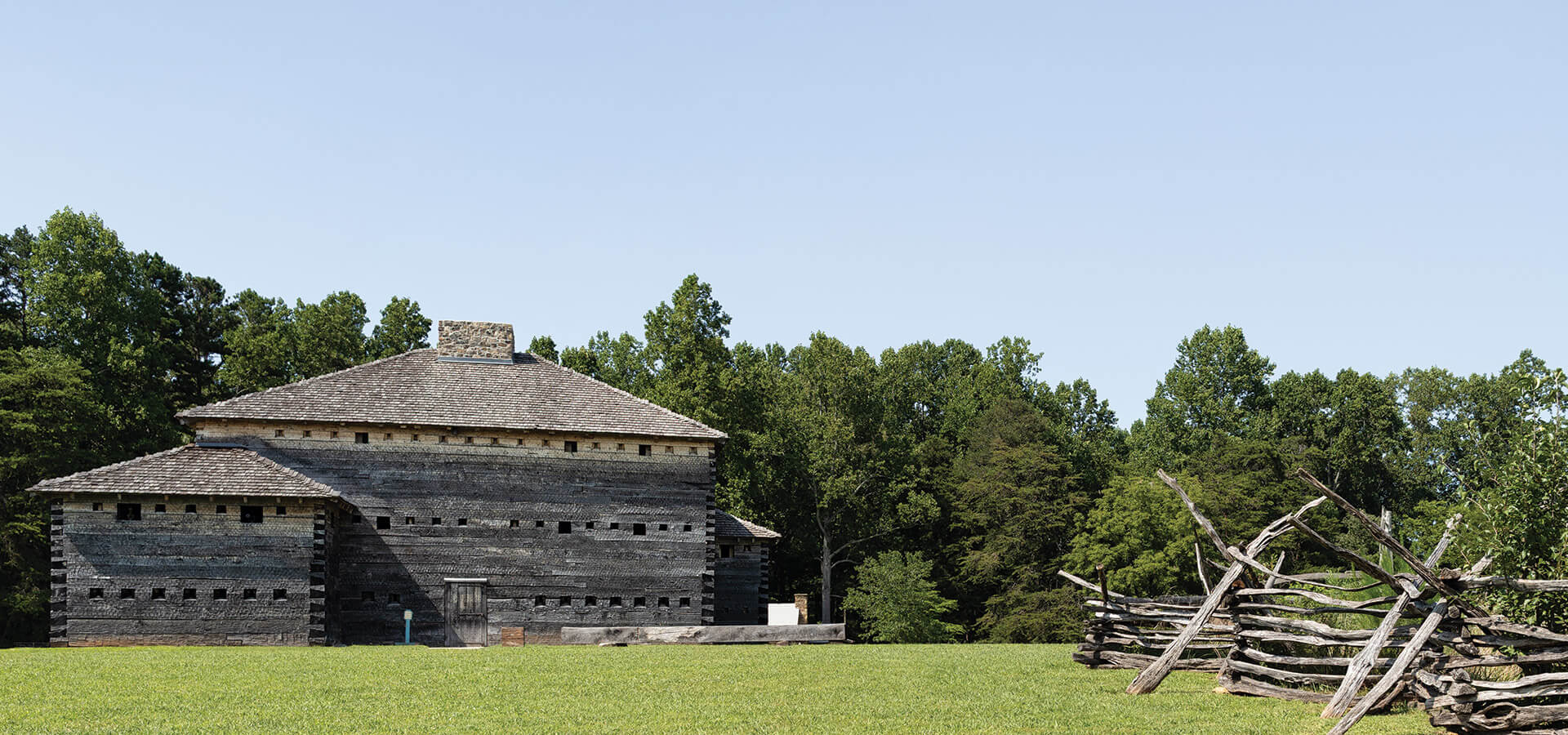
A few miles outside Statesville, a curling ribbon of a road unfurls across a wide, grassy field. Here, a spot-on replica of a frontier fort perches on a small rise. The fort looks like a large wooden block, its sides freckled with 300 gunports. The flanks of its dovetailed timbers bear the marks of broadax and adze, their rough-hewn surfaces rippling like fish scales.
Fort Dobbs State Historic Site tells the story of North Carolina’s role in the French and Indian War, a conflict that decided who would control the eastern part of North America. It’s a history often overshadowed by the Revolutionary War that followed little more than a decade later, out of which a new nation was born and our “great experiment” in democracy began.
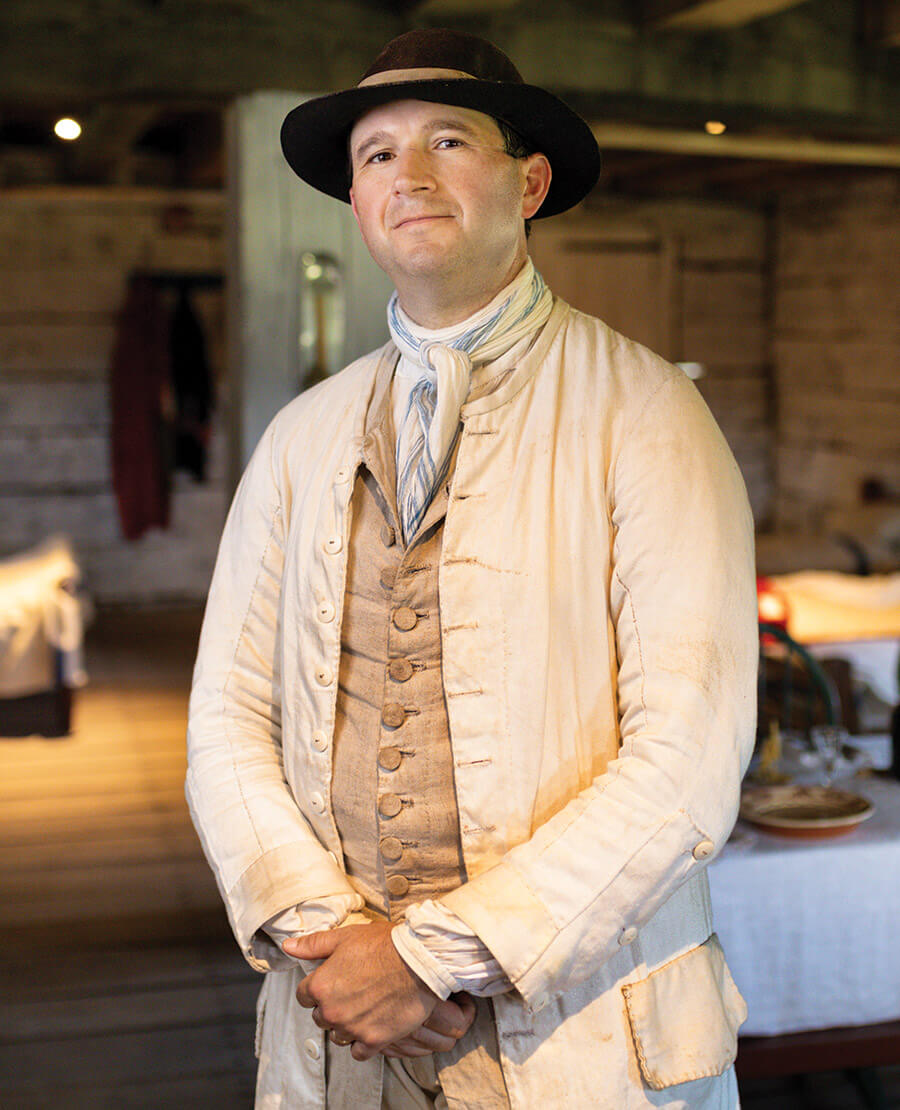
Former Site Manager Scott Douglas oversaw the fundraising, planning, and design of the replica of Fort Dobbs. He even helped hew some of the logs. photograph by Revival Creatives
To enter this faithful re-creation of a building constructed in this exact spot 270 years ago is to step back in time. A time when clothing consisted of petticoats and caps with lappets, shifts and stays, knee breeches and wrapping-gowns. A time when you could have been a cordwainer, a chandler, or a fellmonger. When kitchens would have held trammels and trenchers and long peels.
“When we lead guided tours, almost all of the time, it’s done by someone in authentic clothing,” says Scott Douglas, former site manager at Fort Dobbs. “It kind of helps you immerse into the environment itself and facilitates that time travel for visitors a little bit.”
• • •
Today, Douglas wears hemp trousers; a linen shirt, waistcoat, and jacket; a wide-brimmed felt hat; and a handkerchief wrapped around his neck. Around him, more than a dozen volunteers wear similar period clothing, most of which they researched and made themselves. The occasion is Historic Trades Day, a recurring event that allows Fort Dobbs staff to take visitors back in time to the Province of North Carolina, circa 1750s.
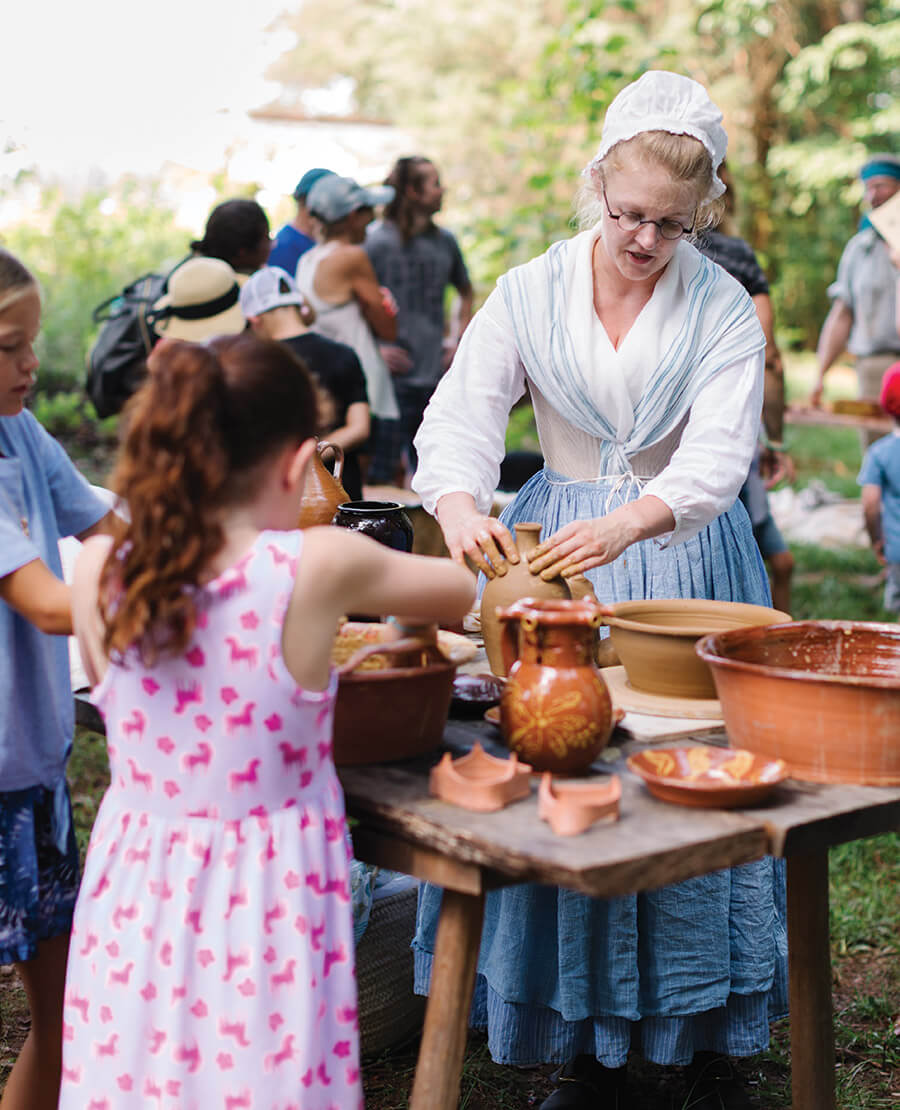
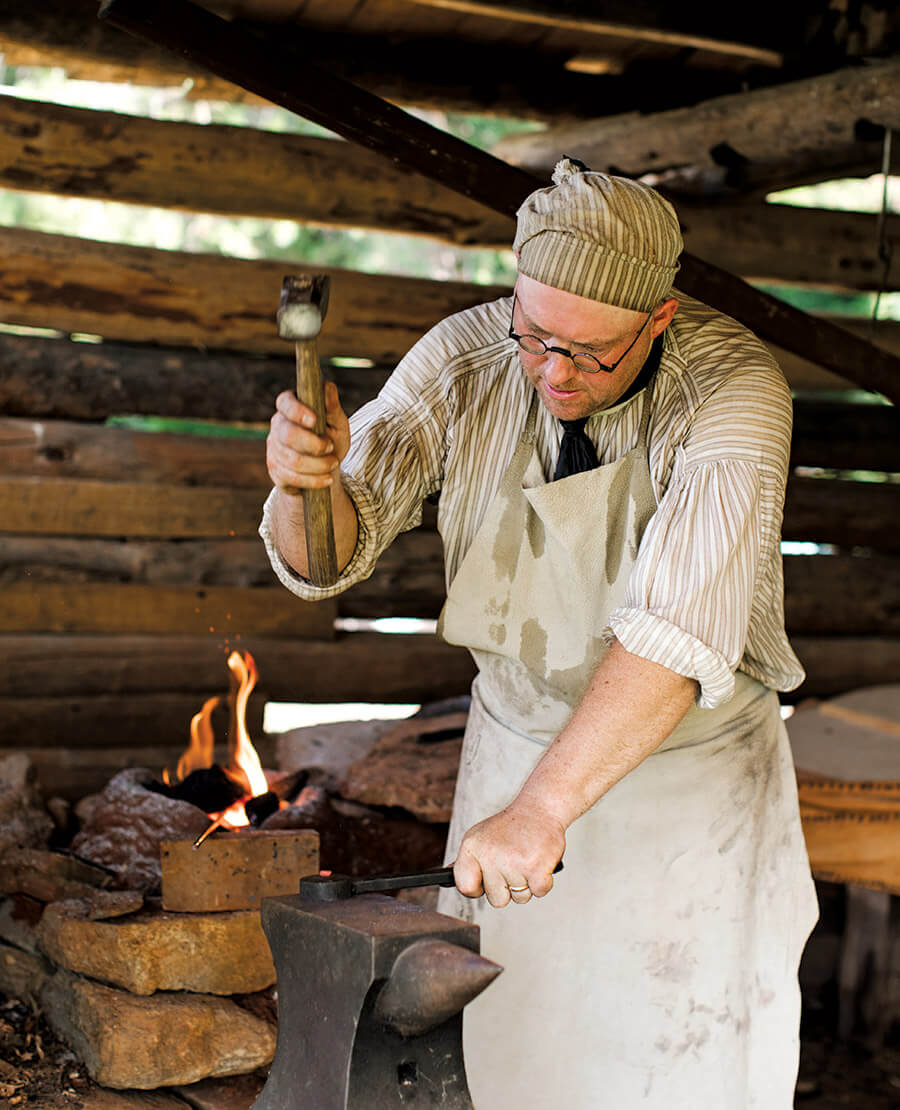
Across the fort grounds, these reenactors demonstrate the trades that were vital at the time. Here, a brickmaker uses a wooden form to mold bricks, setting them aside to bake in the sun. There, under a three-sided shed, a blacksmith labors over an anvil, hammering glowing iron into hardware. By an open fire, a chandler dips wicks into hot tallow and beeswax before hanging them to dry.
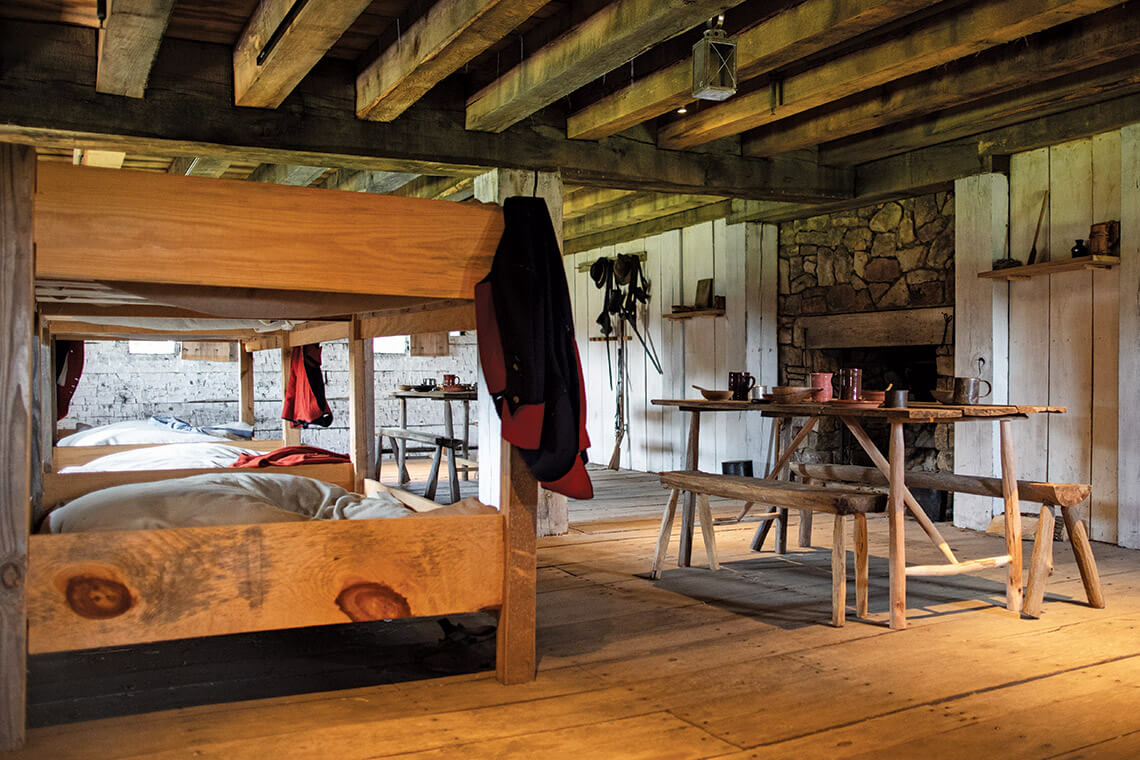
Inside the blockhouse fort, visitors can kick back on the soldiers’ bunks or take a seat at their table. photograph by Revival Creatives
Inside the fort, cordwainers fashion leather footwear with silver buckles. And everywhere you look, the accoutrements of an 18th-century fort jump out at you: Crockery and cookware piled on wooden shelves. Uniform jackets, haversacks, and waistcoats hanging from wooden pegs. Muskets leaning against walls. A storeroom brimming with barrels of flour, rice, and dried peas. Barracks stacked with soldiers’ bunks.
What you won’t see are signs saying, “Don’t touch.” Instead, you’re encouraged to climb into a soldier’s bed — the ticking mattress lofted with straw for the enlisted men, feathers for the officers — and try on an officer’s heavy wool jacket.
“Our visitors can interact with everything in the fort,” Douglas says. “It’s not a house museum where everything is behind a rope. It’s a big classroom, and it’s literally a way for people to get their hands on everything.”
• • •
The original Fort Dobbs was completed in 1756 as part of the British colonial defenses against raids by the Shawnee, allies of the French in what was also to become known as the Seven Years’ War. The fort protected the Fourth Creek Settlement, named for the tributary that flows into the South Yadkin River. The community of about 35 homesteads, a Presbyterian church, a store, and a tavern was a vanguard: the very edge of the western frontier. At the beginning of the French and Indian War, the British and Cherokee were on the same side, trading with one another, sharing resources, and fighting a common enemy.
On Historic Trades Day, former site manager Jason Melius is dressed as a middle-class businessman of the time, someone who would have had a license to trade with the Cherokee. Attired for hot weather, he wears a linen cap, shirt, and neckcloth over a dressing gown, checked trousers, and handmade leather shoes with brass buckles.
On Historic Trades Day, volunteers in period dress create a fuller picture of frontier life around Fort Dobbs with crafts like pottery … photograph by Revival Creatives
“The Cherokee were incredibly tight allies,” he says. “They’re tied economically at the hip with the colonies. The Shawnees were their ancient enemies, so that makes for a natural alliance.”
But it was not to last. A series of murders of Cherokee people — first by Virginia colonists and then by South Carolinians — frayed the alliance and ignited the Anglo-Cherokee War, essentially a second conflict within the French and Indian War.
Only one skirmish associated with this war took place at Fort Dobbs. A group of Cherokee people attacked the fort on the night of February 27, 1760, and were repelled by troops commanded by Col. Hugh Waddell. Unfortunately, the long-term consequences of the war were far more devastating for the Cherokee.
… and blacksmithing. photograph by Revival Creatives
The commanders of the two British armies sent on campaigns against the Cherokee knew the Cherokee weren’t responsible for starting the conflict. They wanted them back as allies and understood the best way to do that was to minimize the impact of the war. But things didn’t turn out that way.
“In 1760, they burned 10 Cherokee towns and all the associated food,” Melius says. “In 1761, they burned as many as 18 towns, and in that one campaign, they destroyed the homes and food of 5,000 men, women, and children.”
When the Cherokee signed a treaty to end the conflict in December 1761, they ceded vast tracts of land. The new line of demarcation between British colonial and Cherokee lands moved farther west, and by 1764, the frontier had moved some 70 miles, close to present-day Morganton, making Fort Dobbs obsolete. The fort was abandoned.
• • •
As the only North Carolina State Historic Site devoted to the French and Indian War, Fort Dobbs plays an important role in illuminating the lesser-known conflicts that live in the shadow of the American Revolution. But even more important, it showcases what life was like on North Carolina’s colonial frontier, from the clothing to the comestibles and beyond.
“In a big way, it’s a window into the larger story of the settlement of western North Carolina,” Melius says. “If you were to take a tour of the fort on a regular Tuesday through Saturday, a lot of the focus is the daily lives of the people. The soldiers. The civilians in the area. The Native people who interacted with the fort in hostile and friendly ways.”
From 2016 to 2019, craftsmen used oak logs and traditional techniques to reconstruct the fort that soldiers built on this site in 1756. A new 3,600-square-foot visitor center will open this spring. photograph by Revival Creatives
In fact, prior to the Anglo-Cherokee conflict, this was a place that was more about cooperation than conflict. Fort Dobbs showcases “the kind of interconnectedness of this world economy,” Melius says.
Yes, as remote as this tiny community was, it had a place in global commerce. At the time, deerskins were in high demand in Europe. The Cherokee hunted and traded deerskins in great volume. “Ninety-five percent of deer hides came from Native hands,” Melius says. “In 1765, Charleston exported 100,000 deer hides.”
In return, the Cherokee would have received items from across the globe: block-printed handkerchiefs from India, silk from China, linen and wool from England. Rum from Jamaica. Spices from the East Indies. Plus beads and ribbons and silver and tobacco. Powdered pigments, knives, axes, musket balls, and gunpowder. It was a veritable Walmart of the 1750s frontier — a world not nearly so isolated as it would seem.
That global connection is further highlighted by one of Melius’s favorite artifacts: “There were peach pits found in the cellar of the fort,” he says, referring to one of several archaeological digs that have taken place at the site. “Peaches are from China. And there are peach orchards all over North Carolina by the early 1700s because the Spanish had brought them in the 1500s, and the Native people spread them because they ended up loving them, too. It’s kind of a neat connection.”
Broadax and adze marks on the dovetail corner joints show age on the fort. photograph by Revival Creatives
For Melius, the peach pits connect us to our ancestors in a poignant way: “To me, that is the most human connection I can make with those guys who served here. You can kind of picture soldiers sitting out there on a hot summer day, eating peaches. And that is something any of us can sit out there and do to share that same experience.”
So we may never don a petticoat or knee breeches in our everyday lives. We may never walk a mile in our ancestors’ handmade shoes. But we can still enjoy a ripe, juicy peach. And in so doing, we can get a taste of life on the North Carolina frontier.
Split-rail fences don’t shout “keep out.” They lean, they shift, they invite. And in western North Carolina, they remind us that some lines are meant to hold, not harden.
Each May, spring climbs nearly 3,000 feet to the seat of Alleghany County. Here, as the rhododendrons blush, a beloved mountain town welcomes visitors with its food, art, and flourish of color and creativity.
Brief but delicious, soft-shell crab season is cherished by diners as well as the folks who work around the clock to put these native pinchers on our plates.



 Listen as the pages of the magazine come to life in the