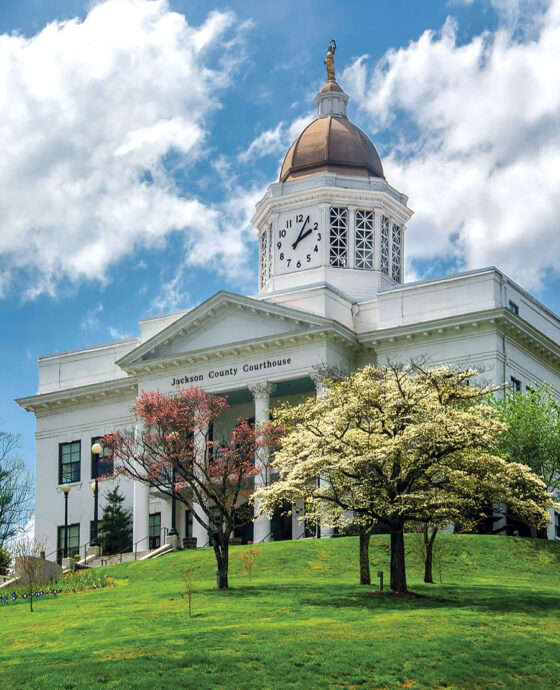
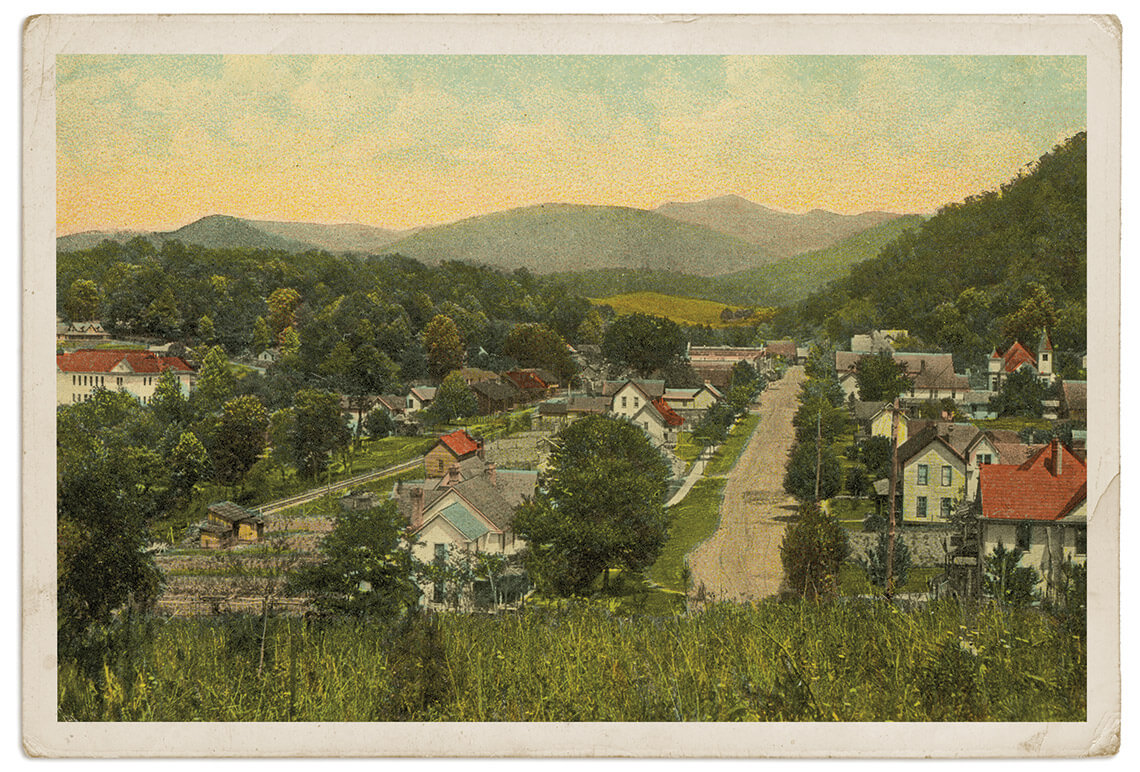
The Jackson County Courthouse has seen a lot in its 112 years, perched on a tall hill with its view overlooking Main Street. Like the time, shortly after its construction in 1914, when J.S. Higdon, the town’s first automobile dealer, drove a Model T Ford up the 107 steps leading to its doors. He wanted to prove to skeptical customers that the roadster could handle the area’s steep mountainous terrain. Sure enough, business picked up after his daring feat.
But the iconic building wouldn’t be here without C.J. Harris, who came to Jackson County in 1890 in search of investment opportunities. He and his nephew purchased the Carolina Clay Company and renamed it the Harris Clay Company. Then, he set his sights on making Sylva the place to be.
Photography courtesy of The Collection of Hunter Library, Western Carolina University
“Every little town in western North Carolina, it seems, had a big industrialist who kind of ran the show, and ours was C.J. Harris,” says Lynn Hotaling, former editor of The Sylva Herald and author of Sylva (Images of America: North Carolina). “He came here from Colorado because he was interested in mining. And then once he got here, he got interested in everything.”
Some residents wanted to move the Jackson County seat to Sylva from Webster because the Western North Carolina Railroad ran through town. Harris, one of the most outspoken of these “removalists,” promised that if voters approved the change, he would build a courthouse in Sylva. The vote passed, and construction began right away.
Following the courthouse’s construction, Sylva experienced a booming economy. Beginning in the 1920s, just about the whole of Jackson County came to town on Saturday mornings to shop and socialize. Before automobiles became popular, some folks from more remote areas would camp nearby overnight. Men would sit around, swap knives and tales of coon dogs, and chew tobacco while their wives shopped. If you needed to talk to someone, you would find them or get a message to them on Main Street on Saturday morning. This continued until the four-lane bypass to Asheville opened in the 1970s, facilitating travel to the bigger city.
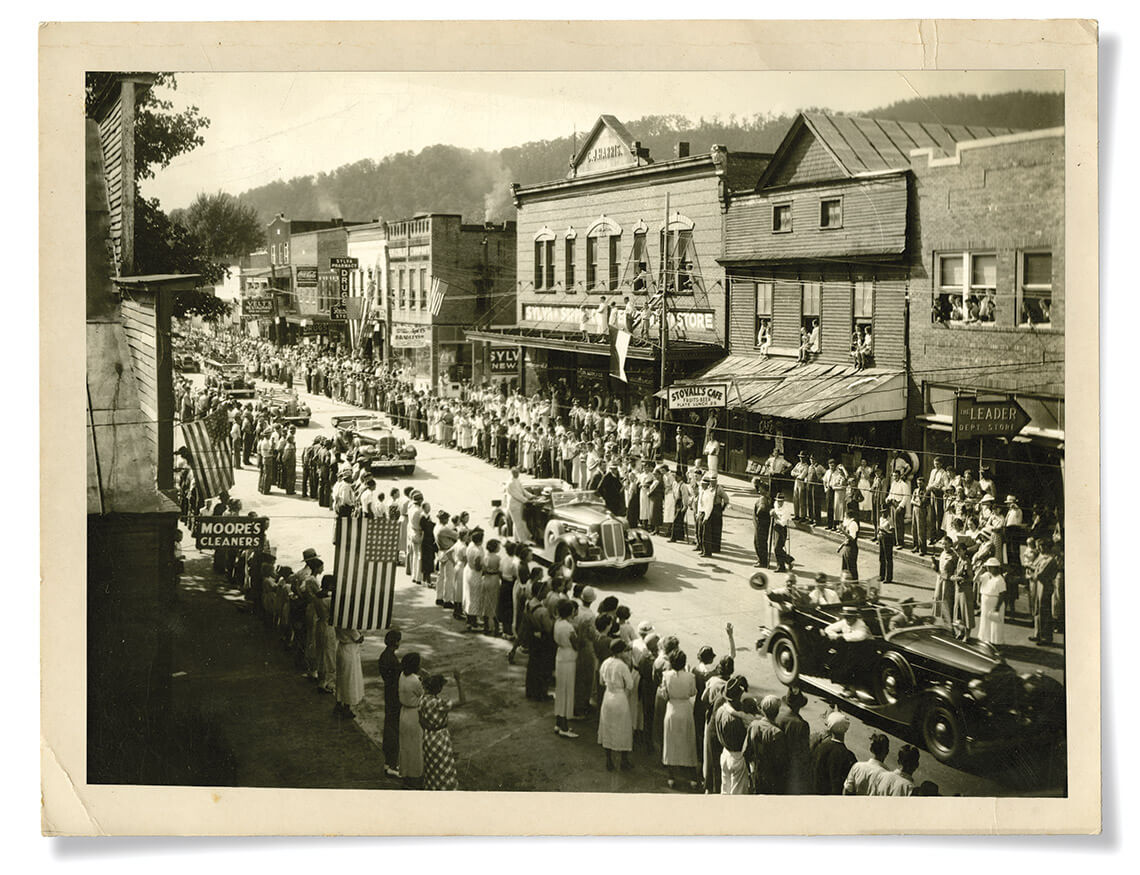
In September 1936, President Franklin D. Roosevelt — in the first car, tipping his hat — visited Sylva during a tour of Great Smoky Mountains National Park. Photography courtesy of The Collection of Hunter Library, Western Carolina University
In 1936, President Franklin D. Roosevelt came to town two months before his re-election. As many as 10,000 people lined the streets, stood on rooftops, and leaned out of windows to watch the president drive down Main Street. Many roared in excitement or threw their hats into the air, while others were so moved they couldn’t speak. But only one person, a young child, received the honor of shaking Roosevelt’s hand.
During World War II, stores on Main Street began closing on Wednesday afternoons so that shop owners and residents could go home and work on their victory gardens. When the war ended, there was a celebration downtown. “There must have been 10,000 people in the streets,” remembers Bill Crawford, a 90-year-old volunteer with the Jackson County Genealogical Society. “They was dancin’, hollerin’, and they was shootin’ guns, everything.”
Related: Click here to find out what to see and do on Main Street in Sylva.
print it