Charles Morton was sure of it: Aristotle was wrong, Morton figured in his 1703 essay. It was the moon that called to the swallows. Where else could the great flocks of swooping, chattering birds hide during winter?
Aristotle had announced that the swallows hibernated in holes, like hollow trees, but Morton held firm that they migrated to the moon. Or dove to the bottoms of lakes and rivers, wrote the Swedish archbishop Olaus Magnus, to hibernate in the mud. Carl Linnaeus and then Samuel Johnson agreed. The moon or the mud. Those were the top contenders. It was there that the swallows hibernated, clad in stardust or muck. Those were the only obvious choices.
Scientists, scholars, and poets have long been fascinated by the notion of hibernation, a type of dormancy that animals undergo when the temperatures plummet. They knew that winter is a challenging time for those who can’t huddle up to a fireplace hearth. Smaller animals struggle to keep their body temperatures regulated in a deep freeze. Snowy woods make travel a chore when your legs are only half an inch long. And a blanket of white offers little camouflage for a mouse under the watch of a hungry owl.
For all of us, this is the cozy time, the slowing-down time, the time of crackling fires and shearling slippers.
Larger creatures in colder climates, like black bears, may struggle to find enough food to sustain themselves. So they gorge during late summer and autumn, and then they hunker down. Which sounds nice, yes?
For all of us, this is the cozy time, the slowing-down time, the time of crackling fires and shearling slippers. We huddle, squinch, spoon, and cuddle. We hibernate under our covers and groan and complain when the alarm bids us arise. If only for an evening, or on a cold afternoon, we seek what quizzed the ancients and confounded the scholars: Rest and renewal. A long winter’s nap.
• • •
It’s always been a mystery how hibernating creatures pull it off. During hibernation, an animal goes into a sleep as deep as Rip Van Winkle’s 20-year power nap. Its heartbeat drops to just five or so beats per minute. Metabolism plummets. Body temperatures can cool to just above freezing in some animals.
Before hitting the sack, true hibernators pack on a layer of specialized fat called “brown fat.” Filled with extra heat-producing mitochondria, brown fat is pretty much like nature’s electric blanket. But deep hibernators can be pulled from their dens and remain listless and nearly motionless. Like a teenager on Saturday morning.
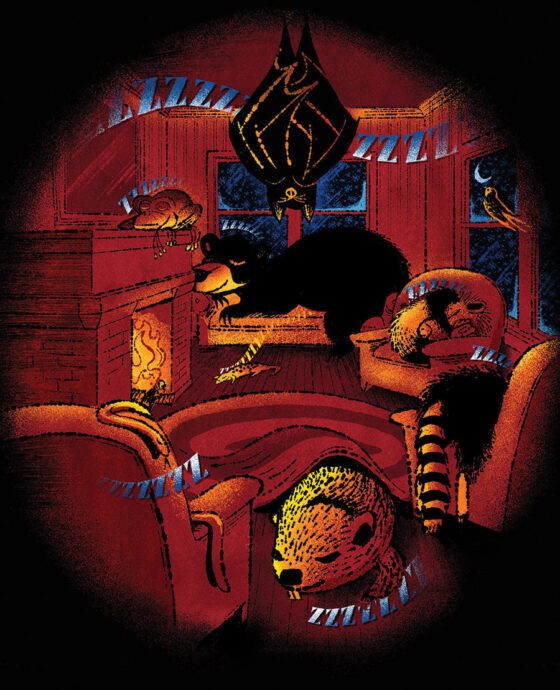
In relatively balmy North Carolina, only two animals truly hibernate: groundhogs and bats. And they hit the snooze button with vengeance. A groundhog’s body temperature can drop to as low as 37 degrees Fahrenheit, and it might breathe only a few times a minute. Bats crowd into mass hibernation sites called “hibernacula,” and these are probably not places you want to take the family.
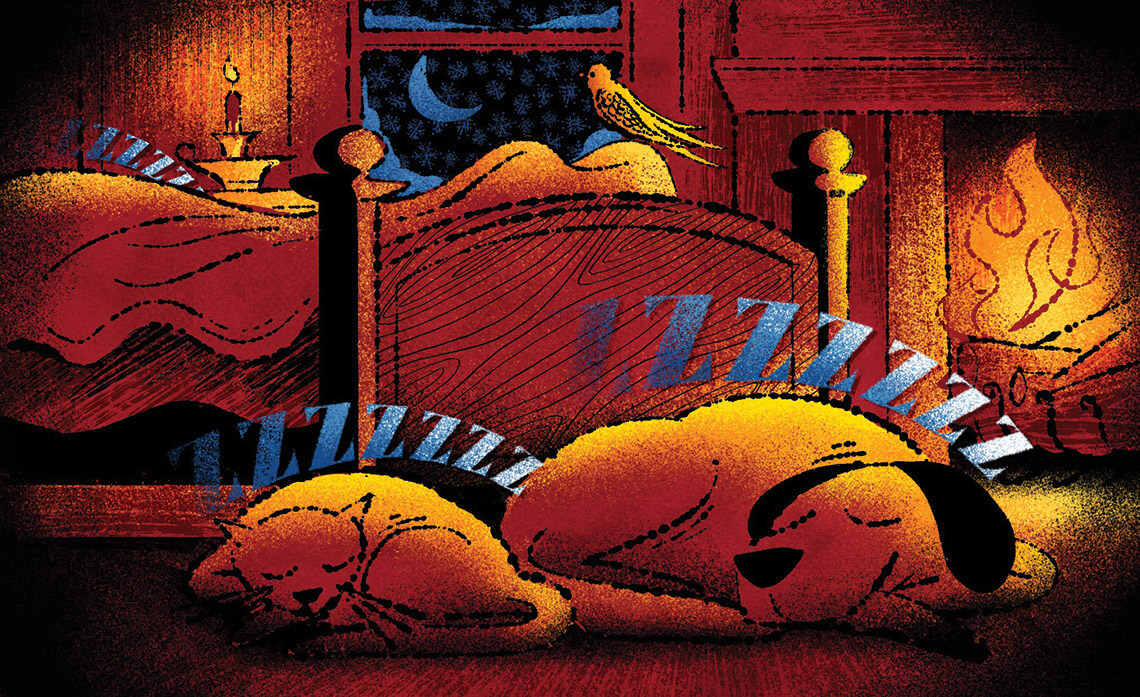
illustration by Ed Fotheringham
Bears, raccoons, opossums, and all the other North Carolina mammals that snooze during winter aren’t true hibernators, but they enter a period of torpor. Their heartbeat and respiration rates will fall, but not precipitously, and they can wake up more easily. They’ll still come out for a snack.
Reptiles and amphibians experience what biologists call “brumation,” which, to be honest, doesn’t sound like a lot of fun. Terrestrial toads burrow deep into rock cracks or dig below the frost line. Aquatic frogs pretty much just tough it out on the bottoms of ponds and creeks. During the coldest periods, a frog’s liver increases its payload of glucose, and the extra sugar in its body acts as an antifreeze, preventing the formation of ice crystals that would, sad to say, be the end of them. Wood frogs might be the toughest soldiers in the forest: They can freeze nearly solid. Brain activity and heartbeats can almost cease. But warm up that wood frog’s toesies in the sun, and it’ll spring back to life.
• • •
Compared to all that, we humans have it pretty easy. We moan about freezing rain and groan about a cold wind on our cheeks. There’s practically a cottage industry that’s grown up around forecasting wind chill, like we’d ever ride a bicycle down a wintry January street without clothes on. But it’s all better than freezing solid and hoping our cell walls don’t rupture. And brown fat sounds positively yucky, no matter how warm it might keep a winter critter.
So we don’t hibernate or brumate. We turn a bit sluggish. We retreat to places of comfort. Like a snoozing garter snake, we seem to lose touch with the outside world, although we will occasionally rise for a drink. This phenomenon of human response to cold weather has a widely accepted scientific name. It is called “Sunday afternoon football.”
Daylight is shortened, and sunlight is weakened. This is the lean time, and a mean time for many. A time of bare branches and sleet tinkling on the roof. Whether one hibernates, brumates, or simply goes horizontal on the sofa for a bit, it seems that the entire universe suggests we take it easy for a few months.
So bring on the heavy coats and thick fleece sofa throws. That old ragged sweatshirt, that favorite one you’d wear every day if your spouse would let you — it’s in a drawer somewhere. This is a time for rest and renewal and hot chocolate. If not for a winter, then for a long winter’s night.
Or for an hour or two until kickoff.
print it