 Listen as the pages of the magazine come to life in the Storytellers podcast showcasing the voices of Our State writers. Each podcast episode features a writer reading their column aloud, allowing each distinct voice to shine. Click below to listen to Sheri read her column aloud.
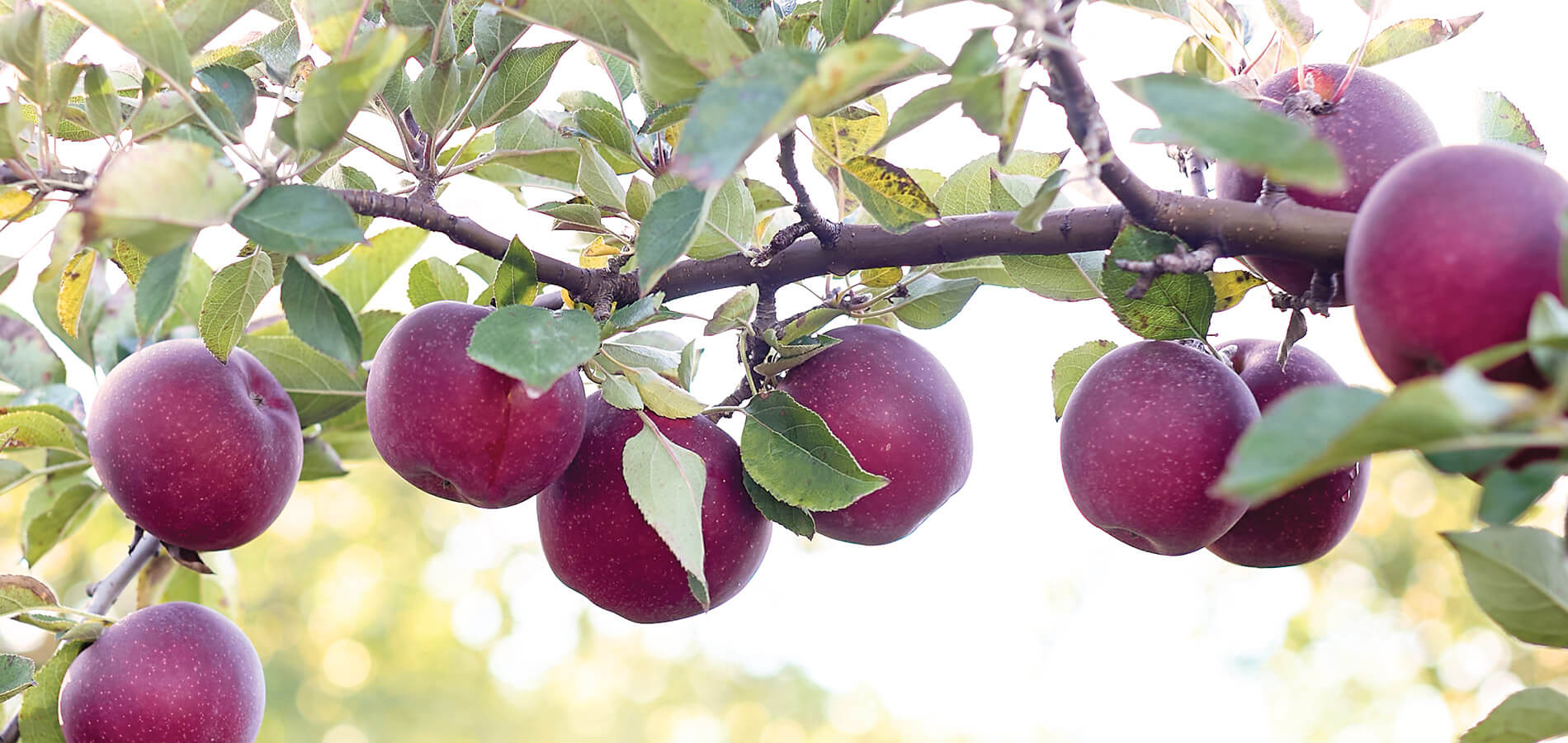
Starting in early summer, little pale apples called Transparents ripened on the three trees in front of my grandparents’ place in the Blue Ridge Mountains. Other types of apples came to fruition as their land just outside Boone eased into autumn. There were dark-skinned, striped, and russeted varieties — perhaps Limbertwig, Stayman Winesap, Magnum Bonum, or Rome. As many as a dozen different kinds of apples grew on those same three trees, like changing exhibitions in our tiny orchard gallery. When I was growing up, I thought that’s how all apple trees worked, somehow knowing how to produce any variety we needed at the right time, as though they could read our minds and recipe cards.
As a grown-up, I realized that the trees weren’t thinking ahead, but my granddaddy sure had been. Well before we picked apples, he’d picked out apples for us, making sure we had options for eating, cooking, and drying, as he searched for and found cuttings to graft onto the sturdy limbs of our well-established trees. I can still see him taking a knife (it might have been a special grafting knife, but knowing him, I bet it was his all-purpose pocketknife) to make notches in the rootstock and the scion, fitting them together like jigsaw pieces. He bound these arranged marriages into happy unions with black tape. He was literally adding branches to our family trees.
For all the hullabaloo over the tale of Johnny Appleseed, grafting is the true story of perpetuating apples. The seeds inside an apple do not produce more of that same apple; each seed is a wild card. To replicate an apple, someone must intentionally graft that variety from the tissue of a mother tree, which humans have known how to do for more than 2,000 years. Every named apple we have today exists because someone loved it enough to keep it and keep at it.
• • •
Once the apples came into the house, my grandmother took over their care and keeping. There was always an enameled dishpan of fresh apples available for snacking and baking. Long-keeping apples bided their time in wooden crates in the cool basement. She’d scatter apple wedges onto drying racks to transform into leatherlike crescents that smelled faintly of ripe fruit polished with beeswax. Some of those dried apples went into the hand pies she’d fry in a skillet. We’d hold out our napkins to receive them like a blessing, each one a golden-brown gift of fork-crimped buttery dough encasing the smooth, sweet, spiced filling.
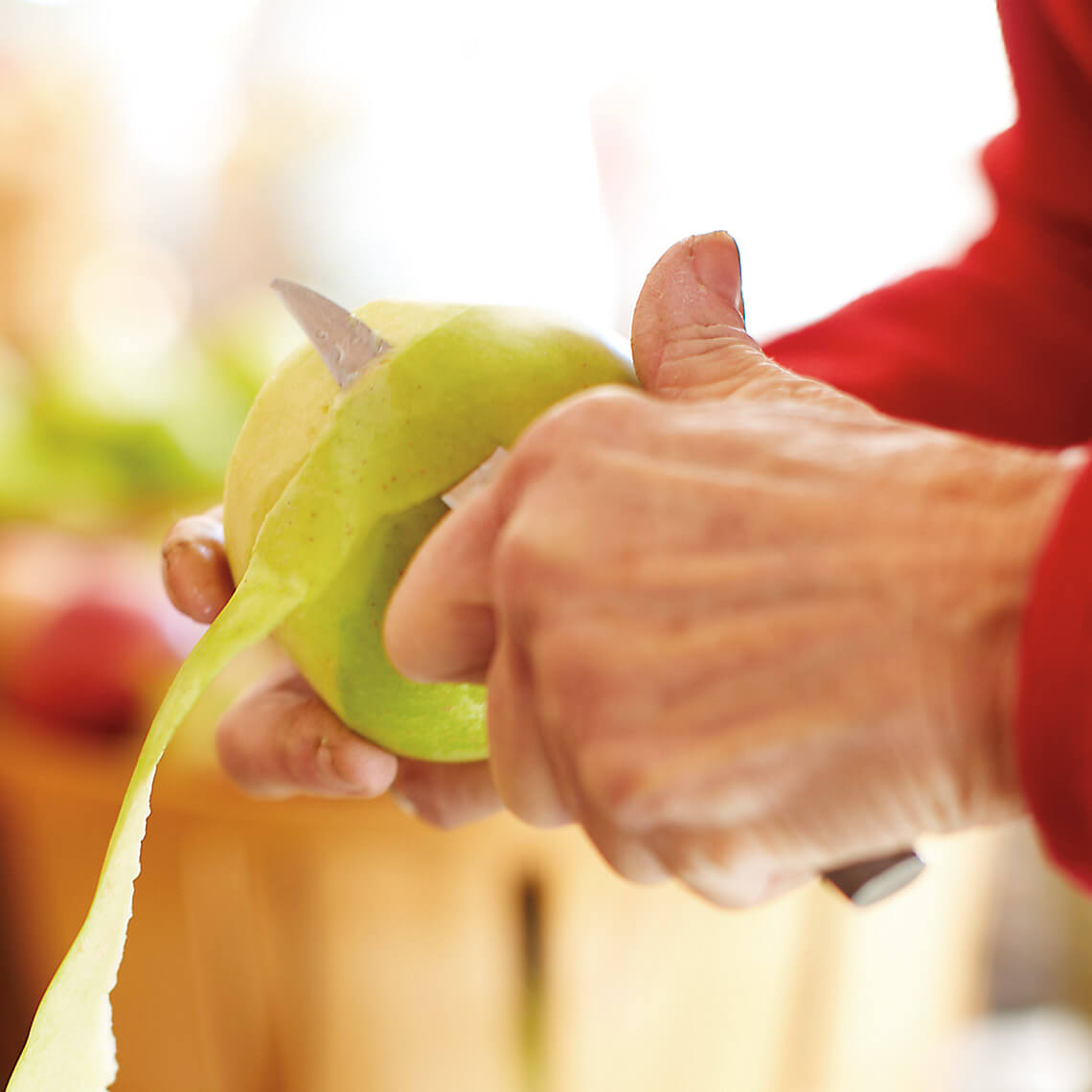
In some homes, the apple peeler isn’t a kitchen tool but rather a family member. In the author’s case, it was her grandmother, armed with only a paring knife. photograph by Stacey Van Berkel
My grandmother worked up bushels of apples using nothing but her all-purpose paring knife. Decades of use had custom-fitted its ebony handle to her grip like a ballplayer’s perfectly broken-in glove. The blade was worn as thin and curved as a scythe, sharpened on whetstones. Her knowing hands could quickly spin the peel off an apple in one continuous piece, like unspooling ribbon. She told me that if I dropped one of those long peels over my left shoulder, it would fall into and form the first initial of a true love. Little moony-eyed me thought she meant a person’s name, but as a grown cook and writer, I’m now looking to see the names of our local apples, especially our storied heirlooms.
North Carolina is apple country, among the best in the land. We must keep at it. We owe it to ourselves to keep falling in love with our apples, learning their names and ways, and tending our family trees.
Picking the Best Apples
The best way to identify the perfect North Carolina apples for a recipe is to ask the grower or seller, especially when seeking less familiar heirloom varieties. No one is more eager to guide you to the best choices. For pie, we want apples that have a sweet-tart balance, nice acidity, and good flavor retention after baking, and that will hold their shape when cooked without turning mushy, grainy, or mealy. Good apple choices for pie include Arkansas Black, Braeburn, Cortland, Ginger Gold, Golden Delicious, Granny Smith, Mutsu, Pink Lady, Rome, and Stayman.
photograph by Tim Robison
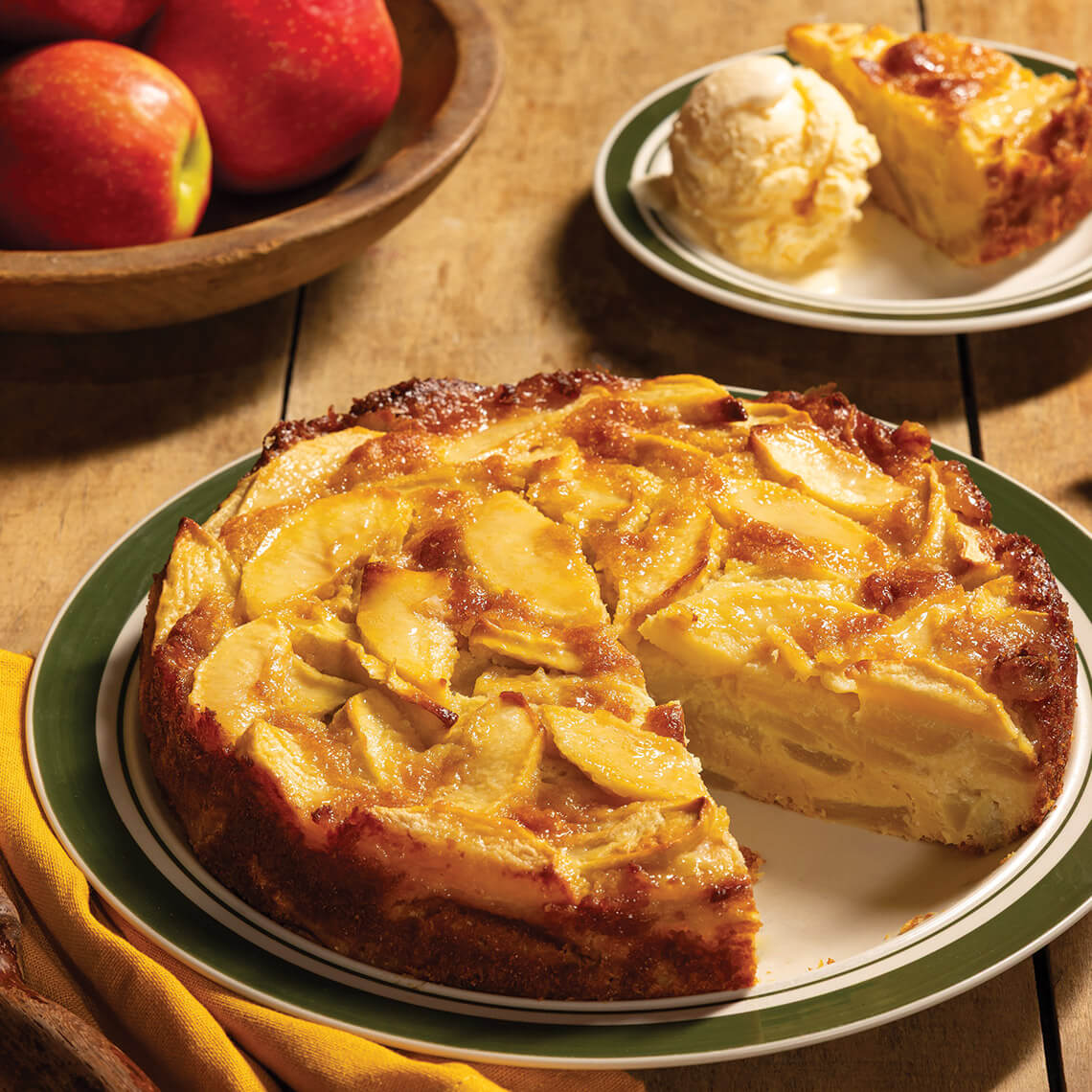
Apple Custard Cake
I call this a cake, but it reminds me of a custard-style apple pie baked without a crust. There’s just enough honey-kissed batter to hold the apple slices together. I first made a simpler version of this recipe nearly 25 years ago after seeing it in a Parisian cookbook. The author learned it from a woman who sold apples in a local farmers market, so she called the recipe “The Apple Lady’s Apple Cake.” I’ve made several changes over the years to Southern it up a bit. The most important tip I can share is to use a blend of North Carolina apples rather than any one single variety. Be sure to choose apples that are recommended for pie so that they’ll hold their shape when cooked instead of softening into sauce.
Yield: 8 servings.
Cake Base
½ cup all-purpose flour
1 tablespoon baking powder
¼ teaspoon fine sea salt
⅓ cup heavy cream
2 large eggs
1 large egg yolk
3 tablespoons granulated sugar
3 tablespoons honey
2 tablespoons unsalted butter, melted
2 teaspoons vanilla bean paste or vanilla extract
2 pounds mixed variety of sweet-tart baking apples, peeled, cored, and cut into thin wedges
Topping
3 tablespoons granulated sugar
2 tablespoons honey
1 large egg
3 tablespoons unsalted butter, melted
Position a rack in the center of the oven and preheat to 350°. Prepare a 9-inch springform pan with nonstick cooking spray.
In a large bowl, whisk together the flour, baking powder, and salt.
In another bowl, whisk together the cream, eggs, yolk, sugar, honey, butter, and vanilla bean paste until well-combined. Pour into the flour mixture and whisk until smooth. Fold in apples to coat them with batter. Pour into the prepared pan.
Bake in the center of the oven until the top sets and turns golden, about 30 minutes.
Quickly whisk together the sugar, honey, egg, and melted butter, then remove the cake from the oven. Pour the mixture evenly over the top. Return the cake to the oven and continue baking until the top is a deep golden brown, about 15 minutes more.
Let the cake cool in the pan on a wire rack for 15 minutes. Run a thin knife around the inside of the pan and then release and remove the outer ring. Let the cake cool to room temperature before serving.
print it