My wife, Tita, was at the kitchen window — making coffee, rinsing dishes, staring into the middle distance, something. Both boys were in the backyard. At first, she couldn’t make sense of what she was seeing, she says, when she tells the story now, years later. This was springtime, just after we’d started cutting the grass again for the season.
Our older son, Tomás, then 5, almost 6, was riding his bike back there in wide circles. We’d taught him as you do: in the park at the bottom of the hill, grassy slope, pedal fast, etc. But behind him that evening, in the yard? Our little one, Nico, just 3 years old, had somehow taken the training wheels off his own bike, taught himself to ride in the space of maybe 30 minutes, and was tucked in right behind his brother, free as can be. Tita called me at work. You won’t believe this, she said.
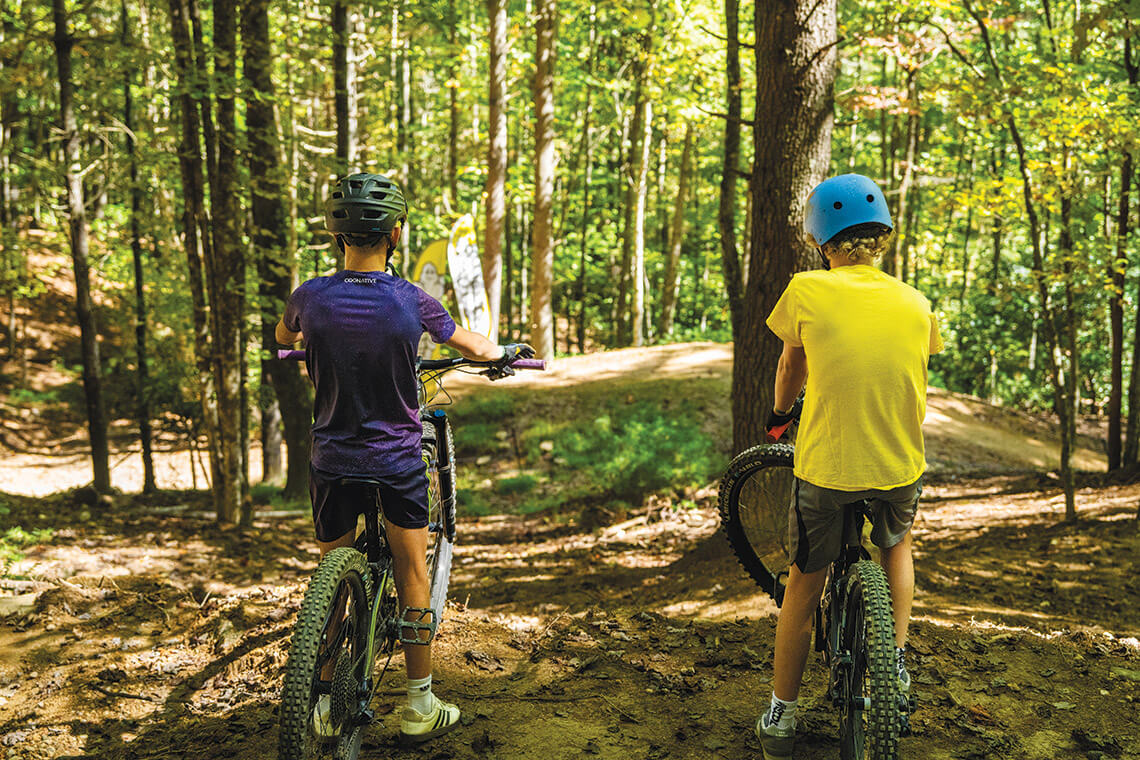
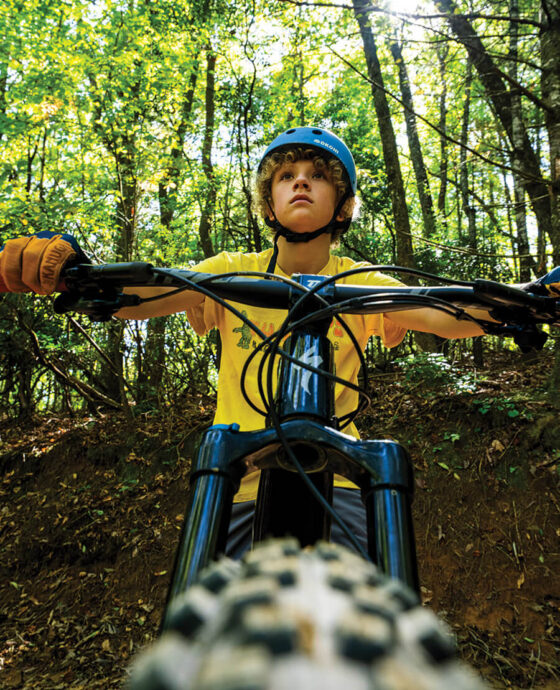
Tomás and his brother, Nico, like to start at the Skills Park, a warm-up area to practice some of the features found along the downhill trails on the mountain. photograph by Derek Diluzio
Except we were learning to believe it, even then. Both boys are cut from the go-fast-and-crash-into-anything cloth, but the little one carries that ideal toward performance art. He has surfed tropical storms. Skimboarded flash floods in the park. Ice skates, skateboards, snowboards. He won the pool’s Fourth of July belly flop contest two years ago. He won last year’s, too, with a soaring, twisting backflip that ended with him hitting the water — like a corpse, his older brother said gleefully, with all the tweens and teens in the pool roaring their approval.
Of late, though, it’s been bikes. Last spring, a used mountain bike from a shop in town. This spring, a brand-new full-suspension bike that far exceeded any birthday budget we’d ever considered, but that he agreed to help pay for. He’s had me take him to a local pump track — a hilly dirt track where, once you’re up to speed, you can complete laps without pedaling, just by “pumping” your body on the bike. We take him to trails both local and far-flung.
He was 12 last year. Thirteen now. You want a metaphor? Put a bigger kid on a bigger bike. Tell him sure, he can go ride in the woods. Don’t tell him to be careful. Tell him, instead, to be intentional, to make decisions on purpose. Watch him disappear. Hope like hell that he’ll be fine.
• • •
Or: mention that your childhood summer haunt, Camp Kanuga in Hendersonville, sends you emails all the time, and it now seems to lease land to something called Ride Kanuga, which is a downhill mountain biking course, something you did not really know existed. If you do not downhill mountain bike, or if you do not have a 12- to 15-year-old child who does, then just imagine a ski slope in the actual forest. Or you can look over your younger child’s shoulder as he obsessively watches YouTube videos that show 20-ish-year-old humans hurtling past trees and jumping off wooden structures, videos that make you say things like, Please promise me you’ll never do that.
So last year I took both boys to Ride Kanuga. I took them again in the fall, and I’ll certainly take them again this spring break. At some point during that first trip, Nico used the word “paradise.” His brother rode, too, a little more cautious, a little more prudent. I asked Nico to try his best to keep us out of orthopedic urgent care. He is, each time we’re at Kanuga, intentional, from what I can tell — often intentionally several feet in the air off what I’ve learned are called rollers. The boys usually start down on a little warm-up skills course, then move to a jump course, and then ride way, way into the woods, into the park.
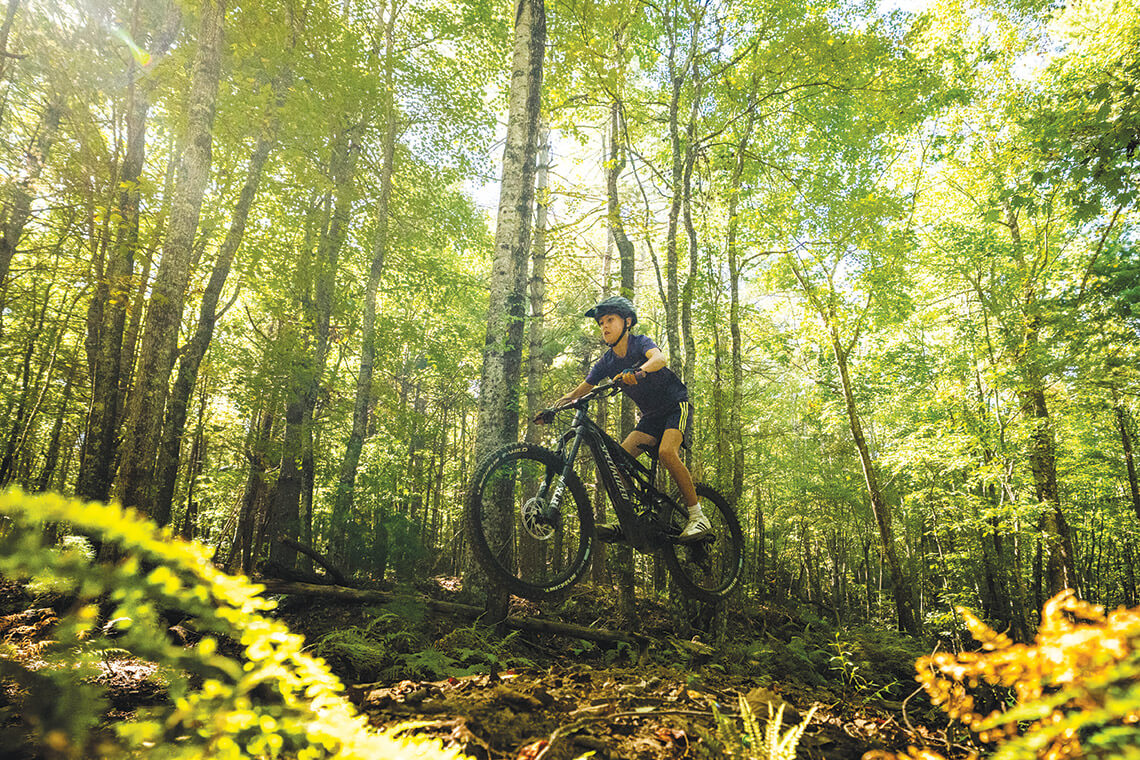
Along with his mountain biking skills, Nico has picked up the lingo: If he hits a jump perfectly, he “dialed” it. Rough, technical terrain is “chunky.” To master a difficult element without hesitation means he “sent” it. photograph by Derek Diluzio
The downhill courses are pedestrian-free zones, which means you don’t get to watch your kid try to maim himself. Each time, they pedal across the road and vanish. “How long does it take to pedal up?” I asked at the shop. “Takes me 20 or 30 minutes, depending,” the shop dude said, which means my guys are usually gone for almost an hour before I see them again, red-faced and delighted. They eat snacks and drink a gallon of water apiece. They disappear again.
During our first trip, a day camp showed up. I didn’t ask many questions of the two counselors, who were both, impossibly, named Walker, because I was trying to be invisible, trying to read my book and hope my boys, up the hill, were still OK. The camp was filled with kids my kids’ ages, and it was hard not to take what was happening as a conversation the universe was trying to have with me. The Walkers disappeared and the campers went feral, laughing and racing a souped-up RC car across the parking lot and talking unencumbered, because I was invisible, about all manner of things you hope your 12- to 15-year-old might not be talking about yet.
Does downhill mountain biking turn your kid kind? Is this what growing up looks like?
Except. Except that while they talked about whether they’d ever snuck any adult beverages (maybe) and whether they’d ever done X or Y thing with another human (maybe), they were also getting out their lunches and discovering that the way the picnic tables were set up meant they couldn’t all sit together. And what they did next, friend, is both impossible and true, and it is the thing you don’t even dare to hope for from your tween: They rearranged the picnic tables into one long table, and the kid who’d been shuffled out and silent sat down in the middle of everyone, and it was the kindest thing I’ve ever seen in my life.
My boys came back down the hill and promptly folded themselves into the camp, and soon my kids and the camp kids were jumping off an eight- or 10-foot ramp onto a giant inflatable thing, and The Walkers were shouting WOOOOOOO while lying on their backs on the ground, and everything was somehow very dangerous yet very safe at the same time. There was my 12-year-old way up in the air, E.T.-style, and there was my 15-year-old telling a scared kid that he was scared, too, at first, and if he does it again, will the kid try it? Does airborne downhill mountain biking turn your kid kind, turn him into the type of kid you always hoped he’d become, or has he been this way all along? Is this what growing up looks like?
• • •
The Walkers asked who wanted to go up the hill one more time, and everyone did, and there they all went, gone again, and I was alone at the picnic tables, thinking about how old they all seemed, yet how young at the same time. How this age is all about becoming something, about finding out who you’re trying to be. It’s beautiful every time, a breeze in the trees and that rhododendron-pine smell I remember from having basically grown up not even a mile from here, coming to Kanuga every summer and sitting under the stars, talking about how scared of it all we all were, how excited, how hopeful, how alive.
My guys were sorry to be late, they told me in the parking lot that first time, but everybody stopped to help the kid who crashed bend his handlebars back into place. In town, at a barbecue food truck, they ate lunch at 5 o’clock because they could not, would not leave Ride Kanuga. In the car on the way home, their sentences were filled with jargon, all about the flow and the tech and which jumps they “dialed” and which ones they “cased,” and they wanted to know how soon we could go back. Soon, I told them, thinking of all the times other kids might not rearrange the lunch tables as they move through the coming years.
But maybe they’ll surround themselves with ones who will. With kids who will stop on the trail to help. Maybe they’re learning that — from the Walkers of the world, I hope, but also from each other. Maybe our 12- to 15-year-olds, these kids who were once so, so small, will go off in the woods with no adults around and figure it out on their own. They certainly did again last fall, and Nico’s been riding all spring this year, going a little farther afield each time.
print it