The boy spent his rare moments of idle time on his family’s 40-acre farm traipsing through the garden behind his mama’s house. Skipping amid tomato and okra plants, he’d spot patches of crabgrass, snap up one of the long, jointed stems, put one end between his teeth, and pull the other end taut. When he plucked it with his right hand, its reedy twang sounded to him like nature’s symphony.
Earl Scruggs heard music in everything around him: The percussive patter of the plow handle that he gripped while tilling cotton fields. The rat-a-tat-tat of hooves clomping on hard ground as he rode a mule-drawn buggy from the family home in Flint Hill, just southwest of Shelby, to nearby Boiling Springs. The rhythm in the rumble of a motorcar whizzing by, perfectly synchronized with the hum that the tires made as their treads connected with grooves in the road.
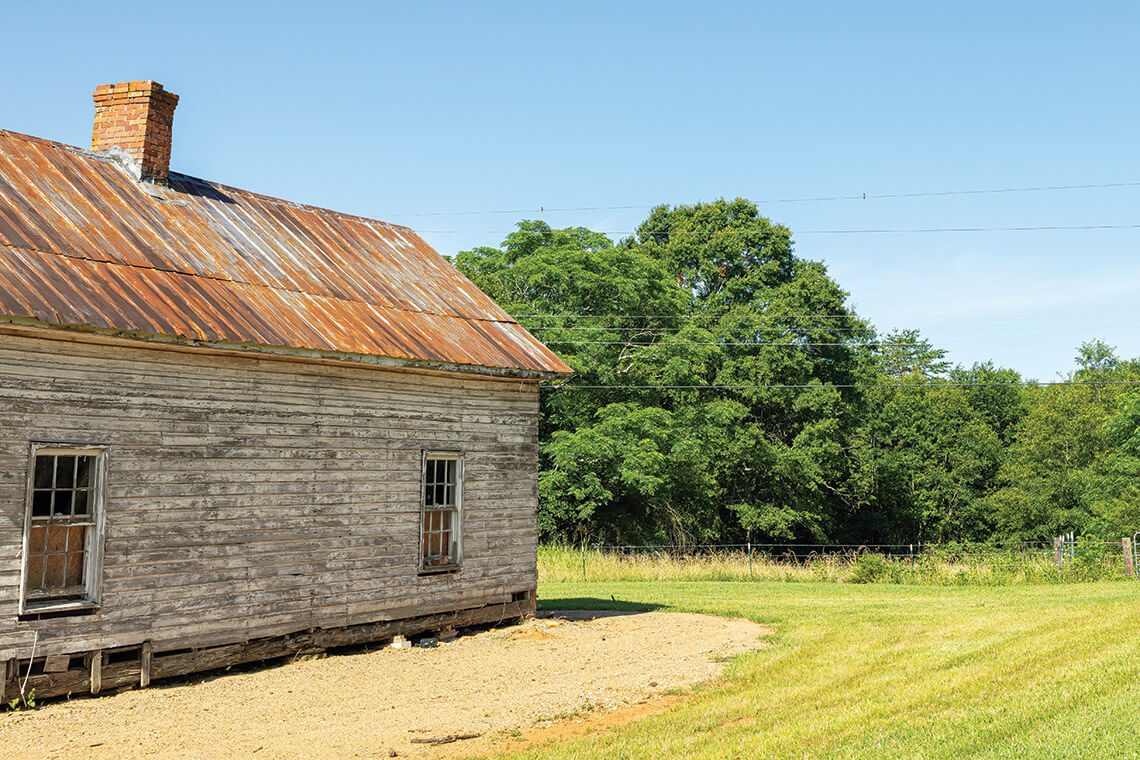
When touring through North Carolina, Scruggs would drive past his childhood home in Flint Hill, just to see it. photograph by Tim Robison
“In other words, it was difficult for me to keep my mind on the chores I was into,” the pioneering banjo picker wrote many years later in his private journals. “Anything that would make a sound as a musical tone was experimented with.”
The tin top of a snuff can. The edge of a knife. A stiff seam in his overalls. The dial on a rotary telephone.
“Give me a job to do,” he wrote, “and I would still find something to pick on.”
• • •
On a stormy morning, I’m navigating the twists and turns of Maple Springs Church Road in southwest Cleveland County, searching for the sounds that fired Scruggs’s imagination. Thick pockets of dense white mist blanket the valleys, creating dangerously low visibility. As I drive, a pair of classic songs by Flatt & Scruggs and the Foggy Mountain Boys blare from my speakers: “Flint Hill Special” and their most famous tune, “Foggy Mountain Breakdown.” The latter instrumental provided the soundtrack for the nail-biting chase scenes in the 1967 film Bonnie and Clyde.
Cruising along this rural rollercoaster, I feel the inspiration in Scruggs’s picking: The turn of his banjo tuner throughout “Flint Hill Special” sonically mimics the sharp bends in the road. The steady churn of “Foggy Mountain Breakdown” simulates the straightaways as my car tops a hill, nearly lifts off the ground, and then dips down again into a foggy valley.
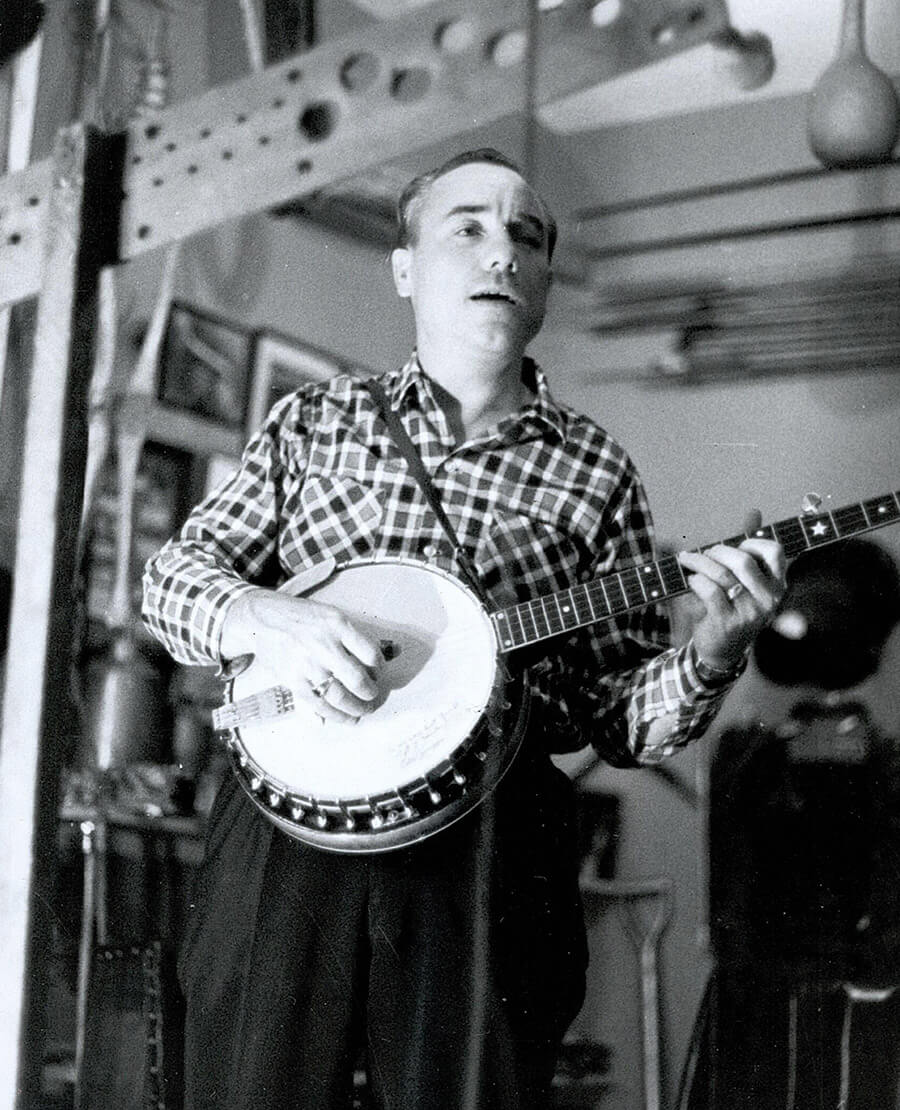
Earl Scruggs Photography courtesy of Earl Scruggs Center
Just before the turnoff to Riverside Road, past sprawling farmland, sits a house with a green roof. This is where Earl Eugene Scruggs was born on January 6, 1924. About half a mile down Riverside, I pull into the gravel driveway of a smaller house. This is where Scruggs lived from about age 7 to 17. His grandfather owned much of the land in this farming community, and young Scruggs was intimately familiar with every house and barn, every field and patch of woods, every creek and river. It’s pretty much all Scruggs knew until he left Cleveland County four years later for Nashville, where, along with mandolin player Bill Monroe, he’d set the template for the lightning-speed banjo picking that defines the sound of bluegrass music.
I’ve come to his childhood home to meet with Mary Beth Martin and Zachary Dressel, executive and assistant directors, respectively, of the Earl Scruggs Center in nearby Shelby. We briefly huddle on the front porch as a hard rain batters the rusted tin roof. It sounds like the steady white noise of the machines that Scruggs heard inside Shelby’s Lily Mill, where he worked as a teenager for 40 cents an hour. Inside the house, a massive brick fireplace is the centerpiece of a dark front room.
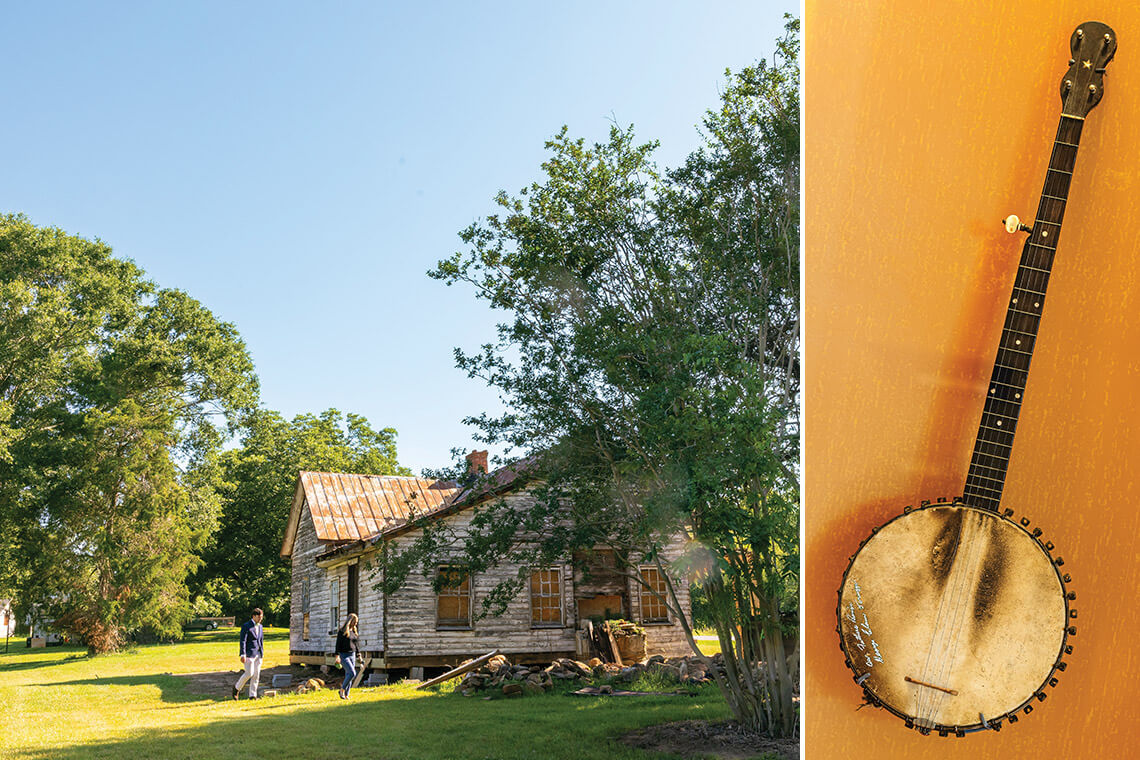
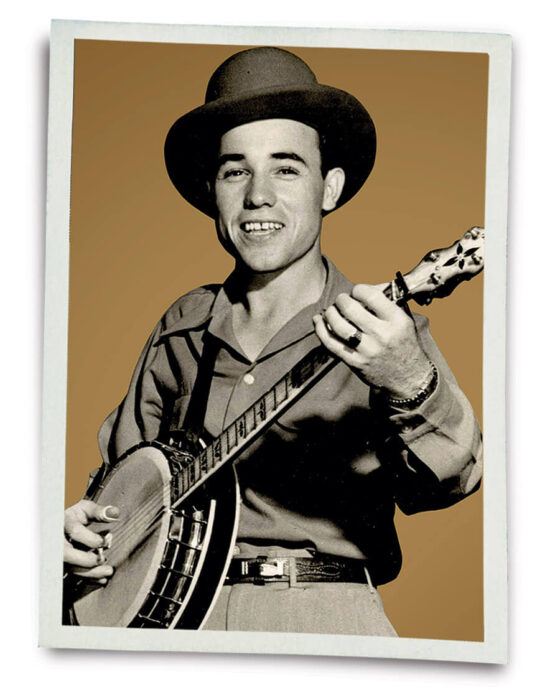
A young Scruggs taught himself to play on his father’s banjo (right) in the family home near Shelby. photograph by Tim Robison

Mary Beth Martin &
Zachary Dressel photograph by Tim Robison
“Right there,” Martin says, pointing to a spot in front of the fireplace. “That’s where Earl, as a child, learned to play the three-finger style of banjo picking that he’d become famous for.”
I think back to the first time I heard Scruggs play live, at a 1976 festival in Galax, Virginia, as part of The Earl Scruggs Revue with his sons Gary and Randy. I think back to the hazy days of my childhood, stretched out on the couch in my family’s front room, watching The Beverly Hillbillies and singing along to the show’s banjo-fueled theme song recorded by Flatt & Scruggs. I think back to those chase scenes in Bonnie and Clyde — the reeling and churning of Flatt & Scruggs’s banjo, guitar, and fiddle as the notorious Barrow gang careens down dirt roads, their 1934 Ford sedan fishtailing around curves as they try to escape the police.
This is where it all started. Right here in this room. This is where the sounds that Scruggs heard on the farm and in his head transformed into one of America’s most recognizable original musical forms.
• • •
Banjo pickers in this part of North Carolina had long been experimenting with ways to adapt the African-derived rhythm instrument to old-time mountain music. Snuffy Jenkins, born just 17 miles west of the Scruggses’ farm, was one of the earliest progenitors of the three-finger picking style. But it was Scruggs who perfected the technique, learning to make sounds with his fingers that no one had heard before. It became known as the “Scruggs Style” and was copied by nearly every subsequent bluegrass banjo player.
In the mythology of American music, bluegrass was invented by Bill Monroe, who, in 1938, named his band the Blue Grass Boys in honor of his home state of Kentucky. His distinctive high-pitched tenor voice and blend of Black and white musical styles — country gospel, Scots-Irish folk, blues, and African American spirituals — set the group apart from other “hillbilly” bands.
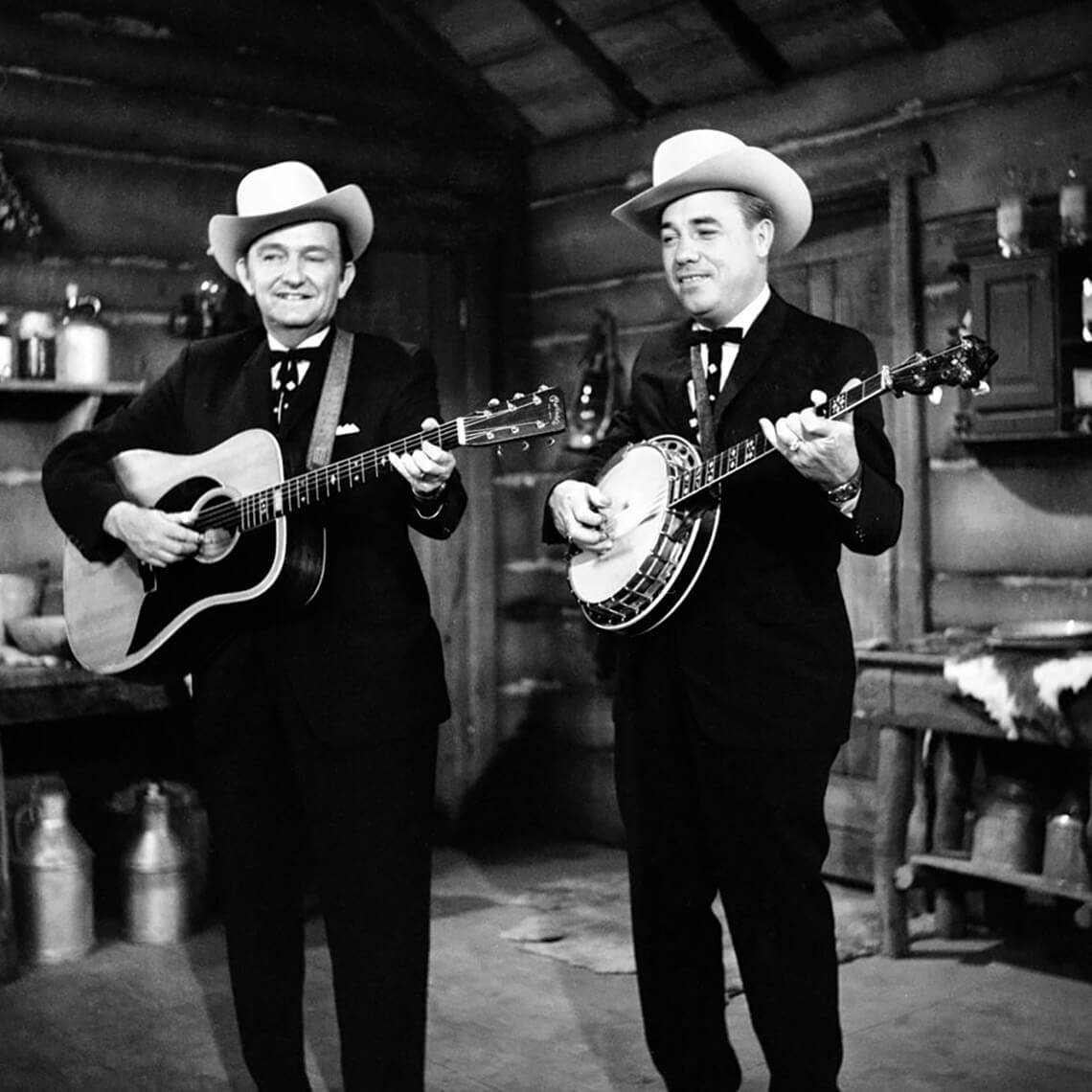
Scruggs (right) and guitarist Lester Flatt both played with Bill Monroe’s Blue Grass Boys before breaking off in 1948 to form Flatt & Scruggs. The duo recorded and performed together — including on The Beverly Hillbillies — for two decades before parting ways. photograph by CBS Photo Archive/CBS/Getty Images
But bluegrass as a distinct genre likely would not exist had Scruggs not joined Monroe’s band in 1945. What this 21-year-old from the foothills of North Carolina brought to the mix was a wholly original banjo style. His breakneck picking gave the band’s music a sharper, more muscular and urgent sound — a contrast to the comparatively laid-back fiddle sawing and clawhammer-style banjo strumming of the typical string ensembles of the day. Scruggs’s rolling, three-finger style on Blue Grass Boys recordings like “Heavy Traffic Ahead,” “Molly and Tenbrooks,” and “Blue Grass Breakdown” did for old-time Appalachian banjo what Jimi Hendrix’s squalling licks would later do for rock ’n’ roll guitar. Without having to plug into an amplifier, Scruggs’s fiery solos electrified the band.
Scruggs only lasted two years with Monroe before he and guitarist Lester Flatt set out on their own. In 1949, the duo recorded “Foggy Mountain Breakdown” as a single and hit the road, building their reputation by playing local events and doing live radio appearances across the South. While on tour, Scruggs grew nostalgic whenever the duo found themselves traveling through North Carolina. “When his tour bus was coming through this area,” Martin says, standing next to a window in the front room of the old house, “he’d sometimes drive by here just to look at the homeplace.”
• • •
Throughout the ’50s and ’60s, Flatt & Scruggs were so forward-thinking in their approach to old-time music that younger rock musicians took note. Bands like The Byrds and the Nitty Gritty Dirt Band had started to experiment with country and bluegrass, and the energy and edginess of Flatt & Scruggs’s sound appealed to them.
But in 1969, in the thick of the duo’s most successful years, Flatt and Scruggs parted ways. Flatt, always more of a traditionalist at heart, wasn’t happy with the direction their music was taking and chose to go solo. Scruggs, hungry to keep experimenting with new sounds, formed The Earl Scruggs Revue with two of his rock-loving sons, then 20 and 16. “One of the biggest thrills a person will ever get is to go onstage with his children,” he told NPR many years later, adding that his sons “knew younger people’s material.”
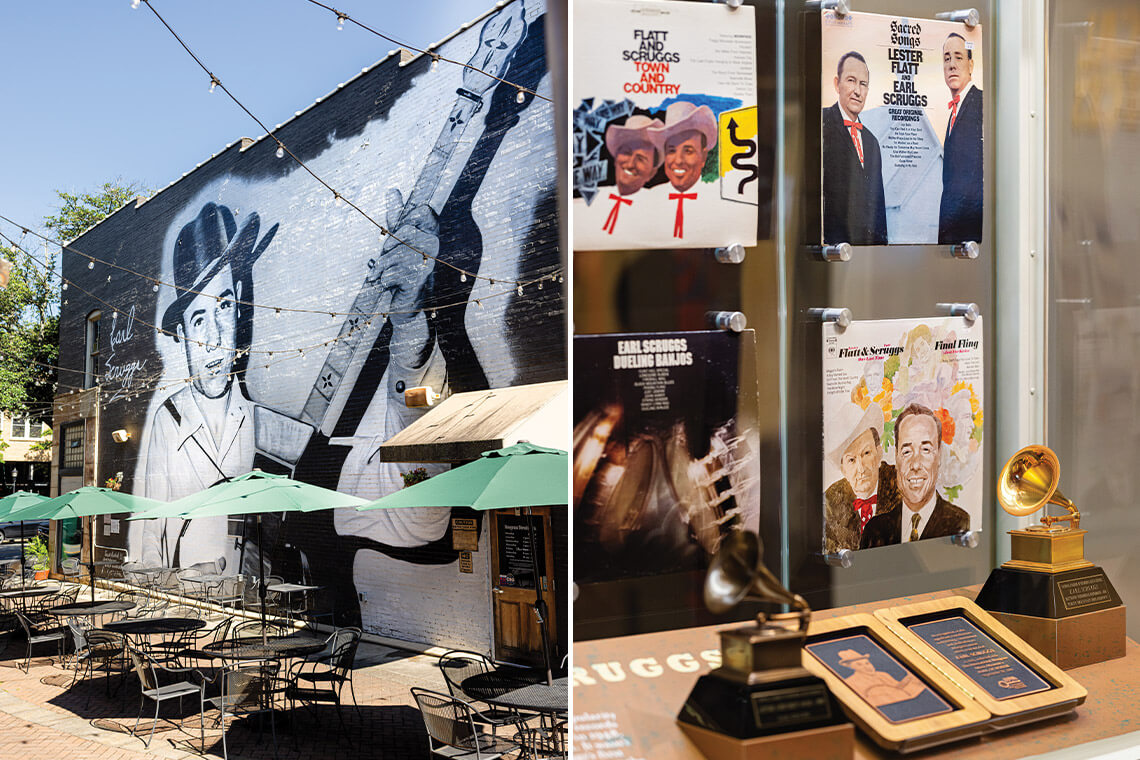
Scruggs left his mark on bluegrass music — and on his native Cleveland County, as seen on display at the Earl Scruggs Center (right) and Newgrass Brewing (left). photograph by Tim Robison
Earl Scruggs’s banjo photograph by Tim Robison
Scruggs continued listening for new sounds and collaborating with younger musicians well into the 21st century. And on September 13, 2006, he got the opportunity to watch and listen to hundreds of those musicians honor him before an Atlanta Braves game: 239 banjo players from around the world — each heavily influenced by the Scruggs Style — gathered at Turner Field to perform “Foggy Mountain Breakdown” in unison. It was a twang the likes of which Scruggs had never heard before. During the tribute, a camera zoomed in on the 82-year-old as he smiled bashfully and waved. The hundreds of banjos performing his most famous tune earned a Guinness World Record for “Largest Musical Instrument Ensemble.”
A handful of years later, Travis Book of progressive bluegrass band The Infamous Stringdusters saw Scruggs play one of his final gigs before his death in 2012 at age 88. As he listened, Book’s mind drifted back to all the different sounds Scruggs had introduced to American music over the previous six decades. He was awed by the musician’s never-ending innovation, even in the face of pushback from old-time music purists. “It was not necessarily the easiest career path for him to take,” Book said in a WNCW radio documentary about Scruggs. “Any artist that continues to sort of push and progress, especially after these really distinct moments of success like he’d had … I thought that was really cool and very inspiring and very brave. I feel like I learned a lot watching that show about what it meant to be fearless and to follow the sound that you hear in your head.”
• • •
Driving away from Scruggs’s old homeplace, the rain tapers down and the clouds dissipate, replaced by sunshine and blue sky. The fields look greener now, richer and full of life. I think of something Scruggs said in 1996 after being honored with a state heritage award: “My music came up from the soil of North Carolina.” The words reverberate in my head as I cruise into Shelby’s downtown, where a mural of the musician covers an exterior wall at Newgrass Brewing Co.
A block and a half up Lafayette Street stands the old Cleveland County Courthouse, transformed in 2014 into the 10,000-square-foot Earl Scruggs Center. The museum traces the banjo pioneer’s life from his humble beginnings to his superstardom to his twilight years.
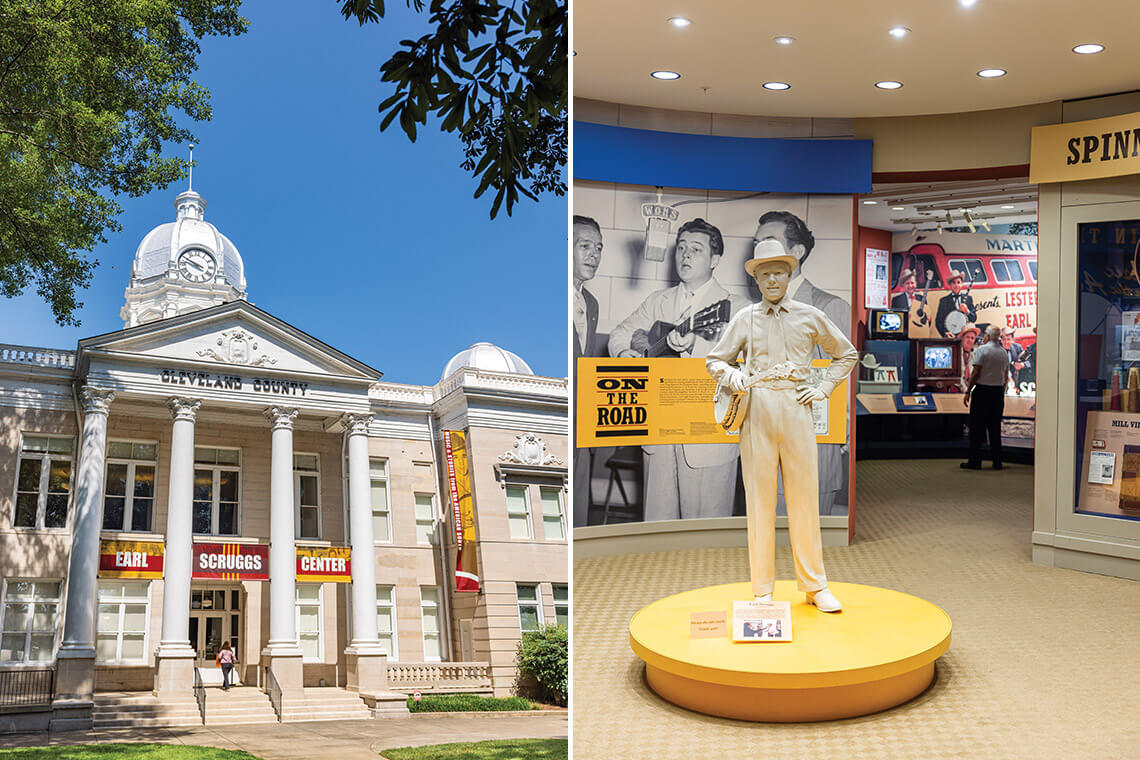
Inside the former Cleveland County Courthouse, the Earl Scruggs Center interprets the history of Earl Scruggs and the culture around where he grew up. photograph by Tim Robison
Dressel, who curates the museum, opens to the pages in Scruggs’s journals where he had jotted down memories of those sounds he heard growing up: as a farm kid, plucking on that blade of grass; as a teen, hearing the hum of the spinning, twisting, spooling, and reeling of fibers into yarn at Lily Mills; in his 20s, jamming with friends in Shelby and weighing whether or not he could afford to leave his family and enter show business professionally. But a single scribbled line with a misspelling pops out to me as if it’s highlighted in bright yellow. It suggests that the course of Scruggs’s life was inevitable, that his fate had been sealed from day one. “Annilising my life, I suppose one way I could describe it,” he wrote. “I was born ‘addicted to picking.’”
Earl Scruggs Center
103 South Lafayette Street
Shelby, NC 28150
(704) 487-6233
earlscruggscenter.org
print it