Ronnie Buff always has the best seat in the house, and he always will. On a hillside located 11 miles southwest of Shelby and only a few minutes above the South Carolina state line — that is, if you adhere to the speed limit — sits a simple gray stone cemetery bench engraved with bold lettering that reads, simply, “BUFF.” The seat is fenced off and adorned with a pile of flowers that are replenished every weekend.
As the sun begins to settle into this valley that sits at the very beginning of North Carolina’s western rise into the Appalachians, it throws a bright yellow tinge onto the trickling waters of a bordering creek. A cardinal sings. You can hear the bustle and laughter of parishioners gathered beneath the steeple of Flint Hill Baptist Church in the distance.
It’s all so peaceful. Until it isn’t.
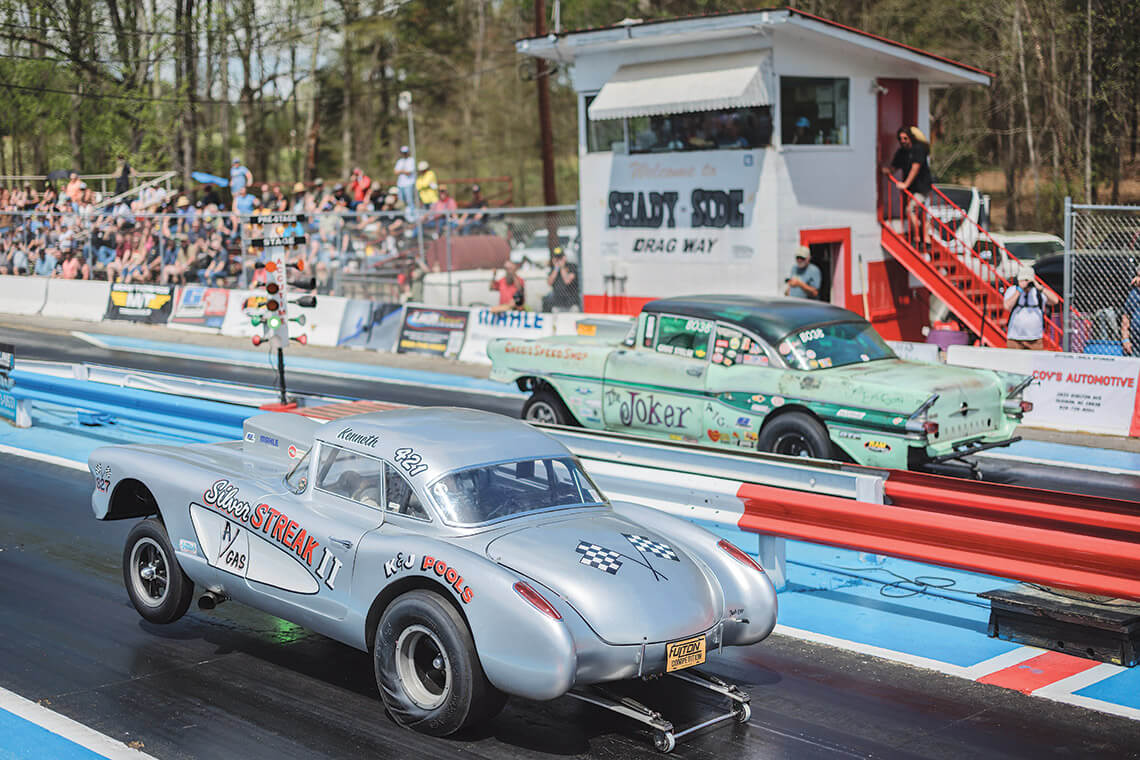
When Silver Streak II takes on The Joker at Shadyside, there’s no bad seat at the track. photograph by Jerry Wolford & Scott Muthersbaugh
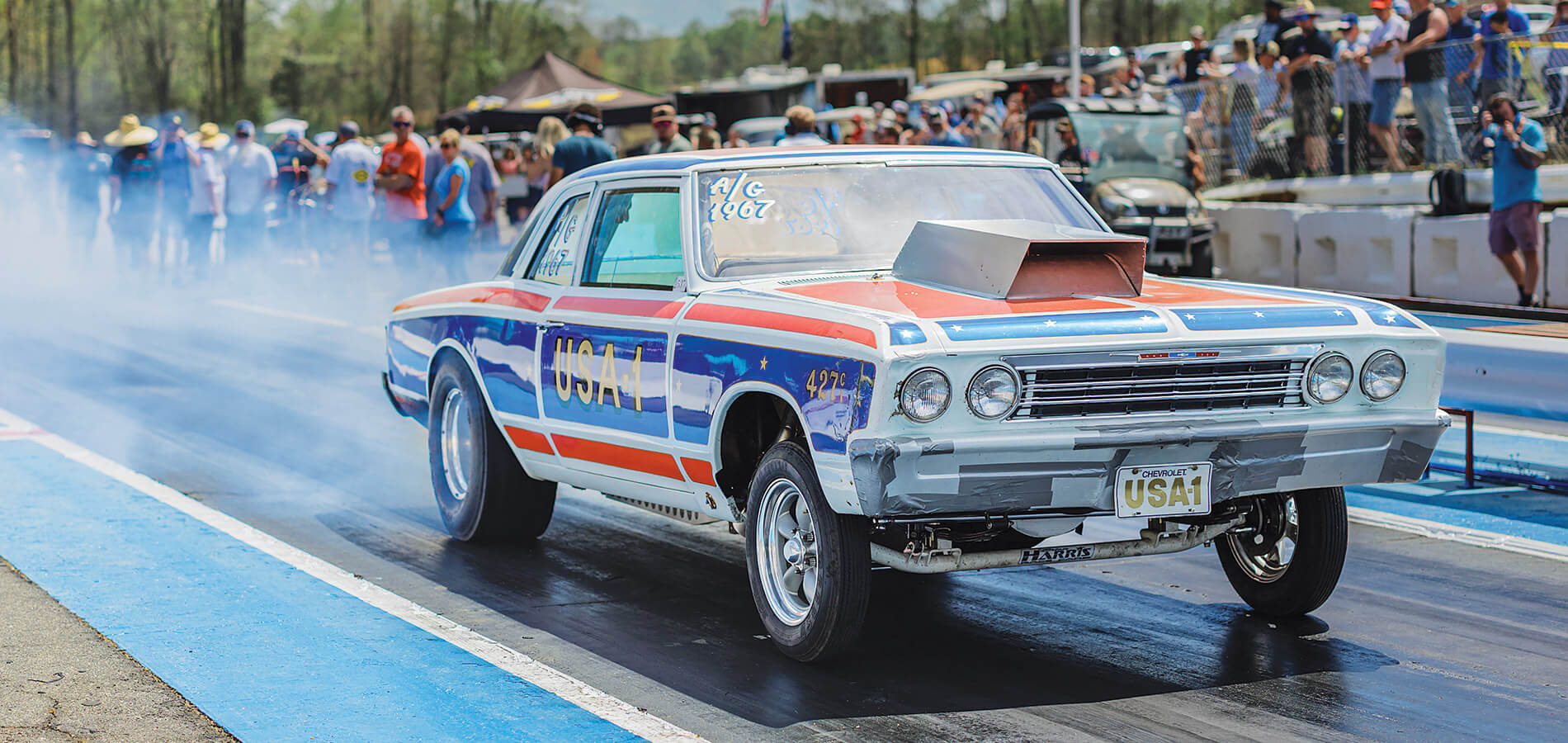
A voice crackles over the loudspeakers that are mounted throughout the valley: “The lanes are open for all classes! Just bring ’em on down!” Suddenly, from behind all those folds of all those hills in that once-sleepy holler, emerges machinery. Golf carts and puttering scooters. Pickup trucks pulling trailers. And race cars. So many race cars. They’re painted silver and orange and purple and … does that one have an angry shark plastered on its rear fender? And is that one called Chick Magnet? And Bad Alibi? And Loose Cannon?
With a boom and a squeal and the high-octane groan of RUUUUNNNHHHHH, all those flowers that were resting in the grass around Ronnie Buff’s best seat in the house are sent to rustling. The birds in the trees above the creek are startled into flight. And those churchgoers? Well, OK, they don’t even turn around. They just smile. After nearly seven decades, they’re used to the ruckus. They love it. Just as they loved Ronnie.
• • •
Welcome to Shadyside Dragway, A living, fire-breathing throwback testimony to North Carolina’s red-clay auto-racing roots, and to the drag racing dreams of a man who still oversees the family business, even now, seven years after his death at the age of 68.
“Grandpaw got this place in 1980, and I was born in 1991, so I have spent my whole life right here,” explains Seth Buff, the oldest of the three boys known around here as Ronnie’s grandbabies, followed by Zack and Bryson. “Everyone you see, working or racing, is family. Everything we do, it’s with Grandpaw’s spirit. The only thing he loved more than hard work was racing.”
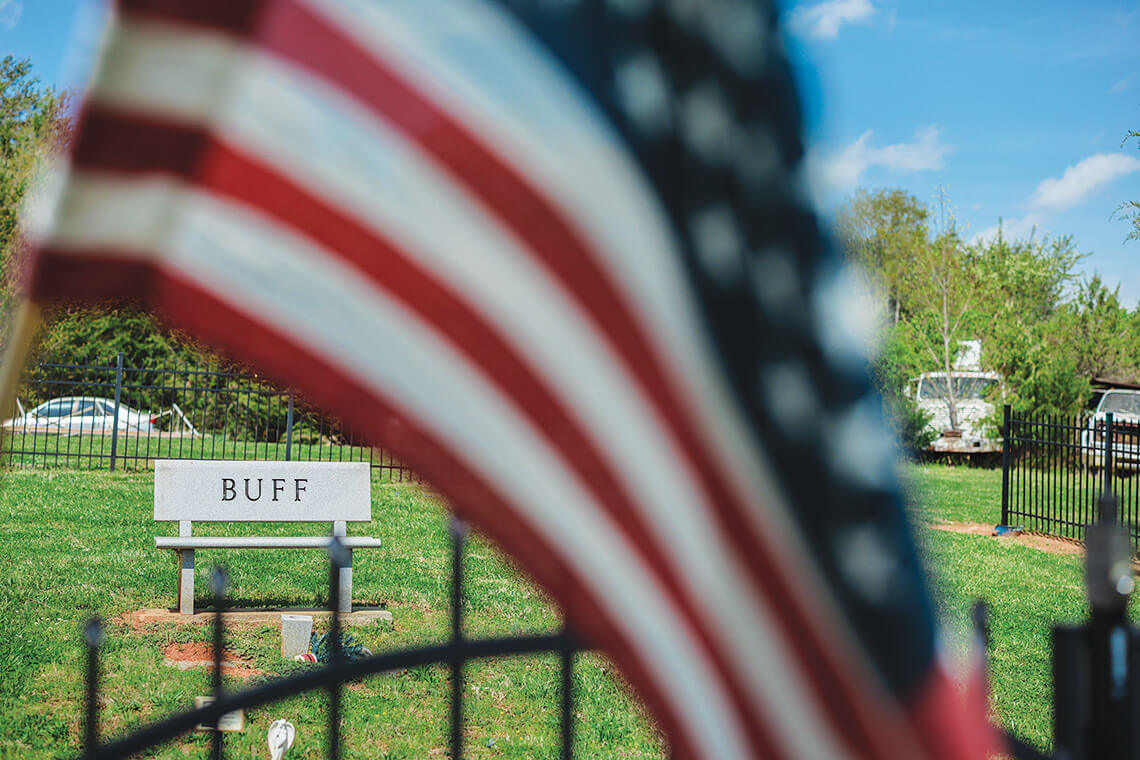
Ronnie Buff’s grave photograph by Jerry Wolford & Scott Muthersbaugh
Whenever people discuss motorsports and the Old North State, the conversation immediately turns to NASCAR, and that’s fair. Its torrid tale is taught to us by everyone from our North Carolina history teachers to Talladega Nights: moonshine runners settling their “my ride is faster than yours” arguments on the Carolina ovals where stock car racing was born. The reality is that those bullrings made up only half of stock car racing’s creation. The path to the other side of that story, the Shadyside, is a very straight line.
“Everyone knows Daddy and all the guys he started with because of what they did on racetracks,” recalls Richard Petty, the seven-time NASCAR champion and the son of three-time champ Lee Petty. “But I remember, as a kid, seeing guys racing side by side on the roads all around our house in Level Cross. That’s drag racing, and a lot more people did that because racetracks are hard to find. Anybody could get on a road.”
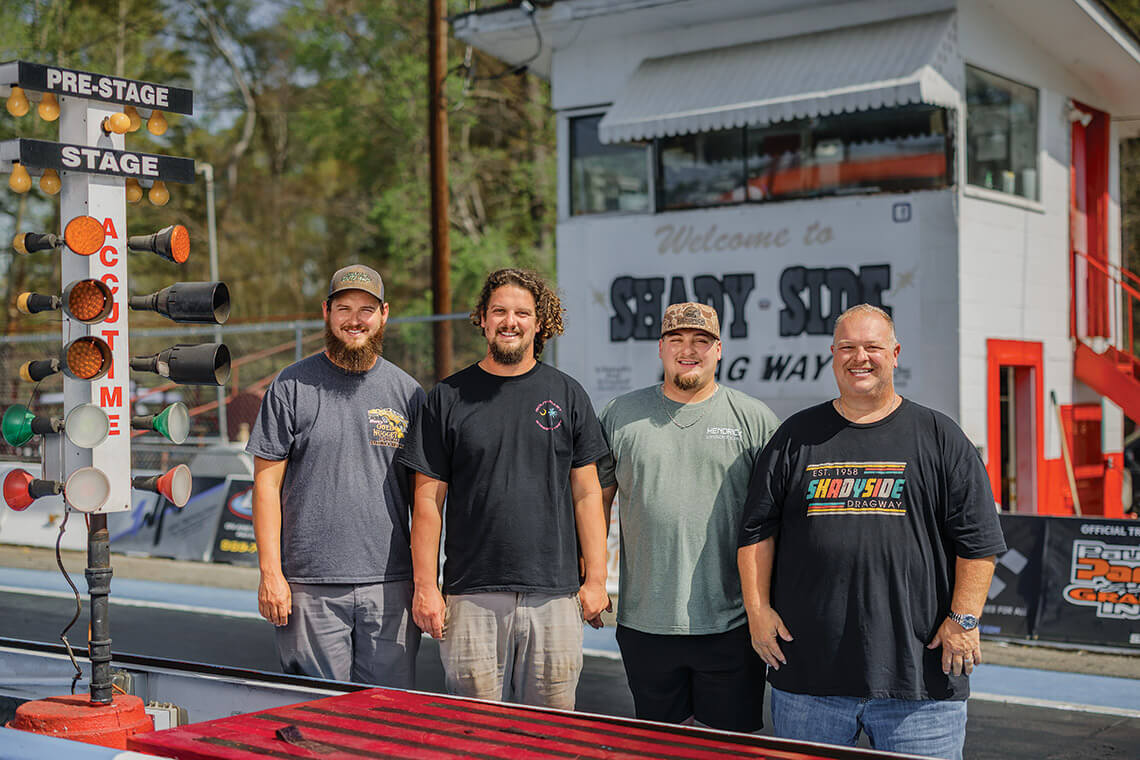
The Buff boys — (from left) Zach, Seth, Bryson, and Lennie — continue a tradition that was passed down to the family’s patriarch and Shadyside’s architect, Ronnie Buff. photograph by Jerry Wolford & Scott Muthersbaugh
Those road racers started plowing clandestine dirt runways through any flat plot of land they could find that was also protected by a natural hill-bracketed hiding spot. When drag racing culture roared into the American mainstream in the 1950s and ’60s, set to the tunes of the Beach Boys and immortalized on the silver screen by the likes of Elvis and James Dean, drag strips began operating out in the open.
In North Carolina, racers would tow their rides from Wednesday nights in Monroe to Friday nights in Kinston to Saturday evenings in Rockingham or Wilkesboro. Some events were officially sanctioned by the National Hot Rod Association (NHRA) or some other alphabet soup sampling of governing bodies. But most policed themselves, welcome to all-comers. They were called outlaw tracks.
• • •
Shadyside was then, and is now, the realm of the outlaws. On this weekend, it’s playing host to the Southeast Gassers Association, a traveling nitro circus with the stated goal of “bringing back the authentic drag racing experience from the 1960s and creating an enjoyable atmosphere for the entire family.” It’s true. All the way down to the go-go boots worn by the women who help guide every machine into its lane. A real-life American Graffiti. Only much, much faster.
“There are places where you kind of have to dress up the place to fit that 1960s vibe,” says Steve “Spinny” Davis of Monroe, driver of the 1962 Ford Falcon known as Spinny III. “Not Shadyside. This place is a time machine.”
Some events were sanctioned; most policed themselves. They were called outlaw tracks.
In 1958, brothers Marshall and Travis Hamrick gathered up their tractors and graded out an eighth-of-a-mile dragway in the malleable but solidly slick clay on the banks of a Broad River branch known as Yancey Creek. Their track was never sanctioned, and they didn’t intend to seek any fancy letters to hang over the gate. Outlaws they were and an outlaw facility they would be.
Soon after it opened, a local named Garland Buff towed his 1948 Austin A40 into Shadyside to see what his British midsize might do when unleashed upon the hills of Cleveland County. Riding shotgun in the ’57 Chevy Bel-Air wagon that towed the Austin was Garland’s 10-year-old son, Ronnie. The kid was mesmerized. Only two years later, he was allowed to make a pass down Shadyside in the wagon.
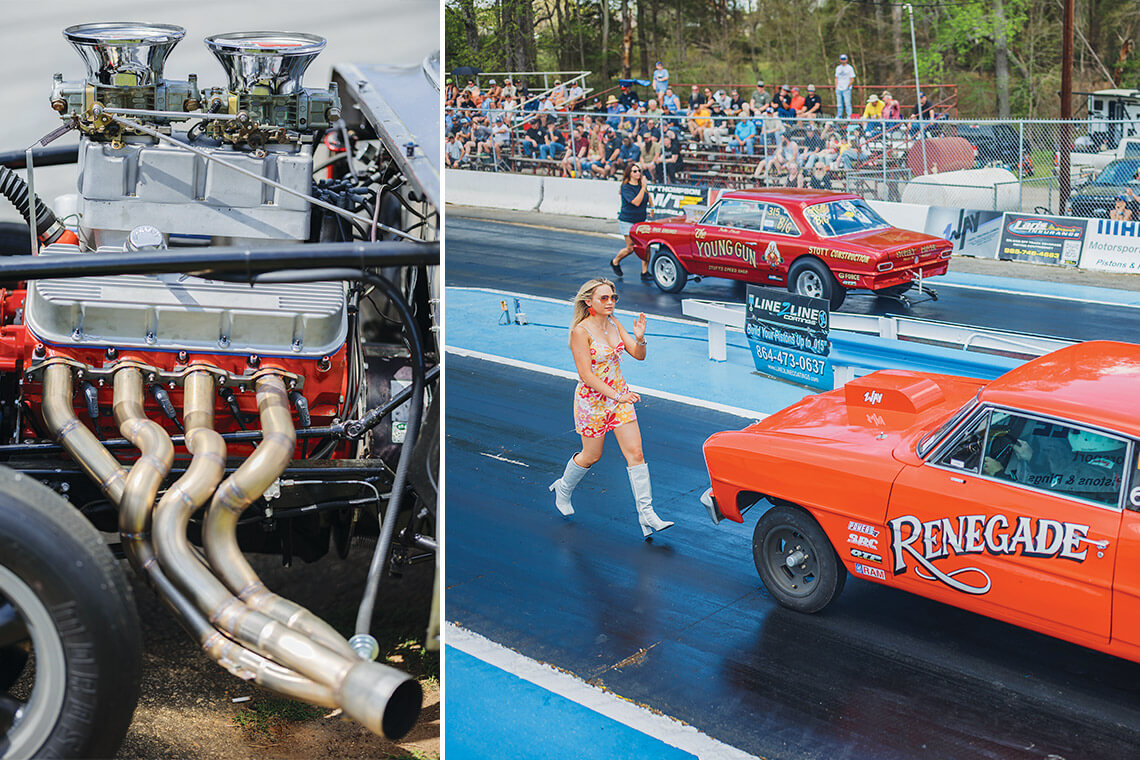
Drivers count on their souped-up engines for horsepower and on “Backup Girls” — affectionately called BUGS — like Alexis Phillips (in white boots) to get back into position behind the starting line after a tire-smoking burnout. photograph by Jerry Wolford & Scott Muthersbaugh
As an adult, Ronnie brought his new wife, Gail, to the track, because he was romantic like that. Soon, they were bringing their own son, Lennie. He, too, fell in love with the place.
By 1980, the urban sprawl of the Piedmont had devoured most of the fabled North Carolina outlaw drag strips. Cul-de-sacs don’t much care for all of that high-horsepower hullabaloo.
That’s when Ronnie told the Hamricks that he wanted to buy Shadyside. They agreed, and Ronnie went to work updating the place.
He and Gail hauled out truckloads of glass bottles that had been tossed into the dirt over the past 22 years. Eventually, they moved onto the property permanently. Lennie and grandfather Garland helped install the facility’s first real timing system. Ronnie repaved the track and installed guardrails where there had been stacks of old race tires. He widened the racing surface from a very narrow 22 feet to a downright Broadway-feeling 51. And he straightened out Shadyside’s greatest detriment, quite literally.
“You go there, and it’s a classic. There’s nothing but real racers at Shadyside.”
For 50 years, racers had to let off the throttle early, because just past the finish line, the track took a sharp left-hand turn, too cramped by the hills around it for a proper runoff area. In 2008, Ronnie pushed those hills back. The result: Shadyside’s first-ever 200 miles per hour run. People still talk about the tears in Ronnie’s eyes when he witnessed that dash.
“What’s so great to me about Shadyside is that Ronnie and his family update it, but it still feels like it should,” says the man who made that 200 mph run, Todd “King Tut” Tutterow, a North Carolina-born speed legend with 19 championships throughout the drag racing world. “You go there, and it’s a classic. There’s nothing but real racers at Shadyside.”
• • •
Now, just like his grandfather and father before him, Lennie and the full-grown grandbabies spend every weekend not named Christmas making sure that their guests — racers and racing fans alike — receive the best old-school outlaw drag racing experience possible. At any given moment, the Buff boys, their spouses, and their extended family of friends and volunteers are in perpetual motion. At the wheel of the tractor that scrubs the racing surface. Behind the counter of the concession stand, wrapping hot dogs. Beneath the grandstand applying one more coat of Rust-Oleum.
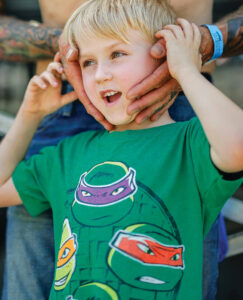
When the sound at the track gets too loud, Asheville’s Chris Dalton lends a pair of helping hands — to muffle the mayhem for son Weston, 5. photograph by Jerry Wolford & Scott Muthersbaugh
All of the above rattled every few minutes by the click and bang of engine ignitions. The creaks of physics-defying metal. The shriek of burnouts. All building toward that loveliest noise of all: the symphony of Shadyside. The release of hammer-down passes from the likes of Quick Draw, Odd Rod, and the Junkyard Dino. Each roaring their way along that eighth-of-a-mile, their drivers looking up to their right at the scoreboard to see how fast they went and then looking up to their left to pay tribute to the best seat in the house. Ronnie Buff’s perfect final resting place points toward the starting line, per his instructions when he raced off this mortal coil, carried there via one last ride down the strip in a 1936 Plymouth hearse.
“That’s how Grandpaw wanted it to be. He wanted to be where he could see those cars out there, running Shadyside,” Seth says. “He’s also always keeping an eye on all of us. And we wouldn’t want it any other way.”
Shadyside Dragway
2149 Honey Haven Farm Road
Shelby, NC 28152
(704) 434-7313
shadysidedragway.net