Put ramekins on a baking sheet. Bake for 25-35 minutes, until puffed and golden. Remove from oven, and let stand for 5 minutes. With a flexible spatula, remove strata to
When you say their name, remember to … pause. The pause is about who they are and in whose footsteps they follow even when the twinge in their shoulders and
When you say their name, remember to … pause. The pause is about who they are and in whose footsteps they follow even when the twinge in their shoulders and
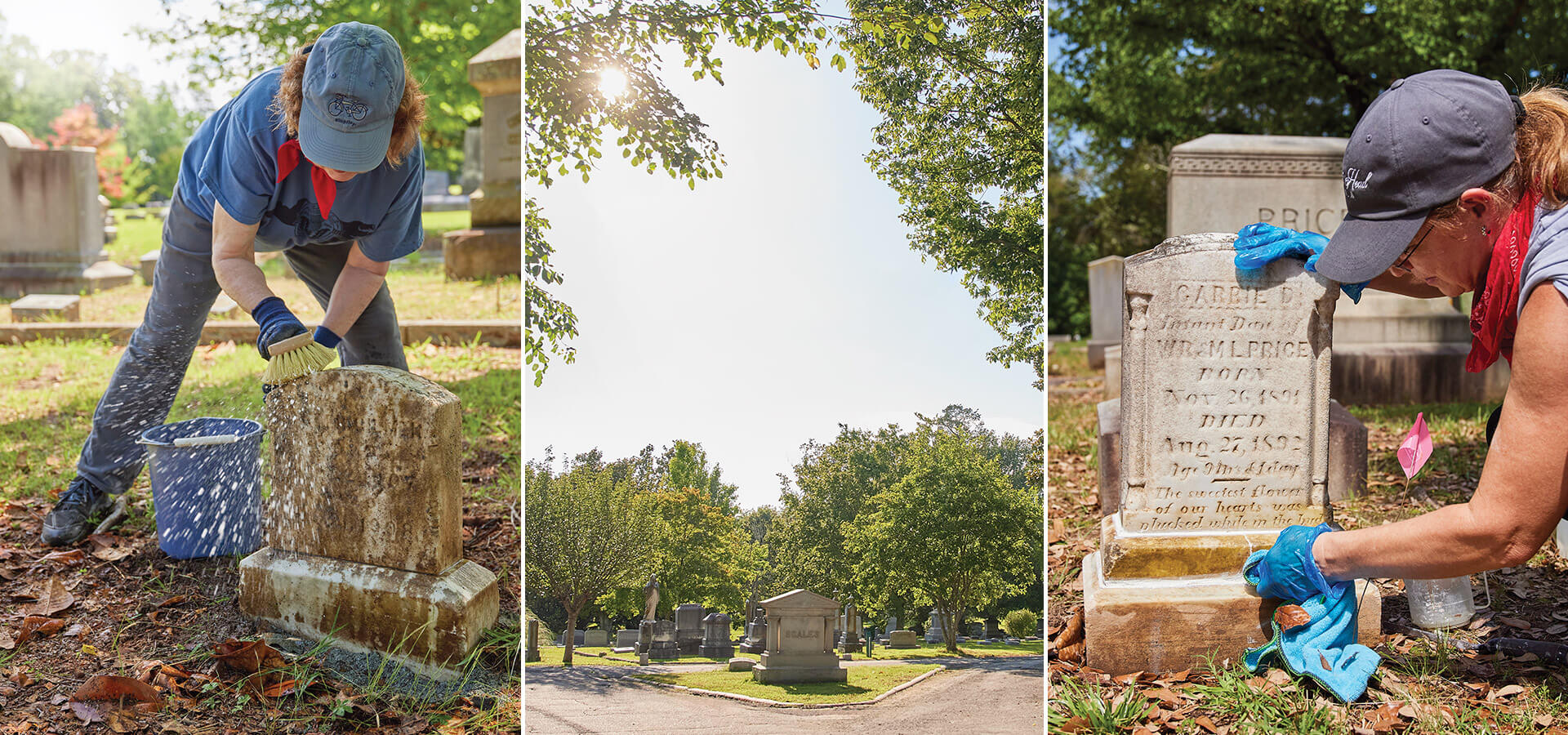
A group of volunteers repairs and cleans the gravestones of the Gate City’s oldest public cemetery to honor those who came before them and beautify what they see as hallowed ground.
When you say their name, remember to … pause. The pause is about who they are and in whose footsteps they follow even when the twinge in their shoulders and elbows makes them question why they have a shovel, a scrub brush, or a pry bar in their hands. It’s because of a guy named Bill.
So they call themselves the Green Hill — pause — Billies. The pause is them — and their work.
They clean and repair gravestones in Greensboro’s Green Hill Cemetery, the city’s oldest public burial ground. Near the entrance is a sign that bears their logo, a red bandana — every few weeks, they tie them around their necks and gather. They’re all volunteers, of all ages, young and not so young. They scrub, brush, dig, and lift for a few hours, and sometimes fan out across the city and county to help churches understand how to beautify their own private graveyards and preserve a sacred space.
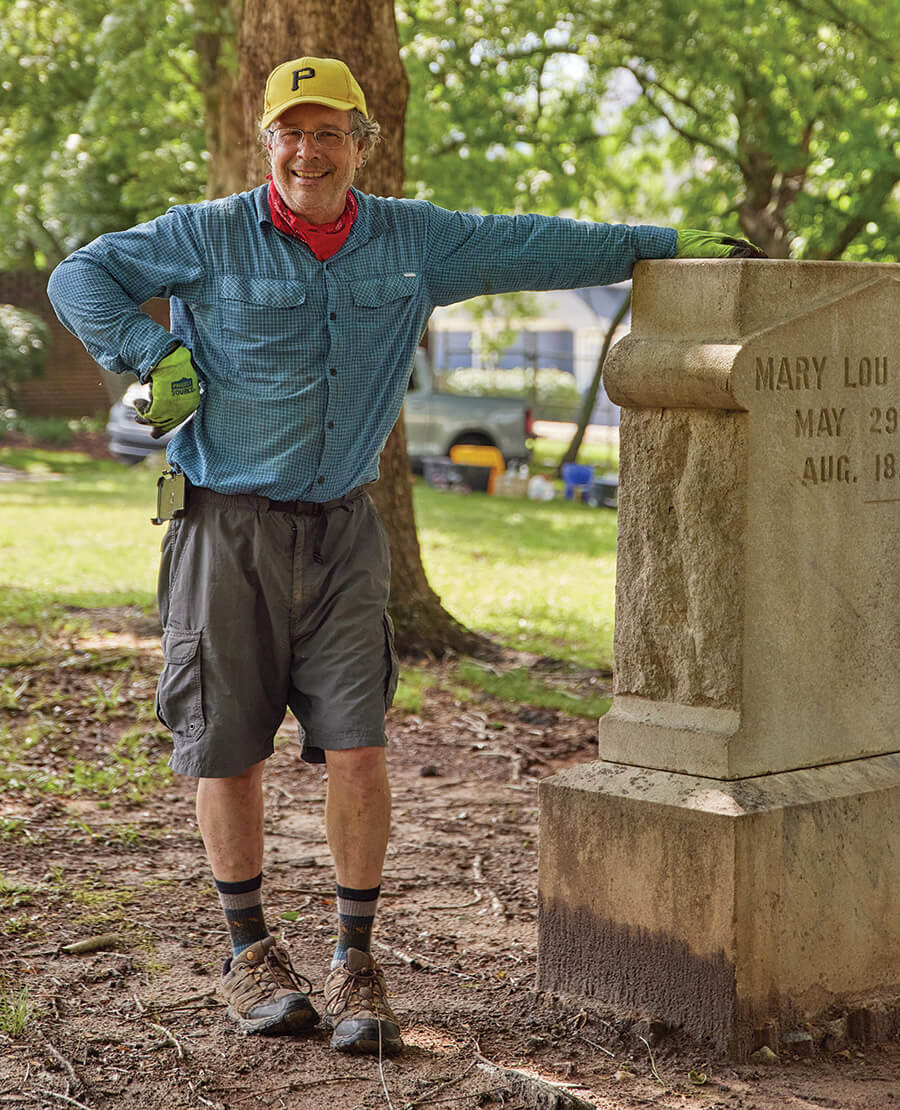
“I’m 62, and if I can do this until I’m 70, I think I’ll have accomplished what I wanted to accomplish,” Craft says. photograph by Joey Seawell
David Craft formed the Green Hill Billies two years ago. He lives three blocks from Green Hill, and whenever he walked through the cemetery, he saw too many gravestones in various stages of disrepair, including a six-foot obelisk that could topple over with a gentle shove.
“I couldn’t sit there and let it fall,” he says.
He began to research. He talked to experts, watched YouTube videos, and drove to Statesville for a gravestone restoration workshop presented by a company out of Connecticut. There, he met another future amateur gravestone preservationist — Dr. Sherrie Drye, an associate professor of information systems at NC A&T University in Greensboro — and their similar passion built the foundation for their nameless team of volunteers.
The name would come. But first came what they saw as urgent: improving hallowed ground and appreciating the lives of those who came before them, people they didn’t even know.
• • •
Green Hill is like a statuary garden, shouldered zipper-tight beside a one-way street constantly buzzing with traffic, less than a mile north of downtown. But inside the cemetery, the busyness of the city fades into a whisper. The paths corkscrew through 51 acres — former farmland the city bought at least 150 years ago — and wind past heritage and history etched in marble and granite.
Green Hill is the final resting place for the well-known and little-known. They started a college, pastored a church, governed a city, led a school system, raised a family, immigrated to the United States from across the Atlantic, and moved beyond slavery to build a life free from bondage.
With its more than 300 kinds of trees and shrubs, Green Hill became what some call an “accidental arboretum.” When the cemetery opened in 1877, Greensboro was more country than city, and public burial grounds were gardens that exhibited respect and love for those in eternal rest. The stone used became the forever canvas to remember those gone.
“These are people, part of Greensboro’s history, and we have to honor them.”
But today, that canvas is crumbling, and time is the eraser. Names and dates are barely legible on many gravestones, and trees and bushes have become an unintentional bully, engulfing monuments of memory and nudging them enough to topple them like dominoes. Decades of weather haven’t helped either. The shifting earth has become a slow-moving quicksand, swallowing many of the tiny markers and thin slabs in the cemetery’s 35 sections.
So much to do. So Craft and Drye get to work.
“When you see all these statues that have fallen over, it’s not right,” Craft says. “These are people, part of Greensboro’s history, and we have to honor them.”
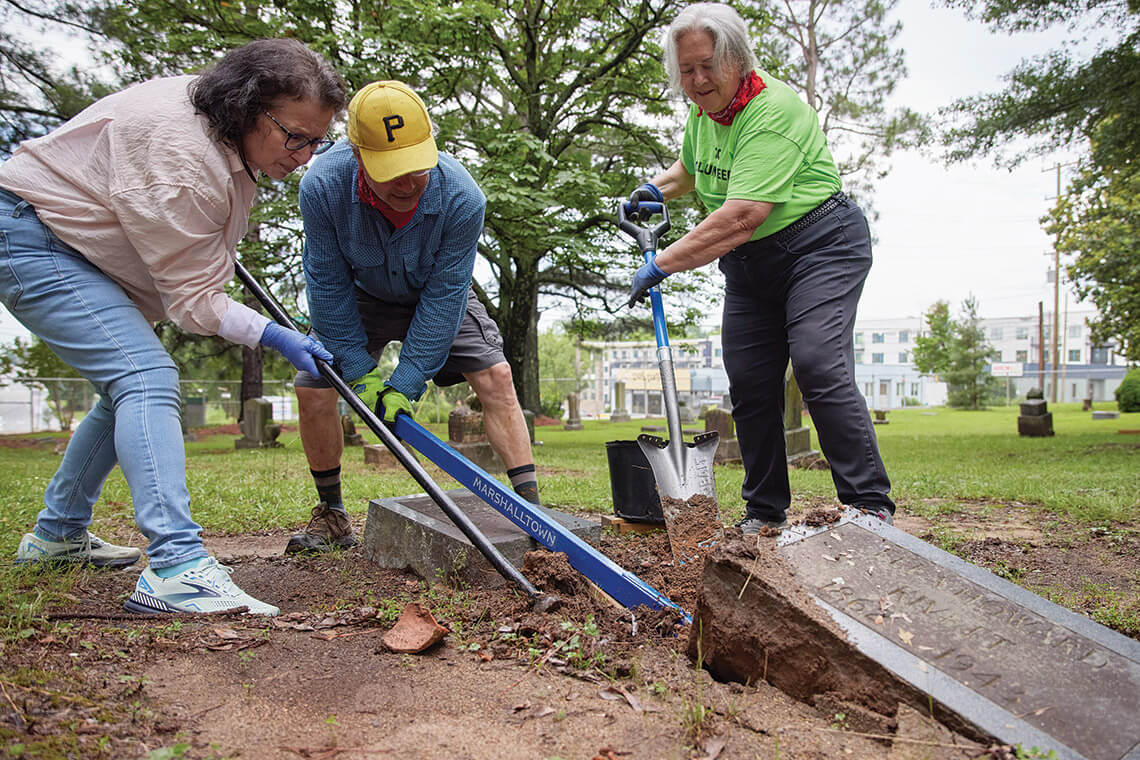
Since forming the Green Hill Billies in 2023, David Craft (center) has brought in volunteers like Arlene McKane (left) and Ann Roberts to help clean and repair gravestones once or twice a month. photograph by Joey Seawell
“There’s this quote attributed to Ernest Hemingway where he said everyone has two deaths,” Drye says. “One is when you die and are buried; the second death is the last time someone says your name. And when I see the graves of children, who have no offspring — who is going to care for their stones? That hits home for me.”
As the number of their volunteers grew, one of them proposed the idea of coming up with a name for “our little ragtag group.” She suggested a play on the word “hillbillies.”
“What about the Billies?” she said. “As in the Green Hill Billies?”
“Well,” Craft responded. “That’s my dad’s first name.”
• • •
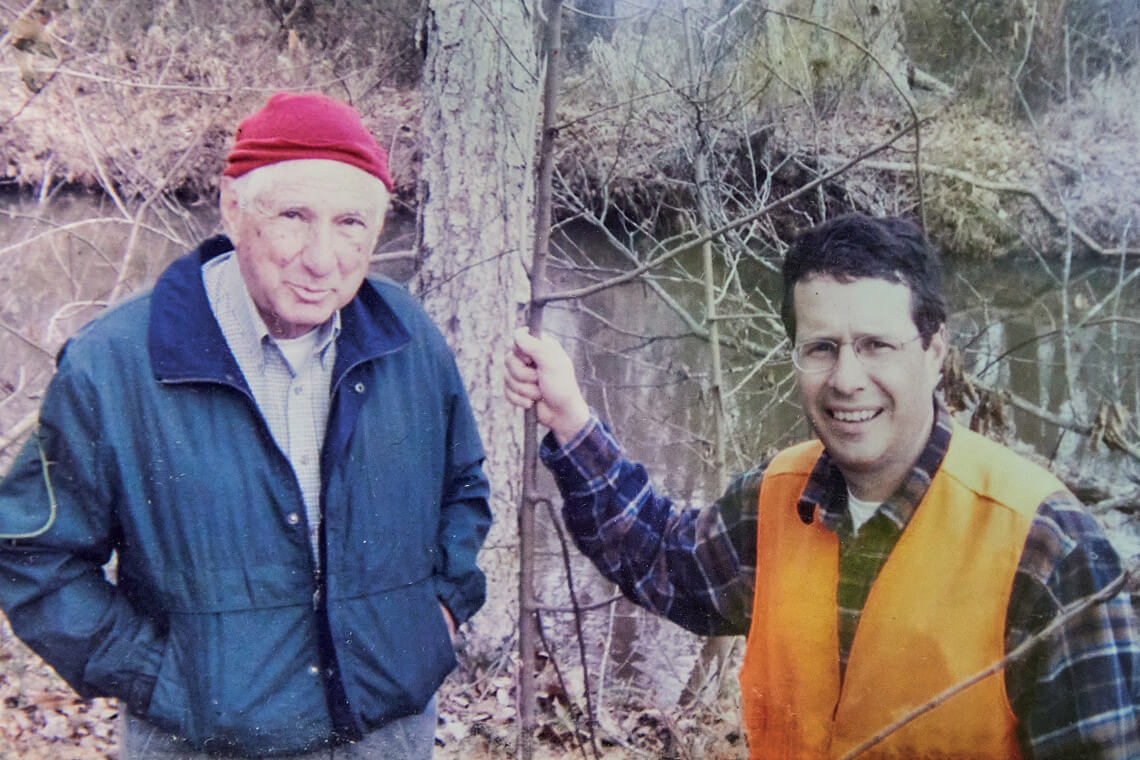
Bill Craft, a father of nine, was an amateur botanist with a drive that never waned. For decades, he ran his family’s insurance company in Greensboro and beautified places in his hometown by planting trees and shrubs. When his kids were young, he would bring them along after hearing his wife say, “Take them out and go do something!”
Bill’s kids would help some. But mainly, he did everything solo. Bill became known as the Johnny Appleseed of Greensboro. He planted trees and shrubs he bought or dug up and transplanted to create green islands in the middle of a growing city.
Bill (left) and David Craft Photography courtesy of David Craft, Photographed by Joey Seawell
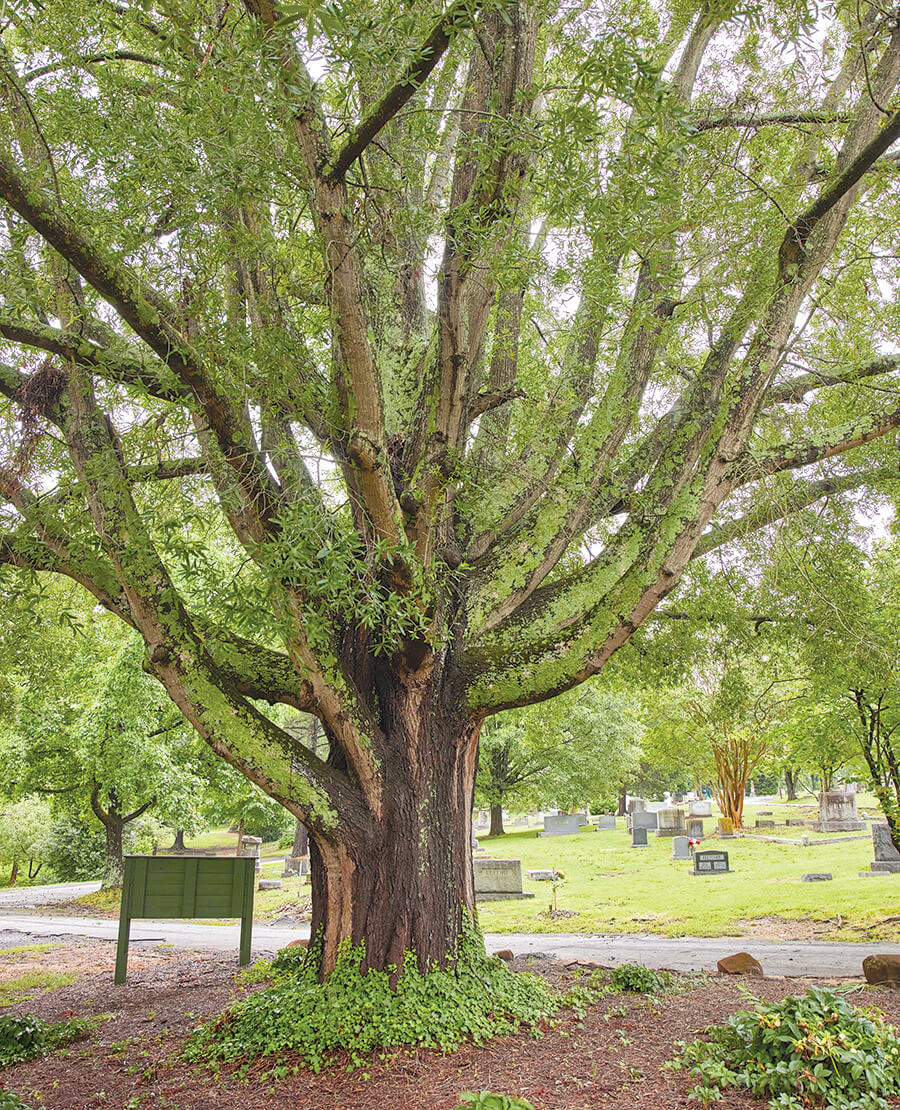
In Green Hill, evidence of his green thumb is everywhere: a redwood near the entrance, a Mexican weeping pine alongside a fence, a Kentucky coffee tree beside the walking path. For years, he gave tours of the cemetery and pointed out the family names he knew and the 400 trees he planted. In January 2000, when a reporter asked him about his Johnny Appleseed habits in Green Hill, Bill said, “This way, I can come over here and enjoy the plants, and everyone else can, too.”
Bill died in December 2010 at age 81. Yet the tours he started years ago continue. Ann Stringfield, who lives a block from Green Hill, offers tours at least eight times a year. She joined one of Bill’s tours in the mid-1990s, and after going two more times, she told Bill she’d like to help.
“You’re giving the next tour,” he responded.
She did. And more.
“It helped me feel like a living part of the city,” she says, “and it helps bring the living back in.”
Craft’s father, Bill, added 400 trees and shrubs to Green Hill at his own expense. He saw cemeteries as green islands essential to good living in growing cities like Greensboro. photograph by Joey Seawell
In 2009, she started the volunteer group Friends of Green Hill Cemetery with David Craft to do things like recruit volunteers to cut back overgrowth and help create a fund to buy benches, bronze plaques, and labels for the many trees.
Stringfield calls her tours “The Plants & the Planted,” and from her research, she’s gleaned more than a few lessons about Greensboro and about life. Take her favorite epitaph: “Here endeth the first lesson.”
“We’re all only here for a short time, and every one of these graves represents someone whose family has experienced loss,” says Stringfield, a retired research librarian. “Grief is natural, and this helps me recognize this is everyone’s experience, so we might as well get on with the now and enjoy it.”
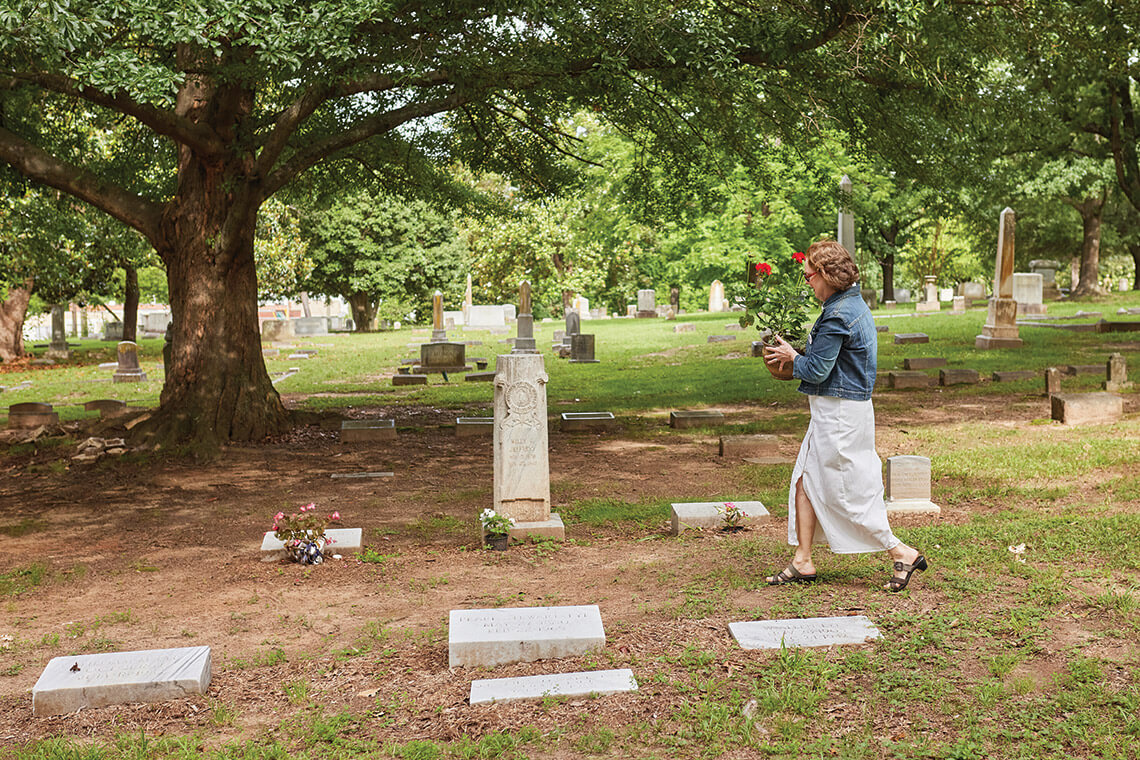
Laura Allred continues a family ritual that started when she was a little girl: placing a red geranium on the grave …<br><span class="photographer">photograph by Joey Seawell</span>
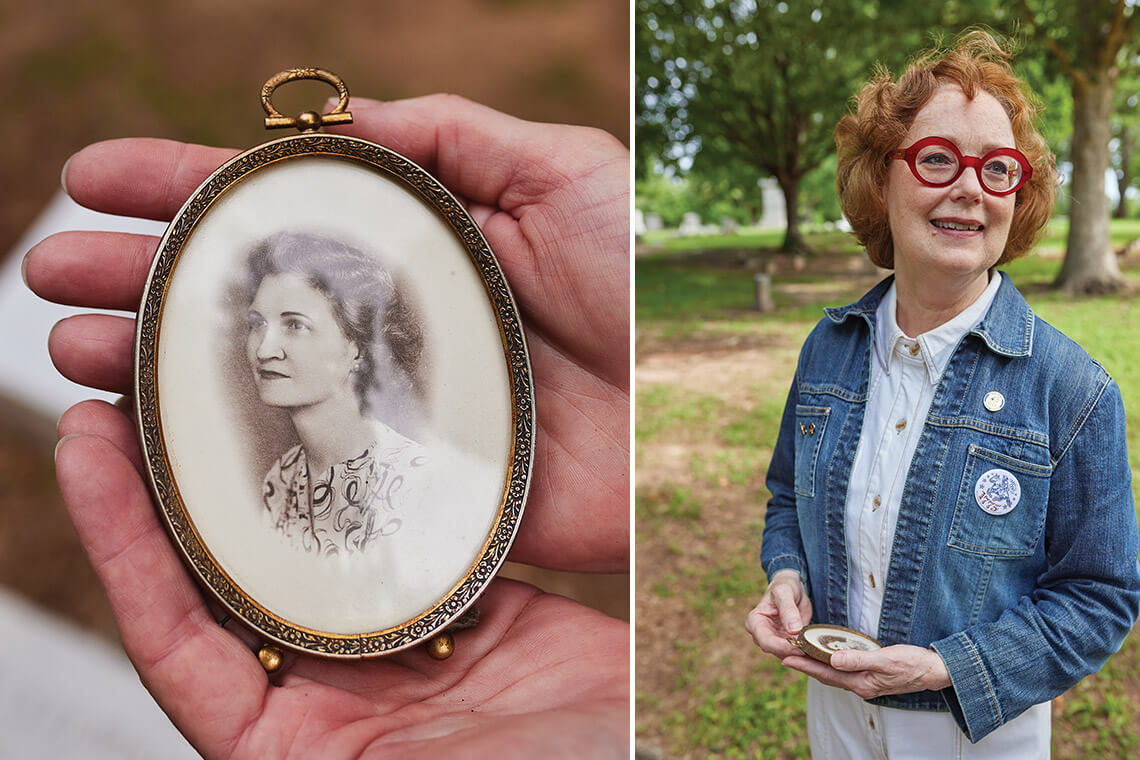
… of her paternal grandmother, Alice Sue Jeffreys Allred.<br><span class="photographer">photograph by Joey Seawell</span>
Laura Allred, one of the Green Hill Billies, can attest to that. When she was a child, Allred came to Green Hill with her family to visit the graves of her father’s relatives. They’d lay a red geranium or a chrysanthemum atop the grave of her paternal grandmother, and her Aunt Margie or her parents would say, “She would have loved you so much.”
Decades later, when Allred visited her dad’s only sister in Florida, Aunt Margie pulled from a file cabinet the deed for the last spot in the family plot at Green Hill and handed it to Allred. “There’s one space left,” she said. “It’s yours.”
Whenever she volunteers, Allred tidies her family’s two plots and sets a red geranium or some other flower atop her grandmother’s grave to remember her. Then, as she stands near the very spot where she and her husband, Hugh, will have their ashes interred, she prays.
“I feel they are looking down from heaven and smiling at me, and loving me from afar, and that gives me a feeling of peace,” she says. “It reminds me that no matter what our troubles are here on earth, we are still alive, and life is still worth living.”
That’s what David Craft has helped create. Like his dad, he enjoys working with his hands. He digs in the dirt and beautifies where he feels rooted. And Green Hill makes him feel rooted. He’s surrounded by friends in red bandanas who understand the passion of that guy named Bill.
Try to contact families before proceeding with any preservation work.
Don’t do things you are not trained to do.
Be safe. Stones are heavy.
Always be willing to learn about the local history, the families you’re working with, and the preservation methods you need to honor those laid to rest.
Get our most popular weekly newsletter: This is NC
At both the turn of the century and today, Beaufort’s waterfront has attracted a hum of commerce and community. At its heart, a historic avenue tells that history, from the stately double-porched homes to the sound of ships announcing their arrival at port.