Put ramekins on a baking sheet. Bake for 25-35 minutes, until puffed and golden. Remove from oven, and let stand for 5 minutes. With a flexible spatula, remove strata to
Listen as the pages of the magazine come to life in the Storytellers podcast showcasing the voices of Our State writers. Each podcast episode features a writer reading their column
Listen as the pages of the magazine come to life in the Storytellers podcast showcasing the voices of Our State writers. Each podcast episode features a writer reading their column
Listen as the pages of the magazine come to life in the Storytellers podcast showcasing the voices of Our State writers. Each podcast episode features a writer reading their column aloud, allowing each distinct voice to shine. Click below to listen to Brad read his column aloud.
At Currituck Sports in Barco, the regulars start trickling in around 6:30 a.m. “We solve all the world’s problems,” says Rodney Kight, whose father, Marshall, also used to attend the informal gathering.
The tradition has been carrying on since Willa Lane opened the store in the late ’60s. An avid fisherwoman, she was distressed that there was no place to buy fresh bait locally. She asked her eldest daughter, Sybil, if she wanted to invest in the enterprise. Ten-year-old Sybil raised $5 mowing a neighbor’s yard, staked her claim to half the business, and started digging worms.
Today, Sybil and her husband, Ed O’Neal, run the bait and tackle shop in a converted horse stable, where locals have been gathering in the mornings for decades to share local news, discuss national and world affairs, and maybe tell the occasional whopper. They sit in a circle of mismatched office chairs on a plywood floor that tilts like a ship in heavy seas. “We tease them that they need to have the [chair] wheels chocked,” Kight says.
The chairs are all that Sybil and Ed provide in the way of hospitality. “If we served coffee,” one employee jokes, “they’d never leave.”
The good-natured ribbing is a tradition, too, just like the store’s eclectic inventory, which includes just about anything related to the sound or ocean, from shotguns to surfboard wax. Even so, there’s one northern Outer Banks item of which the folks at Currituck Sports are particularly proud. You’ll have to head to the back to get your hands on one — if you’re lucky.
• • •
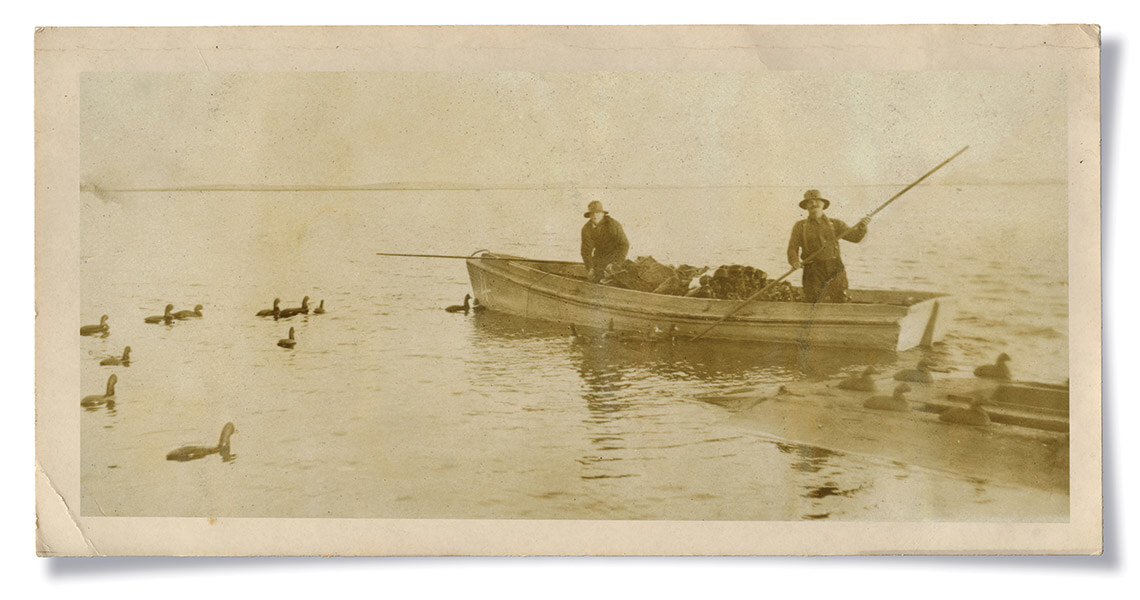
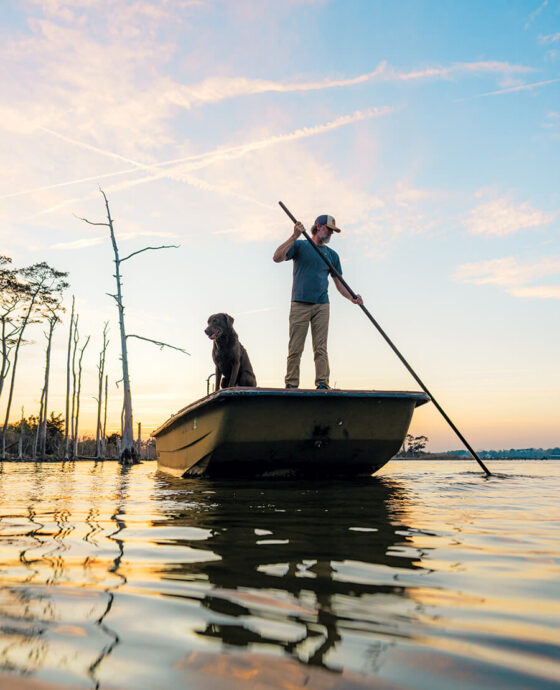
Shove poles — also called shoving poles or shoving paddles — may date back to the Carolina Algonquian, who used sharpened poles for fishing and probably for propelling their watercraft in the shallow sounds. Immigrants to the New World adapted them for use on boats they developed across generations: flat-bottomed hunting and sailing skiffs, shad boats, commercial fishing boats, and runabouts.
“You can be in six feet of water, then — smack — you’re in six inches,” says Kight, who’s been using them since he was a wee fellow. “Back in the day, there weren’t a boat in this area that got in the water that didn’t have a shove pole in it.”
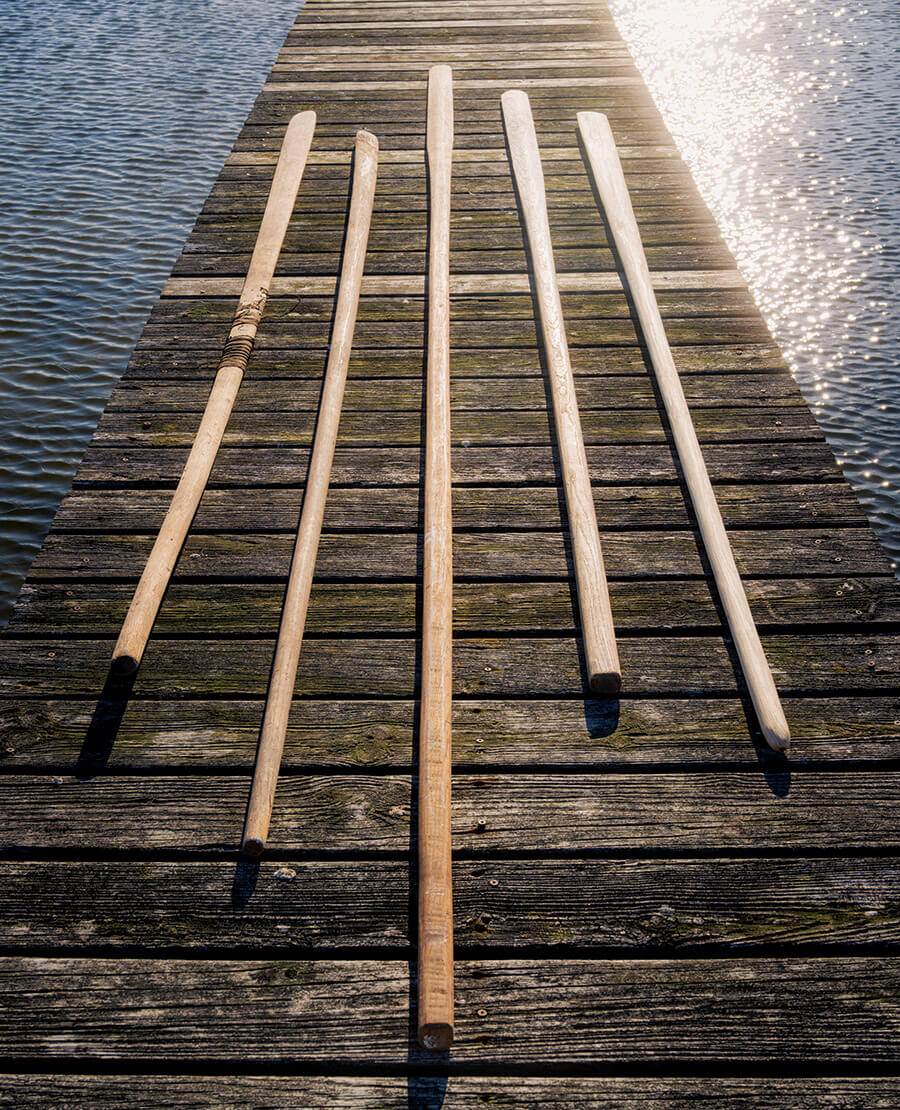
Most commonly made from ash wood, which is strong and provides just the right amount of flex, shove poles come in a range of sizes — from 10 to 16 feet — and shapes, reflecting the personalities and preferences of their makers. Some have a flatter, paddle-like end that allows anyone to scull from the stern of a boat when necessary. Others are more oval at the base. “You can stob the boat and tie it off,” Kight says. “Shove it down. Tie yourself off and make yourself stationary.” Still others feature a squared-off middle section to prevent the pole from rolling on the boat’s gunwale.
A family employed shove poles in the early 1900s near Hog Quarter in Currituck Sound. Photography courtesy of The Northern Outer Banks
Shove poles are especially handy when you’re placing and picking up decoys around hunting blinds — or when your outboard conks out.
“I’ve had to do it, had to shove a mile and a half, two miles home,” says Chandler Sawyer, manager of the Currituck Maritime Museum. Sawyer regularly commutes to work across Currituck Sound. He points to several historic shove poles displayed on the museum wall. “That’s your boater’s insurance policy, is what that is.”
But don’t let the seeming simplicity of the shove pole fool you. There’s an art to using one. Sawyer remembers his granddaddy, Travis Morris, handing him a pole when he was 10 years old. “After I got through spinning around in circles for about 10 minutes, he said, ‘Give me the damn pole,’ ” Sawyer says with a laugh.
“You’re actually pulling against the boat as you’re pushing to keep your bow in line,” explains Kight, whose dad taught him to use a shove pole. “The gunwale is like a guide that keeps it in line.” Kight likens it to learning to ride a bike: “Once you grasp the concept, you can walk the boat up the water pretty good.”
Dan Merrell inherited a collection from his relatives that dates back to the early 1900s — or earlier. He still uses them. photograph by Chris Hannant
According to Currituck County native Dan Merrell, any shove poler worth his or her salt should be able to pole alone from one side. But it better be the leeward side: “If you shove from the windward side, you’re just going to go with the wind.”
Like Sawyer and Kight, Merrell was a tadpole when he learned the technique, taught by his dad, who also made him his first pole — and his first boat, both of which he still owns today. If you want to learn how far shove poles go back in Merrell’s family, visit his garage. The pole his dad made for him can be found there, along with ones made by his grandfather and great-grandfather — a tradition vaulting back to the late 1800s.
While there have been several notable makers in the area, one name always seems to float to the top. There was a time, Kight says, when “everybody in Currituck County who was going out on the water wanted a Newton Hampton shoving pole.”
• • •
Frances Hampton stands at a workbench in her late father’s workshop, a tidy metal building behind the house where she grew up. Outside, in a field her father used to farm, the soybeans are turning from green to gold. Inside, Frances rests her hand lightly on an unfinished shove pole. “This is the last one he touched,” she says.
At one time or another, Newton Hampton worked as a farmer, a mail carrier, a county commissioner, a school bus driver, a church deacon, and a boatbuilder. He died in 2021.
Lately, Frances has been spending more time here in this shrine of table saws and sanders, with ranks and rows of tools hanging on the wall. “Yesterday, all I did was sweep out and cry. To be around his things and know how much time he spent in here …”
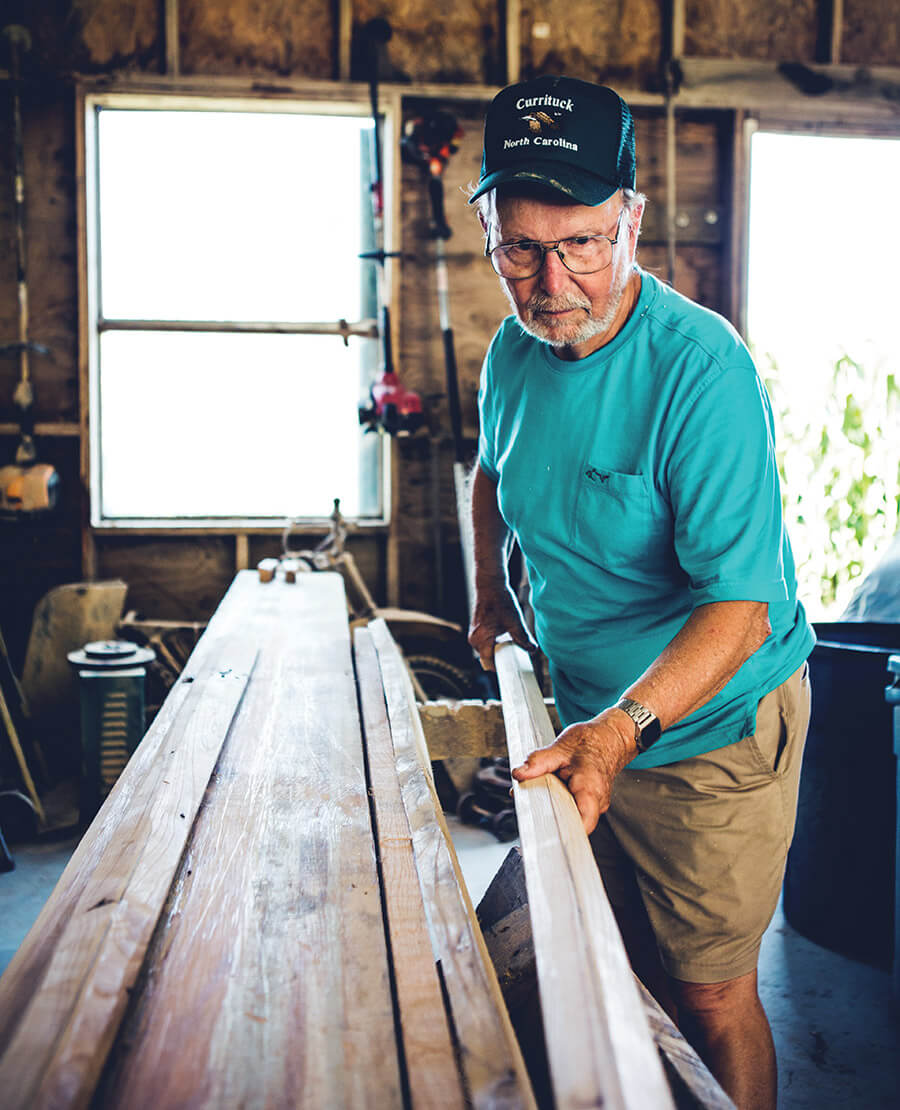
A photo taken about five years ago shows the exquisite care Newton Hampton took in turning shove poles into an invaluable tool for any boater. Photography courtesy of The Northern Outer Banks
For two decades, Newton provided shove poles to Currituck Sports, just across the road. His idea of mass production? Two poles a day. The O’Neals couldn’t keep them in stock. “He grew up using one and knowing how useful a tool it was,” Frances says. “It made it important for him to keep that going here in Currituck and the surrounding waters. He knew the importance of it in this environment.”
Instead of hand-carving the entire pole, her father relied on his deft touch with a table saw to rough out the shape. He knew a length of wood angled the wrong way under a saw blade could shoot out of his hands like an arrow. But Newton was a master.
Four years after his death, Frances has begun working on her first shove pole: “This is something I could carry on for him that would be useful to the community.”
And that last unfinished shove pole of her father’s? “It will sit here for a while,” she says, “and be a great example for the rest of us.”
• • •
After Newton died, some thought it was the end of an era. Currituck Sports had a hard time finding anyone who made shove poles anymore. And newcomers to the area weren’t familiar or weren’t interested in learning how to use them. After all, if your engine quits, you can always fall back on your electric trolling motor.
“Most new folks don’t have ’em,” Sawyer says. “You’re only going to find them in an old duck hunter’s boat.”
As a child, poling was as natural for Merrell as backing up a boat trailer. But today, he says, “there are young people who’ve never had their hands on a shoving pole.”
Back at Currituck Sports, the morning gathering has broken up. “The older men who come to the store, we’ve lost a lot of them over the years,” Sybil says before offering up a roll call of former regulars: “Marshall Kight. Graham Keaton. Newton Hampton. Now we have a smaller circle.”
But for native Currituckers, Currituck Sports remains a touchstone they remember — and cherish. “It means a lot,” Kight says, “to reach back and feel a little bit of yesterday in [this] store.”
Outside, Caratoke Highway hums with traffic. Over the years, the main road through Barco has grown from dirt to pavement, from two lanes to five. Visitors outnumber residents by a wide margin. Private hunting and fishing clubs have given way to Airbnb rentals and multistory vacation homes. Times change. Yet, the circle, though smaller, remains unbroken.
In the back, Kight and Merrell marvel at something they’ve never seen in such quantity: almost three dozen brand-new shove poles of various lengths, delivered by a builder from Dare County. They’re made the old-fashioned way, handcrafted in lengths from 10 to 14 feet. Merrell grabs one — despite having several others at home — buys it, and heads outside to see how he’s going to get a 12-foot pole into a small sedan.
But there’s one thing Merrill doesn’t have to puzzle out. It’s clear to him that, like his circle of friends who gather every morning to try and make sense of a changing world, shove poles are an Outer Banks tradition worth holding on to — with both hands.
At both the turn of the century and today, Beaufort’s waterfront has attracted a hum of commerce and community. At its heart, a historic avenue tells that history, from the stately double-porched homes to the sound of ships announcing their arrival at port.



 Listen as the pages of the magazine come to life in the