Metropolis
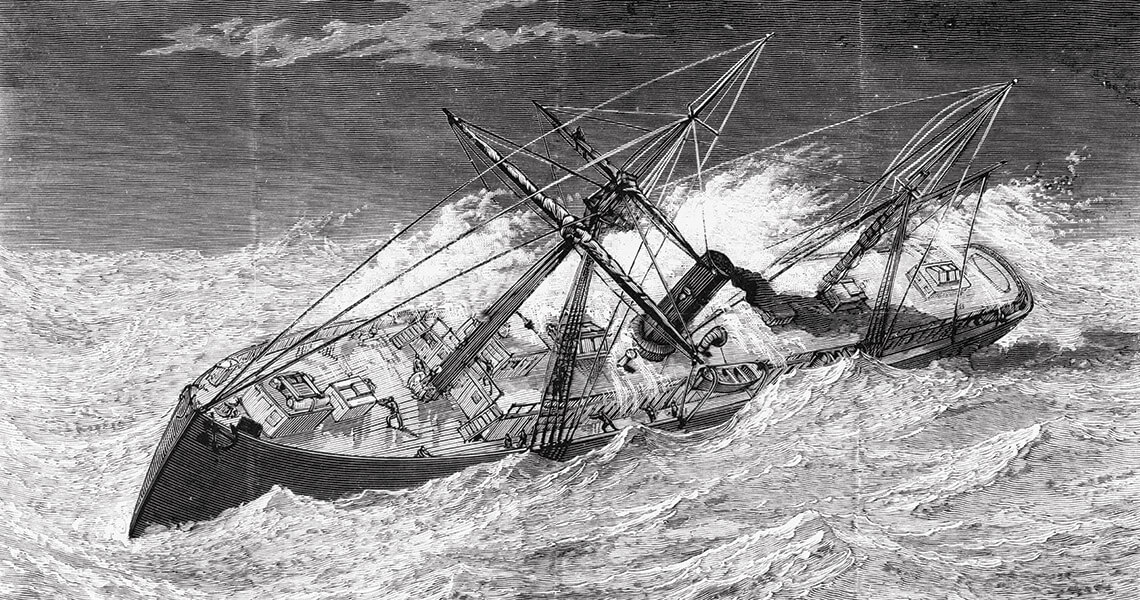
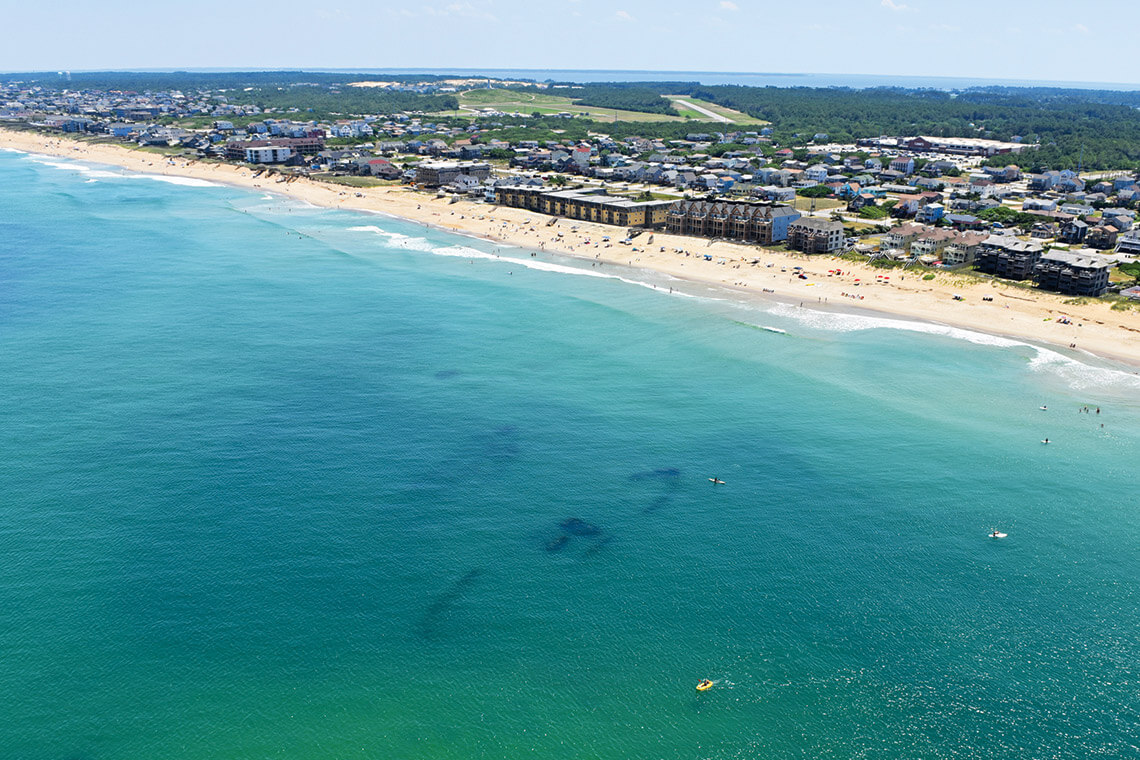
One of the most famous shipwrecks off the Carolina coast, the Metropolis sank in January 1878. The steamer was built in 1861 as the USS Stars and Stripes and served her country in the Battle of Roanoke Island. After the war, she transported freight and passengers until she was deemed unfit for long voyages. She was then cut in half, and 56 feet were added to her midsection in less than eight weeks. Unfortunately, the work may not have been thoroughly inspected. On January 29, the Metropolis departed Philadelphia for Brazil on what would become her final voyage. Reaching the Chesapeake Bay, the vessel began to take on water. As she continued southward in a gale, a wave broke over the ship, flooding the engine. The steamer then struck a sandbar off Corolla. Crew from the Jones Hill Life Saving Station attempted to rescue the 245 passengers, but 85 died. The wreck occurred just two months after the USS Huron sank, and the resulting public outcry led to the construction of new lifesaving stations. Today, parts of what is believed to be the Metropolis can be seen three miles south of the Currituck Lighthouse, 100 feet offshore, 15 feet below the surface.
Laura A. Barnes
Dense fog rendered the Bodie Island Lighthouse powerless to prevent the Laura A. Barnes from wrecking in 1921. The four-masted schooner was traveling from New York to South Carolina when a murky mist overtook her. Fortunately, all eight of her crew survived. In 1973, the National Park Service transported the ship’s remains about a mile south to Coquina Beach.
Oriental
The Federal transport vessel Oriental was built in 1861 for the U.S.-Cuba sugar trade, but before she made her first run to the Caribbean island, the Union Army drafted her into service. Just one year later, she ran aground off Pea Island — maybe due to a faulty compass, maybe because the ship’s pilot fell asleep on his watch. She carried personnel — all of whom survived — supplies, ammunition, and some 30,000 letters to Union soldiers. The steamer now rests in about 20 feet of water 150 yards from shore, opposite Pea Island National Wildlife Refuge. It is often called the Boiler Wreck, a nod to the boiler that protrudes above the ocean’s surface.
Photography courtesy of Outer Banks Visitors Bureau
Triangle Wrecks
An unusual sight lies beneath the turquoise waters at Milepost 7 near the Second Street beach access in Kill Devil Hills: not one but two shipwrecks. The Kyzickes, carrying crude oil, went down here in 1927 in a violent collision that wrenched her hull in two, killing four men. After her demise, the Army used the wreckage as target practice for its airplanes. Two years later, the 244-foot, Swedish-owned Carl Gerhard ran off course and smashed into the Kyzickes. The Coast Guard rescued all 22 crew members, and the heroism of the rescue team was later honored by the Swedish king. Now known as the Triangle Wrecks, the site ranges from 100 to 250 yards offshore in 15 to 20 feet of water.
Pappy’s Lane Wreck
Recognized as significant by archaeologists in 2011, the Pappy’s Lane Wreck — named for the street in Rodanthe off which it lies — may have been the USS LCS(L)(3)-123, a World War II amphibious landing craft. It is believed to have served in the Okinawa Campaign during the occupation of Japan, then later was used as a petroleum tank barge. It was possibly sold to a Dare County company and used to haul gravel in the 1960s before ultimately sinking in the Pamlico Sound later that decade. Though locals spotted the ship shortly after it sank, archaeologists dismissed it as insignificant before realizing, half a century later, that it may be a World War II craft. The vessel lies approximately 1,000 feet off the western shoreline, and parts of the bow and stern are exposed above the waterline.
William H. Sumner
The 165-foot, three-masted schooner William H. Sumner ran aground at Wrightsville Beach in 1919 while taking phosphate from Puerto Rico to New York, and shortly thereafter, her skipper was dead from a bullet to the head. First mate Charles Lacey claimed that Capt. Robert E. Cochrane had committed suicide in a “fit of despondency,” but suspicious circumstances led to a charge of murder for Lacey. His attorney argued that the captain had wanted to go down with his ship, and the jury acquitted the first mate. Today, low tide and shifting sands periodically reveal part of the ship’s hull. It rests 150 yards north of the old Barnacle Bill’s Pier in Surf City.
General Beauregard
Built in Scotland in 1858 and operated as a ferry between Glasgow and Dublin, the ship first known as the Havelock was later purchased by the Chicora Company in Charleston. The Confederacy used the vessel as a blockade runner, renaming it the General Beauregard after the commander who captured Fort Sumter, and used it to run supplies from the Caribbean to the Wilmington area. On its 17th run, the ship ran aground as it attempted to escape the Union blockaders USS Howquah and USS Tuscarora. Most of the crew survived, but all of the supplies that were on board — candles, coffee, brown sugar, bacon — went down with the ship. Today, the General Beauregard sits about 100 yards off Carolina Beach in approximately 18 feet of water. At low tide, the paddle wheel, shaft, and hubs sometimes protrude above the waterline.
Mary E. Morris
While sailing from Charleston to Philadelphia with a load of phosphorus, the three-masted schooner Mary E. Morris met her watery grave off Brunswick County during an 1893 hurricane. For more than a century, the ship rested on Oak Island, where shifting sands occasionally revealed her skeleton. Then, in 1999, Hurricane Dennis picked up the vessel, breaking her in half. The town of Oak Island, along with archaeologists, moved the Morris to Barbee Street, where visitors can see the remains of her hull on a median.