Jason Zombron backs his deep blue Honda Ridgeline until its rear tires kiss the concrete slab. When he brakes, 110 gallons of seawater slosh inside two tanks in the truck bed.
With a huff, he drags the larger tank to the edge, screws a hose onto its spout, and flips the switch on an industrial pump. Atlantic water flows through the 75-foot hose into a black plastic tray. Collected and filtered just hours earlier from the soundside of Wrightsville Beach, it pours clear, then foams and fizzes — one last wave break for this bit of ocean.
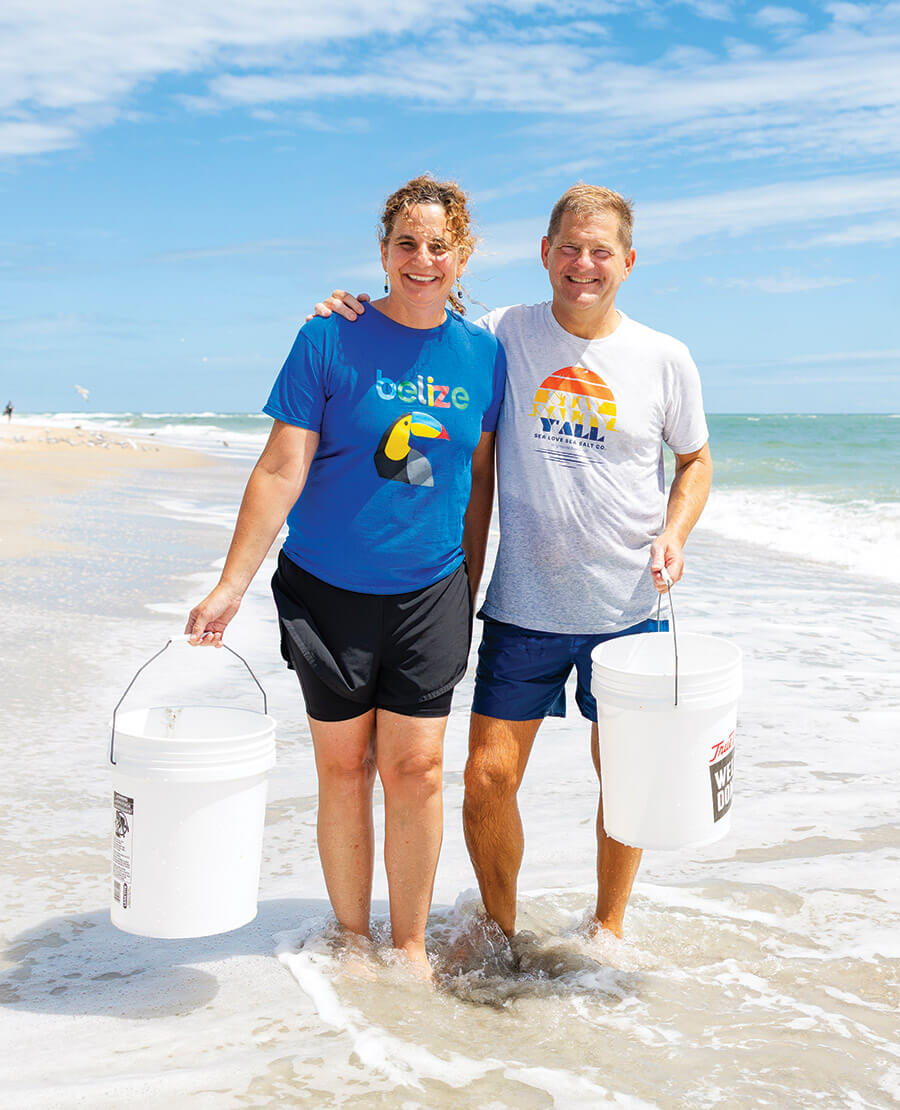
Jeanette Philips and Jason Zombron photograph by Matt Ray Photography
When the pump shuts off, Sea Love Sea Salt Co.’s main salthouse feels like the beach on a still summer day: salt air, high humidity, bright sun, 91 degrees. Outside, though, it’s a windy February day on a farm in Burgaw.
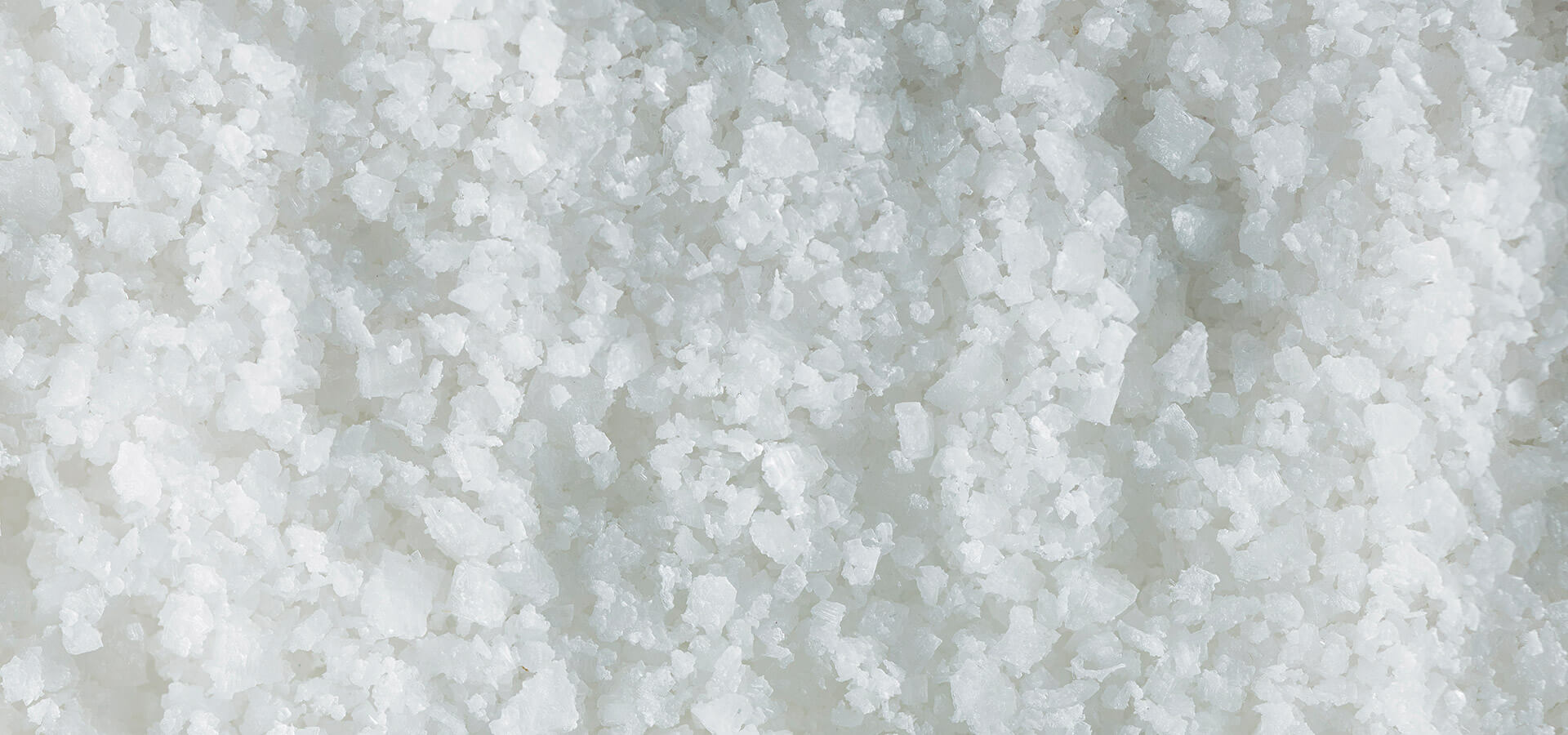
Zombron and his wife, Jeanette Philips, spread seawater across 40 of these shallow trays whenever they’re empty, then let time take the next shift. Over days and weeks, the Carolina sun streams through the clear roofs of their two salthouses to steal away the water. Only bright, crispy, briny sea salt remains, each crystal a tiny, pyramid-shaped piece of our coast. That patient work yields about one ton of salt each year. Here, on this tiny farm about 20 miles inland, an ancient practice is still alive and well.
• • •
Though Philips and Zombron are Sea Love’s current stewards, the company began more than a decade ago with Amanda Jacobs, a teacher who wasn’t trying to start a business. She and her husband, Dave, liked bringing home sea salt from their travels. After moving from New York to an oceanfront house in Wrightsville Beach in 2013, Jacobs decided to make her own.
Her first attempt was in the kitchen.
“It was a complete disaster,” she says. “We had just bought a very expensive oven because my husband loves to cook, and the salt literally chewed off the enamel.”
Sea Love Sea Salt Co. owners Jeanette Philips and Jason Zombron collect the seawater they transform into salt, now a staple at local restaurants like RX Chicken & Oysters in Wilmington. photograph by Matt Ray Photography
So she carried her experiment outside to let the sun dry it. First, she had just a couple of Pyrex dishes on the grass. Then, a plastic greenhouse to keep out bugs and debris. From her yard, she was able to coax out “super flaky, beautiful salt” — so good that she and Dave started bringing it with them whenever they ate out.
One slow Tuesday night at Pembroke’s in Wilmington, Chef James Doss overheard Jacobs mentioning her salt and asked to sample some. The first batch she took him was in a Tupperware container that “probably had lasagna in it the week prior,” she jokes.
By May 2014, Jacobs was selling not only to Doss but also to locals at farmers markets. Within a year, she’d bought a small farm in Burgaw, where she built a permanent greenhouse with cinderblock walls and a polycarbonate roof.
But in 2021, when a director’s position opened at the school where she taught, Jacobs decided it was time to sell. Of the more than 100 interested buyers, Philips and Zombron were the only ones who arrived with their own salt — an herb blend Philips had made from a cookbook.
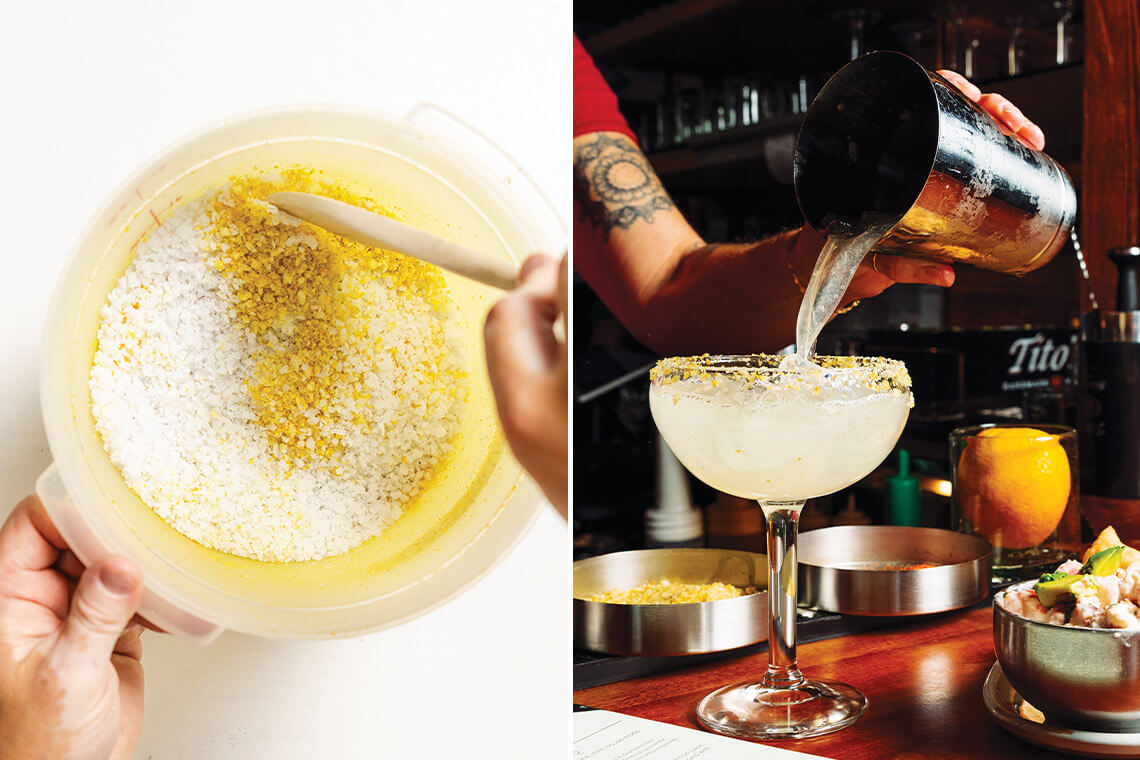
The couple’s infused offerings are popular on local menus including Ceviche’s in Wilmington, where patrons can sip the Sea Love Margarita rimmed with their citrus salt (left). photograph by Matt Ray Photography
Zombron had grown up in Virginia, and Philips in Georgia, but they’d met in their 30s while both living in Asheville. After a stint in Seattle, they moved to Wilmington in 2018 so their two sons could attend a Quaker school. Over the decades, both worked various sales and management jobs, but Zombron had long wanted to own a business, something creative and regional. Holy cow, he thought when the pair met Jacobs. This hits every bucket.
Philips was drawn to Sea Love in part because it was woman-owned, but also because solar evaporation demands patience. “I had just come off a really busy period of my life,” she says, “and felt so lucky to find something that let me slow down and appreciate things.”
Zombron and Philips bought Sea Love in 2021. By 2024, the couple, who were in their 50s, had grown the venture enough to make salt full time.
• • •
Salt-making isn’t new to North Carolina. After Britain cut off trade with the colonies during the Revolutionary War, North Carolina opened a salt work near Beaufort. Later, during the Civil War, the state produced salt in Morehead City and on Myrtle Grove Sound, southeast of Wilmington. In that sense, Sea Love belongs to a long North Carolina tradition.
Its method, though, reaches back even further. For all its modern implements like pumps, hoses, tanks, and hygrometers, Sea Love relies on solar evaporation — the oldest way of making salt in warmer climates, a process that dates back thousands of years.
Zombron believes Sea Love is one of a dozen or so operations on the East Coast still using solar evaporation. Salt can be made much faster by boiling the water, but “you lose a lot of flavor that way,” Zombron says. Solar evaporation helps preserve trace minerals and subtle flavors that make the salt distinctive.
But that also requires surrendering control. A bright, hot week brings steady progress, which means summer is their busy season. A run of cloudy or cold days can slow things to a crawl.
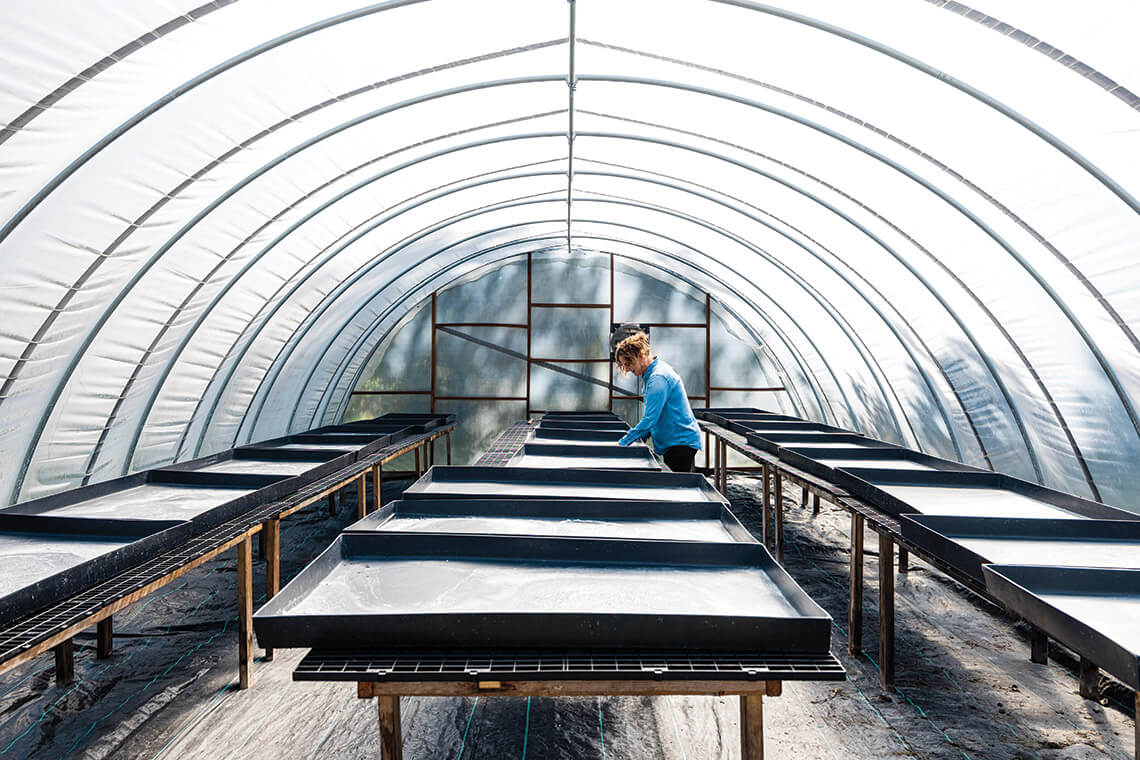
Philips monitors the trays of seawater in one of Sea Love’s salthouses in Burgaw. photograph by Matt Ray Photography
In the salthouses, the trays look unremarkable at first. But then the surface begins to frost into a lacy bloom. Not ice, but salt: Sodium and chloride bind into pyramid-shaped crystals, like high-salinity snowflakes.
“Eventually, it gets heavy enough that they all descend to the bottom and attract and build,” Zombron says, leaning in close to inspect his crop. “Who says right angles don’t exist in nature?”
By the time most of the water has evaporated, each tray looks like a topographical map, with ridges, valleys, and contour lines created by small differences in depth. Where the water sits deeper, the crystals grow larger.
Once the sun has done its part, Zombron and Philips scrape and scoop the salt into muslin bags and hang them from cup hooks in neat rows to finish drying.
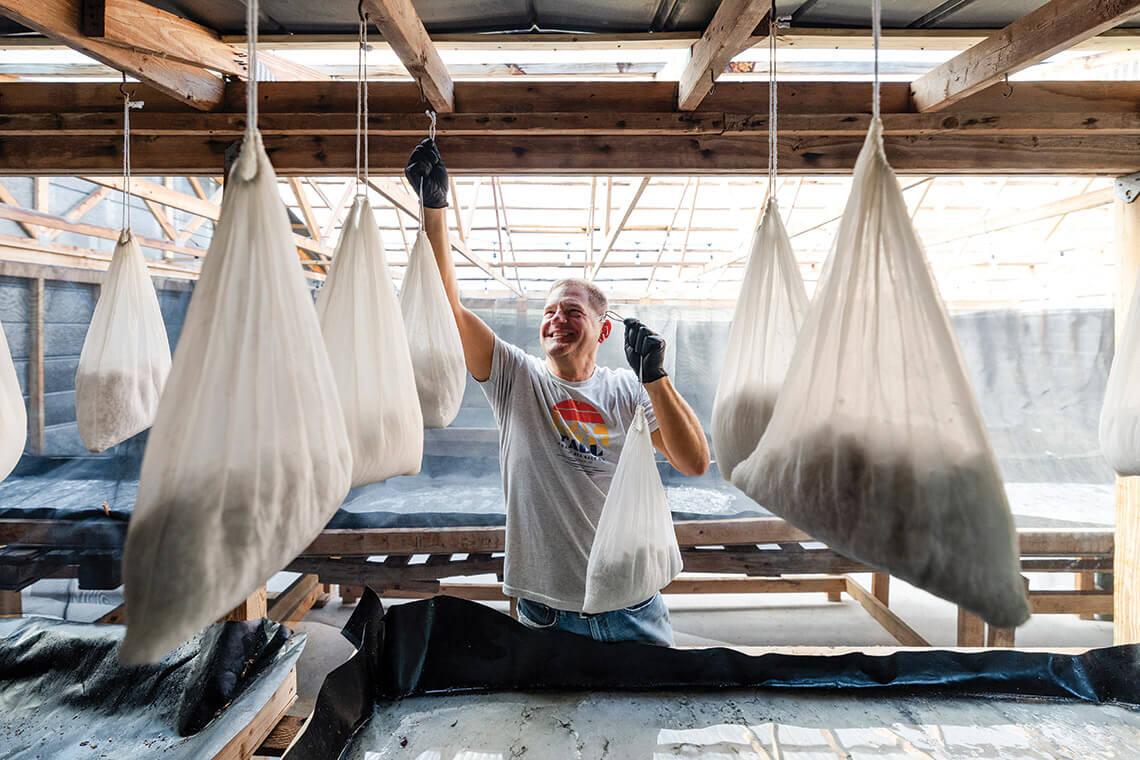
Zombron hangs the salt to finish drying before being sifted and packaged. “Being here, it gives you a lot of gratitude for where things come from,” Philips says, “for the time and energy it takes to make something.” photograph by Matt Ray Photography
Among the salt-scarred rafters and the drip-drip-dripdripdrip of drying salt, a person can witness something so simple and deliberate that it feels nostalgic, even if they’ve never been here, never seen salt harvested. It stirs the same kind of feeling as standing beside a smoking barbecue pit or watching someone shuck an oyster seaside with a pocketknife.
Philips feels it, too. “There’s no urgency, and you can’t control the outcome,” she says. “I love that about it. It really does feel like its own entity, like another part of our family — a living, breathing thing.”
Once the salt is dry, the couple carry the bags across the carport and into Sea Love’s primitive shop building.
“Everything else happens here,” Zombron says, patting a well-used table like the rump of a good ol’ farm dog. This is where they sift the salt by hand for imperfections, then jar and label it.
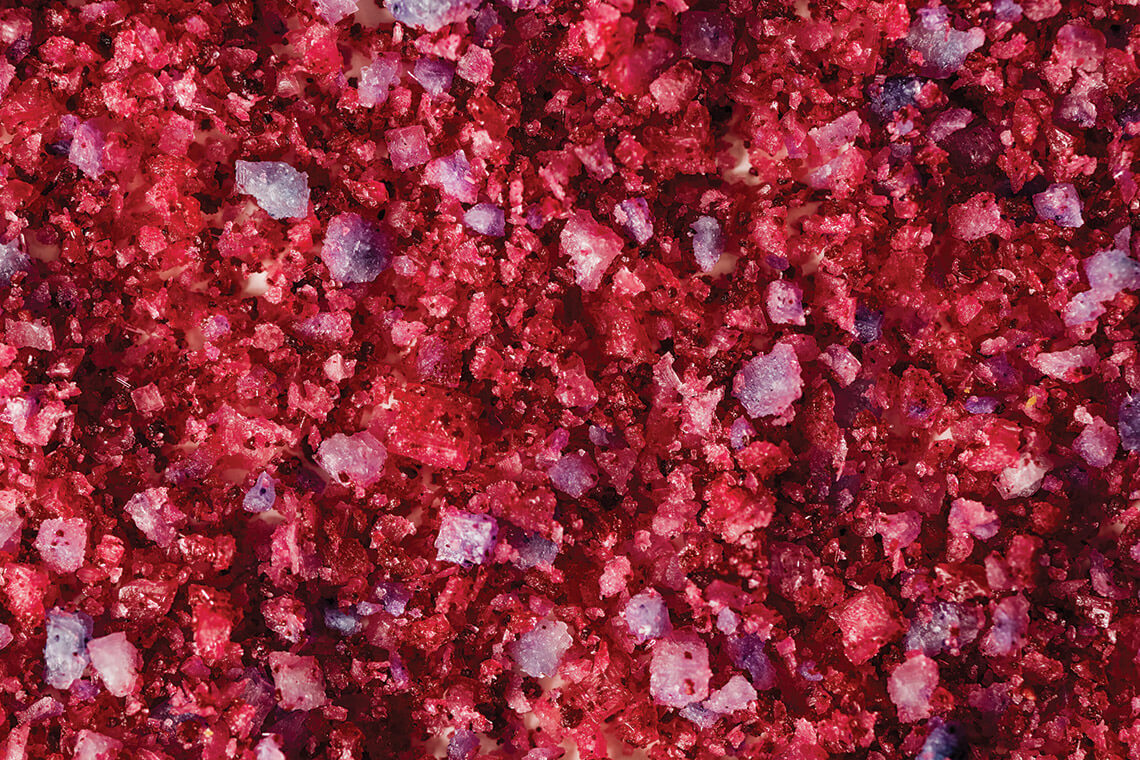
Hibiscus Sea Salt is popular on local menus around the Wilmington area. photograph by Matt Ray Photography
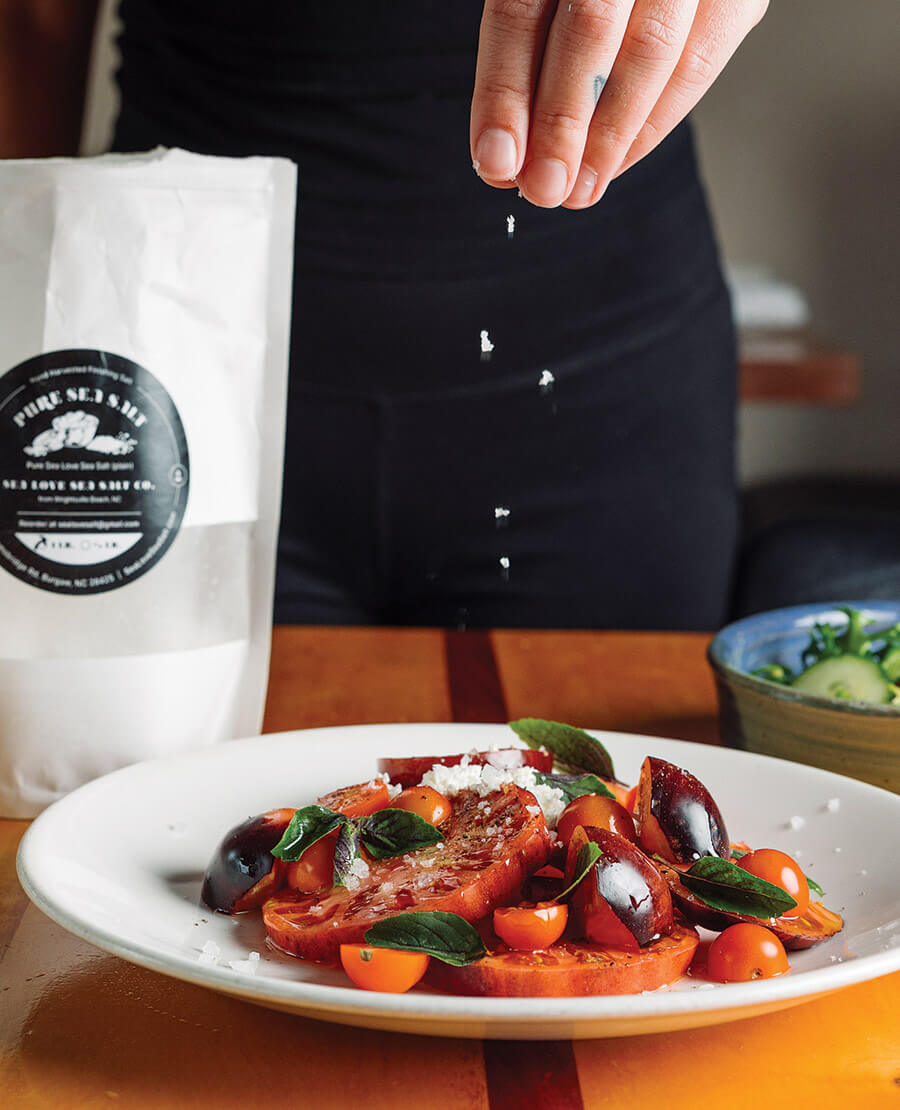
On plywood shelves beneath a “Got to be NC Agriculture” sign sit dozens of plastic bins with labels scrawled on masking tape: Live Oak Smoked, Fennel, Reaper-Bonnet, Dill Pickle. Their flavored salts. The Herbed Sea Salt — the one Philips brought Jacobs — is a best-seller. Philips is also fond of the seasonal Truffle Sea Salt, made each spring with truffles from Burwell Farms in Burlington. Zombron even started growing hibiscus in their backyard last summer to make Sea Love’s vivid fuchsia Hibiscus Sea Salt, popular for rimming cocktails.
Still, the pure sea salt is the heart of this whole operation.
“People will ask, ‘What do you put in your salt?’ ” Zombron says, laughing. “It’s ocean water and sunlight.”
At a recent market, a couple of women visiting from Ohio bought some jars to take home with them as a souvenir of North Carolina — a taste of Wrightsville Beach that they can savor long after their trip is over. Our coast, distilled.
To learn more about Sea Love Sea Salt Co., visit sealoveseasalt.com.