I was a young girl the first time I found a constellation, completely by happenstance. We were learning about Greek mythology in elementary school and had discussed the constellations associated with mythological characters. On the way home from my grandmother’s house one winter night, in the back of my mother’s car, I gazed out the window and happened to see three stars in a row. My curiosity was piqued. Orion’s Belt? I looked outward from the belt and clearly saw the shoulders, the club, the shield. I was transfixed. I didn’t utter a word to my mother or sister in the front seat. This was a moment just for me: the instant my fascination with space began.
As I continued learning about astronomy, I couldn’t get enough of the night sky. I would crawl out my bedroom window, lie on my back on the roof over our screened-in porch, and wish on shooting stars. I’d pick out constellations and planets. Sometimes, because we lived in rural Warren County with very little light pollution, I could even see the Milky Way. I was struck by the enormity of space — how many of the stars I could see were thousands of light-years away. Then I would crawl back into my room and stay up past my bedtime watching Star Trek: Voyager. I’d observe Captain Janeway and her crew traveling to distant solar systems and nebulae, discovering new phenomena, and encountering alien life, before falling asleep and dreaming of becoming an astronaut with my own space adventures.
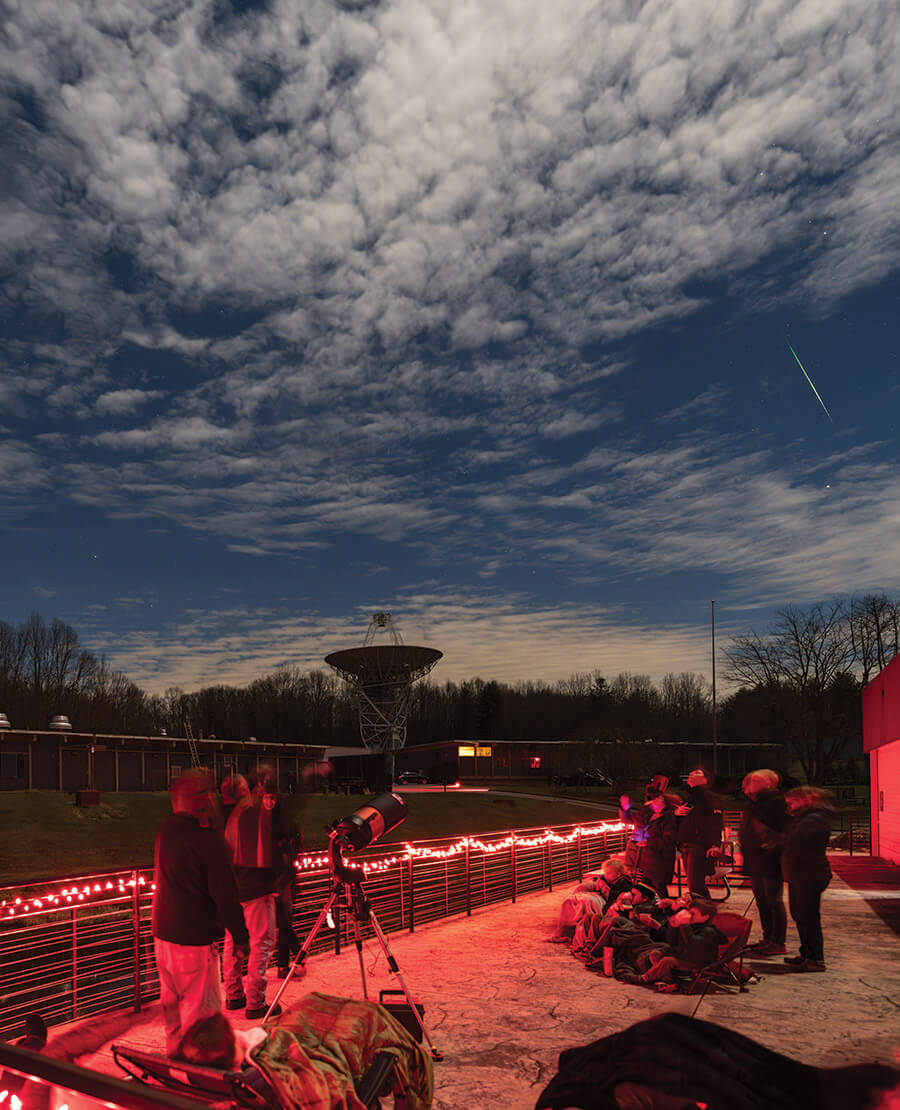
The sky lights with magic as a green meteor shoots toward Mars during one of PARI’s meteor-watching events. photograph by Tom Moors
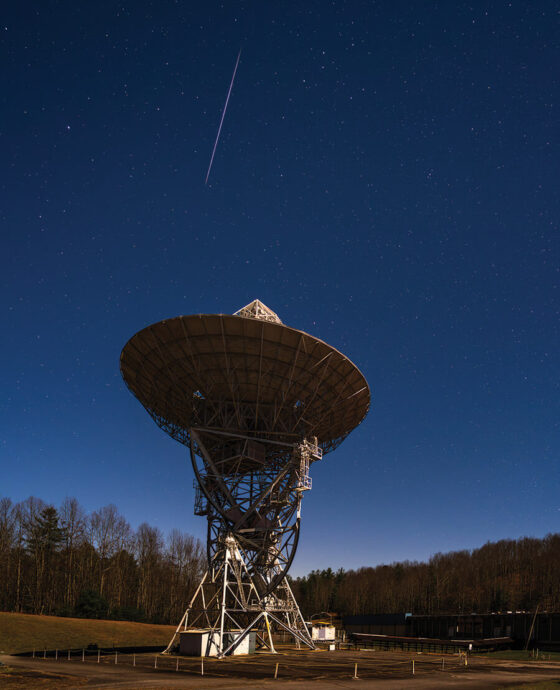
Tonight, I’ve come to Pisgah Astronomical Research Institute in Rosman with that same curiosity and eagerness that kept me looking up as a child. Here, at one of the state’s three Dark Sky Parks, surrounded by mountains and forest, is the perfect place for stargazing. It’s the peak night of the Geminids meteor shower, and PARI is holding one of its viewing events.
Meteors are bits of space debris that incandesce in our atmosphere thanks to friction, so they’re not actually stars. But “wish upon a meteor” doesn’t have quite the same ring to it. I’ve come with a wish to make, and tonight, under this vast sky, it feels like the universe might finally be listening. With Christmas magic almost palpable in this crisp, cold air, I just know it’s bound to come true.
• • •
Before heading out to the observation deck, the crowd of about 45 adults and kids is treated to a tour of the facility. We see a tire that’s been in space, a piece of a space shuttle, and a rocket engine. We see glass that a meteorite made when it struck and melted sandy soil. We see meteorites from the moon and from Mars — much rarer than lunar ones. Where did they come from? I wonder. What incredible sights have they seen on their long journeys through our immeasurable universe?
We even get to hold a lunar meteorite. This isn’t just a rock; it’s a piece of another world, and for a moment, the distance between the Earth and the moon collapses. When I’m instructed to set it on the ground and step on it, it feels like a dream come true: The little girl who once fantasized about being an astronaut gets to set foot on the moon.
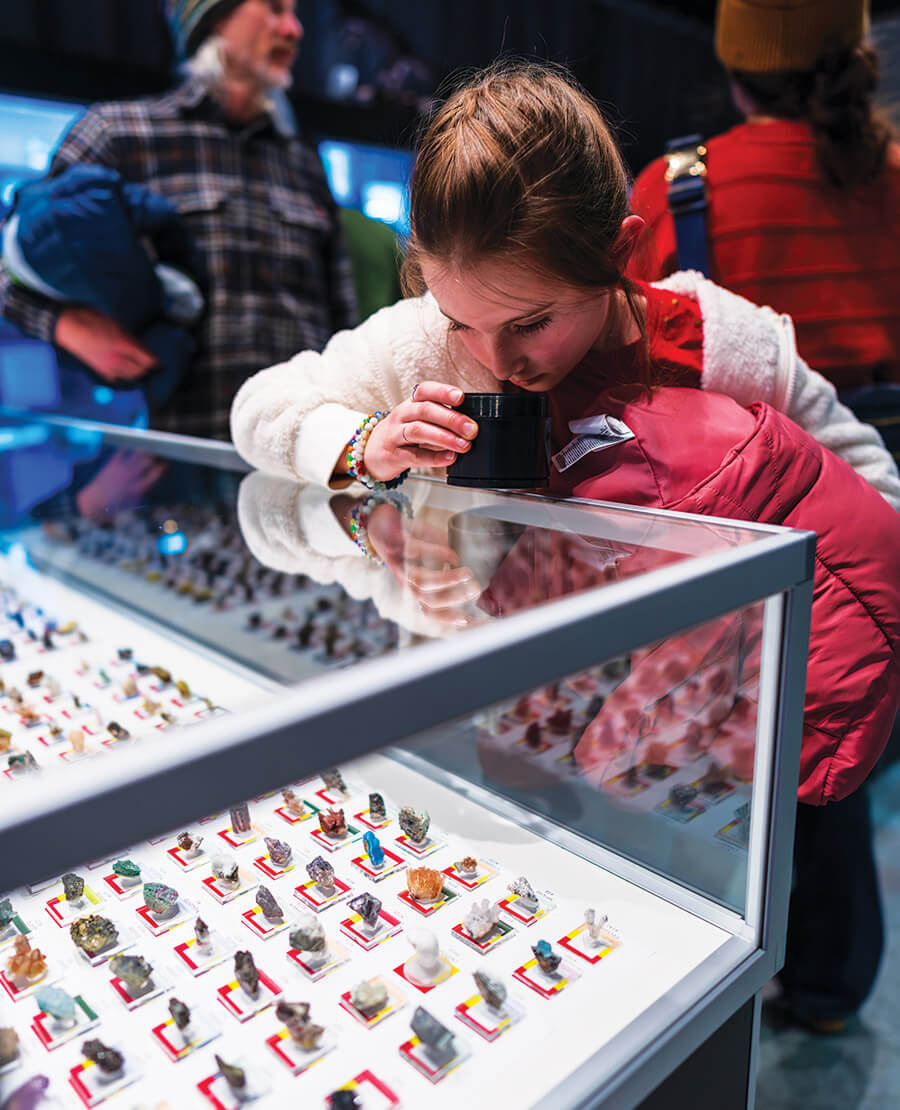
A rare collection of meteorites and minerals captivates visitors. photograph by Tom Moors
PARI volunteer Robert “Bob” Ross explains that meteors are bits of space debris that we see in the night sky, and they’re about the size of a pea or a grain of rice. Once they land on Earth — if they’re big enough not to burn up in the atmosphere — they’re called meteorites. Sometimes, he says, you can see a meteor skip across the edge of the atmosphere like a stone skipping over water. Ross tells us that fireballs are debris that range from as small as an adult’s fist to as large as a basketball, and they burn more brightly — and burn in color. I’ve seen one! I think. A flash of brilliant green, outside the movie theater in Henderson when I was in middle school. It left me awestruck.
Meteors light up, Ross tells us, because they whiz through the atmosphere at approximately 20 to 50 miles a second. They’re more common than most of us realize. “Some estimate that 50 tons of meteor stuff per day vaporize in the Earth’s atmosphere,” he says. “You could actually harvest meteor dust from your roof if you were so inclined.” If only I had known, as a child looking up at the night sky from my rooftop, that I was lying on pulverized space debris.
Meteor showers are usually produced by debris from a comet’s tail, but the Geminids are different. This one is caused by debris trailing off an Apollo asteroid — a group of asteroids that cross Earth’s path — that’s three to four miles in diameter. They’re called the Geminids because they appear to radiate from the constellation Gemini.
• • •
Once the educational programming wraps up, we head outside to view the shower. It’s cloudy when we first get to the observation deck, and it’s getting pretty chilly. Will I get to make my wish tonight?
Suddenly, the stubborn canvas of gray splits. A white light streaks across the thin gap in the clouds, quick as a blink. A collective gasp ripples through the crowd, followed by an explosion of boisterous cheers. With this one meteor comes a little spark of hope to see more. Maybe I’ll make my wish tonight, I think. But not yet. It’s got to be the right meteor.
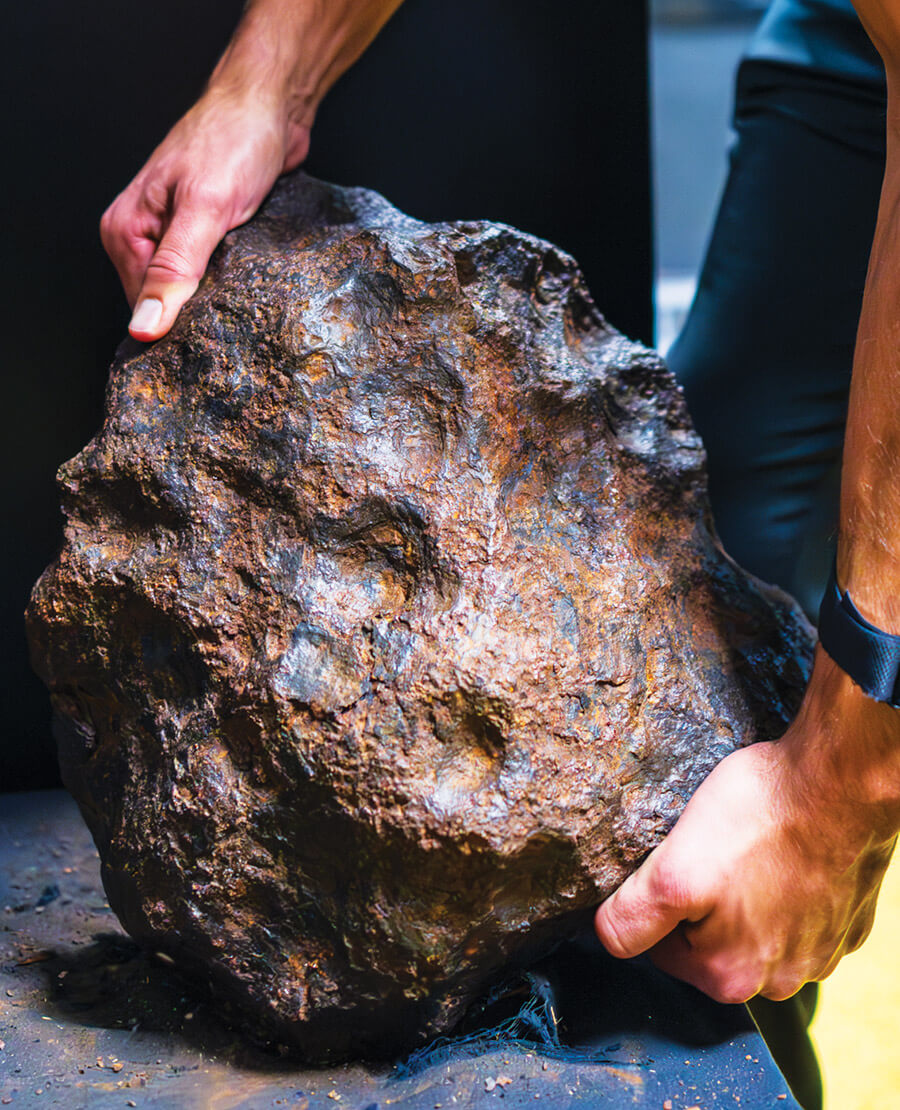
Guests can try lifting an iron meteorite weighing more than 100 pounds. photograph by Tom Moors
As the sky begins to clear, Ross sets up a telescope, and folks take turns viewing the moon. Peering through the eyepiece, I can see the moon’s rough, pockmarked surface. Ross explains how we can only ever see one side of the moon, and for this reason, “If you were to go to the moon and look back at the Earth, the Earth is never going to change its position in the sky. It’s going to sit there and not rise, not set, and it’s going to spin in place.” Oh, to be an astronaut and see such a sight.
Next, Ross cues up Jupiter. I lean in. Tiny pinpricks of light, four of its 95 moons (95!), surround the gas giant. On the planet, I see swirling bands of ochre and cream. “Those are the cloud tops of Jupiter — big storms, just like clouds here, but it’s all volatile gases. It’s not water vapor. It’s all toxic,” he says. “And Jupiter is way bigger than us. There’s a persistent storm on Jupiter that’s as big as three Earths.”
There are things in the universe that are so immense, so far away, so splendid, they put one’s earthly troubles into perspective. It’s surely enough to make one feel small.
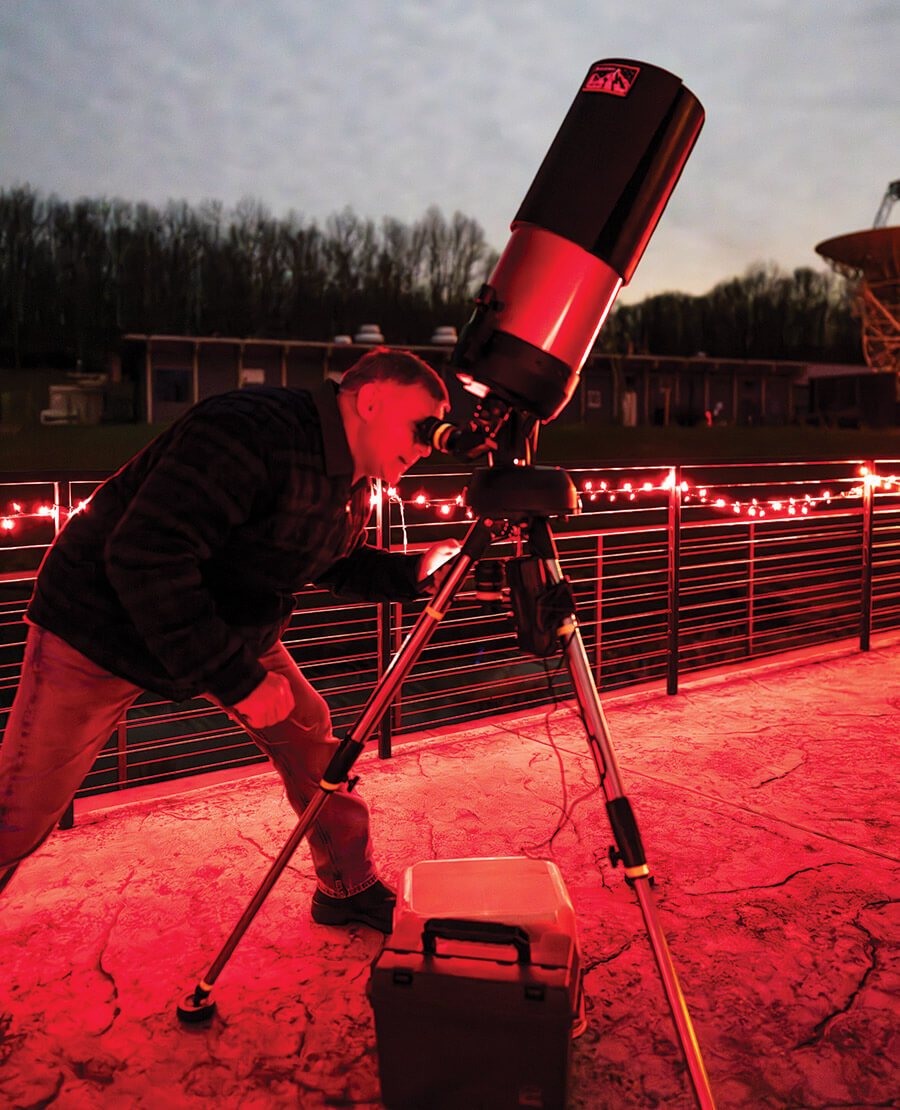
Tommy Wilkinson, president of the Astronomy Club of Asheville, gazes into the night sky through a high-powered telescope on the observation deck. photograph by Tom Moors
As the sky continues to clear, I settle in to watch for streaks of light. We begin to see more as the night progresses. Around 10 p.m., the crowd disperses, as many are parents with small children. But I’m determined to stay up until the wee hours of the morning, the time predicted for seeing the most meteors. With the nights being long this time of year, I’ve got all the time in the world to watch — and wait.
As the temperature drops below freezing, I wrap more blankets around myself. Still, there’s a numbing cold in my fingers and toes. It’ll be worth it, I know, if I get to see something really extraordinary. Then, it’s 3 a.m. My body is shivering, my teeth are chattering, but my eyes stay fixed. Finally, it happens. A streak of electric blue! Vivid! Brilliant! A fireball! Only the second I’ve seen in my life. My breath catches. This isn’t just a meteor; it’s a sign. The same childlike certainty that once pulled me onto the roof now courses through me.
This is my chance. I close my eyes, the cold air sharp on my face, and make my wish.
Pisgah Astronomical Research Institute
1 PARI Drive
Rosman, NC 28772
(828) 862-5554
pari.edu
print it