Murphy to Manteo: Finding new adventures, historic detours, and the soul of North Carolina on the state’s longest highway: U.S. Route 64. Read the series.
I’m lying in the pitch black, my sleeping bag and blankets pulled up to my chin, when the tent separating me from the chill of the night suddenly feels rather insignificant. I should be slumbering to the sweet sounds of nature: the faint buzz of insects, the gentle breeze through the branches, the water lapping against the dock.
Instead, I’m smack in the middle of a troop of wild monkeys that’s hooting and hollering and chattering above me in what sounds like a party that’s gotten out of hand. I imagine them swinging from the branches, wrestling in the trees. Silence briefly falls, and in the gloom, I peer over at my husband, Alex, who’s staring upward, wide-eyed.
“Do … do you think they’ll ever quiet down?” he whispers, like we’re living next to a fraternity house.
“I think we aren’t going to sleep tonight,” I say, smashing my pillow over my ears.
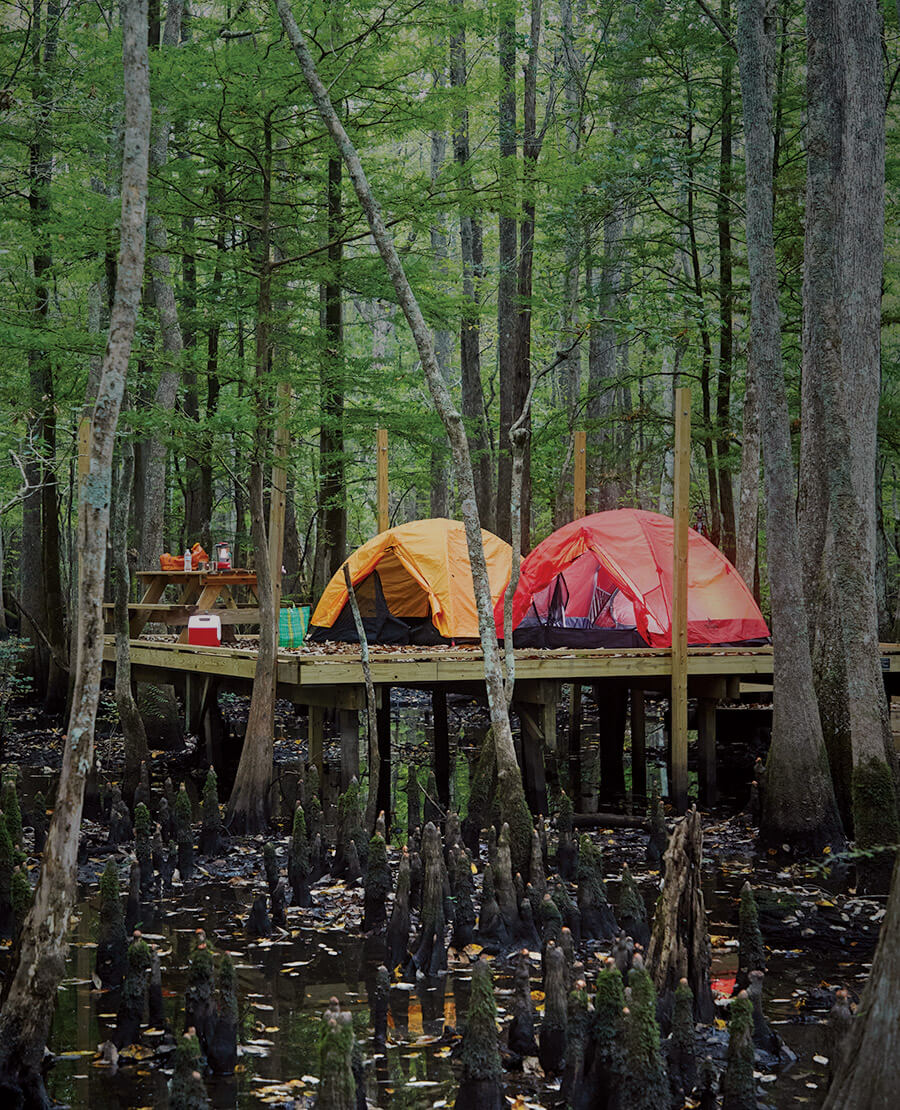
At Barred Owl Roost, the raised platforms are large enough to hold six paddling campers and their tents. photograph by Chris Rogers
I grew up camping with my family across the state. One year, among the dunes on Ocracoke, the no-see-ums were so bad that we abandoned our tents in the middle of the night for the last hotel room on the island. Another time, after a freak rainstorm flooded our campsite at Stone Mountain State Park, us kids all piled into the cars to sleep.
But there’s no abandoning this campsite — because we’re surrounded by water on all sides. On a wooden paddle-in camping platform. Deep in a swamp. Three miles up the Roanoke River.
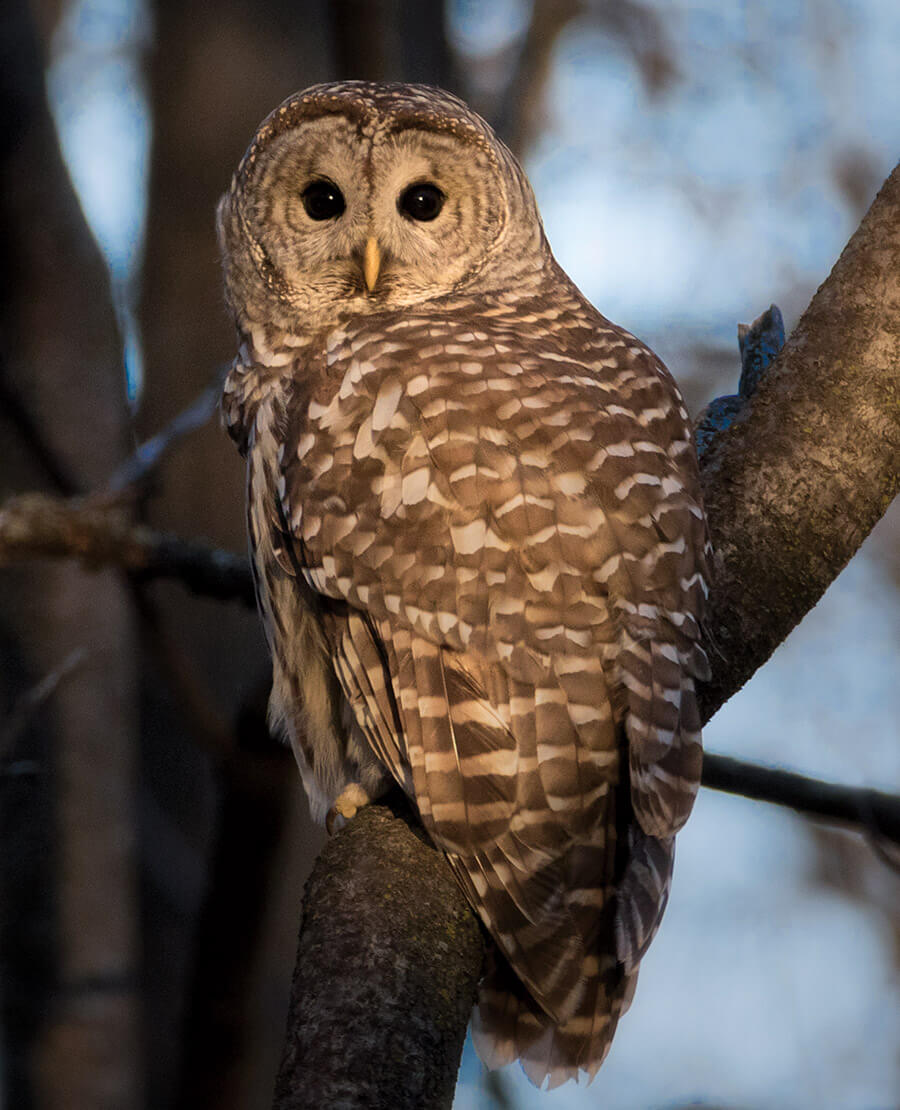
Since barred owl caterwauling is seasonal, you may get lucky and enjoy a quieter night out in nature. photograph by Jean Landry/iStock/Getty Images Plus
I close my eyes as another call echoes around us and imagine the monkeys picking up this tent and carrying it off to the Wicked Witch. And, as strange as it sounds, that inches closer to the truth — because the clamorous troop of monkeys is actually a parliament of barred owls.
Barred owls, also known as hoot owls — and isn’t that an understatement? — are known for their iconic and distinctive call through the woods: Who cooks for you? Who cooks for you all? But a midnight Google tells us that — oh, by the way — they’re also known for their monkey-like vocalizations called caterwauling, which, by definition, means “a shrill howling or wailing.” Oh. Good.
Beyond our tent, our kayaks float serenely in the darkness.
• • •
Our journey BEGAN when we loaded up and launched into the Roanoke from the North Carolina Wildlife Boating Access in Jamesville, just off Highway 64. With clear blue skies, we paddled upstream to a bend in the river, where we entered Devil’s Gut. Despite its spooky name, the side channel was the picture of solitude, its still, dark waters rippled only by the kerplunk of fish and turtles. The current, which we’d heard could sometimes be challenging? Nearly nonexistent. Our phones? On silent in the dry bag. Our son? With Grandma — for our first joint night away. And before us: an escape into nature’s peace and quiet.
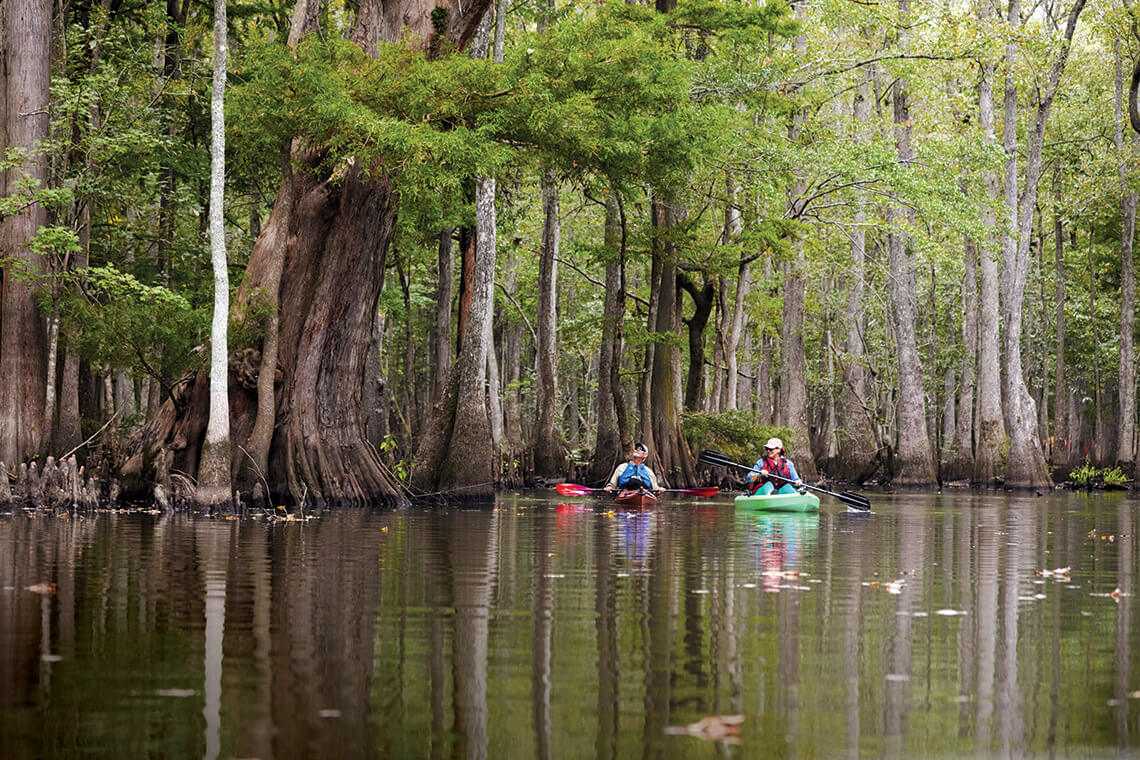
Paddle beneath towering bald cypresses in the Roanoke River. photograph by Chris Rogers
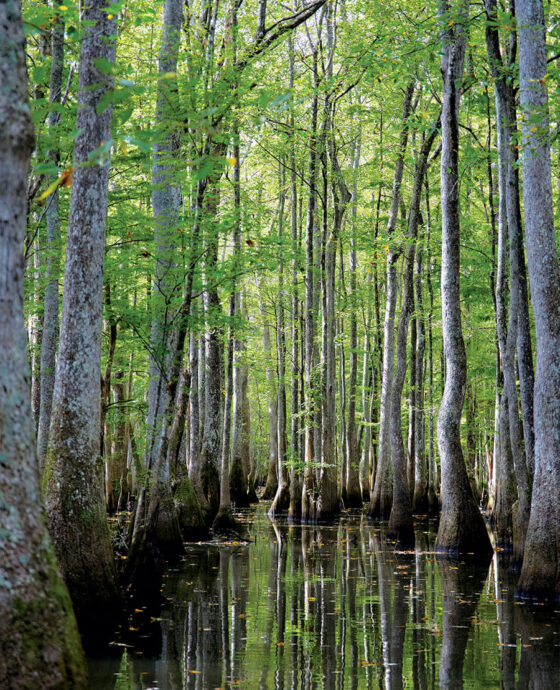
There were no shores to speak of. Instead, on either side of the channel, tupelo gums and bald cypresses grew straight out of the water, a forest of thick, wide trunks and knobby protruding “knees” that Alex and I silently coasted by. These bottomland swamp forests create a unique ecosystem that makes this segment of the Roanoke River a wonderland for wildlife — and fishermen, bird-watchers, and paddlers like us.
Lily pads and leaves speckled the water like confetti. We breathlessly watched a great blue heron cruise the channel like a highway until he disappeared. We were surprised by an osprey that took flight from a branch just over our heads. The only humans we saw were fishermen, and I gave Alex a stern look that said, Don’t you dare disturb them by asking 50 questions about their bait. He obliged.
This 410-mile-long river flows past riverports. It widens before emptying into Albemarle Sound — the largest river basin in the state. But to us, here, it felt like a secret.
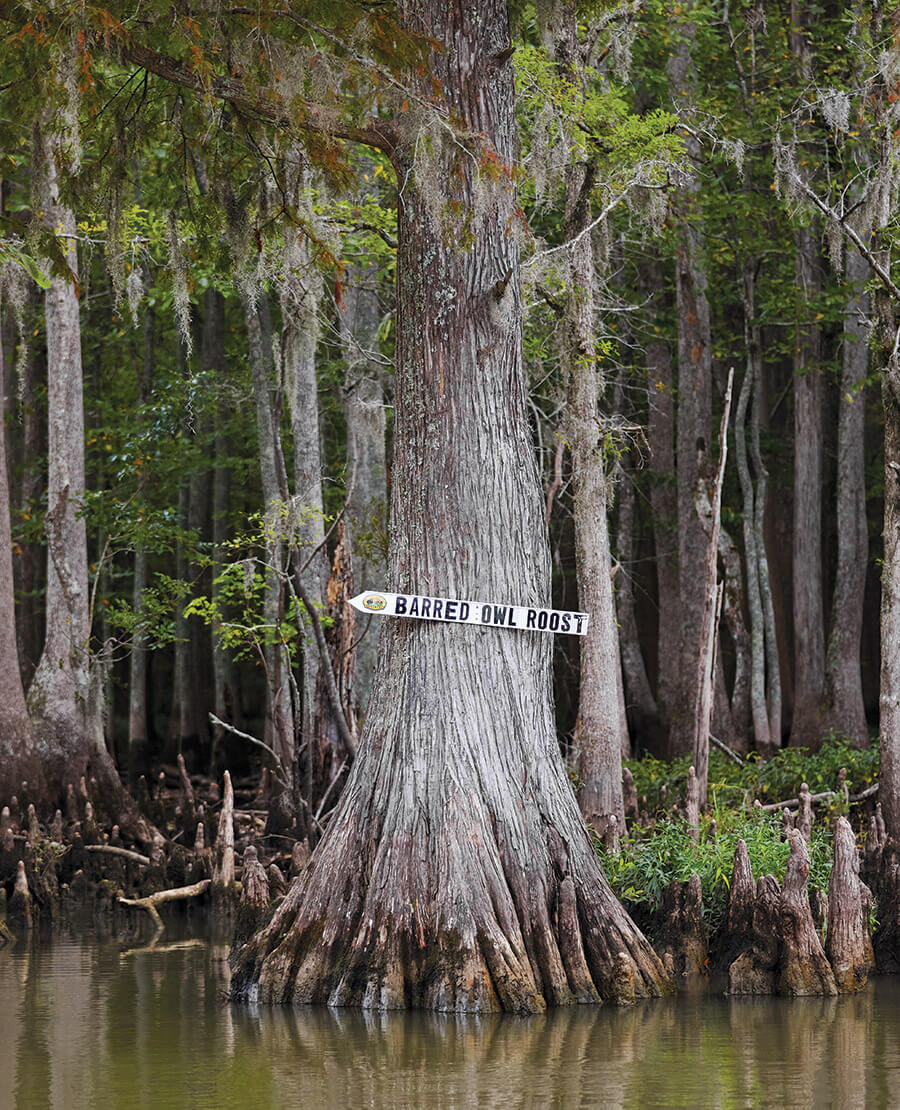
Barred Owl Roost photograph by Chris Rogers
After about a mile of leisurely paddling, we reached the next split, where a gigantic tupelo gum draped with Spanish moss stuck out farther in the water, signaling the start of Lower Deadwater Creek — the Roanoke’s version of a highway marker. On its trunk, a thin white sign with capital letters pointed us toward our destination, deep in the bottomlands: Barred Owl Roost.
One of a series of tent-camping platforms built by Roanoke River Partners, Barred Owl Roost can only be reached by kayak or canoe. By now, we had just a little less than a mile to go. The channel slowly closed around us until, suddenly, we were simply paddling among the towering trees themselves, dappled sunlight filtering softly through the leaves.
“I didn’t know that a swamp could be so …” Alex whispered. Me either.
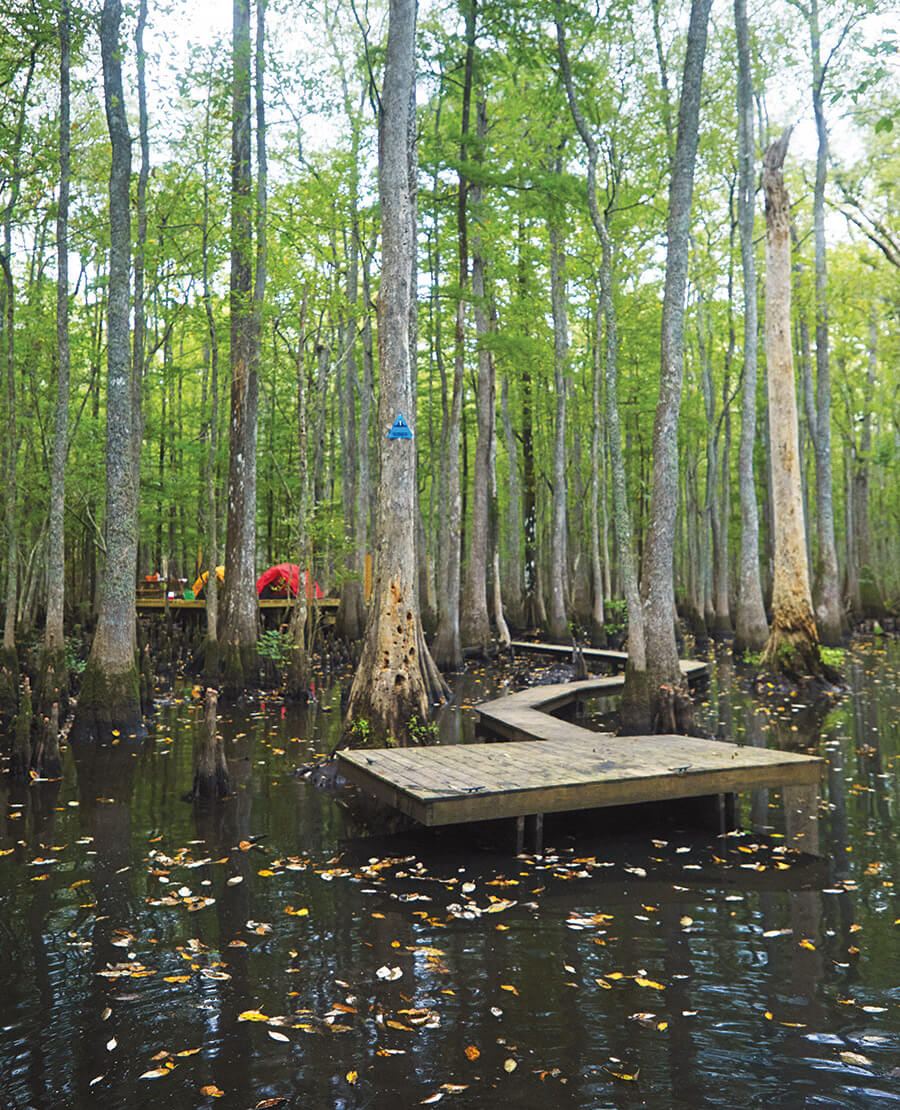
Roanoke River State Trail, managed by Roanoke River Partners, begins in Roanoke Rapids and, with access points all along, follows the river to Albemarle Sound. photograph by Chris Rogers
And then, the dock and the thin, winding pier that connects to the large main platform, complete with a picnic table, appeared like a mirage. They looked like they were floating.
As we tied up our kayaks and unloaded our supplies for the night — water and sandwiches; tent, sleeping bags, and lantern — the only sounds were the occasional insect chirps and birdcalls. Our only neighbors were so many trees, with their knobby knees, twisted trunks, and waterlines. Ah, solitude, I thought. But as twilight fell, we quickly learned that every echoing sound in the swamp is eerier and more unknowable in the darkness — and just how the Barred Owl Roost Platform earned its name.
• • •
“Maybe they should have called it ‘Barred Owl Party Platform,’” Alex says thoughtfully.
“I didn’t know,” I whine, “that I would get more sleep with a toddler at home than I would in the middle of nowhere.”
But we must fall asleep at some point, because I wake to the pure silence I’ve been longing for. The owl-monkeys have settled their differences, flown back to Oz, hunkered down until nightfall, or, for all I know, were my imagination. I certainly see no sign of them when I unzip the tent to reveal the watery wonderland that surrounds us. It still feels like a dream. Leaves float lazily past like tiny yellow boats on the black water. Our boats still float, too, but I’m surprised to find I’m less excited to see them this morning than I would’ve expected at 2 a.m.
Nature, I’m reminded, is not always a place of peace and quiet. But if you’re lucky, you paddle back to reality feeling restored just the same.
Learn more about the Roanoke River camping platforms — and make a reservation — at roanokeriverpartners.org.
More to Explore: To read our roundup of great places to paddle in and camp out, visit ourstate.com/paddle-and-camp.
print it