On the beach in Nags Head, zipped into a full-length wet suit with fins in hand and an air tank strapped to my back, I’m pleased to find a mostly blue sky and sunlight glinting off the water’s surface, calm in the still air.
While sunshine means little to a scuba diver, wind and heavy rain can chop the surface, stir up sand that limits visibility, and create surges deep below that toss you around like a tumbleweed. Waves and currents also reshape the ocean floor, pulling sand from beaches and bars and depositing it elsewhere. The underwater landmarks divers rely on one day may be gone the next.
The Outer Banks are constantly changing shape — part of why an estimated 5,000 ships now rest in the Graveyard of the Atlantic. Hundreds of those wrecks lie in less than 130 feet of water, within recreational diving limits. Civil War blockade runners, German U-boats, and World War I steamers offer glimpses of North Carolina history that few people ever see in person.
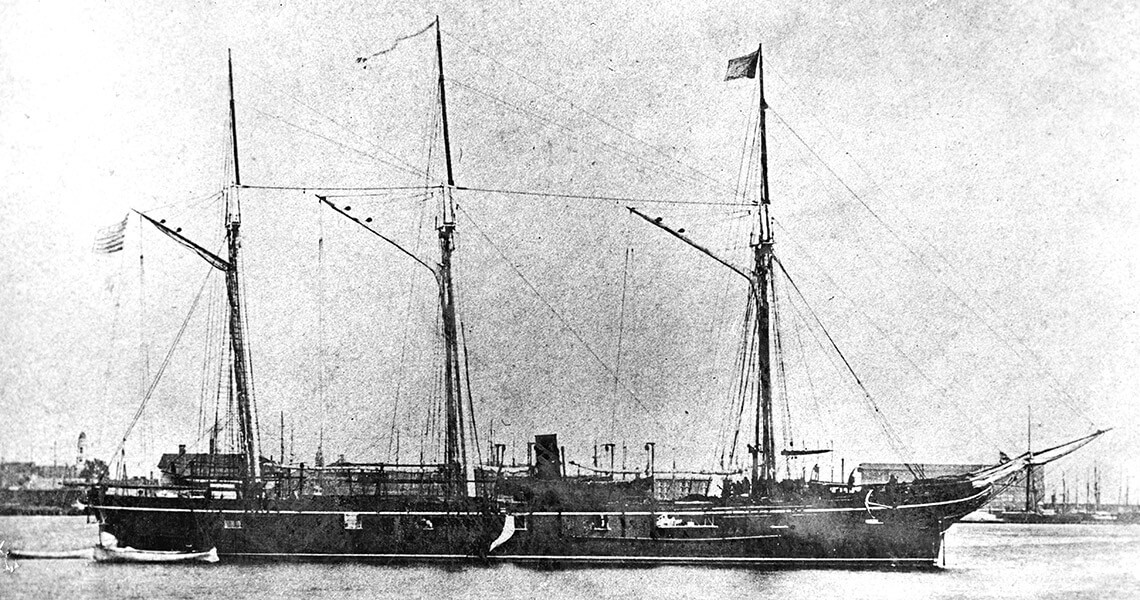
USS Huron Photography courtesy of THE OUTER BANKS HISTORY CENTER, STATE ARCHIVES OF NORTH CAROLINA
Today, Pam Landrum of Roanoke Island Dive Shop is leading me and a group of divers to one such wreck: a Civil War steamer called the USS Huron. It’s been about two weeks since Hurricane Erin passed off the North Carolina coast in August 2025, and though it never made landfall, it churned things up.
“The weather gets a vote,” my dad often says. It’s an old military adage meaning that any outdoor mission has to take Mother Nature into account.
Earlier this summer, about 25 feet of the ship’s 175-foot hull were exposed. But one storm can change everything.
• • •
That was the case for the Huron in November 1877. Commissioned in 1875 as one of the country’s last iron warships before the Navy switched to steel, the Huron spent much of its service surveying the northern coast of South America. After repairs in New York City in the fall of 1877, the steamer set off for Cuba. It never arrived.
On November 23, the ship stopped to gather supplies in Hampton Roads, Virginia. From there, rather than sail against the Gulf Stream, the commander decided to take a route closer to North Carolina’s shore.
That night, a dense fog settled in. Heavy wind and rain roiled the sea. The compass malfunctioned.
The Huron passed Currituck Beach Lighthouse, but before the crew spotted Bodie Island’s light, the ship ran aground on a sandbar off Nags Head, just 200 yards from shore.
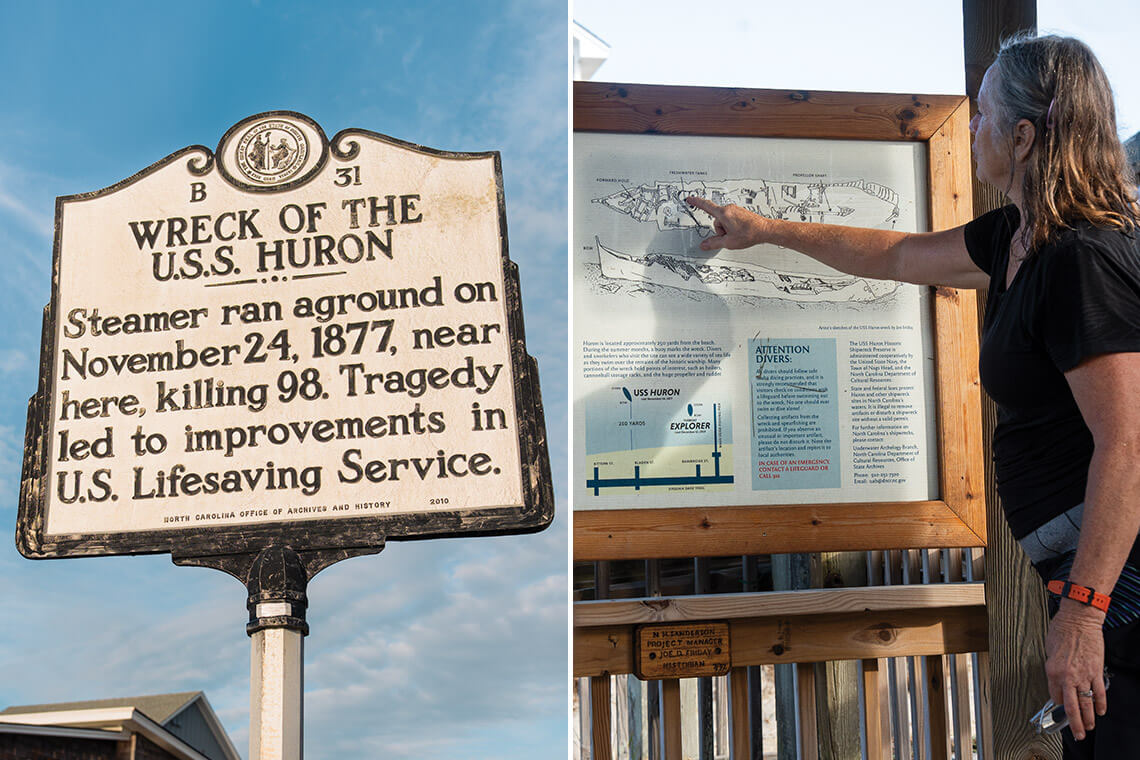
Pam Landrum, owner of Roanoke Island Dive Shop, has been diving on the Outer Banks since 1991 and has logged more than a thousand visits to the Huron wreck site. photograph by Chris Hannant
While the nearest lifesaving station was just two miles away, it was closed for the season. Nags Head residents watched helplessly as the crew fought for their lives. Some were able to swim to shore through the raging surf and freezing temperatures, but 98 of the 134 men on board died that day.
The national tragedy — along with the wreck of the Metropolis, which killed 85 people 23 miles north two months later — marked a turning point for the U.S. Life-Saving Service. Congress approved more funding for year-round staffing, added 11 stations along the North Carolina coast, and invested in equipment, management, and training. Over the next several decades, before merging with the Revenue Cutter Service to become the Coast Guard, the service saved more than 186,000 lives nationwide.
The Huron remains where it sank, a solemn reminder of the human cost.
• • •
Today, the Huron is one of two state-recognized Heritage Dive Sites in North Carolina. (The other is the Condor, a Civil War blockade runner off Kure Beach.) In 1991, some passionate local divers worked with the town of Nags Head, local groups, and the Underwater Archaeology Branch (UAB) of the Office of State Archaeology — the nation’s oldest such organization — to erect a historical marker for the Huron at the Bladen Street Beach Access and construct a gazebo with a small exhibit detailing the wreck’s history, significance, and layout.
Joe Friday and N.H. “Sandy” Sanderson were among the divers who worked to secure this rare designation. Friday became fascinated with shipwrecks after visiting Ocracoke and reading David Stick’s Graveyard of the Atlantic in 1982. Soon afterward, he moved to Nags Head, where he worked for Sanderson, an avid diver who had recently started the town’s ocean rescue service. “A country boy from Dallas, North Carolina, not knowing anything much about scuba diving, I saw Sandy gear up and put his tanks on and swim out to the [Huron],” Friday says. “And I’m standing on shore watching, and it’s like, Wow, this is so cool.”
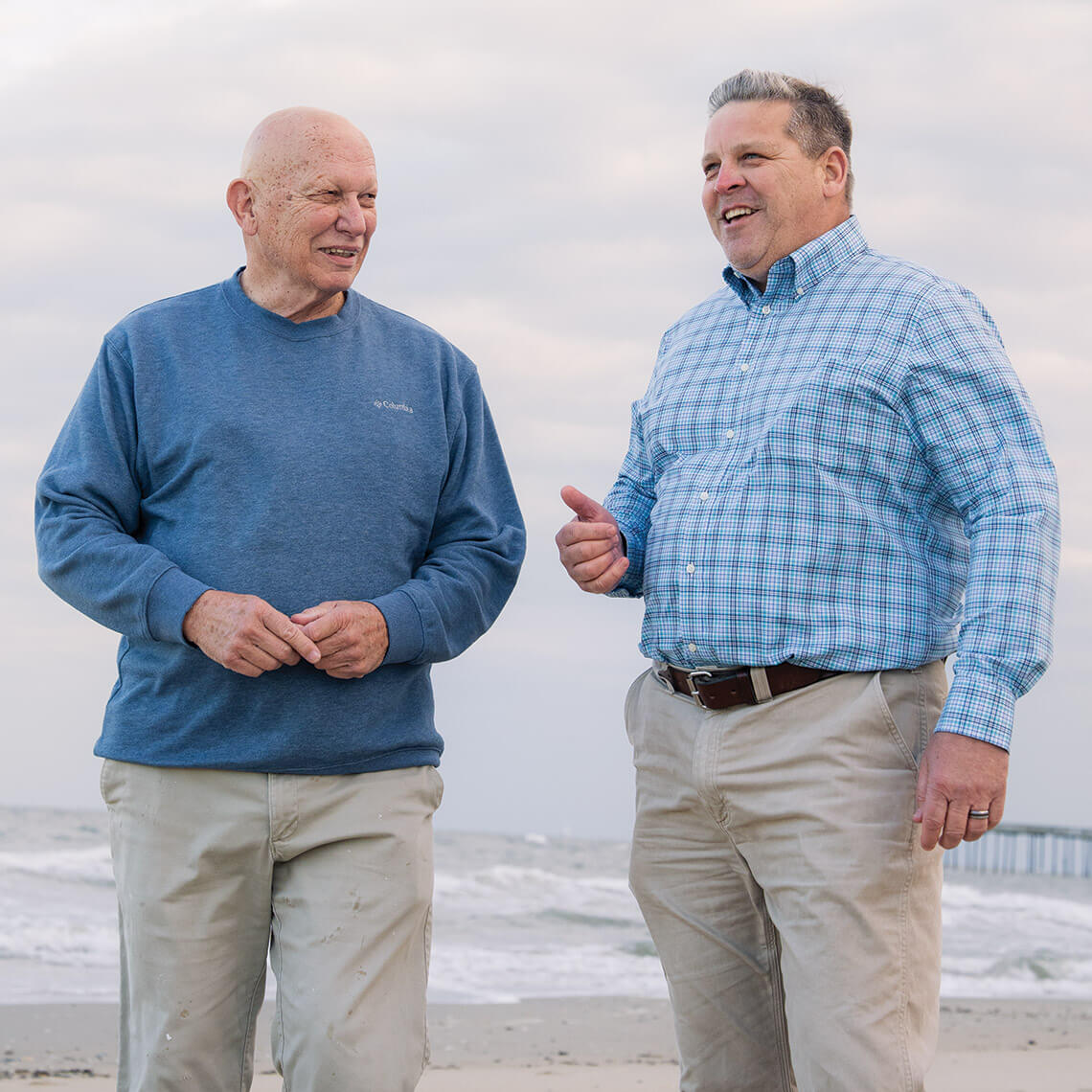
Sandy Sanderson (left) and Joe Friday helped secure a heritage designation for the Huron, where divers — and fish — continue to explore the wreck’s remains. photograph by Chris Hannant
After earning his undergraduate degree from Lenoir-Rhyne University, Friday went to East Carolina University for a master’s in maritime history, focusing his thesis on an archaeological survey of the Huron. In 1987 and ’88, he worked with the UAB on a survey and excavation of the wreck, creating the first official map of the site and recovering artifacts — portholes, cannonballs, pistols — now housed at the UAB and the Graveyard of the Atlantic Museum.
It was during that work, he says, that his interest shifted from “being sort of a treasure hunter to the significance of the wrecks and what they meant to the community,” he says. “I like the human-interest stories — what happened to the people who were on the [Huron], or who were on the beach, or who lived in Nags Head and witnessed the wreck.”
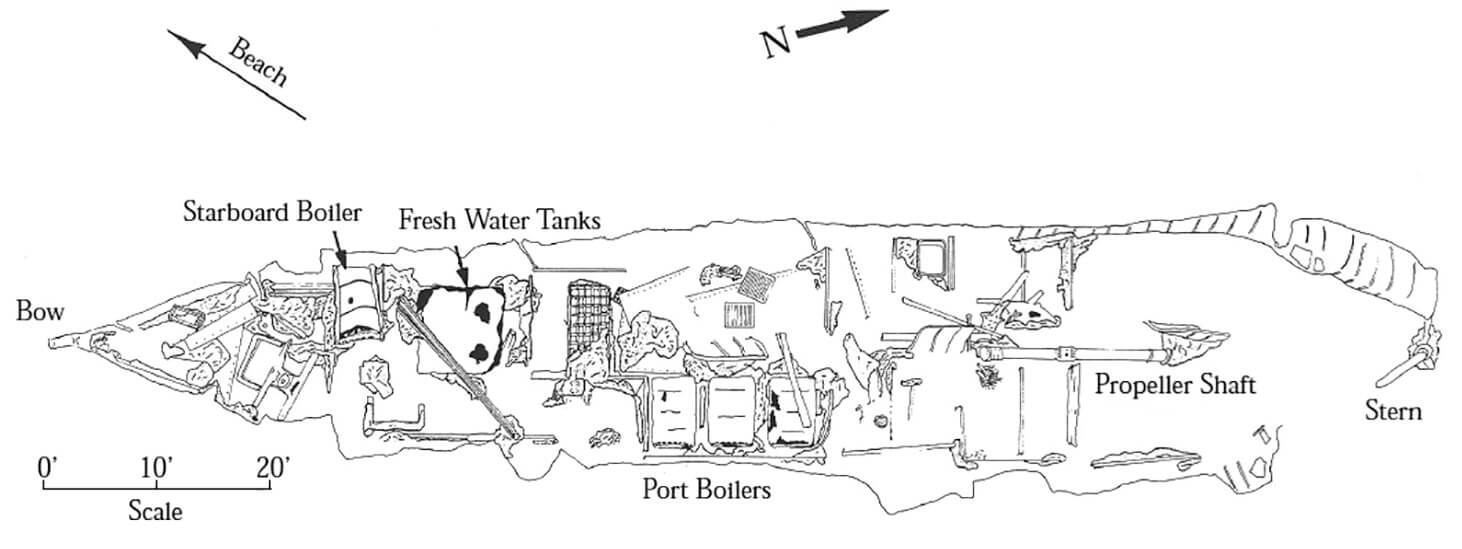
illustration by Joe Friday, Jr., Courtesy of the Department of Natural and Cultural Resources Underwater Archaeology Branch
Friday never pursued a career in marine archaeology and hasn’t dived in years, but those stories still fascinate him, and his research on the Huron continues. “We didn’t have the internet in 1988,” he says. “I could write a whole other thesis on things that I found just by sitting in my living room, going through records that I find online.”
Friday’s efforts with Sanderson and the UAB in the 1980s and early ’90s continue to serve the Outer Banks dive community. For Landrum, the Huron was the first ocean dive she ever completed. That was in 1991. Since then, she has returned three or four times a week each summer. Between the sea life and the wreck’s habit of appearing and disappearing beneath the sand, “it changes every time you go,” she says. “You just never know, which is the fun of it. After 30 years, I never get bored.”
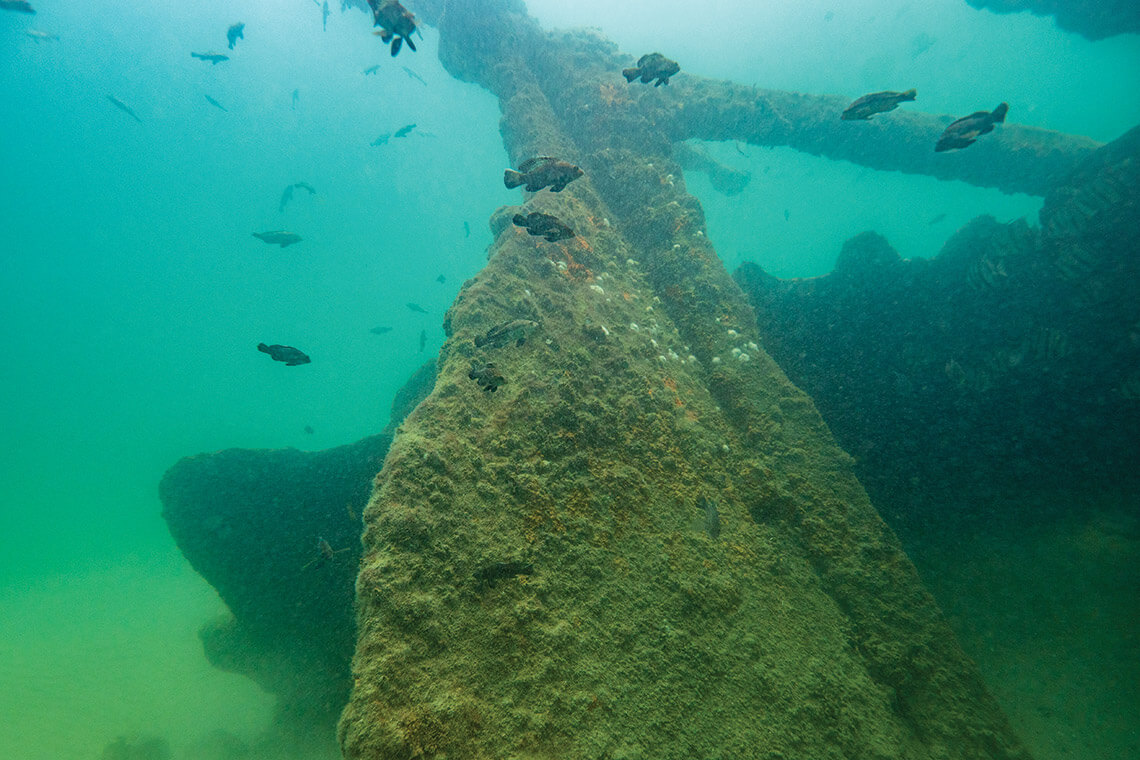
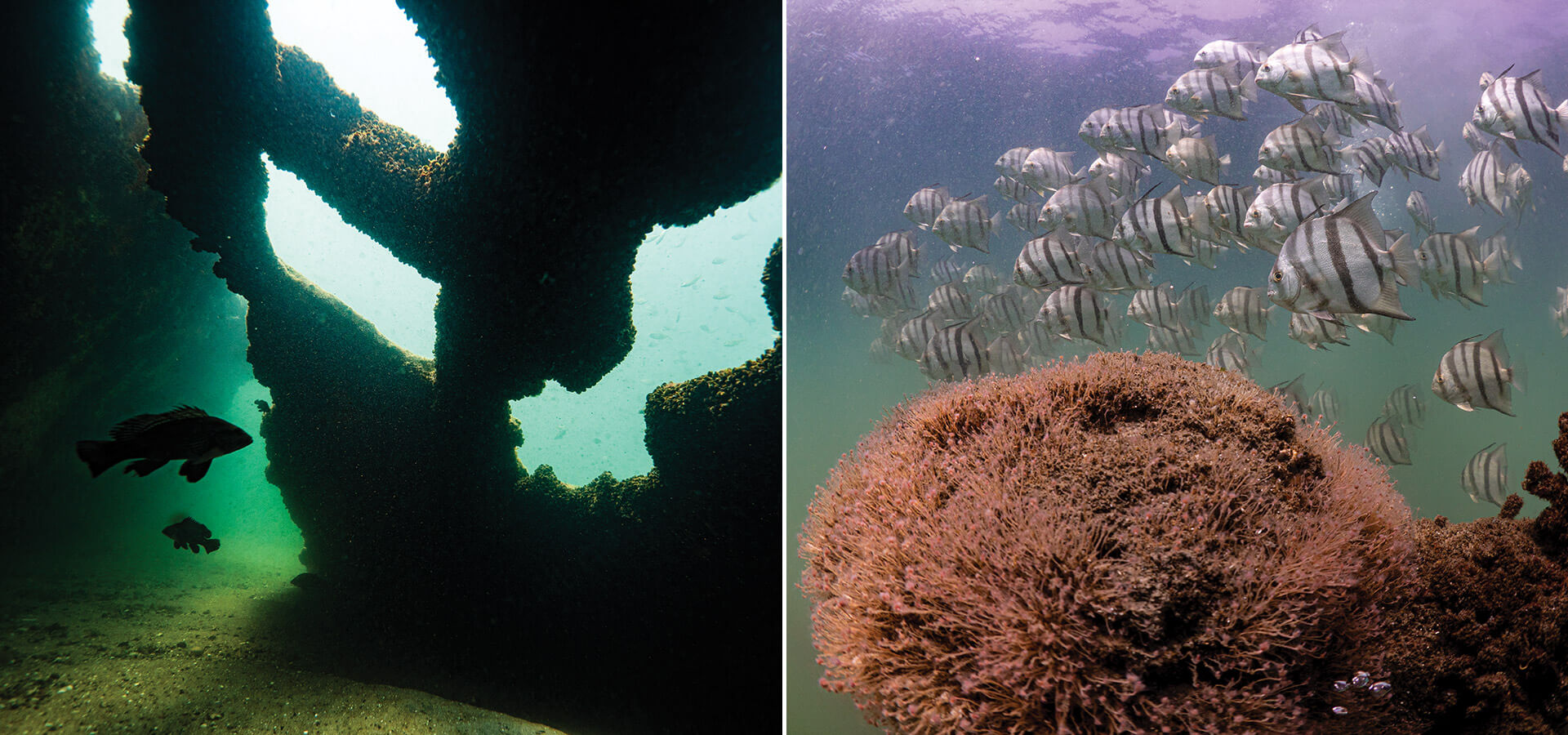
When visible, the wreckage of the Huron offers a habitat for marine life. photograph by Marc Corbett
Most of the artifacts in and around the Huron have been recovered or removed, but Landrum still recalls a haunting discovery from soon after she began diving it. “We could see the shoes of the people who lost their lives sticking out of the side of the wreck,” she says. “I was hoping I didn’t see bones sticking out of them. That’s all I could think of was the people that lost their lives right there. That’s kind of spooky. There they were, just going down the coast, and next thing you know, they’re swimming for their lives.”
In recent years, excess sand from beach renourishment projects — intended to counter coastal erosion — has at times covered even more of the wreck and worsened visibility. Landrum is now one of the only dive masters still taking people to the Huron, though the local dive community remains deeply invested in the wreck and its place in North Carolina’s maritime heritage. “The locals are very connected to that wreck. They’re very protective,” she says. “It’s part of Nags Head history.”
• • •
Scuba — short for “self-contained underwater breathing apparatus” — offers a perspective on the world that not many people get to experience: floating weightlessly below the surface, listening to the hollow sound of slow inhales and the bubbly gurgle of exhales, with nothing to distract from the wonders around you.
Before we wade into the waves in search of the Huron, Landrum warns us that we might not see much. The water is murky today. “But it’s good to do a beach dive, a low-vis dive,” she says, staying positive. “It all adds to your tool kit.” None of the eight or so divers going out today turns back. Whether we see anything or not, we’re all just happy to get underwater.
My dive boots squish in the sand as I wade into the surf. The water, surprisingly warm, seeps through my wet suit and creeps up my body as I push past the waves and pull on my fins. Then I fall backward into the water, my inflated vest keeping me afloat as I kick on my back toward the buoy bobbing about 200 yards offshore.
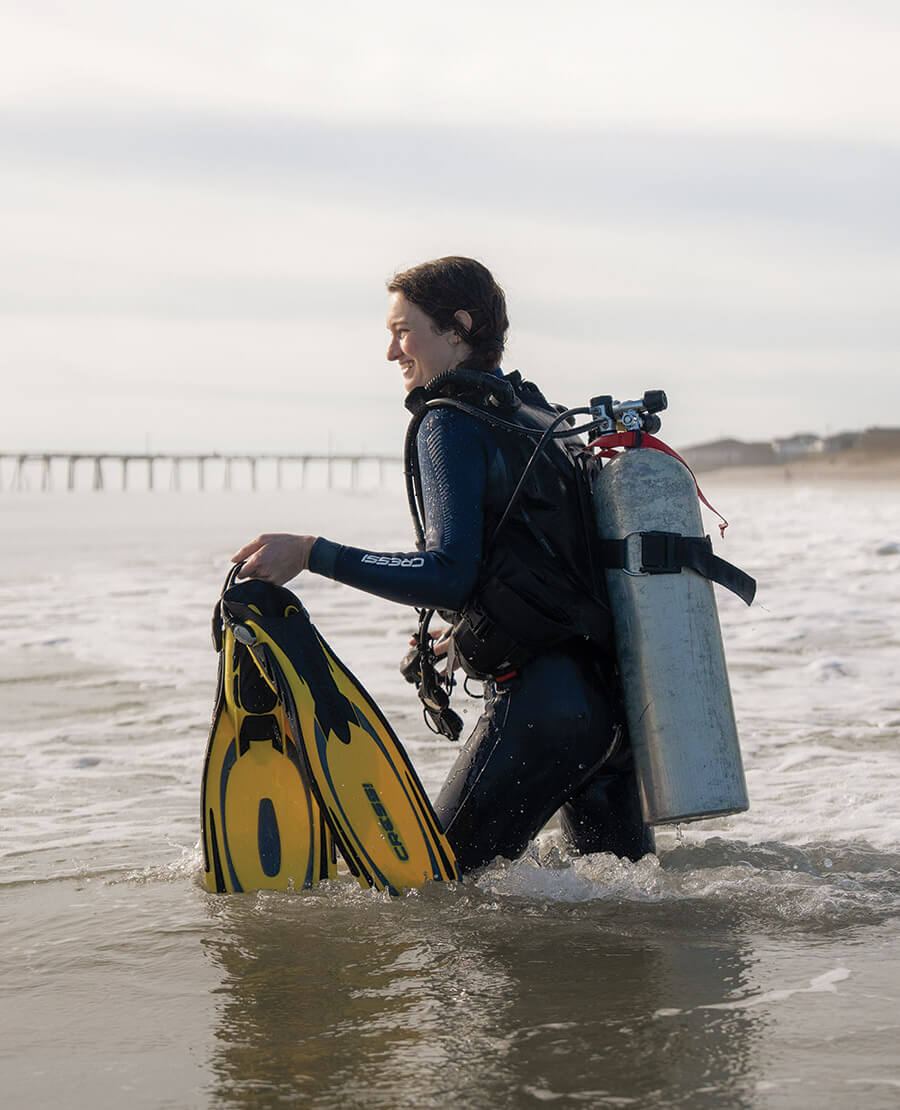
The author wades into the Nags Head surf before diving in search of the elusive wreck of the USS Huron. photograph by Chris Hannant
I reach the buoy and prepare to descend. With my mask snug and regulator in my mouth, I deflate my vest and sink below the surface. I look down and see …
Nothing.
A second later, my feet hit the bottom. Only I can’t see the bottom through the cloudy green water. Did I hit part of the ship? Am I on sand? I look up. Through the stream of air bubbles rising toward the surface, I see the sun filtering through a few feet of water. Huh, I think. That wasn’t very far. I check my depth gauge. Nine feet. The Huron is about 20 to 30 feet deep. Which means …
“It’s 100 percent covered,” Landrum says when I resurface. “There’s at least 10 feet of sand on top of it.”
The weather gets a vote, and this time it wasn’t in my favor.
But the Huron is still down there — lost again but not forgotten. Ironically, the sand covering it may be the best protection against corrosive seawater. She’s safe for now, until the next big storm comes along and the ocean, once more, unveils her secrets.