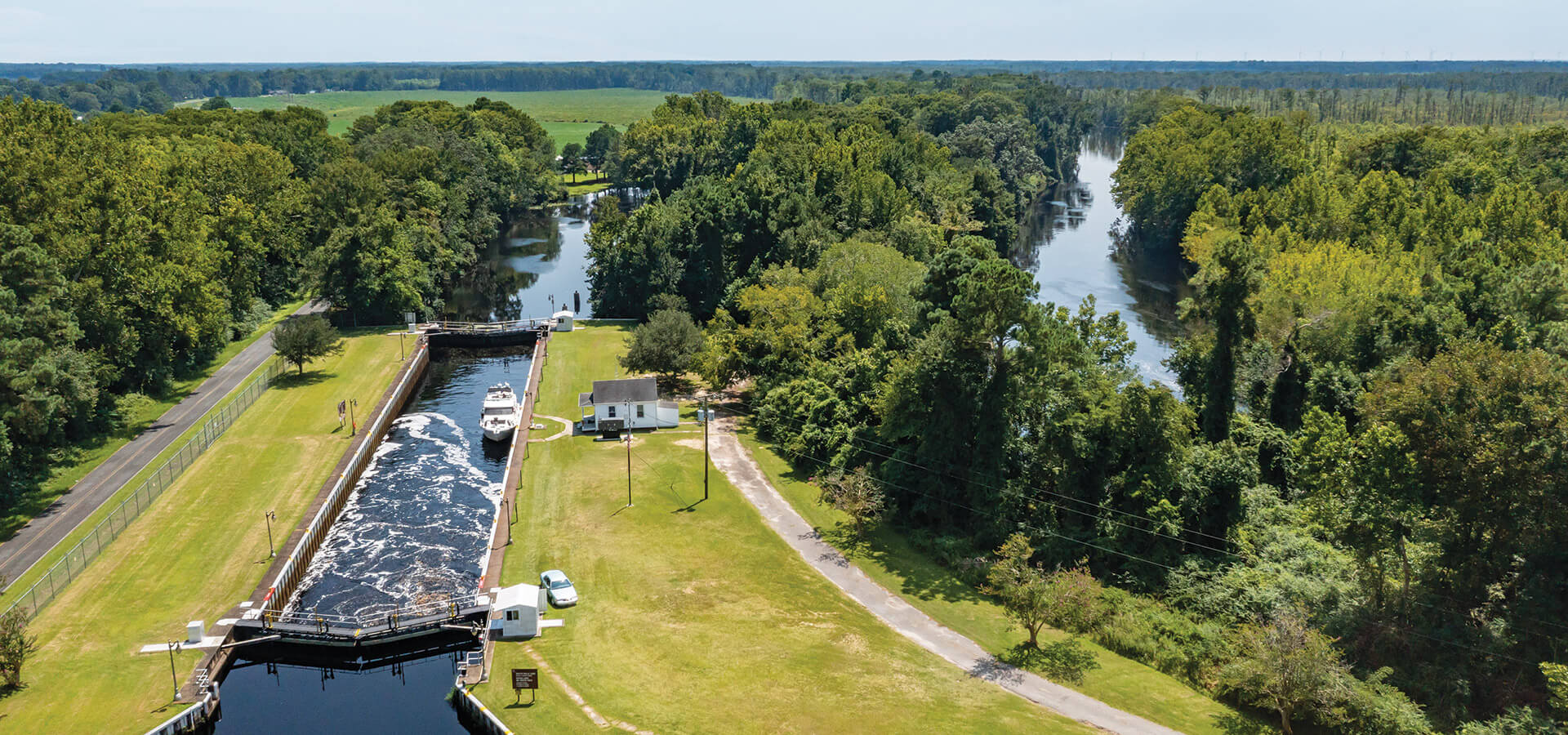
Beside the historic Dismal Swamp Canal, the oldest operating man-made waterway in the United States, Tammy Barnes sees in the distance what to me looks like two white toothpicks between an alley of trees.
But not to Tammy.
“We got a boat! And we got to get to work!” she shouts. “This is when the fun starts!”
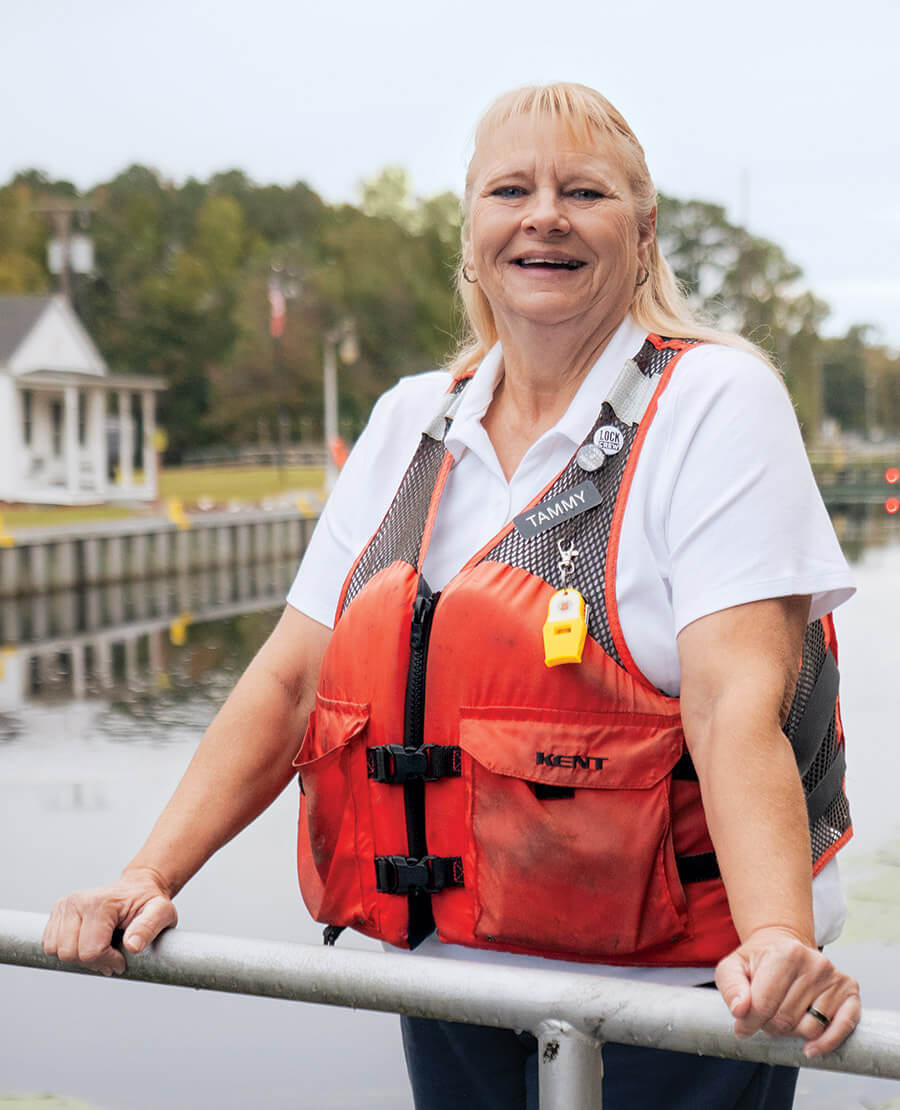
Lockmaster Tammy Barnes operates the South Mills lock along the Dismal Swamp Canal, welcoming boaters traveling between North Carolina and Virginia. photograph by Chris Hannant
We slip on life jackets, and Tammy begins a process she knows by heart. At a windowed shed nearby, her hands seem to dance as she works various toggle switches to open the lock chamber’s gate. Within seconds, we’re in her pickup heading toward a 1934 drawbridge she calls “Ol’ Betsy.” The drive takes no more than a minute. When we arrive, we step into a museum of motors and machines. I’m now a spectator in the Tammy Show.
“Give me a few minutes to get the Ol’ Betsy warmed up here,” she says into a radio, “and we’ll get you through.”
“Good luck with the warming up part,” responds one of the sailors. “We’re happy standing by.”
“Roger that,” Tammy says, laughing.
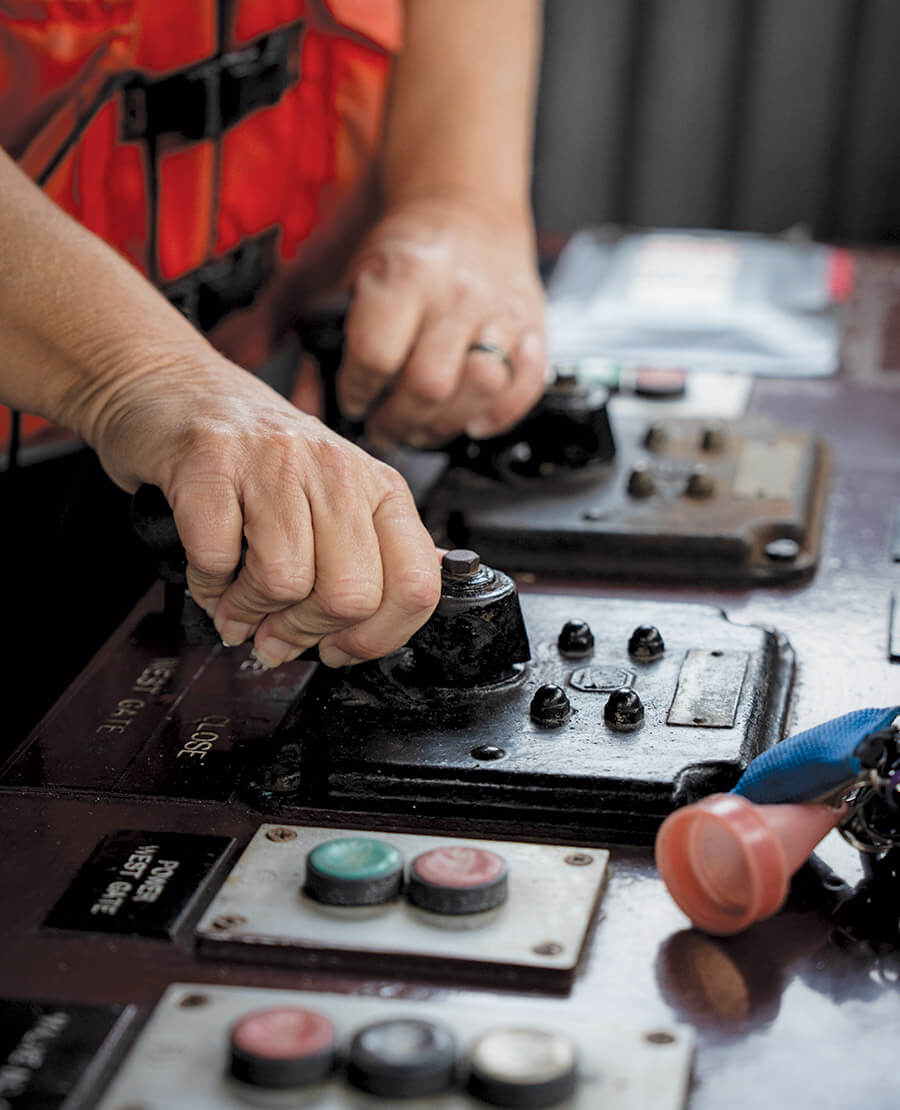
With a series of switches, gates, and careful timing, Tammy raises and lowers boats as they move through the South Mills lock. photograph by Chris Hannant
Tammy powers up a console, pushing and flipping almost everything around her. A stoplight turns red; the traffic arms drop; we slip on noise-reduction headphones; a mechanical whir drowns out everything around us. The drawbridge opens. Tammy then looks out the window, and when she sees the sailboat passing beneath us, she steps in front of a hand brake and gives me a warning: “This is when my trainees are always scared — ” I can’t hear another word. A whining crescendo grows in pitch and reminds me of my own rock show mantra: Never stand near the speakers. In less than a minute, Tammy eases Ol’ Betsy from nearly straight up to road level as gently as putting an infant down to sleep.
Now, back in her truck. Back to the canal. Back to my new job: assistant lockmaster.
“I get to hear you talk to them, huh?”
“It’s what I do best,” Tammy says with a wink.
• • •
For nearly a quarter century, Tammy has operated various locks along the Albemarle and Chesapeake Canal and Dismal Swamp Canal. She’s watched thousands of boaters pass through the 22-mile waterway that connects the Chesapeake Bay with the Albemarle Sound. As the canal lockmaster at South Mills, her professional post in Camden County for the past four years, she knows dozens of boaters. And they know her.
They write about Tammy on their blogs and popular social media platforms, and they navigate the waterway just to see her. When she’s there, their transit becomes a reunion recapping recent adventures. Their conversations are front-porch familiar, fueled by their shared passion of seeing the water as part of who they are, not just how they travel.
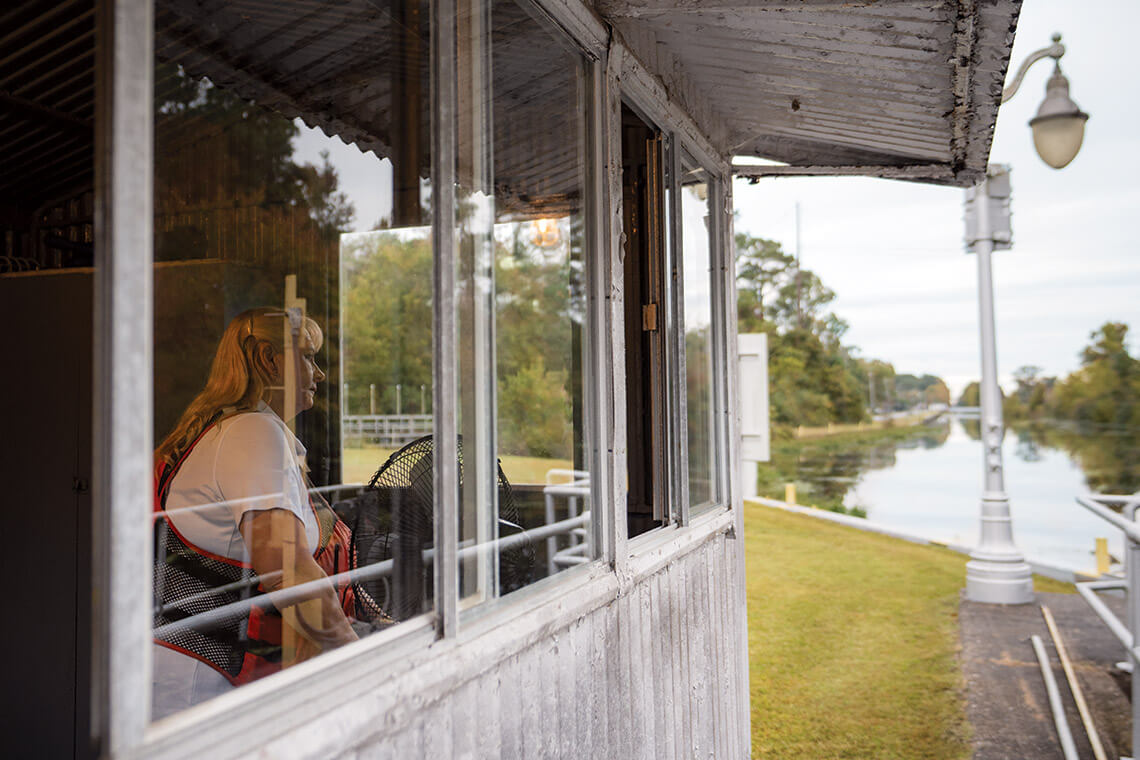
Tammy communicates with arriving boats by radio from her office on the Dismal Swamp Canal. photograph by Chris Hannant
“With locks on the other canals, it’s more of a ‘Hurry, hurry, hurry!’ ” Tammy says from her 1940s two-room house a few steps from the canal. “Over here, you have time to talk, and the boaters talk to you like family. They’re not in a hurry. You can actually sit and talk to them as you’re moving the water.”
As we wait for boats, a photo in her office catches my eye: Two guys in their 20s in a boat that I swear I’ve seen in a movie.
“That looks like the lifeboat from Captain Phillips,” I say.
“You know, when they came through, I asked them, ‘What in the world is this thing?’ and they told me they bought the boat from an old ship, and they were living on it,” Tammy says. “That made me smile. I’ve got their picture up there to remind me to follow your dreams and appreciate life because you never know. It might not be there tomorrow.”
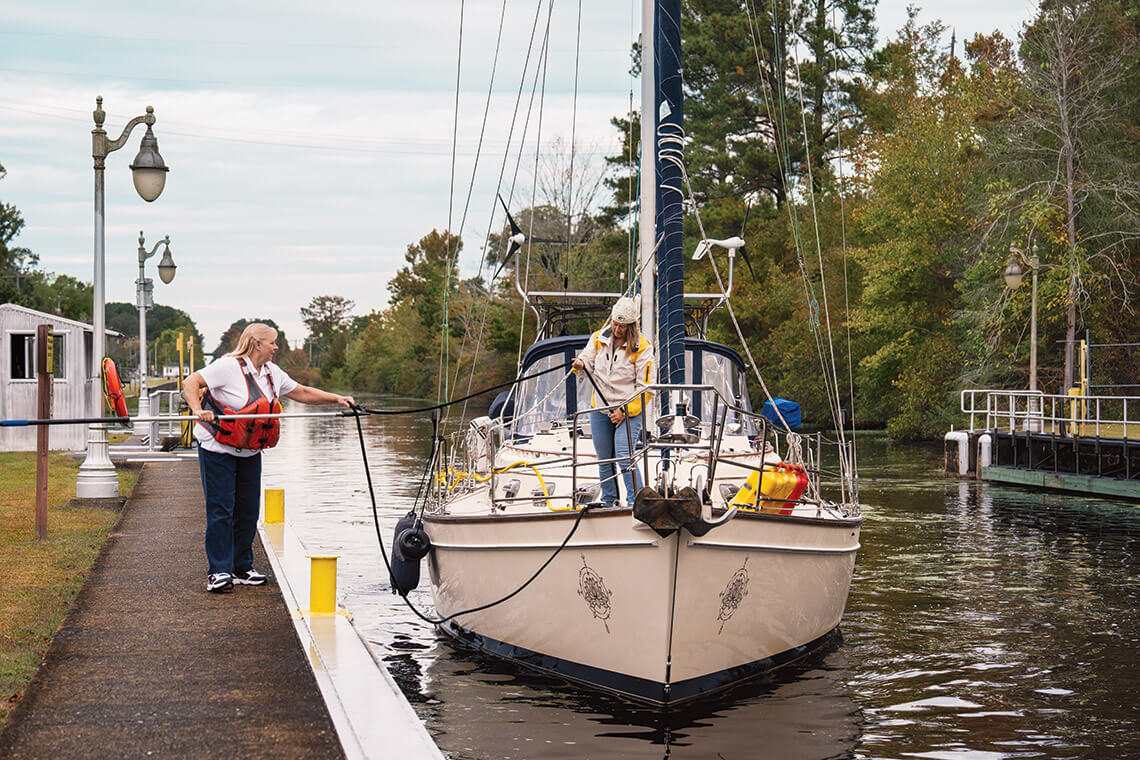
Tammy assists a sailor tying off a sailboat to bollards inside the lock chamber. photograph by Chris Hannant
She looks at the photo. Then, she looks at me. “See, this job is so unique. I get to talk to people from all walks of life.”
When Tammy shows me the business cards she collects from boaters, I see area codes from as far away as Texas and Michigan. When Tammy tells me about her life working alone at South Mills, I hear a litany of responsibilities. She’s the janitor, painter, groundskeeper, landscaper, mechanic, and the rescuer of any animals caught helpless in the canal.
She’s also the oldest daughter of Robert and Betty Hocutt. Her mom drove a school bus and worked in the cafeteria at Tammy’s elementary school; her dad spent 35 years building cars and trucks at the Ford plant in Norfolk, Virginia. She is, as she likes to say, “my daddy’s daughter.”
From their home in Moyock, a tiny community at the doorstep of the Outer Banks, Tammy’s dad taught her to fish, camp, repair cars and boats, work as a volunteer firefighter.
Tammy’s father, Robert Hocutt, emphasized the importance of helping others.
He emphasized the importance of helping others. And Tammy does that on a canal built by enslaved people who downed trees and carved out mud and dirt for a waterway first envisioned in 1763 by a young George Washington.
The workers began in 1793 and finished in 1805, and the Great Dismal Swamp northwest of Elizabeth City soon became as captivating as any folk legend. It turned into a refuge for runaway slaves and moonshiners, spawning stories about creatures and witches living inside a damp, dense enclave of juniper, cypress, and gum trees that Washington once described as a “glorious paradise.”
The U.S. Army Corps of Engineers contracted U.S. Facilities to operate the canal. Tammy, a 60-year-old grandmother, makes it work — with a boat hook, a smile, advice full of gentle wisdom, and a bin full of coloring books, crayons, and markers for any kid passing through the canal on a boat.
As I sit in her office listening to Tammy share stories of growing up with a cane pole in her hands, I spot on her wall a magazine story in a big frame. When I ask, Tammy tells me about Robert Peek.
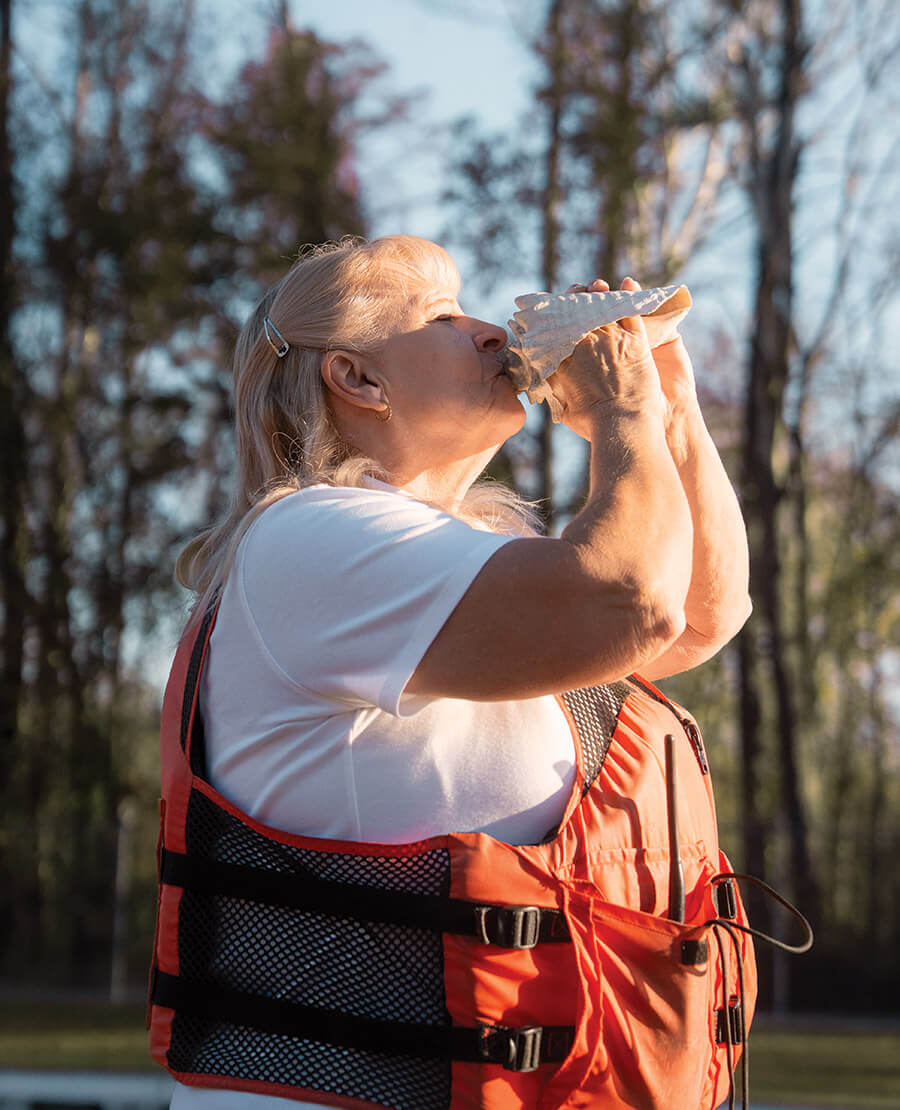
Tammy sounds a conch shell beside the canal, honoring the mentor who taught her the rhythms of the waterway. photograph by Chris Hannant
He spent 25 years as the Deep Creek lockmaster along the canal in Chesapeake, Virginia, where he earned the title, “Pied Piper of the Dismal Swamp” because he could make a conch shell sound like a trumpet. Peek became beloved along the waterway because he helped so many boaters. He also helped make Tammy into the lockmaster she is today.
When he died in the fall of 2020, Tammy learned how to play a conch in honor of him. She also picked up some of the conch shells boaters gave Peek at Deep Creek and arranged them in a flower bed beneath the lamppost beside the South Mills canal, an homage to her mentor.
“I wanted everyone to know Robert,” Tammy tells me. “He was such a special guy. His love for the waterway was contagious, and he gave that bug to me.”
• • •
Now, to the sailboat. And my new job.
In my minutes-old role as assistant lockmaster, I mostly watch: Tammy works. Tammy chats. Tammy instructs. I listen and hear another story. This time, it’s from Karen Girg and her husband, John Flanigan, two retired physicians from Maryland sailing to the Bahamas in a boat they named Tom Bombadil, one of their favorite characters from The Lord of the Rings. After 40 years of sailing, which took them around the world, they’re taking their first trip through the Dismal Swamp Canal with their 36-year-old nephew, Stephen. There, they meet Tammy.
“We’re not used to such gentle lockkeepers,” Karen says, laughing.
“You mean we’re the only nice lockkeepers you’ve come across?” Tammy asks.
“True,” Karen responds. “North Carolina is living up to its reputation of hospitality.”
“See, we’re a good state!” Tammy responds. “Now, let me go check the water, and I’ll open it up for you, OK?”
Through Tammy, North Carolina is living up to its reputation of hospitality.
Tammy gets busy. She speed walks to the other end of the lock, opens the gate, and watches the water empty into the Pasquotank River with the gentleness of an incoming tide. Tammy then turns into a tour guide and tells John and Karen about the best place to dock in Elizabeth City.
In less than 15 minutes, Tammy and I watch a 64-foot sailboat motor out of the lock chamber, southbound toward Elizabeth City 18 miles away. Then, Tammy remembers. She shouts out a request.
“Hey, when you go to the Bahamas, conch shell,” Tammy shouts. “Bring back a conch shell, and I’ll add it to my garden. Godspeed! Don’t forget me.”
Don’t think they will.
FOR JUNE: A restored Coast Guard station at Cape Lookout becomes an immersive classroom, where one man’s vision invites visitors to discover the wonder, science, and stories of Core Banks.